You unbox the sample of beautiful acetate hair clips. The pattern is perfect. The spring tension is strong. But the moment you bring the clip close to your nose, a sharp, chemical smell hits you. It smells like a freshly painted room mixed with nail polish remover. You are not a chemist, but your instinct screams that this cannot be safe to wear against a child’s scalp for eight hours. You email the factory: "Is the glue non-toxic?" They reply instantly: "Yes, yes, all materials eco-friendly. No problem." That two-line email is now the only safety documentation standing between your brand and a potential lawsuit if a customer has an allergic reaction.
You verify that a factory uses non-toxic glue on hair clips by demanding three specific pieces of evidence before confirming the order: a third-party lab test report showing compliance with the EN 71-3 standard for the migration of certain elements or the REACH Annex XVII restricted substances list, a signed Technical Data Sheet from the adhesive manufacturer stating the glue is toluene-free, phthalate-free, and formaldehyde-free, and a live video call where the factory worker physically shows you the glue barrel’s original label with the chemical batch number that matches the lab report.
A verbal promise is worthless in a product liability lawsuit. The glue joint inside a hair clip, the small drop that holds the fabric wrap to the metal spring hinge or the decorative rhinestone to the acetate, is a concentrated chemical point source sitting directly against the wearer’s hair and scalp. I want to show you exactly which chemicals hide in cheap glues, how to read a lab report without a chemistry degree, and what the factory’s glue storage area should look like on a video call.
What Are the Most Common Toxic Chemicals Found in Cheap Hair Clip Glue?
The glue that holds a hair accessory together is often an afterthought in the supply chain. The factory buys a barrel of "universal adhesive" from the cheapest local chemical supplier. That barrel arrives with a hand-written label in Chinese and zero safety documentation. It smells strong because it is loaded with volatile organic compounds that keep the glue liquid in the barrel and then evaporate rapidly when exposed to air, speeding up the assembly process.
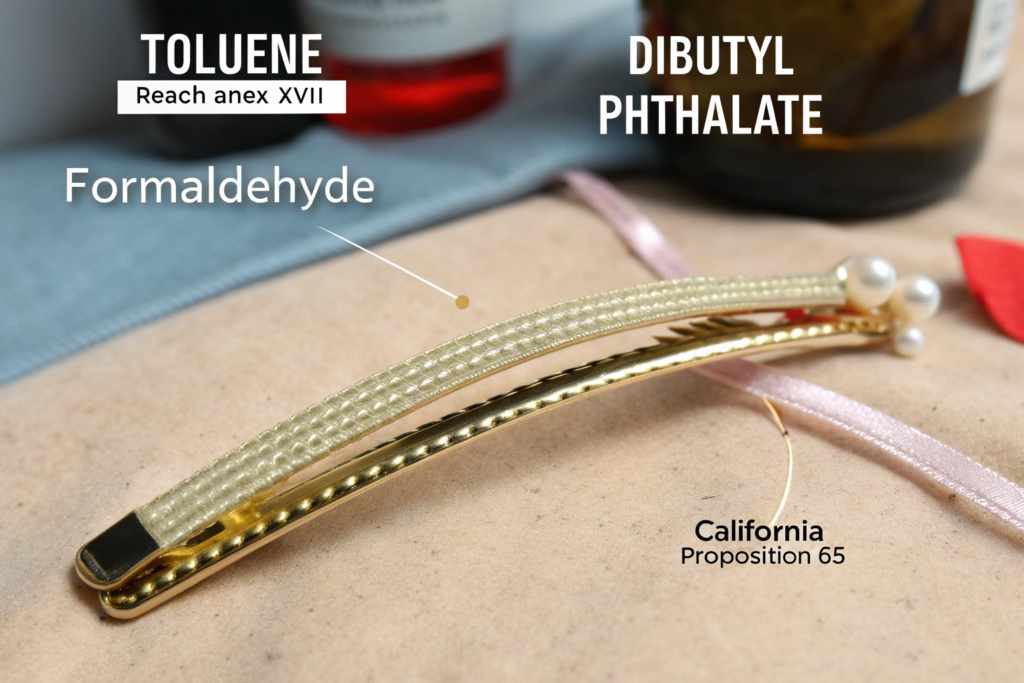
The most common toxic chemicals in cheap hair clip glue are toluene, a nervous system toxin and reproductive hazard; formaldehyde, a known carcinogen and potent skin sensitizer; and dibutyl phthalate, an endocrine-disrupting plasticizer that keeps the dried glue flexible but leaches out onto the skin over time. All three substances are strictly regulated under REACH Annex XVII in Europe and are reportable under California Proposition 65 in the United States.
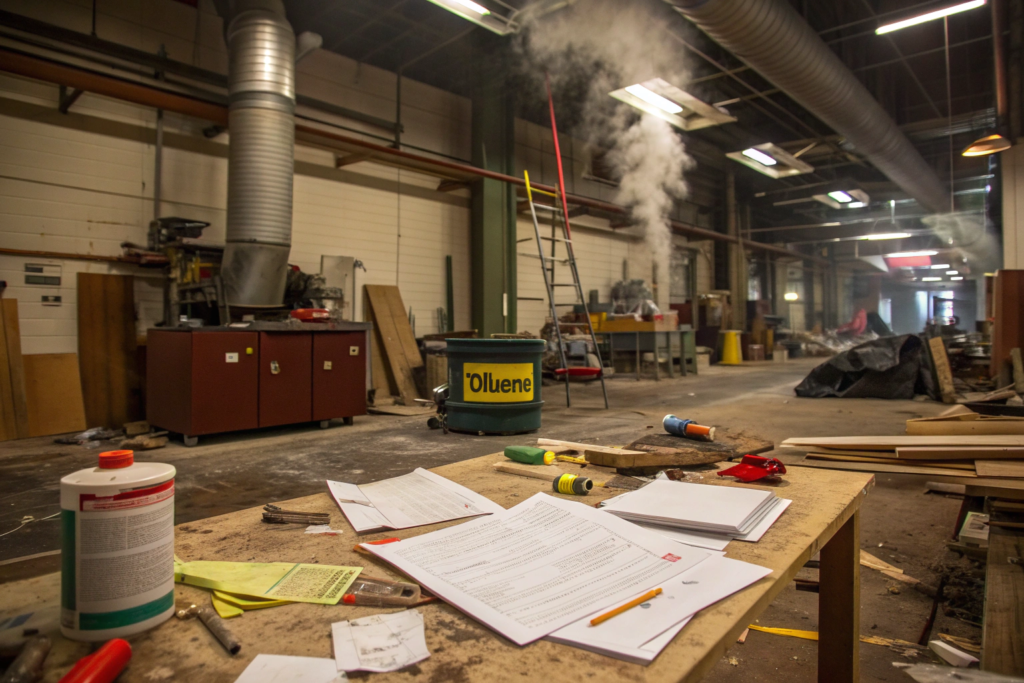
I walked through a random subcontractor’s assembly room once and immediately smelled toluene. It has a distinct, aromatic, almost sweet gasoline smell. I asked the owner for the glue’s safety data sheet. He handed me a photocopy of a photocopy, completely illegible. I refused to place our client’s order in that workshop. The fastest way to chase a buyer away is to have a gluing station that gives the QC inspector a headache within 30 seconds of standing next to it.
Why is toluene specifically dangerous for hair accessories?
Toluene attacks the central nervous system. A hair clip worn by a child who fidgets and touches the clip repeatedly, then puts their fingers in their mouth, creates an ingestion pathway. Even inhalation exposure to toluene off-gassing from a newly manufactured clip sealed in a polybag for weeks concentrates the vapor. When the customer opens the bag, they get a direct whiff. The acute effects for a sensitive individual include dizziness and nausea. The chronic effects from daily wear are far more concerning.
What is the "New Car Smell" in cheap hair bands and why is it bad?
That "new car smell" that many people associate with freshness is actually a mixture of volatile organic compounds, primarily phthalates and aldehydes, outgassing from synthetic adhesives and plasticizers. In a car dashboard, the air volume dilutes them. Inside a sealed polybag holding a hair clip, the concentration spikes. A hair clip stored for six months in a warehouse releases this gas cloud directly onto the retail shelf. A "chemical smell" is not a sign of a freshly made product. It is a sign of an uncured, toxic adhesive.
How Can You Check a Glue’s Safety Data Sheet for Red Flags?
The factory sends you a "Material Safety Data Sheet" in English. It is a five-page PDF with 16 numbered sections. Section 3 lists the chemical ingredients. This is the only section most buyers check. They see "Mixture" and skip it. A smart buyer knows exactly which CAS registry numbers are illegal.
You check a glue’s safety data sheet by scrolling directly to Section 3, Composition/Information on Ingredients, and scanning the CAS numbers. Any CAS number matching Toluene (108-88-3), Formaldehyde (50-00-0), or Dibutyl Phthalate (84-74-2) is an immediate rejection trigger. You also check Section 2, Hazard Identification, for the signal word "Danger" and the skull-and-crossbones pictogram, indicating acute toxicity or carcinogenicity. A glue labeled "Warning" with a simple exclamation mark pictogram is typically a low-toxicity consumer-grade adhesive.
I keep a list of 12 banned CAS numbers taped to the wall next to our QC workstation. Every new adhesive barrel that enters our factory gets its SDS checked against this list. If the SDS is missing Section 3 entirely, or the composition is listed as "Trade Secret, Proprietary," the barrel is rejected. A chemical supplier that hides its ingredients from the manufacturer is not a partner.
What does a compliant, non-toxic adhesive SDS look like?
A compliant SDS for a water-based polyurethane or a hot-melt EVA adhesive will list a non-hazardous polymer emulsion in Section 3. The CAS number will link to a proprietary synthetic resin, not an aromatic solvent. Section 2 will likely state "Not classified as hazardous according to GHS." The VOC content will be listed as less than 5 grams per liter. The adhesive is typically based on a polyacrylate dispersion in water.
Can a factory lie about the glue’s batch number on the label?
Yes, a factory can print a fake label. The only defense is to trace the label back to a valid, active certificate from the adhesive manufacturer. During a live video call, I ask the factory manager to turn the 200-liter glue barrel around and show me the original manufacturer’s stamp burned into the metal rim or the plastic body. That stamp has the batch production date and the factory code. I then ask to see the signed delivery note from the chemical supplier with that same batch number. This cross-referencing makes faking documentation significantly harder.
How Does an Accredited Lab Test Prove a Glue Joint Is Safe?
The safety data sheet describes the raw liquid in the barrel. It does not describe the dried, cured glue joint inside the finished hair clip. The curing process changes the chemical profile. Residual monomers from an incomplete polymerization can remain trapped in the adhesive and slowly leach out onto the wearer’s skin.
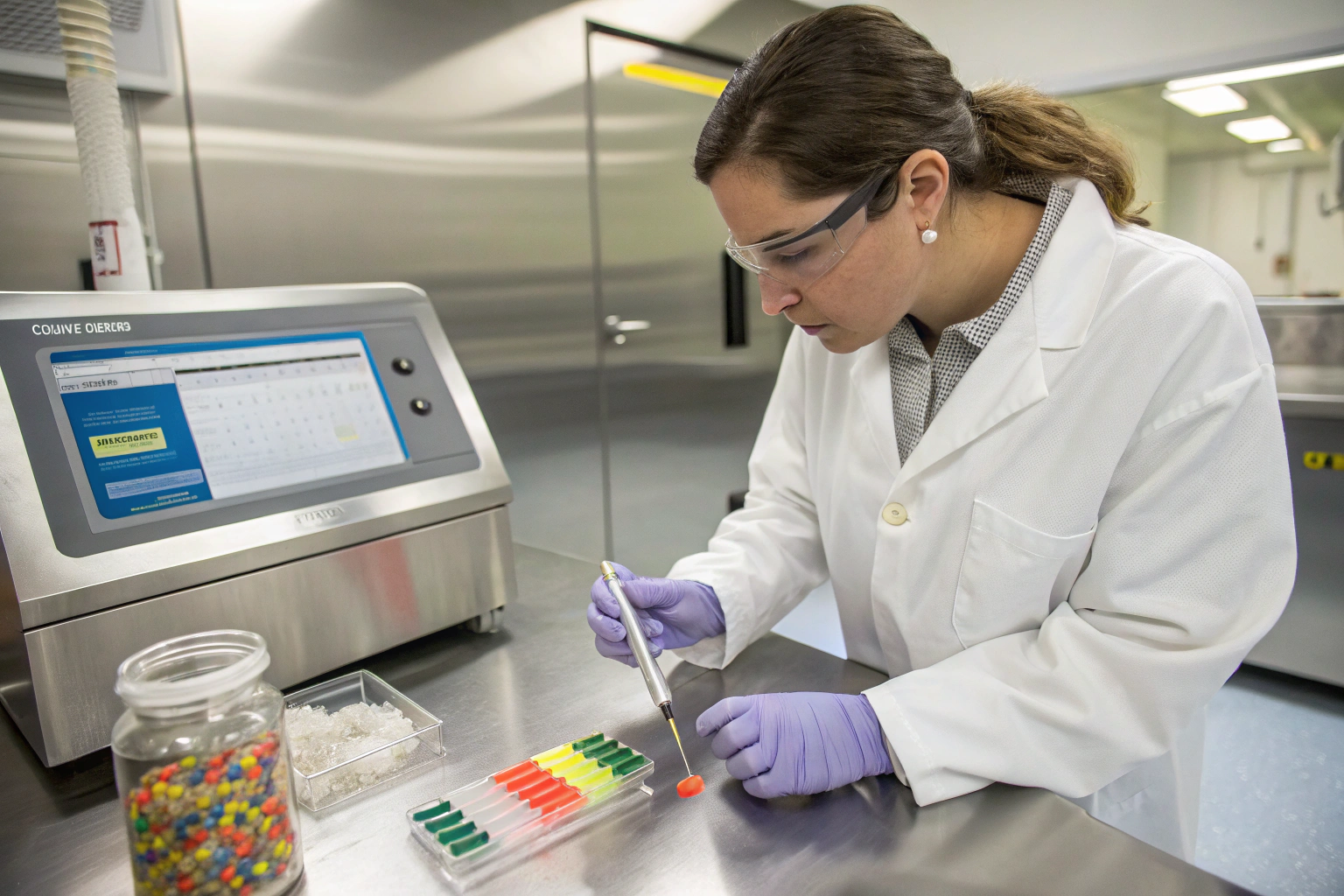
An accredited lab test proves the glue joint is safe by performing a chemical migration test, typically the EN 71-3 standard used for children’s toys, on the finished, assembled hair clip. The lab technician crushes the clip, including the glued fabric and metal components, into small pieces, submerges them in a simulated sweat solution at body temperature for two hours, and then analyzes the liquid extract using Inductively Coupled Plasma Mass Spectrometry to quantify the concentration of any leached heavy metals or restricted organic compounds.
The migration test simulates a child wearing the clip on a hot, sweaty summer day. If the glue leaches nothing dangerous into the sweat simulant, the clip passes. This test is more expensive than a simple SDS review but provides the legal defense your brand needs if a dermatologist ever questions the clip’s safety.
Does the CPSIA total lead content test cover the glue?
The CPSIA total lead content test for children’s products measures total lead in the entire product, including the glue. A cheap adhesive may contain lead-based driers or stabilizers. The lab grinds the entire clip, including the adhesive, and tests the homogeneous material for lead content below 100 parts per million. Passing this test is mandatory for any hair clip marketed to children under 12 in the United States.
What specific test should I request for a metal hair clip with glue?
If the hair clip has a metal spring glued into an acetate jaw, request the EN 1811 nickel release test on the metal component and the EN 71-3 migration test on the glued assembly. Nickel allergy is the most common contact dermatitis associated with metal hair accessories, and the glue can sometimes trap nickel-containing metal dust from the grinding process, creating a localized high-concentration exposure point.
What Should a Clean Glue Application Area Look Like on a Factory Video Call?
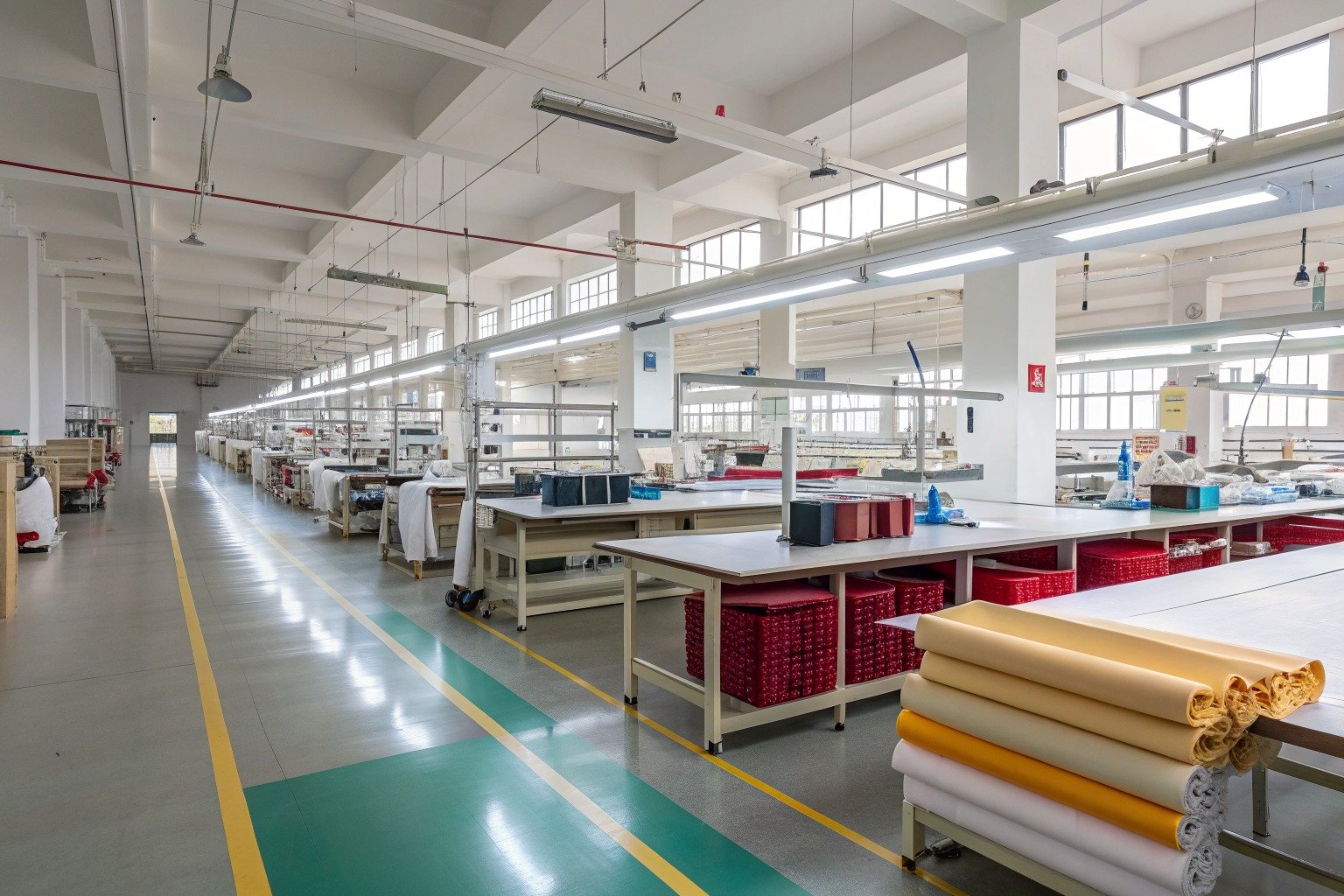
The state of the glue assembly station is the fastest visual audit of a factory’s chemical management. A factory that uses non-toxic adhesives is not ashamed of the process. They will eagerly walk you to the station and show you the setup. A factory hiding something will keep the video camera pointed at the finished goods shelf.
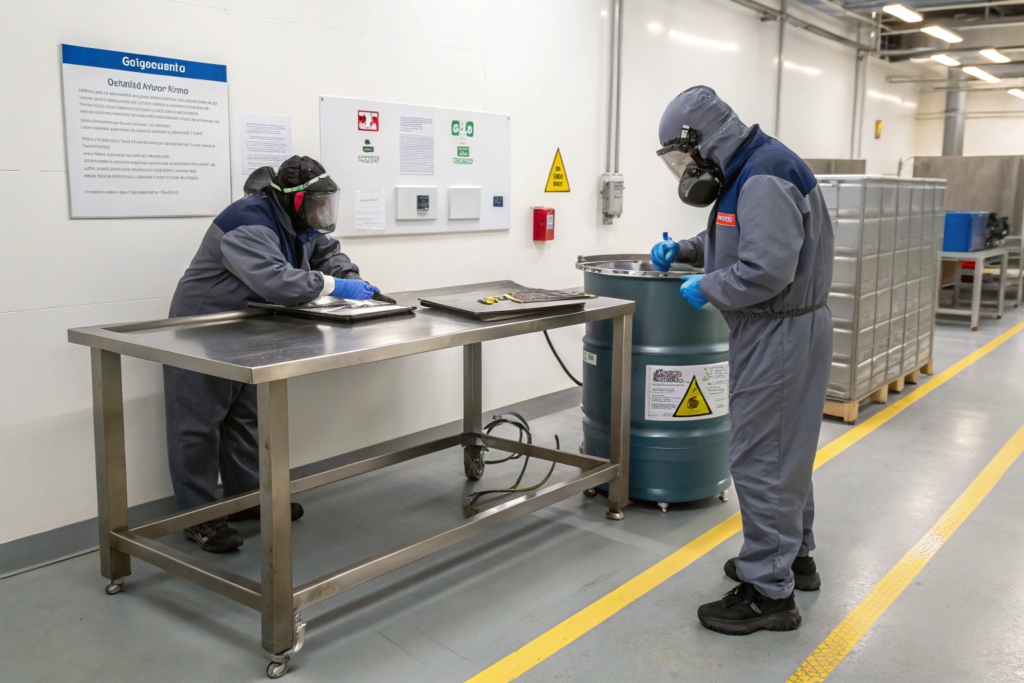
A clean glue application area on a factory video call shows a stainless steel worktable with a dedicated, sealed adhesive dispensing system, not an open bowl of liquid glue. Workers must wear activated charcoal respirator masks or work under a point-extraction fume hood. The floor beneath the station must be clean and dry, not sticky with spilled adhesive. The original labeled adhesive barrel must be visible, and the safety data sheet must be posted on the wall in the local language, not hidden in a manager’s office.
I personally show our glue station on every client tour. The adhesive is a hot-melt that is solid at room temperature, melted in a closed cartridge system at precisely 160 degrees Celsius. There are no fumes. The worker wears clean cotton gloves, not heavy rubber gauntlets. The station is clean enough to eat lunch on, though no one does. This transparency seals the deal for buyers who have been burned by chemical shortcuts.
What does a proper respirator mask indicate about the glue’s toxicity?
A proper mask is a clue, but not a definitive answer. A 3M half-face respirator with organic vapor cartridges suggests the worker is handling solvents that off-gas. If the factory claims the glue is water-based and non-toxic, and you see an open tub of white liquid but a worker wearing a heavy vapor mask, something does not match. Ask the worker to briefly lift the mask while you are watching the video. If they hesitate, the air quality is bad. If they smile and lift it, the environment is likely safe.
Why is a point-extraction vacuum better than an open window?
An open window blows fumes away from the worker’s face but into the rest of the factory, exposing the sewing and packing staff. A proper glue station has a localized extraction vent directly behind the application point, sucking fumes downward and away before they enter the breathing zone. The factory should be able to show you the extraction fan motor running and the flexible duct connected to an exterior filtration system.
Conclusion
Verifying that a factory uses non-toxic glue on hair clips involves three hard stops: reject any adhesive with toluene, formaldehyde, or phthalate CAS numbers on the safety data sheet; demand an EN 71-3 migration test on the finished, crushed clip, not just a raw material certificate; and audit the glue application station live on video for proper ventilation, sealed dispensing systems, and labeled barrels. A factory that passes these three checks is protecting your brand from Proposition 65 warning letters and allergic reaction lawsuits.
Our Zhejiang facility uses water-based and hot-melt adhesives exclusively. We keep the manufacturer batch labels visible, the extraction hoods running, and the third-party lab reports current for every adhesive formula. Our QC team is trained to smell a glue joint before it enters assembly. A chemical odor triggers an immediate batch quarantine and a re-test.
If you want to verify the safety of the glue in your current hair clip supply chain, or if you need a new production batch with full toxicology documentation, contact our Business Director, Elaine. She will send you a sample of our adhesive SDS, a recent EN 71-3 compliance certificate, and set up a live video walk-through of our glue station. Write to her at elaine@fumaoclothing.com. Let’s make sure your hair clips are beautiful and chemically safe.