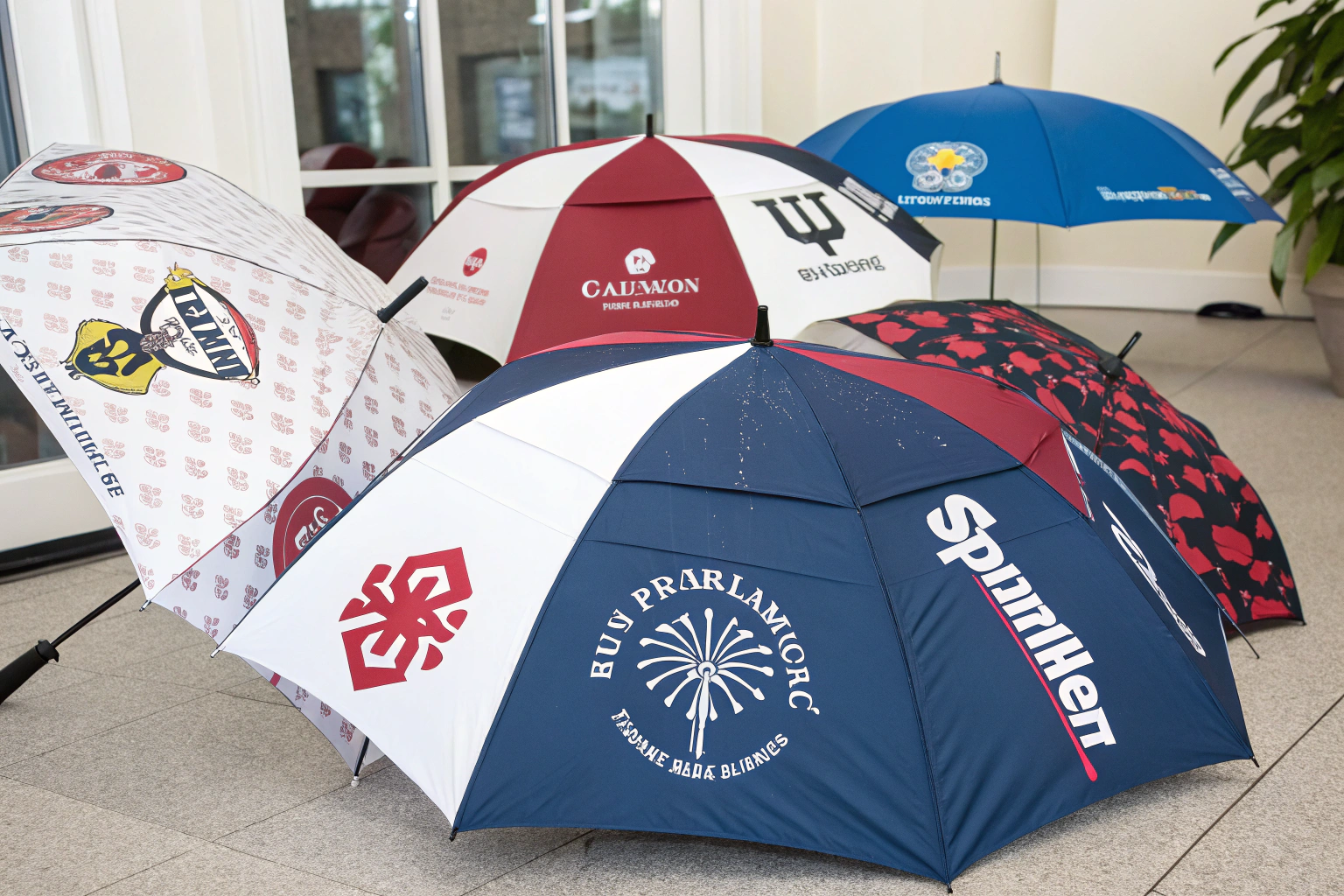
Last spring, a client named Sarah called me with a familiar problem. She ran a boutique hotel chain and wanted to order beautiful, branded umbrellas for her guests. She needed 200 pieces with her logo. She contacted five umbrella factories on Alibaba. Four of them told her the Minimum Order Quantity (MOQ) was 1,000 pieces. The fifth factory said they could do 200 pieces, but the unit price was nearly double. She felt stuck between ordering a decade’s worth of inventory or paying a massive premium for a small batch. She asked me, "Why is this so hard? I just want a few hundred nice umbrellas with my logo." If you are like Ron, you appreciate the economics of manufacturing. You understand that MOQs exist for a reason. But you also need a partner who can find creative solutions that fit your actual business needs, not just the factory’s ideal production run.
The minimum order quantity for custom printed umbrellas with logos typically ranges from 500 to 1,000 pieces per design for fully custom production involving new fabric printing and frame assembly. However, through alternative decoration methods such as screen printing on stock umbrella panels, heat transfer on finished canopies, or utilizing semi-custom "stock print" patterns, the effective MOQ can be reduced to 100 to 300 pieces. The specific MOQ depends on the umbrella style, the number of print colors, and the decoration technique chosen.
I run AceAccessory in Zhejiang Province. While we are known for fashion accessories like hair bands and hats , our manufacturing ecosystem in Zhejiang includes some of the world’s best umbrella factories. The umbrella industry is unique. It is highly automated and material-intensive. The MOQ barriers are real, but they are not insurmountable. There are specific strategies and alternative decoration methods that can dramatically lower the entry barrier for custom branded umbrellas. Let me walk you through the exact MOQ landscape for different types of umbrellas and the specific techniques you can use to get the branded product you need without overcommitting on inventory.
Why Do Custom Umbrellas Have Higher MOQs Than Other Accessories?
The umbrella is a deceptively complex product. It is not just a piece of fabric with a handle. It is an engineered system of fabric, metal ribs, plastic joints, a shaft, a spring mechanism, and a handle. And the primary cost driver—and the reason for high MOQs—is the fabric printing process.
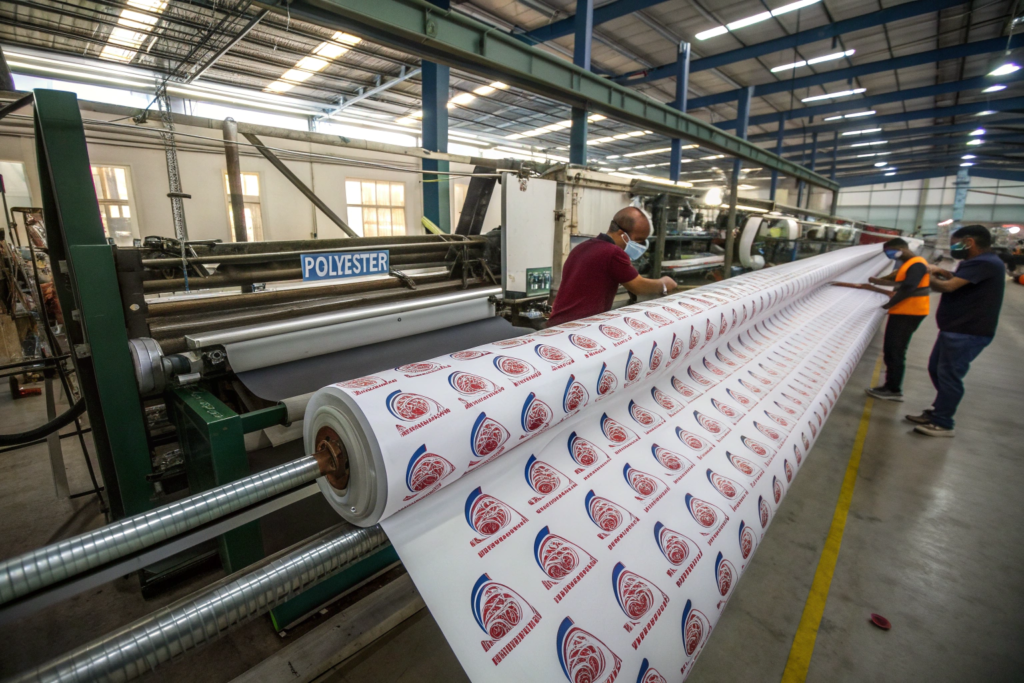
Umbrella canopies are made from large, continuous rolls of polyester or nylon fabric. These rolls are typically 1.5 to 2.0 meters wide and hundreds of meters long. The industrial printing machines used for umbrellas are designed for rotary screen printing or digital sublimation printing on wide-format fabric.
Here is the critical constraint: The machine setup cost is fixed.
- Rotary Screen Printing: Creating the cylindrical screens for each color in your logo design costs money (approx. $50-$100 per screen). The machine requires time to clean and set up. Once running, it can print 1,000 meters of fabric almost as fast as it can print 100 meters. The factory’s cost is in the setup, not the run time.
- Digital Sublimation: While there are no screens, the industrial wide-format printer still requires color calibration, file preparation, and machine time. The labor cost to handle a small 50-meter roll of fabric is the same as a 500-meter roll.
Therefore, the factory sets an MOQ to ensure the Setup Cost is amortized over enough units to make the per-unit price reasonable. If they run only 100 meters of custom fabric, the setup cost per umbrella is $1.00. If they run 1,000 meters, the setup cost per umbrella is $0.10. The difference is massive.
Furthermore, custom umbrellas often require custom Shaft Printing (logo on the metal pole) or custom Handle Molding. These require separate molds with their own high MOQs. At AceAccessory, we understand these constraints intimately. We work with our umbrella partners to find the "Sweet Spot" between customization and cost. We don’t just quote the MOQ; we explain the "Why" behind it.
How Does Fabric Printing Width Drive Up the Minimum Order?
Let’s visualize the math. A standard three-fold compact umbrella has a canopy made of 8 triangular panels. When laid flat for cutting, these panels are nested together to minimize waste.
The width of the fabric roll is fixed (usually 1.5m). To cut a set of panels for one umbrella, you use a certain length of this wide roll. Let’s say one umbrella requires 0.8 meters of fabric length.
- MOQ of 100 umbrellas = 80 meters of printed fabric.
- MOQ of 1,000 umbrellas = 800 meters of printed fabric.
From the factory’s perspective, 80 meters is a "Sample Length." It barely covers the waste at the start and end of the roll during machine setup. The machine operator spends more time threading the machine and aligning the colors than actually printing. The factory loses money on the machine time.
To get a reasonable price, you need to order enough umbrellas to consume a "Production Length" of fabric. This is typically 500 meters or more, which translates to roughly 500-600 umbrellas, depending on the size of the umbrella.
This is why MOQs for Fully Custom Printed Canopies are the highest. At AceAccessory, we guide clients toward alternative solutions if their quantity is below this threshold. We can use Stock Fabrics (solid colors) and apply the logo through a different method, which bypasses the fabric printing MOQ entirely. This is how we make custom umbrellas accessible to smaller brands.
What Is the Cost of Wasting Material on Short Production Runs?
Waste is a silent cost driver in manufacturing. In a short production run, the percentage of waste is much higher. Let me explain the three types of waste that affect custom umbrellas.
-
Machine Setup Waste: When the printing machine starts, the first 5-10 meters of fabric are often misaligned or have incorrect color density. This fabric is scrap. On a 1,000-meter run, 10 meters of waste is 1% (negligible). On an 80-meter run, 10 meters of waste is 12.5% of the total fabric. The factory has to charge you for that wasted material.
-
Cutting Waste: The triangular panels of an umbrella canopy cannot be tessellated perfectly without gaps. There is always edge waste. The layout is optimized, but a certain percentage of fabric ends up as unusable selvedge.
-
Color Matching Waste: If you require a specific Pantone color for the background of the umbrella, the dye house must mix a custom dye batch. They have a minimum vat size. Even if you only need enough dye for 100 umbrellas, you pay for the entire minimum vat of dye. The leftover dye is waste (or is stored, hoping another client orders that exact shade).
At AceAccessory, we are transparent about these cost drivers. When a client asks for a quote for 200 custom printed umbrellas, we show them the Waste Factor line item. This helps them understand that the high unit price is not "price gouging." It is the mathematical reality of short-run manufacturing. This transparency builds trust and allows us to explore more cost-effective customization options .
What Are the Alternative Decoration Methods for Lower MOQs?
If 500 pieces is too high for your budget or storage capacity, do not despair. The umbrella industry has developed several "Post-Assembly Decoration" techniques that bypass the fabric printing MOQ entirely. These methods allow you to brand a high-quality, stock umbrella with your logo at much lower quantities.
Method 1: Screen Printing on Finished Canopy.
The factory assembles a solid-color umbrella. Then, they use a small Screen Printing Press to print your logo directly onto the finished, assembled canopy. This is the most common and cost-effective method for quantities of 100 to 300 pieces.
- MOQ: 100-200 pcs.
- Pros: Affordable. Vibrant colors. Durable.
- Cons: Limited to 1-2 spot colors. Print size is limited (can’t print edge-to-edge). Cannot print on seams.
Method 2: Heat Transfer / Sublimation Patch.
Your full-color logo is printed onto a special Transfer Paper. This paper is then applied to the umbrella canopy using a Heat Press. The heat vaporizes the ink, and it bonds permanently with the polyester fabric.
- MOQ: 50-100 pcs.
- Pros: Full color, photorealistic logos. Small minimums. No setup screens.
- Cons: The print has a slight "plastic" feel. It is a patch, not an integrated print. Over time, it may crack if folded aggressively.
Method 3: Woven Label or Metal Badge.
A small Woven Logo Label or a Zinc Alloy Metal Badge is sewn or attached to the umbrella panel or the carry sleeve.
- MOQ: 50 pcs (Label) / 300 pcs (Metal Badge).
- Pros: Extremely premium look. Adds perceived value.
- Cons: Small branding area. Metal badge requires a separate mold fee.
At AceAccessory, we help clients choose the right decoration method based on their quantity, budget, and design complexity. For a corporate gift order of 150 pieces, Screen Printing is the perfect solution. For a high-end fashion brand doing a limited drop of 100 pieces, a Metal Badge on a premium wood-handle umbrella tells the right story.
How Does Screen Printing on Assembled Umbrellas Reduce the Minimum?
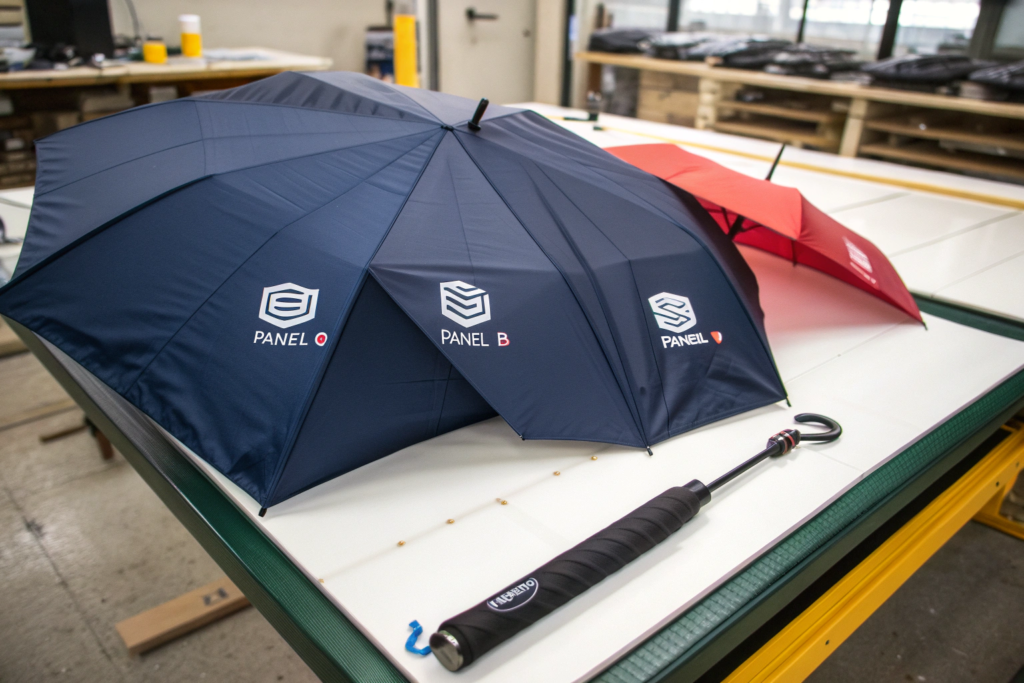
This is the workhorse of the custom umbrella industry. It completely removes the Fabric Printing MOQ from the equation. Here is the process flow:
- Bulk Umbrella Production: The factory produces 10,000 solid Black umbrellas using standard, unprinted polyester fabric. The fabric cost is low because it is a massive bulk run.
- Storage: These finished, unprinted umbrellas are stored in the warehouse.
- Your Order (200 pcs): We pull 200 Black umbrellas from the warehouse shelf.
- Screen Preparation: We create a small screen with your logo. The screen cost is $30-$50.
- Printing: The 200 umbrellas are opened on a special jig. A worker manually screen prints your logo onto the designated panel. The ink dries quickly.
- Packing: The umbrellas are repacked.
Because the umbrellas were already made in bulk, you only pay for the incremental cost of the decoration. You are not paying for a custom fabric run. This is why the MOQ can be as low as 100 pieces.
The Limitation: You can only print on solid color umbrellas. You cannot have a custom pattern background. And the print is typically placed on one or two panels, not the entire canopy.
At AceAccessory, we maintain a large inventory of stock umbrellas in popular colors (Black, Navy, Red, White) specifically for this screen printing service. This allows us to offer a fast turnaround (10-14 days) on small batch custom umbrella orders.
What Is the Difference in Durability Between Screen Print and Sublimation?
Clients often ask, "Will the logo wash off in the rain?" This is a valid concern. Let’s compare the durability of the two main low-MOQ decoration methods.
| Feature | Screen Printing | Heat Transfer / Sublimation |
|---|---|---|
| Process | Ink sits on top of the fabric. | Ink penetrates the polyester fiber. |
| Feel | Slight texture you can feel. | Smooth, part of the fabric. |
| Durability | Excellent. Resists rain and rubbing. Will not wash off. | Good. Resists rain. Can crack over time if the umbrella is folded/unfolded aggressively at the print location. |
| Best For | Simple, bold logos. High longevity. | Photorealistic, multi-color logos. |
For corporate gifts and promotional items, Screen Printing is the industry standard because of its proven durability and lower cost. For fashion brands where the logo is a detailed, full-color illustration, Sublimation offers greater design freedom, but the client must understand the slight trade-off in long-term flex durability.
At AceAccessory, we provide samples of both decoration methods. We want you to feel the difference and make an informed decision based on how the umbrella will be used. This is part of our commitment to quality control and client education.
What Is the MOQ for Different Umbrella Styles and Frame Qualities?
The MOQ for an umbrella is not just about the printing. It is also heavily influenced by the Umbrella Style and the Frame Quality. A complex, high-end umbrella requires more specialized components, which often have their own minimum order requirements from the component factories.
1. Standard Three-Fold Compact Umbrella:
- Description: The most common style. Folds into a 10-12 inch sleeve.
- Frame MOQ: 500-1,000 pcs for custom color frame/handle.
- Fabric Printing MOQ: 500 pcs.
- Screen Print MOQ: 100 pcs.
2. Reverse-Folding (Inverted) Umbrella:
- Description: Folds "inside out" to keep water contained. Uses a double-layer canopy.
- Frame MOQ: 1,000 pcs. (The frame mechanism is more complex and requires specialized tooling).
- Fabric Printing MOQ: 1,000 pcs (Because it uses double the fabric of a standard umbrella).
- Screen Print MOQ: 200 pcs.
3. Long Straight / Walking Umbrella:
- Description: Classic non-folding style. Often has a wooden shaft and curved handle.
- Frame MOQ: 300-500 pcs. (Simpler mechanism than a folding umbrella).
- Fabric Printing MOQ: 300 pcs. (The canopy is a simple 8-panel cut with less waste).
- Screen Print MOQ: 50-100 pcs.
4. Golf Umbrella (Large):
- Description: Extra-large canopy (60-68 inch arc). Fiberglass frame.
- Frame MOQ: 500 pcs.
- Fabric Printing MOQ: 500 pcs.
- Screen Print MOQ: 100 pcs.
At AceAccessory, we help our clients navigate this matrix. We match the umbrella style to their budget and quantity. If a client needs only 100 pieces, we steer them toward Straight Umbrellas or Standard Compacts with Screen Printing. We don’t let them fall in love with a Reverse Umbrella design only to be disappointed by the 1,000 piece MOQ. This is proactive sourcing guidance .
Why Do Wooden Handles and Shafts Have Different Minimums Than Metal?
This is a matter of component sourcing. Metal shafts and plastic handles are mass-produced commodities. The factories that make them run millions of units per month. The MOQ for a standard metal shaft is essentially zero—you just buy them off the shelf.
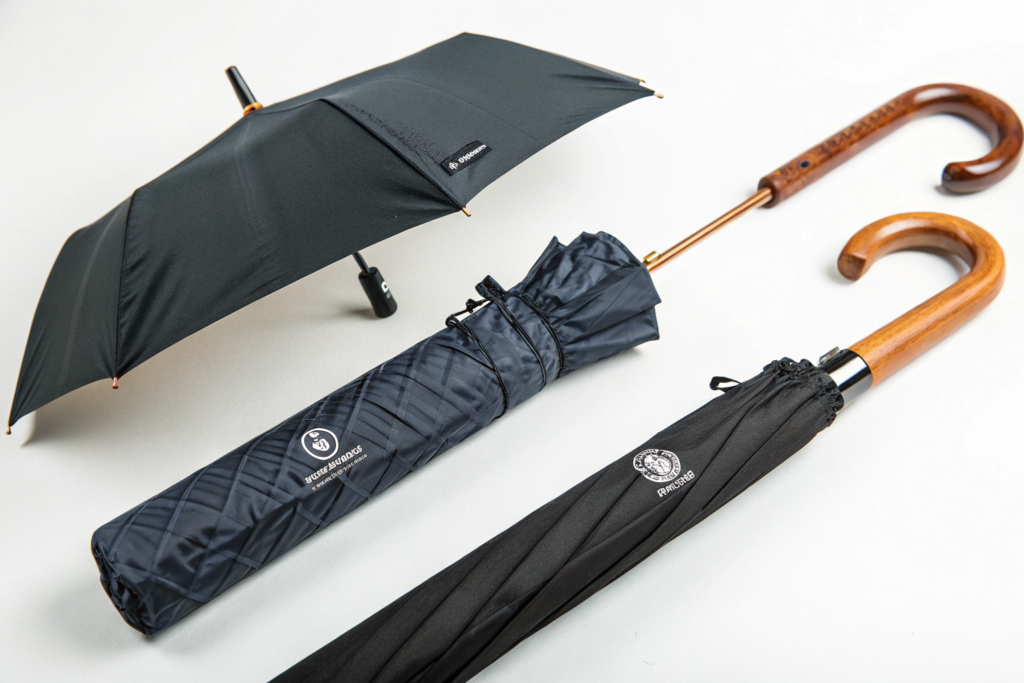
Wooden components are different. A Curved Wooden Handle or a Solid Wood Shaft is a crafted item. It requires:
- Sourcing the Wood: Specific types of wood (Beech, Maple, Bamboo) must be sourced and seasoned.
- Shaping: The wood must be turned on a lathe and bent into shape (for crook handles).
- Finishing: It must be sanded, stained, and varnished.
Wooden component factories typically have an MOQ of 300-500 pieces per color/finish. If you want a custom stain color (e.g., a specific shade of Walnut), the MOQ applies. If you are willing to use the factory’s Stock Wood Finish (Natural Beech, Dark Brown), the MOQ can be lower or waived.
This is a perfect example of how material choices drive MOQ. A custom printed canopy on a Standard Black Metal Frame has a lower barrier to entry than the same canopy on a Custom Stained Wooden Shaft. At AceAccessory, we explain these trade-offs clearly so you can prioritize where to spend your customization budget for maximum impact.
Can You Mix Colors Within a Single Umbrella Order MOQ?
This is a critical question for corporate orders or teams. You want 500 umbrellas total, but you need 250 in Navy and 250 in Red. Does this count as two separate MOQs?
For Screen Printing: Yes, usually possible with a small surcharge. Because the base umbrellas are stock items, we can pull 250 Navy and 250 Red from the shelf. The screen printing setup is the same (the logo is the same color). The only extra work is changing the ink color if needed (white ink on Navy, black ink on Red) and managing the separate packing.
For Fully Custom Printed Fabric: No, or it incurs a significant cost. Each colorway requires a separate fabric printing run. You would need to meet the 500-meter fabric MOQ for each color. So you would need to order 500 Navy umbrellas AND 500 Red umbrellas.
The Workaround: Use Sublimation Patches. Order 500 stock Black umbrellas. Print your full-color logo on 500 sublimation patches. Apply the patches. The base umbrella is consistent, and the logo is vibrant. This allows you to achieve a colorful branded look without hitting multiple fabric MOQs.
At AceAccessory, we are experts at finding these MOQ Workarounds. We don’t just say "No." We say, "Here is another way to achieve a similar result within your budget and quantity." This problem-solving approach is what our clients value most.
How Can You Reduce the Effective MOQ Through Smart Design Choices?
You, as the buyer, have more control over the MOQ than you might think. The design file you submit is the single biggest determinant of cost and minimum quantity. By making Smart Design Choices, you can often fit a "fully custom" look into a lower MOQ decoration method.
Smart Choice #1: Limit Your Colors (Spot Color vs Full Color).
- High MOQ / High Cost: A design with a Gradient Sunset Background and a Photorealistic Logo. This requires 4-Color Process Printing or Digital Sublimation on the fabric roll. MOQ = 500+ pcs.
- Low MOQ / Low Cost: A design using 1 or 2 Solid Pantone Colors. A solid Navy umbrella with a White Logo and a single White Stripe detail.
- Why this works: The 1-2 color design can be achieved with Screen Printing on a Stock Umbrella. MOQ = 100 pcs. The result is still a beautiful, branded umbrella.
Smart Choice #2: Strategic Logo Placement.
- High MOQ: A logo that repeats seamlessly across the entire canopy. This requires the pattern to match at every seam line, which demands precision fabric printing. MOQ = 1,000 pcs.
- Low MOQ: A logo placed centered on one panel of the umbrella.
- Why this works: A single panel print can be done with a small screen on a finished umbrella. It is visible when the umbrella is open or closed. It is the most efficient use of branding space.
Smart Choice #3: Leverage the Sleeve.
The umbrella sleeve is a flat piece of fabric sewn into a tube. It is much easier to print on than the assembled canopy. You can use a Fully Custom Printed Sleeve (with photos, gradients, etc.) paired with a Plain Stock Umbrella. This gives a high-impact branding experience at a fraction of the MOQ.
At AceAccessory, our design team reviews client artwork with an eye toward manufacturability and MOQ optimization. We often suggest minor adjustments to the artwork that unlock significant savings and lower minimums. This is the value of working with a manufacturer that has deep product development expertise.
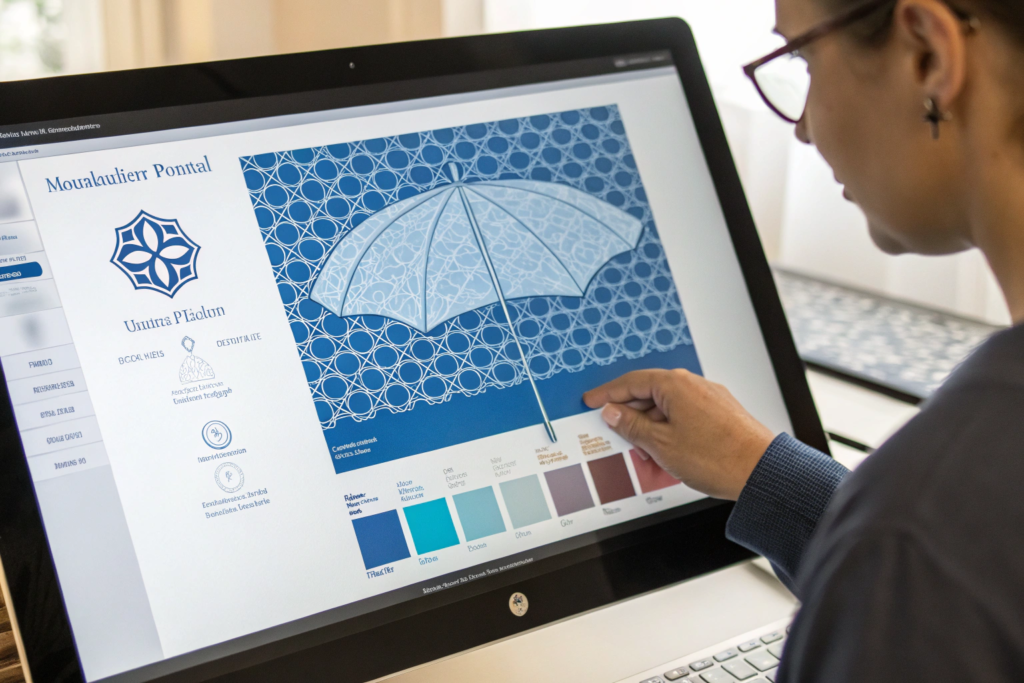
What Is the "Stock Print" Strategy for Simulating Custom Fabric?
This is an insider secret. Umbrella fabric mills produce "Stock Prints" —generic patterns that they run in massive quantities for the open market. These are patterns like:
- Classic Houndstooth
- Thin Pinstripe
- Polka Dot
- Tartan Plaid
Because these patterns are produced in the millions of meters, they have no MOQ and no setup cost. They are essentially "solid" fabrics from a pricing perspective.
The Strategy:
You select a Stock Print (e.g., a Navy and White Pinstripe) as the base fabric for your umbrella. Then, you Screen Print your logo on top of it. The result is an umbrella that looks fully custom and highly designed, but it was manufactured using the Low MOQ Screen Print Method.
This is a brilliant way to achieve a high-end, boutique look for quantities as low as 100-200 pieces. At AceAccessory, we maintain a swatch book of available Stock Print Umbrella Fabrics. We can show you these options and help you select a pattern that complements your brand aesthetic. This is one of the many ways we add value beyond just taking an order.
How Does Packaging Customization Affect the Overall Order Minimum?
Don’t forget the box! If you are giving these umbrellas as corporate gifts, the packaging is half the experience. But custom packaging has its own MOQ.
- Custom Printed Umbrella Sleeve: This is a separate piece of fabric that requires its own printing setup. MOQ for a custom printed sleeve is typically 500 pcs. However, you can Screen Print on a Stock Sleeve with an MOQ of 100 pcs.
- Custom Printed Cardboard Box: A full-color printed box for a folding umbrella requires a printing plate. MOQ is typically 1,000 boxes.
- Low MOQ Packaging Alternative: Use a Stock Kraft Paper Box and add a Custom Sticker with your logo. The sticker can be printed in small quantities (100 pcs) for a few dollars. This achieves a branded unboxing experience without the high MOQ of a custom printed box.
At AceAccessory, we view the umbrella and its packaging as a complete system. We advise clients on how to allocate their budget and navigate the MOQ constraints of each component to create the best possible finished product. We manage the entire supply chain so you don’t have to coordinate between a box factory and an umbrella factory.
Conclusion
The minimum order quantity for custom printed umbrellas with logos is not a single, immovable number. It is a sliding scale that is directly influenced by the manufacturing method, the complexity of the design, the chosen umbrella style, and the components involved. The 1,000-piece barrier that many buyers encounter is specific to fully custom, edge-to-edge fabric printing. It is a real economic constraint driven by the wide-format printing process and material waste.
However, by understanding the alternative decoration methods—particularly Screen Printing on Stock Umbrellas and Heat Transfer Patches—you can unlock access to professional, branded umbrellas at quantities as low as 100 pieces. Furthermore, by making smart design choices that limit the number of colors and strategically place the logo, you can achieve a high-end, custom look while staying within the constraints of these lower-MOQ techniques.
The key is to work with a partner who understands the full spectrum of possibilities and who will guide you toward the most cost-effective and appropriate solution for your specific project. You should not have to over-order or overpay. If you have a specific umbrella project in mind and want to explore the MOQ and pricing for your exact design and quantity, we can provide a detailed consultation. Contact our Business Director, Elaine. She can show you our stock umbrella options and explain the best decoration method for your needs. Email Elaine at: elaine@fumaoclothing.com