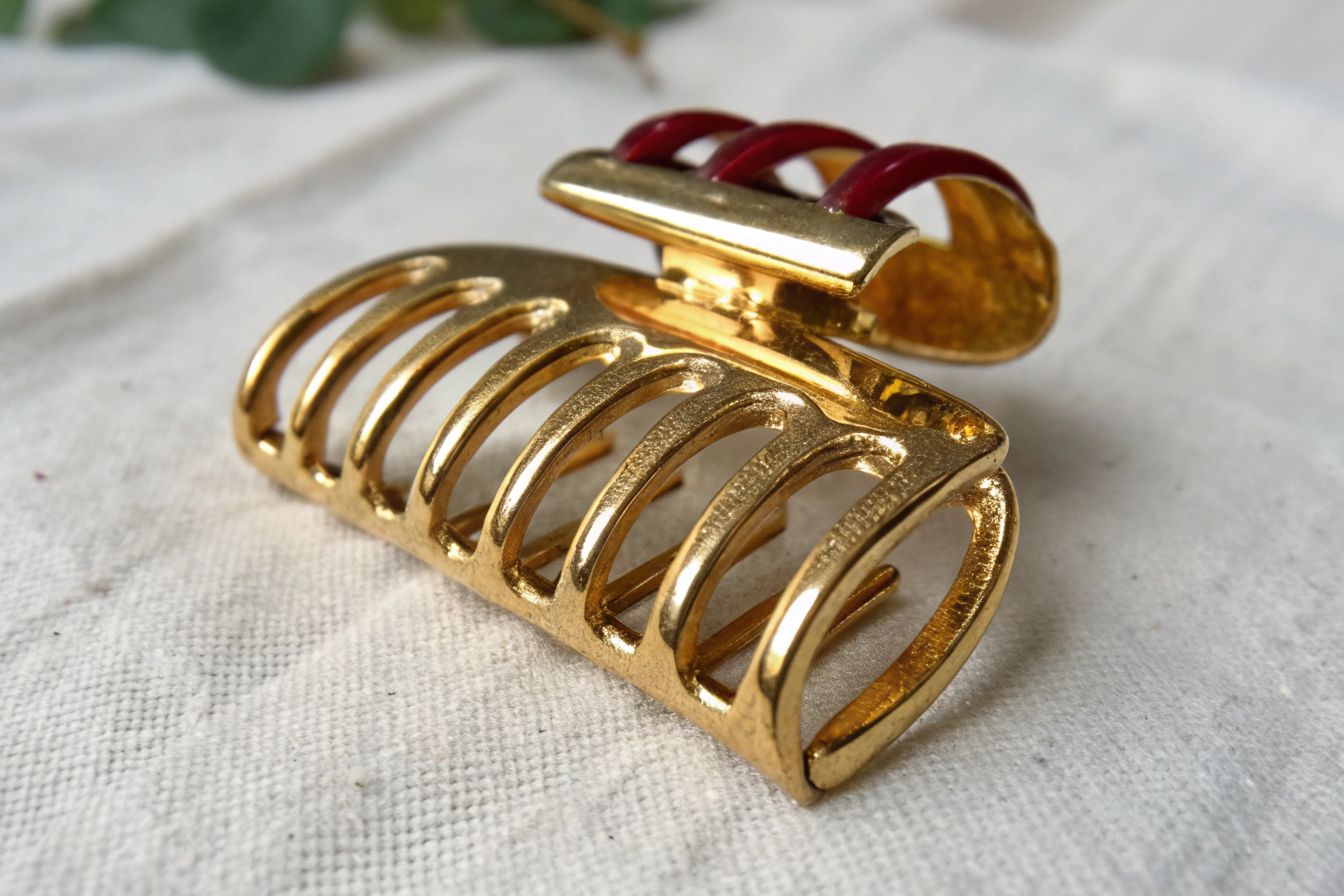
A few years ago, a client named David ordered 10,000 gold-tone metal hair claws from a new factory. The price was great. The finish was shiny. He sold through half his inventory before a customer sent him an alarming email. She had used a home lead test swab on the clip, and it turned bright red. Positive for lead. David had to recall the remaining stock, refund hundreds of customers, and his brand’s name was dragged through a local mom’s group on Facebook. He called me asking, "How do I make sure this never happens again?" The answer is simple: you don’t trust a photo or a promise. You verify with documentation and science. If you import metal accessories like Ron, the fear of toxic heavy metals hiding under a pretty gold finish is a constant, low-grade anxiety. It is a risk that can destroy a business overnight.
Verifying that a factory uses lead-free paints on metal clips requires a three-pronged approach: demanding valid third-party lab test reports (from CPSC-accepted labs like SGS or BV) that show lead content below 90 ppm for surface coatings, performing independent random testing using XRF analyzer guns or chemical spot tests upon receipt of goods, and conducting a factory audit that verifies the paint storage area is free from non-compliant industrial paints. A verbal guarantee is worthless. Only data and physical evidence matter.
I run AceAccessory in Zhejiang Province. We manufacture thousands of metal hair clips and barrettes every month. I have walked through the paint rooms of dozens of component suppliers. I know exactly where the risk hides. The problem is not usually the factory owner intentionally trying to poison children. The problem is the supply chain of the paint itself. A small plating shop buys a barrel of "gold" paint from a local chemical market. The label says "Lead-Free," but the shop owner never tests it. They trust their vendor. That trust is what puts lead on your clips. Let me show you exactly how to cut through that trust and get to verifiable facts.
Why Is Lead Paint Still a Risk in Imported Metal Hair Accessories?
You might wonder, "It’s 2026. Why are we still talking about lead paint?" The answer lies in the economics of metal finishing. To get a bright, shiny gold or silver finish on a cheap base metal like zinc alloy or iron, the factory uses electroplating or vacuum metallization followed by a colored lacquer topcoat. That topcoat is paint.
In high-end manufacturing, that paint is a complex, certified polyurethane. In low-cost manufacturing, that paint is whatever the local chemical supplier had on sale. Lead is a remarkably effective and cheap drying agent and pigment stabilizer. It makes the paint flow smoothly. It makes the color pop. It makes the paint harden faster. For a small plating shop operating on razor-thin margins, the temptation to use a leaded additive is real.
The risk is compounded by the fact that the supply chain is fragmented. The factory making the metal clip body might send it to a separate "plating factory" for finishing. The plating factory buys paint from a "paint shop." The paint shop buys raw materials from a "chemical trader." By the time the clip reaches your hands, it has passed through four or five entities. If any one of them substituted a non-compliant material, the whole batch is contaminated. This is why you cannot just ask the final assembly factory, "Is your paint lead-free?" They might not actually know. They might be getting a fake certificate from their plater. You have to verify the finished product or audit the plating sub-contractor. At AceAccessory, we control this by auditing our plating partners annually and testing every batch of metal accessories .
What Is the Difference Between Substrate Lead and Surface Coating Lead?
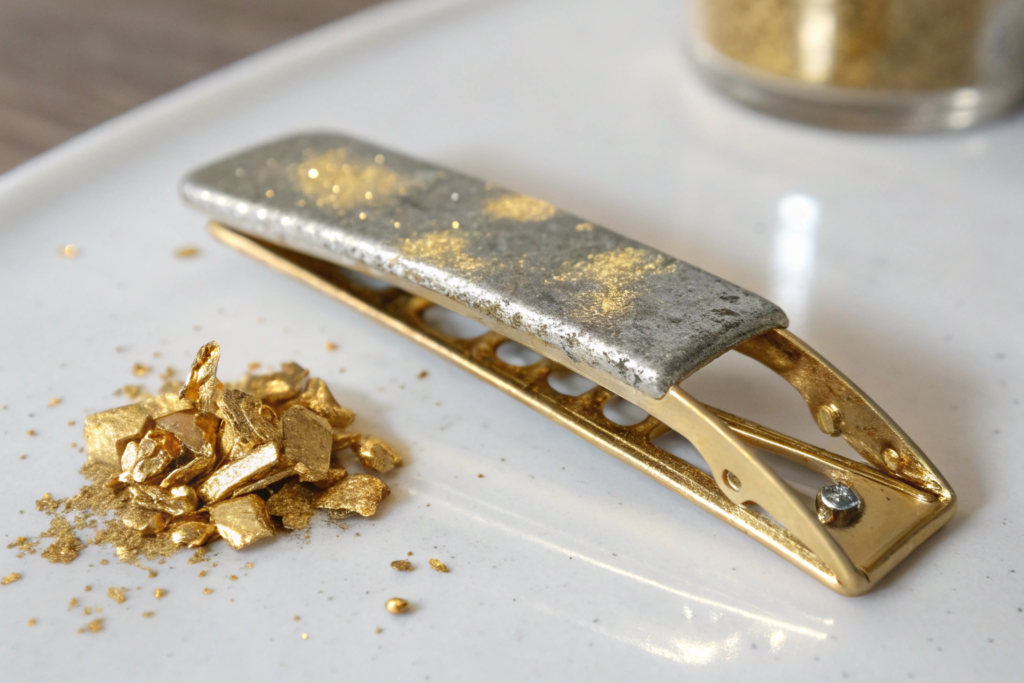
This is a critical legal distinction under CPSIA (Consumer Product Safety Improvement Act) . The law treats lead in the substrate (the metal body of the clip) differently from lead in the surface coating (the paint).
- Substrate Lead Limit: Total lead content in the metal itself cannot exceed 100 parts per million (ppm) . This is for the entire weight of the metal component.
- Surface Coating Lead Limit: Lead in the paint or surface finish cannot exceed 90 ppm . This is stricter because the paint is more likely to chip off and be ingested.
Why does this matter? Because a factory might show you a test report for the substrate that says "Pass (60 ppm)." They might conveniently omit the test for the surface coating. The raw zinc alloy might be clean, but the gold paint on top of it could be 500 ppm lead. The substrate test is useless for verifying the paint.
You must specifically request a test report for "Surface Coating – Total Lead Content" per 16 CFR Part 1303. This test involves scraping the paint off the metal, digesting it in acid, and analyzing it with an ICP-MS machine. It is a separate test with a separate cost. At AceAccessory, we provide both substrate and surface coating reports for all painted metal hair clips . We don’t hide behind the substrate pass.
How Does the CPSIA Define "Accessible Component" for Hair Clips?
This is a nuance that can trip up importers. The CPSIA exempts certain inaccessible components from the lead testing requirement. The logic is: if a child cannot get to it, it doesn’t matter if it has lead.
A factory might argue, "The metal clip is covered by fabric. The paint is inaccessible. Therefore, we don’t need to test it." This argument is invalid for hair clips.
The CPSC has clearly stated that fabric coverings are not a barrier to accessibility. Children put things in their mouths. Saliva soaks through fabric. They pick at seams. The fabric wears away. The underlying paint will become accessible.
Furthermore, the prongs of the clip are almost always exposed metal. Those prongs touch the hair and scalp. They are handled by the parent. They are accessible.
At AceAccessory, we treat all painted surfaces as accessible for the purposes of children’s hair accessories . We do not take the "inaccessible component" loophole. We test everything that has color on it.
How to Read and Authenticate a Third-Party Lead Test Report?
When a factory sends you a PDF of a "Lead Test Report," your first instinct should be suspicion. It is shockingly easy to photoshop a report or to send a report for a different product. You need to know how to read the document and how to verify it is real.
A legitimate third-party test report from a CPSC-accepted lab (like SGS, Bureau Veritas, Intertek, or TÜV Rheinland) has specific security features and a standardized format. First, check the Lab Logo and Address. Is it a real lab? A fake report might say "Shenzhen Testing Co." which is not a CPSC-accepted lab.
Second, look for the Report Number. This is a unique identifier. You should be able to go to the lab’s official website and verify the report number. Most major labs have an online certificate verification portal. Enter the number. If the portal says "Invalid Number" or the product description doesn’t match, the report is fake.
Third, examine the Test Results Table. You are looking for the row labeled "Lead (Pb)" . You want to see the Method Detection Limit (MDL) . A good lab can detect lead down to 10 ppm or less. If the result says "N.D." (Not Detected) but the MDL is 200 ppm, the test is worthless. It just means the lead level was below 200 ppm. It could be 190 ppm, which is a violation. The result must be a numerical value below 90 ppm .
At AceAccessory, we provide the full report PDF, not just the cover page. We also provide the Chain of Custody (COC) document if requested, which proves the sample we sent to the lab matches the production batch.
What Are the Key Sections to Check on an SGS or BV Test Certificate?
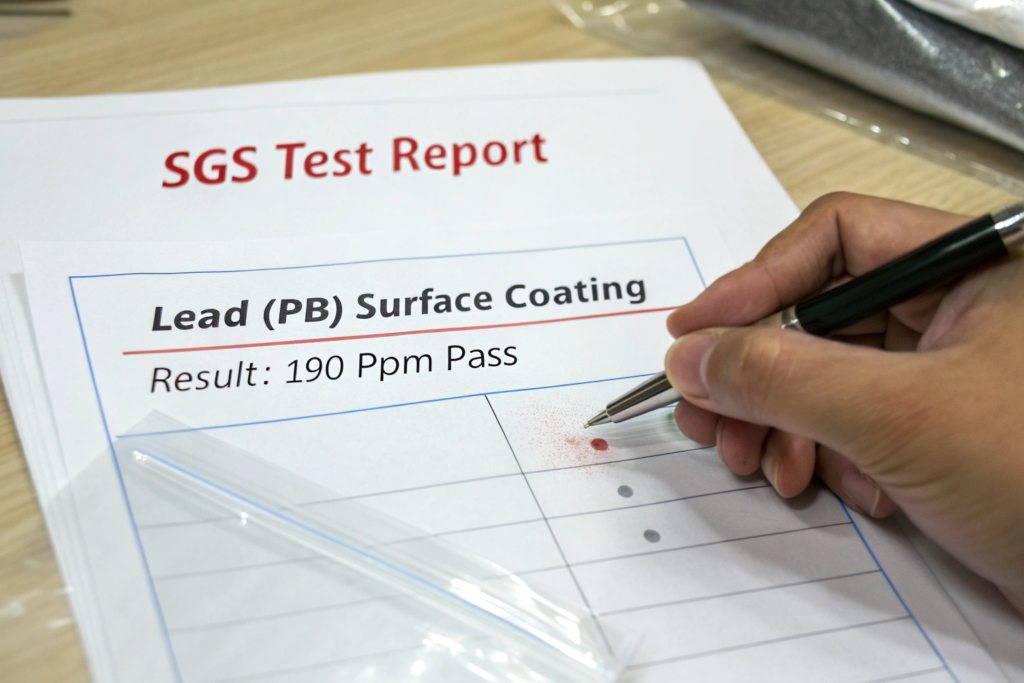
Let me walk you through exactly where to look on a typical SGS report. Don’t get overwhelmed by the 20 pages of technical jargon. You only need to check three things.
-
Page 1: Applicant and Sample Description.
- Applicant: Should be the factory’s legal name (e.g., "AceAccessory Ltd").
- Sample Description: Must match the product exactly. Look for words like "Gold Plated Metal Hair Clip" or "Painted Surface." If it just says "Metal Clip," it is too vague. It might not have included the paint layer in the test scope.
-
Page 2-3: Photo of Test Sample.
- A real SGS report includes a color photo of the item they tested. Zoom in. Does it look like your product? I have seen reports where the photo shows a silver clip, but the client ordered gold. The factory used the silver report to "prove" the gold was safe. Different color = different paint = different test needed.
-
Section: Results for Lead in Surface Coating.
- Look for the Test Method: Should be CPSC-CH-E1003-09.1 or similar.
- Look for the Result: Should be a number less than 90 . Often written as "< 90 ppm."
- Look for the Conclusion: Should be "PASS."
If the report has these three elements verified, you can have a high degree of confidence in the batch. At AceAccessory, we highlight these sections for our clients to make the review process fast and easy. We want you to trust the testing , not just the logo.
How Often Should a Factory Renew Its Compliance Certificates?
This is a common trap. A factory sends you a lead test report from 2019. They say, "We tested this material years ago. It’s fine." Do not accept this.
Paint formulations change. Suppliers change. Plating baths get contaminated over time. A report from 2019 has zero relevance to a batch produced today.
The industry standard, and the requirement for major retailers, is Annual Renewal. The factory should submit samples of their "core materials" for testing once per year.
However, for a specific production batch of your order, the gold standard is Lot Testing. This means taking random samples from your specific finished goods and sending them to the lab.
At AceAccessory, we offer both options. We maintain annual certificates for our standard platings (Silver, Gold, Rose Gold, Gunmetal). These are available for review. But if a client places a large order of 20,000 pieces and wants Batch-Specific Certification, we will pull 3 random clips from the finished cartons, send them to SGS, and provide the report. The cost is added to the invoice. This is the only way to have absolute, defensible proof that your specific shipment is compliant. For a brand selling to children or a major retailer, this cost is non-negotiable insurance.
How Can I Perform On-Site or At-Home Lead Checks on Metal Clips?
Third-party lab reports are essential, but they are a snapshot in time. What if the factory substituted a cheaper paint after the test? What if you are buying from a new supplier and want a quick, cheap screening tool? You have options for verification at the point of receipt.
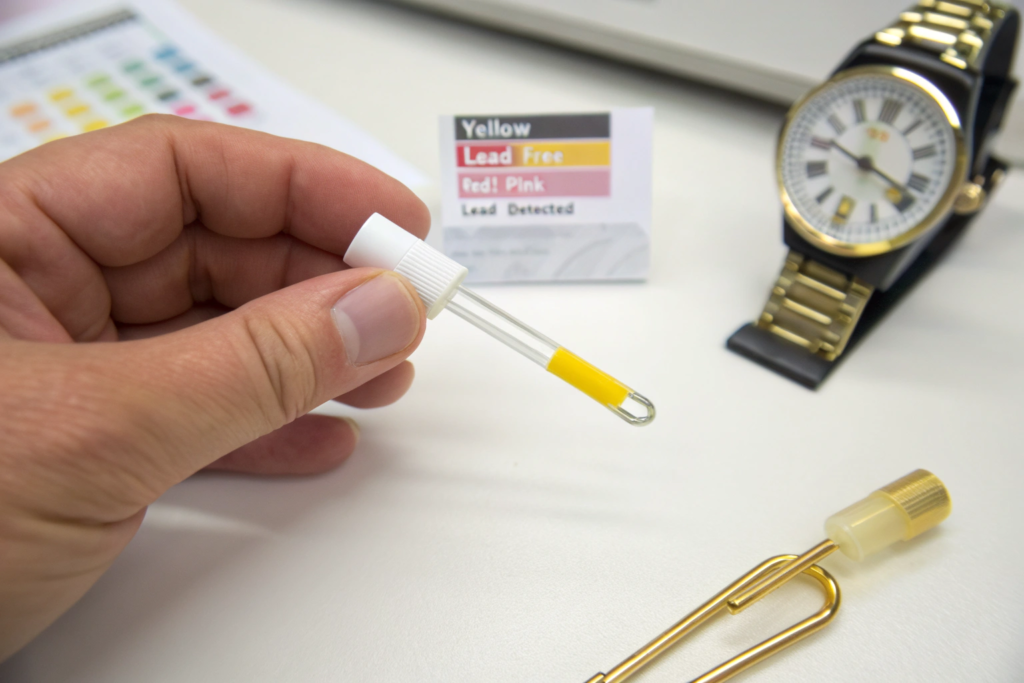
The most practical tool for a small business owner is the LeadCheck® Swab (by 3M) or similar Chemical Spot Test. These are available on Amazon for about $20 for a pack of 8. They are not as accurate as a lab test, but they are excellent for screening for gross contamination.
Here is how they work: You crush the internal vial in the swab to release a chemical reagent. You rub the yellow tip against the painted surface for 30 seconds. If the tip turns pink or red, lead is present above the detection limit (usually around 600-1000 ppm). This is a Fail. Do not sell the product.
Important Caveat: The swab is a presumptive test. It can give false negatives if the lead level is below 600 ppm but still above the legal limit of 90 ppm. It can also give false positives on certain types of stainless steel (due to the metal reacting, not the paint). Use the swab as a "Go/No-Go" red flag detector. If it turns pink, stop. If it stays yellow, it is likely safe, but you still need a lab report for legal compliance.
At AceAccessory, we use these swabs for incoming inspection of paint batches. Before the plating shop dips 10,000 clips, they dip a test clip. We swab it. If it turns pink, we reject the paint barrel before it ever touches our products .
What Are the Limitations of XRF Analyzer Guns for Surface Coatings?
Larger importers or quality control firms use X-Ray Fluorescence (XRF) Analyzers. These are handheld "guns" that cost $20,000 to $40,000. They shoot X-rays at the surface and measure the elemental composition in seconds. They are incredibly powerful but have specific limitations for painted accessories.
| Feature | Chemical Swab | XRF Analyzer Gun |
|---|---|---|
| Cost | ~$3 per test | ~$40,000 device |
| Speed | 30 seconds | 5 seconds |
| Accuracy | Qualitative (Yes/No) | Quantitative (ppm number) |
| Limitation | Cannot measure substrate. Only surface lead. | "Paint Layer Interference." The X-ray penetrates the paint and reads the metal underneath. |
The limitation is critical: If you use an XRF gun on a gold-painted zinc clip, the X-ray beam goes through the thin paint and bounces off the zinc substrate. The reading you get on the screen is an average of the paint and the metal base. If the base metal is clean but the paint is high in lead, the XRF reading might show a "Pass" because the clean metal dilutes the reading.
The only way to get an accurate XRF reading on paint is to physically scrape the paint off the metal, collect the flakes, and test the pile of flakes. This is what the lab does. In the field, the XRF gun is best for screening solid plastic or unpainted metal. For painted clips, trust the Chemical Swab or the Lab Report. At AceAccessory, we use both methods in tandem. Swab for quick screening, Lab for certification.
How Should I Document My Own Due Diligence for Liability Protection?
If you are a US-based importer, you are the "Importer of Record." The CPSC holds you liable, not the factory in China. You cannot say, "The factory told me it was safe." You must show that you exercised reasonable care.
Here is a simple documentation checklist I recommend to every client:
- File the Lab Reports: Save the SGS/BV report PDF in a dated folder on your cloud drive.
- Take Arrival Photos: When the shipment arrives, take a photo of the carton label showing the PO number. Take a photo of you performing a LeadCheck Swab on a random clip from that carton.
- Keep a Log: A simple spreadsheet with columns: Date, PO Number, Product, Lab Report Ref, Swab Test Result (Pass/Fail), Inspector Initials.
- Retain Samples: Keep 2-3 clips from every shipment in a sealed bag labeled with the date and PO number. If a customer complains in 6 months, you have the exact batch to send for confirmatory testing.
This documentation creates a "Good Faith Defense." If a problem is discovered, you can show the CPSC that you did not ignore the risk. You verified compliance using available methods. This can reduce penalties from "negligent violation" to "record-keeping error."
At AceAccessory, we support our clients’ due diligence. We provide the PO-level traceability they need to build this documentation file. We understand that our reputation is tied to your liability protection .
What Factory Audit Questions Reveal True Lead Compliance?
A piece of paper is just a piece of paper. A factory tour reveals the truth. If you have the opportunity to audit a factory (or hire a third-party inspection service), there are specific things you should look for in the finishing department.
Do not just walk the clean sewing line. Ask to see the Paint and Plating Storage Room. This is where the secrets are kept. A compliant factory will have:
- Segregated Chemical Storage: Compliant paints are stored separately from industrial paints.
- Original Labels: Barrels have the manufacturer’s label with a CAS number and a RoHS/REACH compliance logo.
- No Unmarked Jugs: There should be no mystery bottles of clear liquid or colored powder. That is often the "additive" that ruins the batch.
At AceAccessory, our plating partner’s storage room is open for client inspection. The barrels are from certified chemical suppliers. We have the Material Safety Data Sheets (MSDS) for every chemical in that room. We can show you the batch number on the barrel and cross-reference it to the purchase order for that specific month. This is the level of transparency that distinguishes a professional operation from a risky one.

What Specific Questions Should I Ask the Factory Manager About Sourcing?
When you are on a video call or in a meeting, ask these direct questions. Watch their face. Listen to the hesitation.
Question 1: "Can I see the invoice from your paint supplier for the batch used on my order?"
- Good Answer: "Yes, I will send you a redacted copy showing the product code and compliance statement."
- Bad Answer: "My brother-in-law gets it for me." or "It’s from the market."
Question 2: "Do you use the same plating shop for all orders, or do you outsource to different shops based on price?"
- Good Answer: "We use two approved, audited plating partners. We do not change them without re-certification."
- Bad Answer: "We use whoever is cheapest that week." (This means zero control over chemistry).
Question 3: "What is your protocol if a batch fails a lead swab test?"
- Good Answer: "The entire batch is quarantined. We trace it back to the specific plating barrel. We file a non-conformance report with the plating shop and demand a credit. The goods are stripped and re-plated, or scrapped."
- Bad Answer: "That never happens." (It happens to everyone. Lying about it means they hide failures).
These questions reveal whether the factory has a Quality Management System or just a Hope System. At AceAccessory, we welcome these questions. We have documented answers and records to back them up. This is the kind of factory audit that protects your brand.
How Can I Verify That the Plating Subcontractor Is Also Compliant?
This is the weakest link in the chain. The final assembly factory might be clean, but the small plating shop down the street might be a disaster. You need to know who they are using.
Ask for the Plating Subcontractor Disclosure. The factory should be willing to tell you the name and address of the plating shop.
Then, ask for proof of audit. Does the main factory audit the plating shop? How often? What do they check?
A good factory will have a Supplier Audit Checklist for their plating vendor. This checklist includes:
- Photo of the chemical storage area.
- Copy of the plating shop’s business license.
- Copy of their most recent Wastewater Discharge Permit (proves they are a legal, registered operation).
- Copy of a Third-Party Effluent Test (proves they are not dumping heavy metals into the river).
If the main factory cannot provide this, they are not managing their supply chain. They are just passing boxes from one vendor to the next. At AceAccessory, our project managers physically visit our plating partners every quarter. We take date-stamped photos of their storage room. We keep these audit files on record for our fashion accessories clients to review. It is part of the service that defines a reliable exporter.
Conclusion
Verifying that a factory uses lead-free paints on metal clips is a process of replacing trust with evidence. The global supply chain for metal finishing is complex and opaque, and the economic incentives to cut corners with cheap, leaded additives are ever-present. Relying on a verbal promise or a single outdated certificate is a gamble with your brand’s legal and ethical standing.
The path to certainty involves a layered approach. You start with the documentation: demanding current, batch-specific lab reports from CPSC-accepted facilities and knowing exactly how to read the "Surface Coating" section. You supplement this with physical verification, using inexpensive chemical swab tests upon receipt to screen for gross contamination and flag suspicious lots. And for the deepest level of assurance, you ask the hard questions about plating subcontractors and chemical storage, either through a direct audit or a trusted partner.
This is not about paranoia. It is about professional diligence. The cost of a recall, a lawsuit, or the erosion of parental trust is infinitely higher than the cost of a few lab tests and a few pointed questions. You have the right to know exactly what is on the surface of the products you sell.
If you are sourcing metal hair accessories and want a partner who has already built this rigorous verification into their standard operating procedure, we are here to provide that transparency.
Contact our Business Director, Elaine. She can provide sample test reports and walk you through our plating partner audit process. Email Elaine at: elaine@fumaoclothing.com.