As a manufacturer for over two decades, I’ve witnessed a fundamental shift in what consumers value. In the past, "heavy" often meant "high-quality." A heavy belt or a weighty bag felt substantial. Today, the opposite is often true. I talk with buyers like Ron from the US every week, and a major pain point for their customers is being burdened by heavy, clunky accessories. Modern consumers want products that can keep up with their active, mobile lifestyles. They demand accessories that are both feather-light for comfort and tough enough for daily use.
So, how do you solve this classic engineering paradox and source accessories that are both lightweight and durable? The solution lies in a "smarter, not harder" approach to design and material science. It involves a strategic combination of: 1) Choosing Advanced, High Strength-to-Weight Ratio Materials, 2) Engineering Smarter, Skeletonized Hardware, 3) Using Laminated and Composite Construction Techniques, and 4) Focusing on High-Stress Point Reinforcement.
This isn’t about making things flimsy; it’s about eliminating unnecessary weight while intelligently adding strength where it matters most. At my factory, this "performance-first" mindset is at the core of our product development. In this article, I’ll show you how to apply these principles to your sourcing process.
What Are High Strength-to-Weight Ratio Materials?
The most significant weight in any accessory comes from its primary material. Sourcing a lightweight product starts with choosing a material that provides maximum strength for minimum weight. The days of relying solely on thick, heavy leather are over.
High strength-to-weight ratio materials are advanced textiles and composites that offer exceptional durability without the bulk of traditional materials. For accessories, the most important modern materials are: 1) Technical Nylons like CORDURA® and Ripstop, 2) Advanced Composites like Carbon Fiber, and 3) High-Performance Leathers like Kangaroo. At Shanghai Fumao Clothing, our sourcing team has a curated library of these performance materials. It’s the first and most important step in engineering a lightweight product.
Why is Technical Nylon the workhorse material?
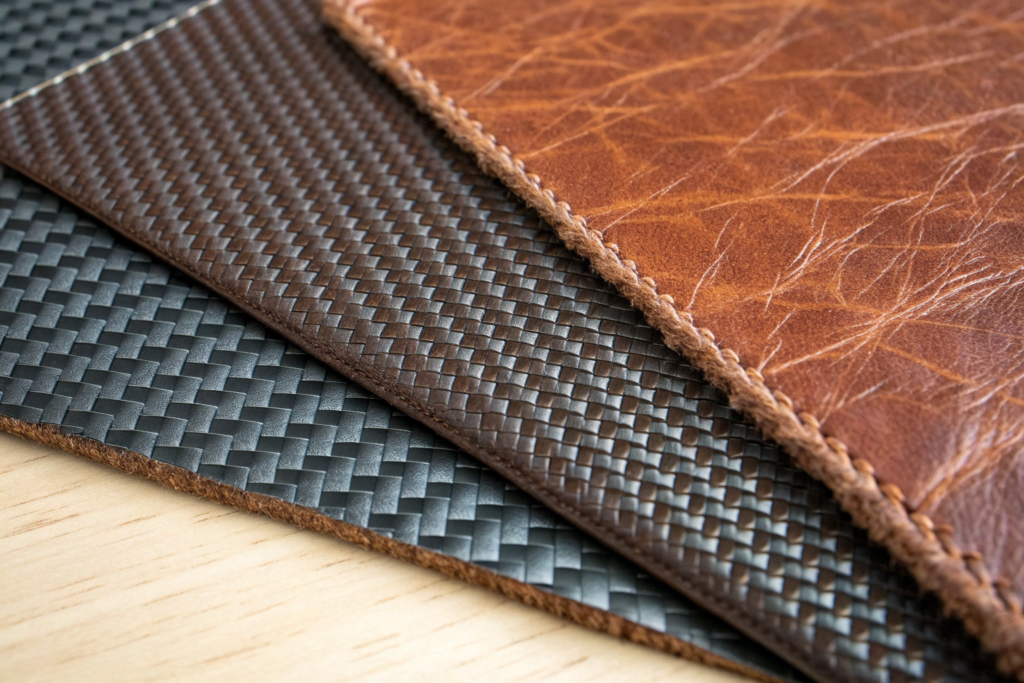
Technical nylons are the cornerstone of lightweight, durable accessories. Unlike basic nylon, these are engineered for performance. CORDURA® is a branded, air-textured nylon fabric renowned for its incredible resistance to abrasion, tears, and scuffs. It’s used in everything from high-end backpacks to military gear. Ripstop Nylon, identifiable by its square grid pattern, has extra reinforcement threads woven in to prevent a small tear from spreading. This allows the base fabric to be incredibly thin and light while maintaining excellent tear strength. These materials are a favorite of outdoor gear brands like Patagonia.
What is the role of Carbon Fiber and Composites?
For rigid components, nothing beats the performance of Carbon Fiber. This material, famous for its use in aerospace and Formula 1 cars, is made of woven carbon filaments set in a resin. It is incredibly strong, stiff, and astonishingly lightweight. While too expensive for an entire bag, it’s an excellent choice for high-end, rigid-structured items like money clips, the frame of a minimalist wallet, or the buckle on a premium technical belt. Its high-tech look also adds significant perceived value. Its properties are well-documented by material science resources like ThoughtCo.
How Can Hardware Be Engineered for Lightness?
After the main fabric, the second heaviest components on an accessory are the metal hardware: buckles, clasps, zippers, and rings. A common mistake is to pair a lightweight technical fabric with a heavy, solid zinc or brass buckle, which completely negates the weight savings.
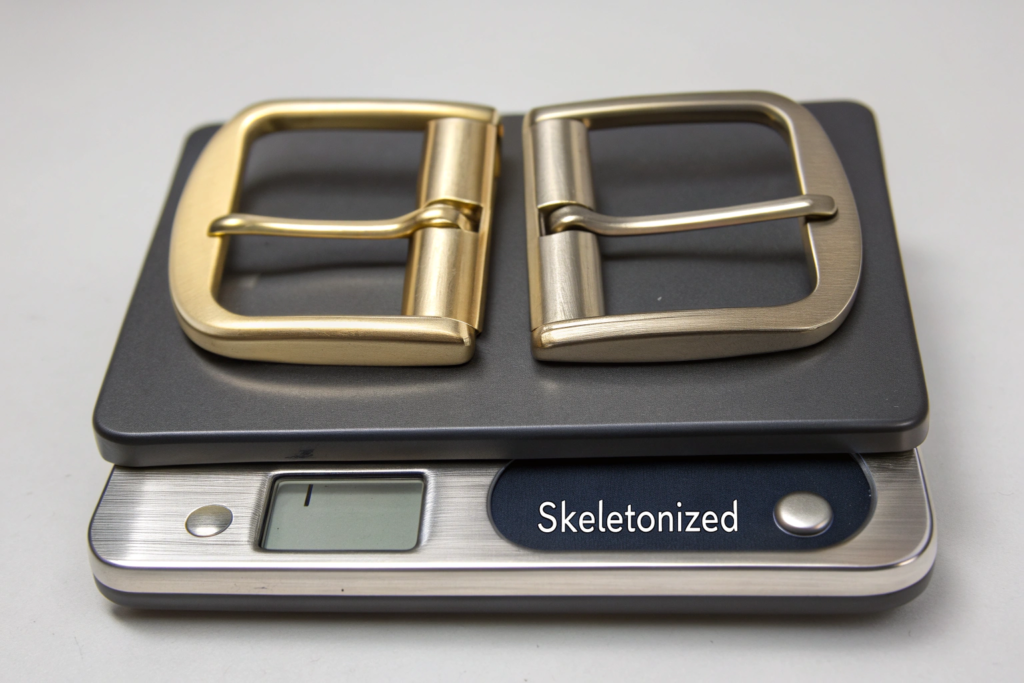
Hardware can be engineered for lightness by choosing lighter materials and using smarter, "skeletonized" designs. Instead of solid, heavy metals, the best choices are: 1) High-Grade Anodized Aluminum, and 2) High-Impact Polymers like Acetal (Delrin®). The design should focus on removing any material that isn’t structurally necessary. This is a detail we work on closely with our hardware suppliers. A few grams saved on every buckle adds up to a significantly lighter final product.
Why is Anodized Aluminum a superior choice?
While traditional brass and zinc are dense and heavy, Aluminum is a fantastic lightweight alternative. High-grade aluminum alloys can be incredibly strong. The anodizing process creates a hard, corrosion-resistant outer layer that is much more durable than simple paint and can be produced in various colors. An anodized aluminum buckle provides the premium look and feel of metal at a fraction of the weight of brass. It’s the standard choice for lightweight backpacking and climbing gear, used by brands like Black Diamond.
What is the advantage of a "Skeletonized" Design?
A skeletonized design is one where excess material has been strategically cut away, leaving only the essential structural frame. Think of the architecture of a bridge. Instead of using a solid block of metal for a buckle, you can design one with cut-outs and a thinner profile that maintains its strength only where needed. This requires more thoughtful engineering and tooling, but it can reduce the hardware’s weight by 50% or more without compromising its load-bearing capacity. This design philosophy is a key principle in lightweight engineering.
What Are Laminated and Composite Constructions?
Sometimes, a single material can’t be both ultra-lightweight and completely stable (non-stretch). A very thin nylon might be light, but it could stretch or deform under load. The solution is to create a composite material by laminating different layers together.
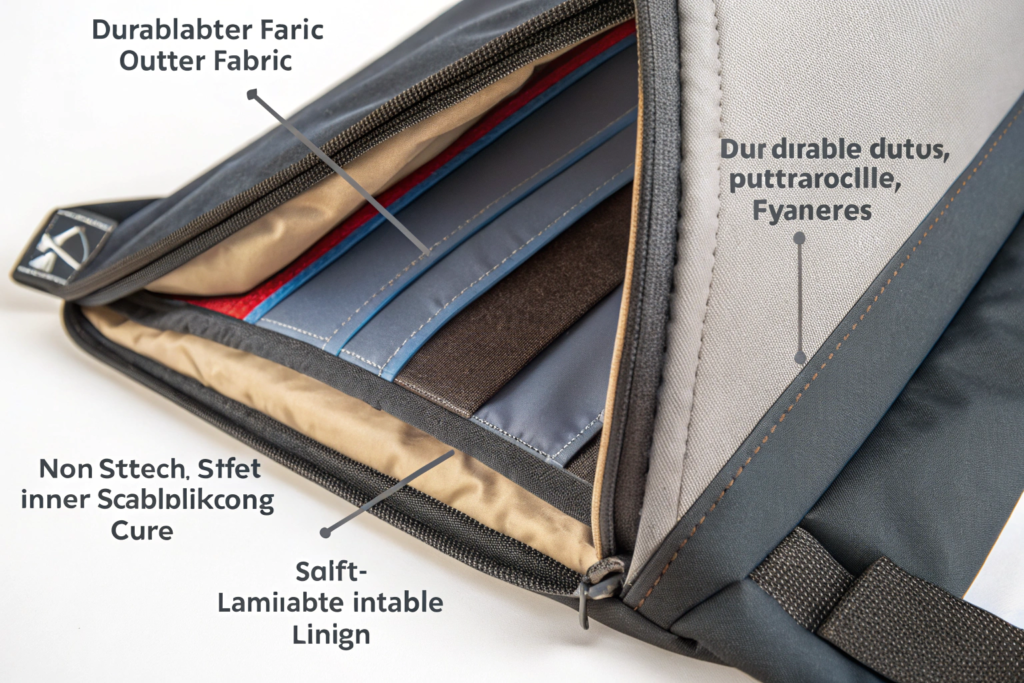
Laminated and composite construction is the process of bonding multiple, specialized layers of material together to create a final fabric that has the best properties of each layer. A typical construction for a lightweight and durable strap might involve: 1) A thin, abrasion-resistant outer face fabric, 2) A non-stretch stabilizing core, and 3) A comfortable, soft inner lining. This technique, borrowed from high-performance sailcloth and technical outerwear, allows us to create materials that are thinner and lighter than a single thick material, but far stronger and more stable.
How does lamination work?
The layers are bonded together using a specialized thermal adhesive film and pressure. This creates a single, integrated piece of fabric. For example, we can take a very thin ripstop nylon face fabric (for durability), laminate it to a non-woven PET film (for non-stretch stability), and add a soft mesh backing (for comfort). The resulting three-layer composite is incredibly thin, lightweight, stable, and strong. This is the technology behind many advanced textiles used by brands like Arc’teryx.
What is the benefit for belts and straps?
This is the key to creating modern, non-leather belts and bag straps. A single layer of nylon webbing can be strong, but it can also be thick and bulky. A laminated strap can be much thinner and lighter while having zero stretch, which is crucial for a belt or a shoulder strap that needs to hold its length under load. This is a technique we at Shanghai Fumao Clothing have perfected for our performance-oriented clients.
Why is High-Stress Point Reinforcement Crucial?
A bag or a belt doesn’t fail in the middle of a flat panel; it fails at its stress points. These are the areas where straps connect, where hardware is attached, and where the most pulling and twisting occurs. A lightweight design is only successful if these critical points are made bombproof.
High-stress point reinforcement is the technique of adding extra strength only where it is needed most. Instead of making the entire product heavy, you use a lightweight base material and then selectively reinforce critical connection points with techniques like Bar-Tacking and using extra layers of webbing. This intelligent, targeted approach to durability is the final piece of the puzzle. It allows the rest of the product to remain light and comfortable.
What is a Bar Tack stitch?
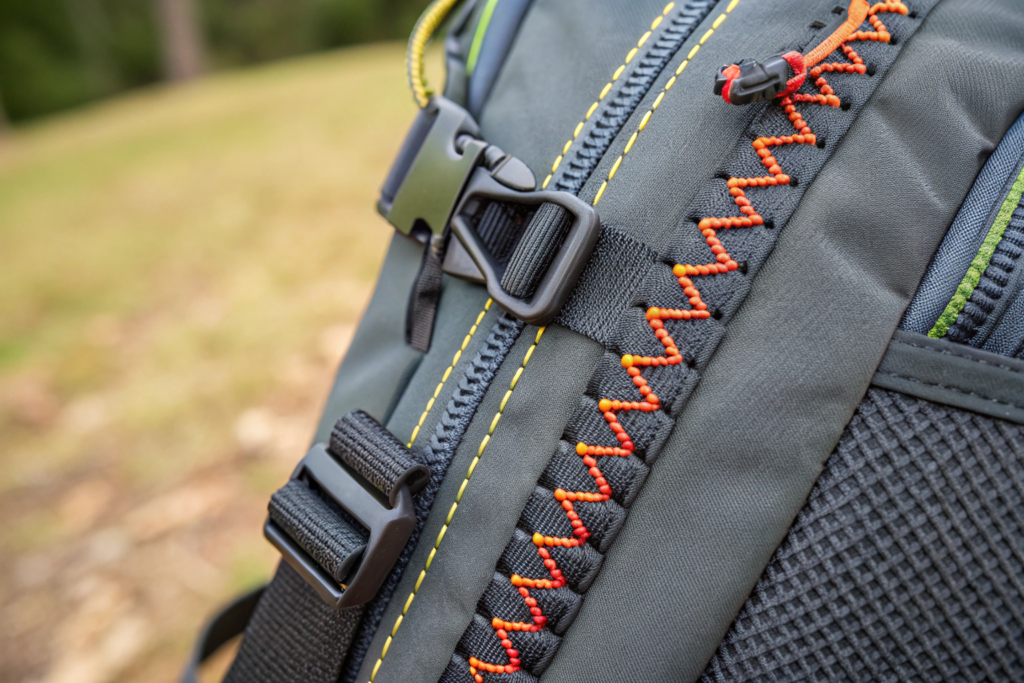
A bar tack is a series of very dense, tight zigzag stitches used to reinforce a small area that is subject to high stress. You will see them on almost any high-quality backpack where the shoulder straps join the bag, at the corners of pockets, and on the belt loops of jeans. It is a clear visual indicator that the manufacturer has paid attention to durability. A product that lacks bar tacks at its key stress points is a major red flag for a professional buyer. The importance of this stitch is a fundamental lesson in industrial sewing.
How is webbing used for reinforcement?
In addition to bar-tacking, another common technique is to place a small, hidden piece of heavy-duty nylon webbing at a key attachment point. For example, the point where a D-ring is attached to a bag might have a small square of webbing on the inside, sandwiched between the layers of fabric. The stitching that holds the D-ring in place goes through both the main fabric and this extra layer of webbing. This distributes the pulling force over a wider, stronger area, preventing the hardware from tearing out of the lighter base fabric.
Conclusion
Sourcing accessories that are both lightweight and durable is not about finding a single "magic" material. It is an engineering discipline that requires a holistic approach to design. It starts with choosing advanced materials with a high strength-to-weight ratio, like technical nylons. It continues with intelligently designing hardware to be strong but light, using materials like aluminum and skeletonized forms. It involves using advanced composite and laminated constructions to create fabrics that are thin but stable. And it culminates in the strategic reinforcement of high-stress points with techniques like bar-tacking. By embracing this multi-faceted strategy, you can offer your customers products that meet the demands of their modern, active lives: accessories that are so light they forget they’re carrying them, and so durable they can rely on them for years.
If you are looking for a manufacturing partner who thinks like an engineer and has mastered these modern construction techniques, my team at Shanghai Fumao Clothing is ready to build your next generation of performance accessories. We believe that true quality is not about weight, but about intelligence. Please contact our Business Director, Elaine, at her email: elaine@fumaoclothing.com to discuss your project.