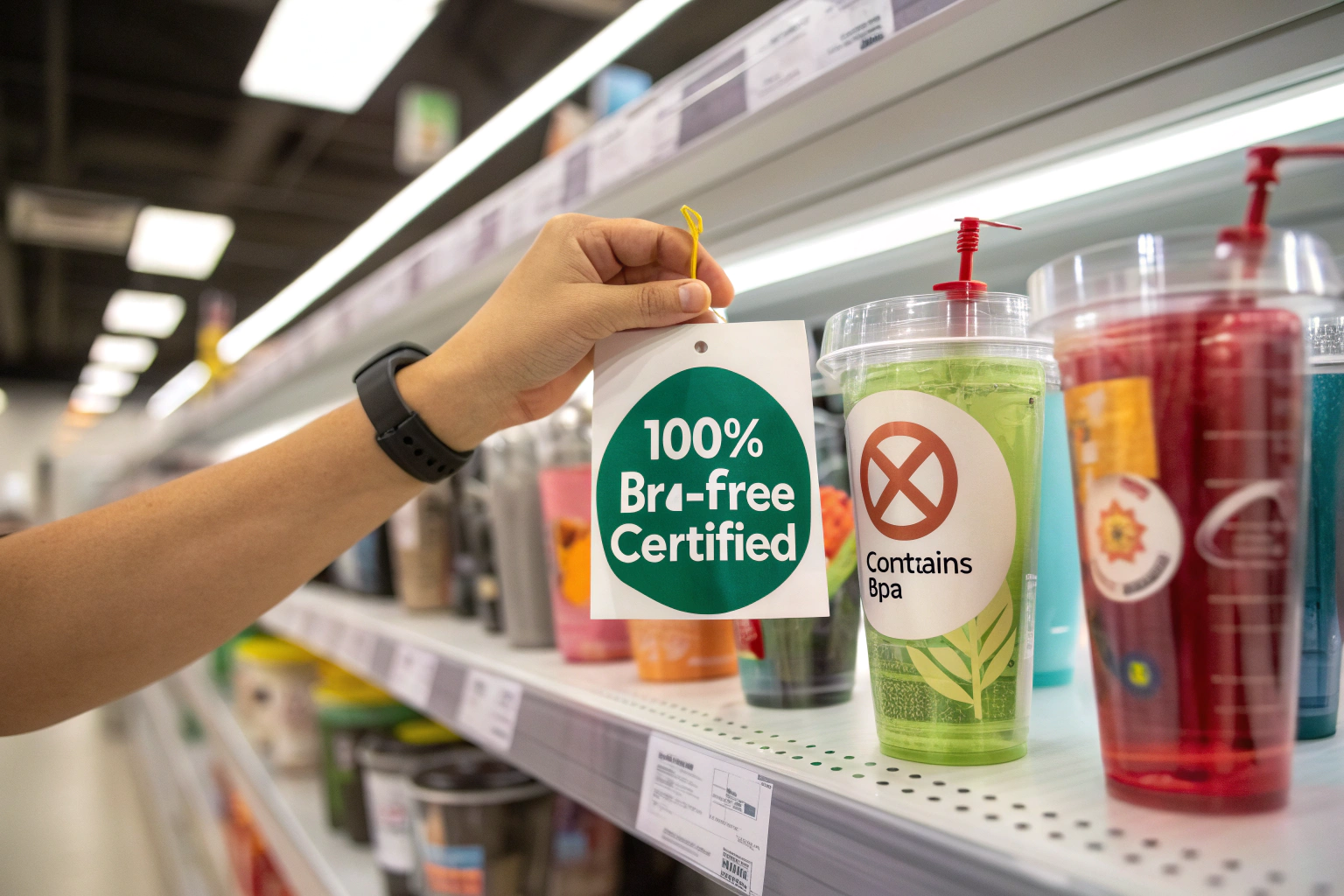
Have you ever watched a customer pick up a reusable plastic cup in a supermarket, scan the label, and then put it back on the shelf with a look of disgust? I have seen this exact moment of rejection. The cup was beautifully designed. The color was trendy. The price was competitive. But the label was missing three critical words: "BPA-Free Certified." The customer, a young mother, was shopping for her child’s school lunch. She did not trust the product. She did not buy it. The supermarket lost a sale. The brand lost a customer. The problem was not the cup’s quality. It was the absence of a simple, verifiable chemical safety promise.
AceAccessory is a professional manufacturer and exporter of accessories. European supermarkets require BPA-free certification on cups because EU Regulation 321/2011 explicitly bans the use of Bisphenol A in the manufacture of polycarbonate infant feeding bottles and has driven a precautionary market-wide demand for certified BPA-free claims on all food-contact plastic articles, enforced by the retailer’s own chemical policy and the potential for severe NGO-led brand reputation attacks.
BPA is the most infamous chemical in consumer plastics. The fear of it has fundamentally changed the reusable cup industry. The European market, led by vigilant regulators and powerful consumer advocacy groups, has set the global gold standard for chemical transparency. As a factory owner in Zhejiang who supplies millions of cups to European supermarket chains, I have lived through this transition. I have redesigned our entire material library to be demonstrably BPA-free. Let me explain the legal, scientific, and commercial logic behind this non-negotiable requirement.
What Is the Specific EU Legislation Banning BPA?
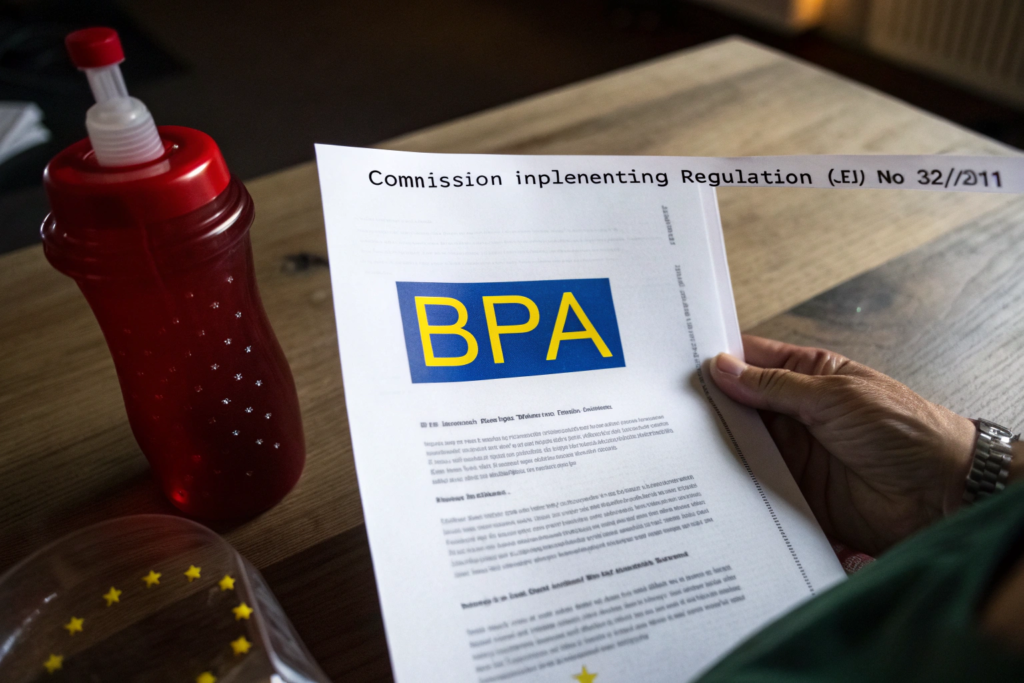
The legal trigger was the baby bottle. In 2011, the European Commission adopted Regulation 321/2011. This law amended the existing plastics food contact regulation. It specifically banned the use of Bisphenol A in the manufacture of polycarbonate infant feeding bottles. The ban was effective from June 1, 2011 for manufacture and from June 1, 2012 for placing on the market. This was the starting point.
The European Food Safety Authority had conducted a comprehensive risk assessment. They identified a concern for potential neurodevelopmental and reproductive toxicity from BPA migrating from the bottle into the milk, especially when the bottle was heated. The European Commission applied the precautionary principle. They banned the substance from the most vulnerable population’s product. This single law had a seismic effect on the entire plastic food-contact industry. It did not ban BPA from adult cups. But it created a massive, irreversible shift in consumer perception. Supermarkets, under pressure from consumer groups, immediately extended the ban in their own private standards. They demanded that all reusable plastic cups, not just baby bottles, be demonstrably BPA-free. The legal ban was narrow. The commercial ban was immediate and total.
What Is the New 2024 EU BPA Ban in Food Contact Materials?
The regulation has now evolved. In early 2024, the European Commission proposed a draft regulation to ban BPA in all food contact materials, including plastic cups, water bottles, and the linings of cans. This is a full, comprehensive ban. The proposed transition period is short. This new law, once enacted, will make BPA-free certification an absolute legal requirement for all cups placed on the EU market. We are already producing to this anticipated standard. We are ahead of the legislation. This is our commitment to our European clients.
What Is the Scientific Definition of a "BPA-Free" Material?
A BPA-free material is a plastic that does not use Bisphenol A as a building block. The classic BPA plastic is polycarbonate. It is made by reacting BPA with phosgene. A BPA-free alternative uses a different monomer. For clear, rigid cups, we use Eastman Tritan, a copolyester, or a clarified polypropylene. Neither of these contains BPA. However, some unscrupulous manufacturers use a substitute like Bisphenol S, which has a similar chemical structure and potential similar health effects. This is the "regrettable substitution." A true BPA-free certification tests for the absence of all bisphenol compounds, not just BPA. Our certification is a "non-detect for all bisphenols" test.
How Does a Factory Prove a Cup Is Genuinely BPA-Free?
A verbal promise is marketing. A test report is proof. European supermarkets do not accept supplier declarations. They demand a third-party laboratory test report from an accredited lab. The specific test is a specific migration test according to EU 10/2011.
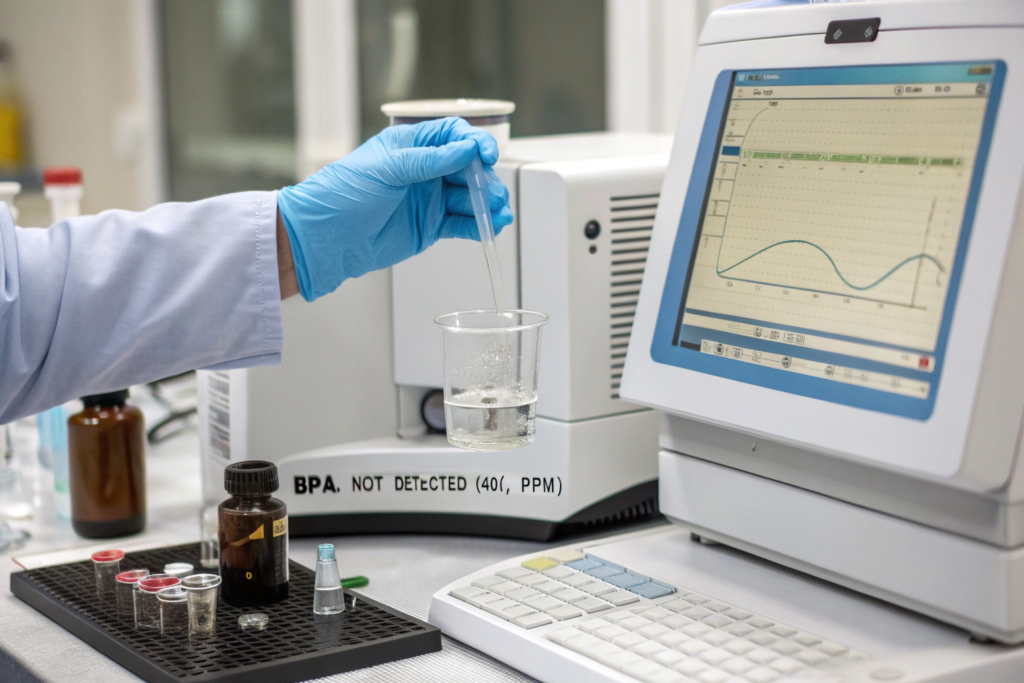
Our protocol is standardized. We send a finished cup sample to an ISO 17025 accredited lab, such as TUV Rheinland or SGS. The lab tests the cup using food simulants. For a cold beverage cup, the simulant is 3% acetic acid, which mimics a soft drink. For a hot beverage cup, the simulant is 20% ethanol at 70 degrees Celsius. The cup is filled and held for a specified time, typically 2 hours at the designated temperature. The liquid is then analyzed using a liquid chromatography-mass spectrometry. This instrument can detect BPA down to parts per billion. The EU specific migration limit for BPA was previously 0.6 mg/kg. The new regulation effectively reduces this to "not detectable," which is a detection limit of 0.01 mg/kg or lower. Our test reports consistently show "Not Detected." This means no BPA migrated from the cup into the drink. The report is issued to the supermarket’s compliance department. We also provide a factory audit report. The auditor visits our factory. They verify our raw material storage. They check that we physically segregate BPA-free materials from any potential BPA-containing plastics. They take a traceability sample from our production line. This dual verification, the lab test and the factory audit, provides complete supply chain integrity.
What Is a "Migration Test" and Why Is It the Only Valid Proof?
A total content test just dissolves the plastic and measures the BPA. It does not tell you if the BPA can actually leach into the drink. A migration test simulates real-world use. It proves the BPA, if present, is locked inside the polymer matrix and will not transfer to the food. This is the legally relevant test. The migration test is the only scientifically valid proof of safety for the consumer.
How Do We Avoid BPA Contamination During Production?
Our entire BPA-free cup production line is a dedicated cell. We do not run any polycarbonate or epoxy products on the same injection molding machine. The raw material silos are separate. The molds are dedicated. The grinding and recycling of in-house scrap is a closed loop. We test the regrind material for BPA. A single contaminated flake from an external source could ruin a batch. This strict physical segregation is verified by the factory auditor. It is a critical part of the certification.
Why Do Supermarket Private Policies Go Beyond the Law?
The legal ban on BPA in baby bottles is the floor. The supermarket’s private policy is the ceiling. The big European retailers, Tesco, Carrefour, Aldi, Lidl, have their own Restricted Substance Lists. These lists are often much stricter than the law.
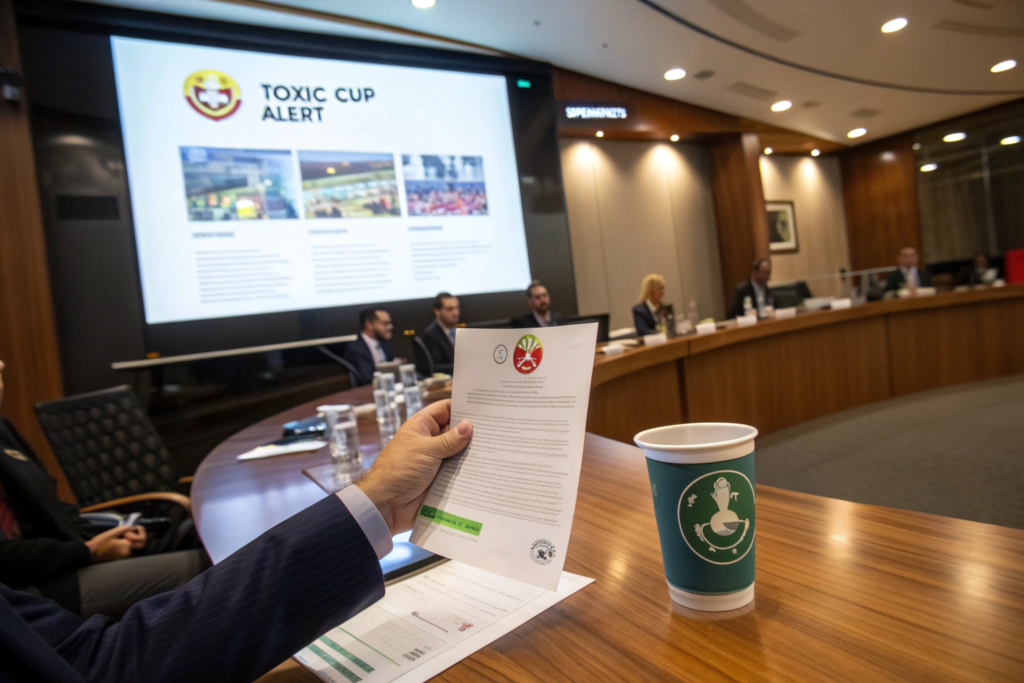
The reason is brand protection. A supermarket’s brand is its most valuable asset. A chemical scandal can destroy that brand overnight. An environmental NGO, like ChemSec or BUND, can purchase a supermarket’s private-label cup, send it to an independent lab, and discover trace BPA. They publish a report titled "Toxic Cups on Supermarket Shelves." The media coverage is brutal. The supermarket loses consumer trust. They are forced into an expensive product recall. The brand damage takes years to repair. To avoid this, the supermarkets enforce a blanket ban on BPA across all their food-contact products, regardless of the current legal status. They require a "BPA-Free" certification as a baseline condition for supplier approval. It is a risk mitigation strategy. They also want to be seen as proactive protectors of consumer health. The "BPA-Free" label is a competitive marketing advantage. It signals that their brand is safer than a brand that is silent on the issue.
What Is the "SIN List" and How Does It Drive Policy?
The SIN List, Substitute It Now, is a database of hazardous chemicals maintained by the NGO ChemSec. BPA is a prominent member of this list. European supermarkets use the SIN List as their reference for their own restricted substance lists. If a chemical is on the SIN List, the supermarket’s policy is to phase it out, regardless of regulatory status. This is the NGO-driven market pressure that bypasses slow legislative processes. It is a direct pipeline from civil society to the corporate boardroom.
How Does a "BPA-Free" Claim Boost Supermarket Brand Loyalty?
The claim is a trust signal. A young parent, the core demographic for a supermarket, is intensely concerned about endocrine-disrupting chemicals. They will actively choose a store brand cup with a clear, certified BPA-free claim over a slightly cheaper, uncertified competitor product. The claim justifies a premium price. It builds a health-conscious brand image that extends across all product categories. It is a powerful loyalty driver.
How Does This Requirement Affect Your Product Development Process?
The requirement for BPA-free certification influences every stage of product development, from the first sketch. You cannot design a cup and then ask, "Is this material BPA-free?" You must start with a certified BPA-free material.
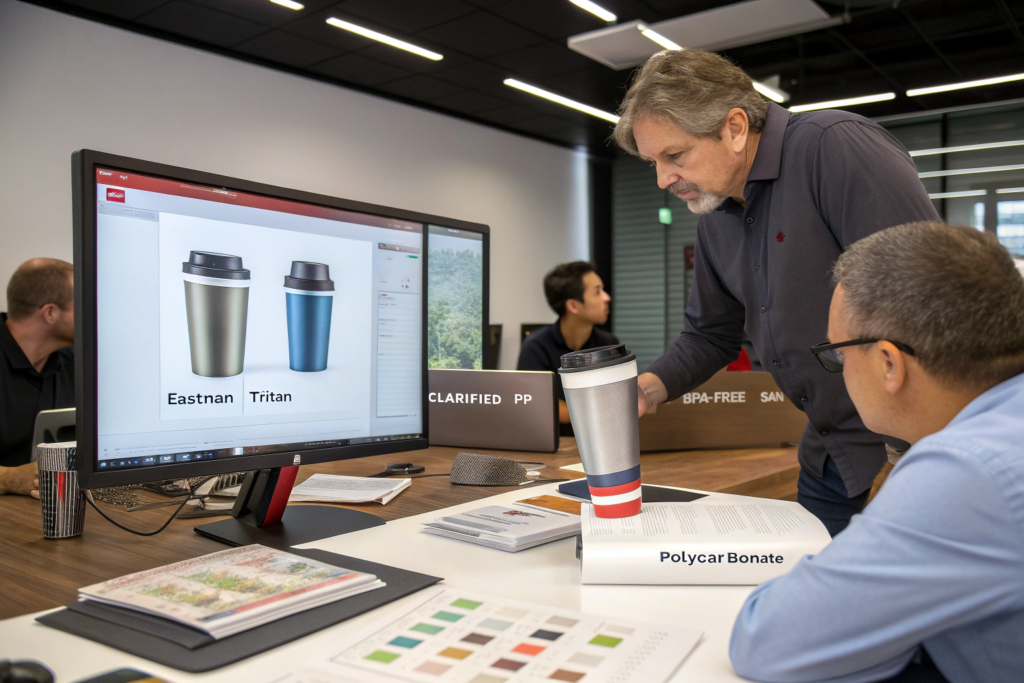
Our material library for European cups is strictly curated. For clear, glass-like cups, we use Eastman Tritan copolyester. It is the industry gold standard. It is BPA-free, BPS-free, and has been certified through rigorous third-party testing for estrogenic activity. It is dishwasher safe and shatter-resistant. For opaque or translucent cups, we use a high-clarity, random copolymer polypropylene. This is a lighter, more cost-effective option. It is inherently BPA-free because BPA is not used in its production. For a premium, heavy feel, we use a BPA-free styrene-acrylonitrile. The material selection dictates the mold design, the processing temperature, and the final product’s mechanical properties. Our design team receives training on the chemical policy of each supermarket client. We know that a Carrefour cup must meet the Carrefour specific migration limits, which may be stricter than the EU norm. We design the product to meet the strictest specification in the client’s market. This pre-compliance engineering is a value-added service.
Why Is Tritan the Preferred Alternative to Polycarbonate?
Tritan is a copolyester developed by Eastman Chemical Company specifically to replace polycarbonate in consumer goods. It has the same desirable properties: brilliant clarity, high impact strength, and heat resistance. But it achieves these without BPA. It is made from different monomers, dimethyl terephthalate, cyclohexanedimethanol, and tetramethyl cyclobutanediol. This unique chemistry provides the performance of polycarbonate without the chemical liability. Eastman provides a comprehensive regulatory support package, including third-party safety assessments and a letter of compliance. This gives our supermarket clients complete documentation confidence.
How Do We Manage the Mold Design for BPA-Free Materials?
BPA-free materials have different shrinkage rates and flow characteristics than polycarbonate. You cannot simply pour Tritan into a mold designed for polycarbonate. The mold must be re-engineered. The gate size and location must be optimized. The cooling channels must be adjusted. Our mold engineering team uses simulation software to model the material flow. We build new molds specifically for the chosen BPA-free material. This investment ensures a dimensionally perfect, stress-free cup.
Conclusion
The European supermarket requirement for BPA-free certification is a complex ecosystem of legal mandate, scientific migration testing, NGO-driven market pressure, and brand risk mitigation. The 2011 baby bottle ban was the legal spark. The comprehensive 2024 food contact material ban is the legislative conclusion. The supermarket’s private Restricted Substance List, fueled by the SIN List, is the ever-present commercial enforcer. The accredited lab’s specific migration test is the only accepted scientific proof. The result is a market where only certified, traceable, BPA-free materials like Tritan and clarified polypropylene are permitted.
In our Zhejiang factory, this requirement is not a burden. It is our operating system. Our material library is strictly BPA-free. Our production is physically segregated. Our test reports are current and from accredited labs. We provide the full certification package with every shipment.
If you are a brand or a supermarket buyer sourcing cups for the European market, I invite you to contact our Business Director, Elaine. She can send you our BPA-free material certification package, including the migration test reports for Tritan and our PP resins. She can explain our dedicated BPA-free production line and factory audit protocol. Send her an email at elaine@fumaoclothing.com. Let us ensure your cups are safe from the molecule to the market.