A UK-based accessories brand owner called me on a Wednesday afternoon in late September, and I could hear the controlled fury in his voice. He had a shipment of 3,000 winter beanies scheduled to depart from Ningbo port the previous Friday. The vessel cutoff was Thursday at 5 PM. His factory had promised, repeatedly, that the goods would be delivered to the container freight station on time. They were not. The container sailed without his beanies. The next available vessel was in twelve days. Those twelve days meant his beanies would miss the October retail window. His buyers at three department store chains had hard delivery dates. Late delivery meant chargebacks, cancelled orders, and a damaged reputation. He had already paid 70 percent of the invoice. He felt helpless, angry, and financially exposed. He asked me what he should do. I walked him through a structured response, and over the following weeks, he recovered a significant portion of his losses and established new contractual protections that prevented a recurrence. That conversation, and dozens like it over the years, has shaped how I think about missed vessel cutoff dates. It is a problem that can be managed, mitigated, and even prevented, but only if you approach it with the right combination of immediate action, negotiated resolution, and systemic prevention.
The best way to handle a factory that misses the vessel cutoff date is a four-step process. First, act immediately to mitigate the logistics damage. Contact the freight forwarder to determine the next available vessel, the cutoff date, and any additional charges. Explore air freight for a portion of the shipment if the retail deadline is absolute and the cost is justified by the margin or the relationship. Secure the earliest possible booking on the next vessel and get written confirmation. Second, document the failure comprehensively. Request written confirmation from the factory of the date the goods were actually delivered to the CFS or port. Obtain the container loading report or the dock receipt that shows the actual delivery timestamp. Compare this to the booking confirmation that shows the cutoff date. This documentation is the foundation of any compensation claim. Third, negotiate compensation based on the actual damages incurred. The damages include the difference in shipping costs if a higher rate applies to the new sailing, the storage fees for the days the goods sat waiting, the air freight cost if air shipment was necessary, and a negotiated amount for lost sales or chargebacks if the delay caused commercial harm. Fourth, implement systemic prevention measures for future orders, including a contractual penalty clause for missed cutoff dates, a mandatory progress reporting schedule in the two weeks leading up to shipment, and a requirement for the factory to provide the container loading confirmation before the cutoff date passes.
A missed vessel cutoff is not just a logistics inconvenience. It is a breach of the supply contract that cascades into financial loss, reputational damage, and relationship breakdown. In the worst cases, it can destroy a seasonal business that depends on getting products into stores during a narrow sales window. At AceAccessory, we manage hundreds of export shipments annually, and we have a zero-tolerance policy for missed cutoff dates on our side. But we also advise our clients on how to protect themselves when working with other suppliers. Let me walk you through the entire process, from the frantic moment you learn the vessel has sailed without your goods to the calm confidence of a supply chain that delivers on time, every time.
What Immediate Steps Should You Take When a Cutoff Date Is Missed
The moment you learn that a vessel cutoff has been missed, a clock starts ticking. Every hour of delay in taking action extends the delay in getting your goods to their destination. The immediate response is not about assigning blame. That comes later. The immediate response is about damage control. The goal is to get your goods onto the fastest possible path to their destination, minimize the delay, and preserve your commercial relationships with your own customers. Panic is the enemy. A clear, structured action plan is your best tool.
The immediate steps to take when a factory misses the vessel cutoff are, in order of priority. One, contact your freight forwarder immediately. Confirm that the goods have missed the cutoff and that the vessel has sailed. Do not rely on the factory’s word alone. Get independent confirmation from the forwarder. Two, determine the next available vessel. Ask the forwarder for the next sailing to your destination port, the vessel name, the estimated time of departure, and the new cutoff date. Ask for the freight rate for the new sailing. Rates can change week to week, and the new rate may be higher or lower than the original booking. Three, evaluate air freight as an alternative. Ask the forwarder for an air freight quotation for all or part of the shipment. Calculate the cost difference between the air freight and the sea freight plus the commercial cost of the delay. If the air freight cost is justified by the margin on the goods or the importance of the customer relationship, this is the moment to make that decision. Air freight transit time is typically 5 to 7 days door-to-door, compared to 25 to 35 days for sea freight. Four, instruct the forwarder to book the chosen option immediately. Do not wait for the factory to agree to pay the difference. Secure the space now. The cost allocation can be negotiated later. Five, notify your customer of the delay. Be honest, be specific, and provide a revised delivery date. Customers value transparency and reliability more than they value a vague promise that everything is fine. Six, secure the goods. If the goods are still at the factory, instruct the factory to hold them securely and not to release them to any carrier without your explicit instruction. If the goods are at a CFS or a port warehouse, confirm the storage arrangements and the daily storage fees.
The first hour after you learn of the missed cutoff is the most critical. Actions taken in that hour can reduce the total delay from weeks to days. Let me explain the two most important immediate decisions.

Should You Immediately Switch to Air Freight After a Missed Sailing?
The decision to switch to air freight is a business calculation, not an emotional one. Air freight is significantly more expensive than sea freight. The cost per kilogram for air freight can be five to ten times the cost of sea freight. For a shipment of fashion accessories, which are relatively lightweight but voluminous, the dimensional weight, not the actual weight, often determines the air freight cost. A pallet of beanies or scarves can have a high dimensional weight, making air freight very expensive. The decision to switch to air freight depends on several factors. The value of the goods. High-value goods, such as cashmere scarves or premium leather belts, justify air freight more easily than low-value goods. The margin on the goods. If the gross margin is 60 percent, spending an extra 15 percent on air freight may be acceptable to protect the sale. The importance of the customer. A key retail account that represents a significant percentage of annual revenue justifies extraordinary measures. A one-time small order from a new customer may not. The availability of the next vessel. If the next vessel sails in three days, the delay is manageable with sea freight. If the next vessel sails in three weeks, air freight becomes more compelling. The nature of the goods. Seasonal goods with a fixed retail window, such as winter accessories in October or summer accessories in April, have a higher urgency. Basic, year-round items are less time-sensitive. The customer’s willingness to share the cost. In some cases, the customer may agree to split the air freight cost because they need the goods urgently. This should be discussed transparently. A common compromise is to air freight a partial quantity. Air freight 20 percent of the shipment to cover the immediate retail need, and ship the remaining 80 percent by the next available vessel. This balances the urgency with the cost. We have helped clients arrange split shipments multiple times, and it is often the optimal solution.
Who Pays for Storage Fees When Goods Wait for the Next Vessel?
Storage fees begin accruing the moment the goods are delivered to the port or CFS and continue until the goods are loaded onto a vessel. When a cutoff is missed, the goods sit in storage for the days between the missed sailing and the next available sailing. These storage fees can be significant, especially at busy ports where storage rates are high. The question of who pays is a matter of contract, fault, and negotiation. If the factory missed the cutoff due to their own production delay, poor planning, or failure to book trucking in time, the factory is clearly at fault. The storage fees are a direct consequence of their failure to perform. The factory should pay the storage fees. If the cutoff was missed due to a force majeure event, such as a typhoon that closed the port, a trucking strike, or a customs hold that was beyond the factory’s control, the responsibility is less clear. The contract may have a force majeure clause that relieves the factory of liability for delays caused by unforeseeable events. In this case, the storage fees may need to be shared or absorbed by the buyer. If the cutoff was missed due to the buyer’s own actions, such as a last-minute change to the order that delayed production, or a delay in providing shipping instructions, the buyer is responsible. The practical approach is to negotiate. The party at fault should bear the cost. The documentation of the delay, the factory’s production completion date, the trucking booking date, and the cutoff date, will establish the facts. With the facts established, the negotiation is straightforward. Without facts, it is a dispute. We always advise clients to include a clause in the purchase order that explicitly states that the factory is responsible for all storage, demurrage, and detention charges resulting from their failure to meet the vessel cutoff, unless the failure is caused by a documented force majeure event.
How Do You Document a Factory’s Failure to Meet a Cutoff
Documentation is the bridge between a problem and a resolution. A missed cutoff is a business dispute, and disputes are resolved with facts, not emotions. The party with the better documentation wins. The documentation must establish a clear timeline of events, the commitments that were made, the deadlines that were communicated, and the actual performance. This documentation serves multiple purposes. It supports your compensation claim with the factory. It provides evidence for any trade assurance or insurance claim. It justifies your revised delivery date to your customer. And it creates a record that informs future contractual protections.
To document a factory’s failure to meet a vessel cutoff, you must collect and preserve six key pieces of evidence. The purchase order or sales contract that states the agreed delivery date or shipment window. This is the foundational document that establishes the factory’s obligation. The booking confirmation from the freight forwarder that shows the vessel name, the voyage number, the estimated date of departure, the port of loading, and, crucially, the cutoff date and time. This document proves the deadline that the factory was required to meet. The factory’s written communication confirming that they would meet the cutoff. This could be an email, a WeChat message, or a WhatsApp message. This document proves that the factory was aware of the deadline and committed to meeting it. The actual delivery record. This is the container loading report, the dock receipt, or the CFS receiving report that shows the date and time the goods were actually delivered to the port or CFS. This document proves that the delivery occurred after the cutoff. The freight forwarder’s written confirmation that the goods missed the vessel. This is an independent, third-party verification of the failure. The revised booking confirmation for the next vessel, along with any invoices for storage fees, demurrage, or additional freight charges. These documents quantify the financial damages.
A well-documented case is difficult for a factory to dispute. The facts speak for themselves. A poorly documented case devolves into a he-said-she-said argument that is unlikely to result in fair compensation. We recommend that buyers create a dedicated folder for each shipment, either physical or digital, where all shipping documents are stored in chronological order. When a problem occurs, the documentation is already organized and accessible. Let me detail the two most important pieces of evidence.
What Shipping Documents Prove the Actual Delivery Date?
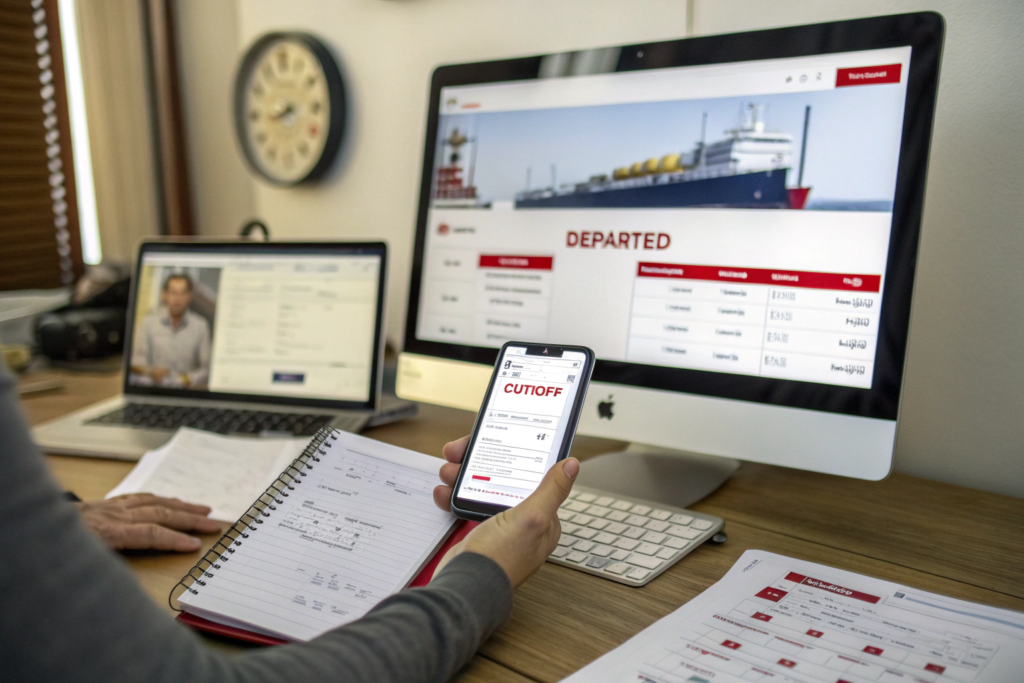
The actual delivery date is the date the goods were physically delivered to the port, the container freight station, or the carrier’s nominated receiving point. This date is distinct from the factory’s production completion date. The factory may have finished production on a certain date, but if they did not deliver the goods to the port until a later date, the delivery date is the later date. The shipping documents that prove the actual delivery date are the dock receipt, the CFS receiving report, or the container loading report. The dock receipt is issued by the shipping line or the terminal operator when the goods are delivered to the port. It records the date and time of delivery, the container number, the seal number, and the condition of the container. The CFS receiving report is similar, but it is issued when the goods are delivered to a container freight station, a warehouse where less-than-container-load shipments are consolidated. It records the date and time, the carton count, and the condition of the cartons. The container loading report is issued when the container is actually loaded with the cargo. It records the date and time of loading. The most authoritative document is the one that shows the first timestamp when the goods were in the custody of the carrier or the terminal. This is the moment the factory’s responsibility for delivery is, in theory, transferred. If this timestamp is after the cutoff date and time, the factory missed the cutoff. It is important to distinguish between the delivery to the port and the customs clearance. In China, export customs clearance occurs before the goods are delivered to the port in many cases. The factory may have cleared customs early, but if they delivered the goods late, they still missed the cutoff. The customs clearance date is not the delivery date. Request these documents from the factory or directly from the freight forwarder immediately after the cutoff is missed. The forwarder has access to the terminal’s systems and can usually provide the dock receipt electronically within hours. If the factory is uncooperative, the forwarder is your independent source of truth.
How Should You Communicate the Delay to Your End Customer?
Communicating a delay to your customer is uncomfortable, but it is far better than silence. Silence creates anxiety, erodes trust, and invites the customer to imagine the worst. A prompt, honest, and specific communication, on the other hand, demonstrates professionalism and respect for the customer relationship. The communication should include five elements. An acknowledgment of the delay. State clearly that the shipment has been delayed. Do not use vague language like "there has been a slight hiccup." Say, "The vessel cutoff was missed, and the goods did not sail as scheduled." An explanation of the cause. Do not assign blame or go into excessive detail about the factory’s failures. A simple, factual statement is best. "The factory completed production later than planned, and the container did not reach the port in time for the scheduled vessel." A statement of the impact. State the original expected delivery date and the new expected delivery date. "The original delivery window was October 15 to 20. The revised delivery window is now October 28 to November 2." A statement of the action taken. Explain what you have done to minimize the delay. "We have booked the goods on the next available vessel, which departs on September 30. We have also explored air freight, but the cost was prohibitive for this order quantity. We are monitoring the shipment closely." A statement of accountability. Accept responsibility for the situation, even if it was the factory’s fault. Your customer’s contract is with you, not with the factory. "We take full responsibility for this delay and are taking steps to prevent it from happening on future orders." The tone should be professional, factual, and solution-oriented. Do not make excuses. Do not over-promise a new delivery date that you are not certain you can meet. It is better to under-promise and over-deliver on the revised date. A customer who is informed of a delay early can adjust their own plans. A customer who discovers the delay on the day the goods were supposed to arrive is justifiably angry.
What Compensation Should You Negotiate for a Missed Vessel
Negotiating compensation for a missed vessel cutoff is a test of the commercial relationship between buyer and factory. The goal is to be made whole for the actual financial damages suffered, not to extract punitive damages that poison the relationship. A factory that acknowledges the mistake, accepts responsibility, and compensates fairly is a factory that can be trusted for future orders, with improved controls in place. A factory that denies responsibility, refuses to provide documentation, and offers no compensation is a factory to exit from. The negotiation should be based on documented facts and quantifiable costs, not on anger or threats.
The compensation you should negotiate for a missed vessel cutoff is based on the actual, documented incremental costs incurred as a direct result of the delay. The core compensable costs are the freight rate differential, if the new vessel booking is at a higher rate than the original booking, the factory should cover the difference. The storage and demurrage fees incurred at the port or CFS for the days between the missed cutoff and the new sailing. The air freight cost differential, if air freight was used to mitigate the delay, the factory should cover the difference between the air freight cost and the original sea freight cost. The chargeback or penalty amounts actually imposed by your customer, if your customer contract includes a late delivery penalty and that penalty was triggered by the factory’s delay, the factory should cover it. The lost sales or markdown costs, if the delay caused the goods to miss the retail season and they had to be sold at a discount, the factory should contribute to the markdown cost. This is the hardest category to negotiate because it requires proving the causal link between the delay and the lost margin. The compensation should be documented in a written agreement, either as a credit note against the current invoice, a deduction from the balance payment, or a discount on a future order.
The negotiation should be conducted in writing, with all claims supported by the documentation gathered earlier. The initial communication should be a formal claim letter that states the facts, lists the costs, and proposes a resolution. The tone should be firm but professional. The goal is resolution, not escalation. Let me explore the two most important compensation categories.

How Do You Calculate Demurrage and Detention Charges?
Demurrage and detention are related but distinct charges that arise from port and container delays. Demurrage is the charge levied by the shipping line or the terminal operator when a container remains at the terminal beyond the allotted free time. The free time is typically 5 to 7 days for a standard dry container. After the free time expires, a daily demurrage charge applies. The charge escalates over time. The first few days beyond free time might be charged at 50 dollars per day. After a week, the rate might increase to 100 dollars per day. After two weeks, to 150 dollars per day. The escalation is designed to incentivize prompt pickup and return of containers. Detention is the charge levied when a container is kept outside the terminal beyond the allotted free time. In the context of an export shipment, detention applies if the factory loaded the container at their premises and kept it beyond the allowed time before delivering it to the port. For most missed cutoff scenarios, demurrage is the relevant charge. The goods are at the terminal, waiting for the next vessel, and the free time is ticking. The calculation of demurrage is straightforward. Determine the date the free time expires. This is the date of delivery plus the free time days. Count the number of days from the free time expiry date to the date the container is actually loaded onto the new vessel. Multiply by the applicable daily rate for each day range. The shipping line’s tariff sheet specifies the demurrage rates. The freight forwarder can provide this information. The demurrage invoice from the shipping line is the authoritative document. The factory should pay this invoice in full if the delay was their fault. Demurrage charges can accumulate to hundreds or even thousands of dollars, depending on the length of the delay and the port. They are a significant financial consequence of a missed cutoff.
Can You Claim for Lost Sales Due to Seasonal Delays?
Claiming for lost sales is the most challenging and the most valuable category of compensation. A shipment of Christmas-themed accessories that misses the October vessel and arrives in January has lost the entire retail season. The goods are worth a fraction of their in-season value. The buyer has suffered a real and substantial financial loss. The difficulty is in proving the amount of the loss and the causal connection between the factory’s delay and the lost sales. To succeed in a claim for lost sales, you need to demonstrate three things. First, that the delay was the sole or primary cause of the goods missing the season. This is established by the shipping timeline. The original vessel would have delivered the goods by a certain date, which was within the seasonal sales window. The delay caused the goods to arrive after the seasonal window had closed. The shipping documents prove the timeline. Second, that the goods had a higher in-season value and a lower post-season value. This is established by your pricing records. Show the in-season wholesale or retail price and the post-season markdown price. The difference is the lost margin per unit. Third, that you attempted to mitigate the loss. Show that you tried to sell the goods post-season, that you offered them to discount retailers, or that you donated them for a tax write-off. The mitigation effort demonstrates that you did not simply let the goods sit in a warehouse without attempting to recover value. The claim amount is the lost margin, minus any recovery from post-season sales or other mitigation, minus the costs you would have incurred anyway, such as the original sea freight. Factories often resist lost sales claims because the amounts can be large and the causal link can be disputed. The factory may argue that the goods would not have sold at full price anyway due to poor design or weak market demand. This is a factual dispute that can be difficult to resolve without a strong contractual basis. The strongest protection is a contract clause that explicitly states that the factory is liable for lost margin on seasonal goods delivered after a specified drop-dead date. Without such a clause, the claim is based on general contract law principles, which vary by jurisdiction. In practice, many lost sales claims are settled through negotiation, with the factory offering a partial compensation as a commercial gesture to preserve the relationship.
How to Prevent Future Vessel Cutoff Misses
Prevention is the ultimate solution to the problem of missed vessel cutoffs. The time and energy spent chasing compensation for a delayed shipment are better invested in creating a supply chain where delays do not happen. Prevention operates on three levels. The contract level, where clear terms create accountability. The communication level, where proactive reporting provides early warning of potential delays. And the relationship level, where a strong partnership creates mutual commitment to on-time performance. A factory that knows you are watching, that knows there are consequences for failure, and that values your business relationship, is far less likely to miss a cutoff.
Preventing future vessel cutoff misses requires implementing a three-part prevention system. At the contract level, include a specific delivery performance clause in every purchase order. This clause should define the vessel cutoff date, state that the factory is responsible for delivering the goods to the CFS or port by that date, list the financial consequences of missing the cutoff, including demurrage, freight differential, and air freight costs, and specify that repeat failures constitute grounds for terminating the business relationship. At the communication level, implement a mandatory pre-shipment reporting schedule. Two weeks before the cutoff, the factory must provide a production status report with photographs of the finished goods. One week before the cutoff, the factory must provide the trucking booking confirmation and the container loading plan. Two days before the cutoff, the factory must provide photographic proof that the goods are packed and ready for pickup, with the cartons labeled and the pallets staged. On the day of cutoff, the factory must provide the dock receipt or CFS receiving report showing the delivery timestamp. At the relationship level, build a partnership with the factory where on-time delivery is a shared priority. Visit the factory. Meet the production manager. Understand their capacity and their constraints. A factory that sees you as a valued partner will prioritize your orders over those of a faceless buyer who only communicates through email.
Prevention requires effort, but the effort pays for itself many times over in avoided delays, avoided costs, and avoided stress. Let me detail the two most effective prevention measures.
Should You Add a Late Delivery Penalty Clause to Purchase Orders?
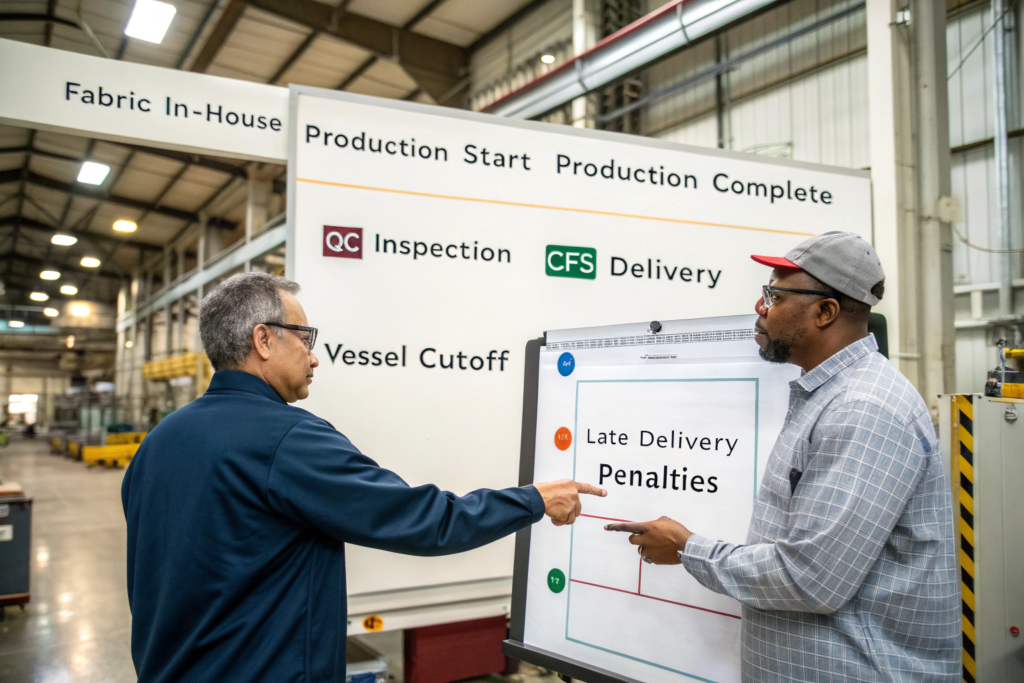
Yes, absolutely. A late delivery penalty clause is the single most effective contractual tool for preventing missed cutoffs. The clause transforms an abstract expectation of on-time delivery into a concrete financial obligation. The factory knows, before production begins, that a delay will cost them money. This knowledge focuses their attention on the delivery deadline in a way that a vague promise does not. The penalty clause should be specific and reasonable. A clause that imposes an excessive, punitive penalty may be unenforceable under contract law in some jurisdictions. A clause that is too vague is ineffective. The elements of a good penalty clause include a clear definition of the deadline. "The factory shall deliver the goods to the CFS nominated by the buyer no later than 5:00 PM China Standard Time on the vessel cutoff date specified in the booking confirmation." A clear statement of the consequences. "If the factory fails to meet the cutoff date for reasons within the factory’s control, the factory shall be liable for the following costs. All demurrage and storage charges incurred. Any difference between the original freight rate and the rate for the next available sailing. If the buyer elects to use air freight, the difference between the air freight cost and the original sea freight cost." An escalating consequence for repeat failures. "If the factory misses the cutoff date on two or more shipments within a twelve-month period, the buyer reserves the right to cancel any open orders without penalty and to deduct a late delivery administration fee of X percent from the balance payment." A force majeure exception. "The factory shall not be liable for delays caused by events beyond the factory’s reasonable control, including but not limited to natural disasters, port closures, or government actions, provided the factory notifies the buyer in writing within 24 hours of such event." The penalty clause should be included in the purchase order or sales contract and agreed to by both parties before production begins. A factory that refuses to agree to a reasonable penalty clause is sending a signal that they are not confident in their ability to deliver on time. That is a red flag that should prompt a reconsideration of the supplier relationship.
What Pre-Shipment Checkpoints Should You Require?
Pre-shipment checkpoints are the early warning system that prevents last-minute surprises. A missed cutoff is rarely a sudden, unforeseeable event. It is almost always preceded by production delays, material shortages, or planning failures that were knowable days or weeks in advance. The factory knew they were running behind. They just did not tell you until it was too late. Pre-shipment checkpoints force transparency. They require the factory to report their progress at defined milestones, and they give you the opportunity to intervene if the progress is falling behind schedule. The checkpoints should be specified in the purchase order and tied to the payment schedule if possible. A recommended checkpoint schedule for a typical 45-day production lead time is as follows. Day 15, material in-house checkpoint. The factory provides photographs of the fabric, trims, and components received and ready for production. This confirms that material shortages are not going to delay the start. Day 25, production start checkpoint. The factory provides photographs of the goods in production on the line. This confirms that production has begun and is on schedule. Day 35, production completion checkpoint. The factory provides photographs of the finished goods, packed and ready for inspection. This is the trigger for the QC inspection. Day 40, QC inspection completion checkpoint. The QC inspection report is provided, and any required rework is scheduled. Day 42, packing and staging checkpoint. The factory provides photographs of the cartons labeled, palletized, and staged for pickup. Day 44, pre-cutoff confirmation. The factory provides the trucking booking confirmation, the vehicle license plate number, and the estimated time of arrival at the CFS. Day 45, cutoff day. The factory provides the dock receipt or CFS receiving report showing the delivery timestamp. Each checkpoint should be documented with a photograph or a scanned document, sent by email or a shared messaging platform. If a checkpoint is missed, you have early warning and can take action, expediting production, sending a QC inspector earlier, or managing customer expectations, before the cutoff is missed. This system transforms the shipping process from a black box into a transparent, managed process.
Conclusion
A factory that misses the vessel cutoff date is testing more than your patience. It is testing your supply chain resilience, your customer relationships, and your business’s ability to deliver on its promises. How you respond, in the immediate crisis and in the long-term prevention, defines the maturity of your sourcing operation. We have walked through the four-phase response. The immediate action to secure the next vessel or switch to air freight, to minimize the delay and protect your customer commitments. The meticulous documentation of the failure, the booking confirmations, the dock receipts, and the cost invoices, that builds an unassailable factual record. The principled negotiation of compensation, based on actual incremental costs, demurrage, freight differential, and documented lost margin, that makes you financially whole. And the systemic prevention, the penalty clauses, the pre-shipment checkpoints, and the supplier partnerships, that make missed cutoffs a rare exception rather than a recurring nightmare.
At AceAccessory, we ship hundreds of containers annually to North America, Europe, and beyond. Our on-time delivery rate is a metric we track, report, and obsess over. We meet our cutoff dates because we have built our production planning, our quality control, and our logistics coordination around that singular objective. The goods must be ready, inspected, packed, and delivered to the port on time, every time. Our clients trust us with their seasonal collections, their retail commitments, and their brand reputations. We take that trust seriously.
If you have been burned by a supplier who missed a vessel cutoff, or if you are looking for a manufacturing partner who treats on-time delivery as a fundamental obligation, not an aspirational hope, I invite you to contact us. Reach out to our Business Director, Elaine, at elaine@fumaoclothing.com. Tell her about your product range, your seasonal deadlines, and your delivery requirements. She will explain how we manage our production and shipping schedules, and she can provide references from clients who will confirm that when we commit to a delivery date, we mean it. Do not let another supplier’s failure define your customer relationships. Work with a factory that delivers.