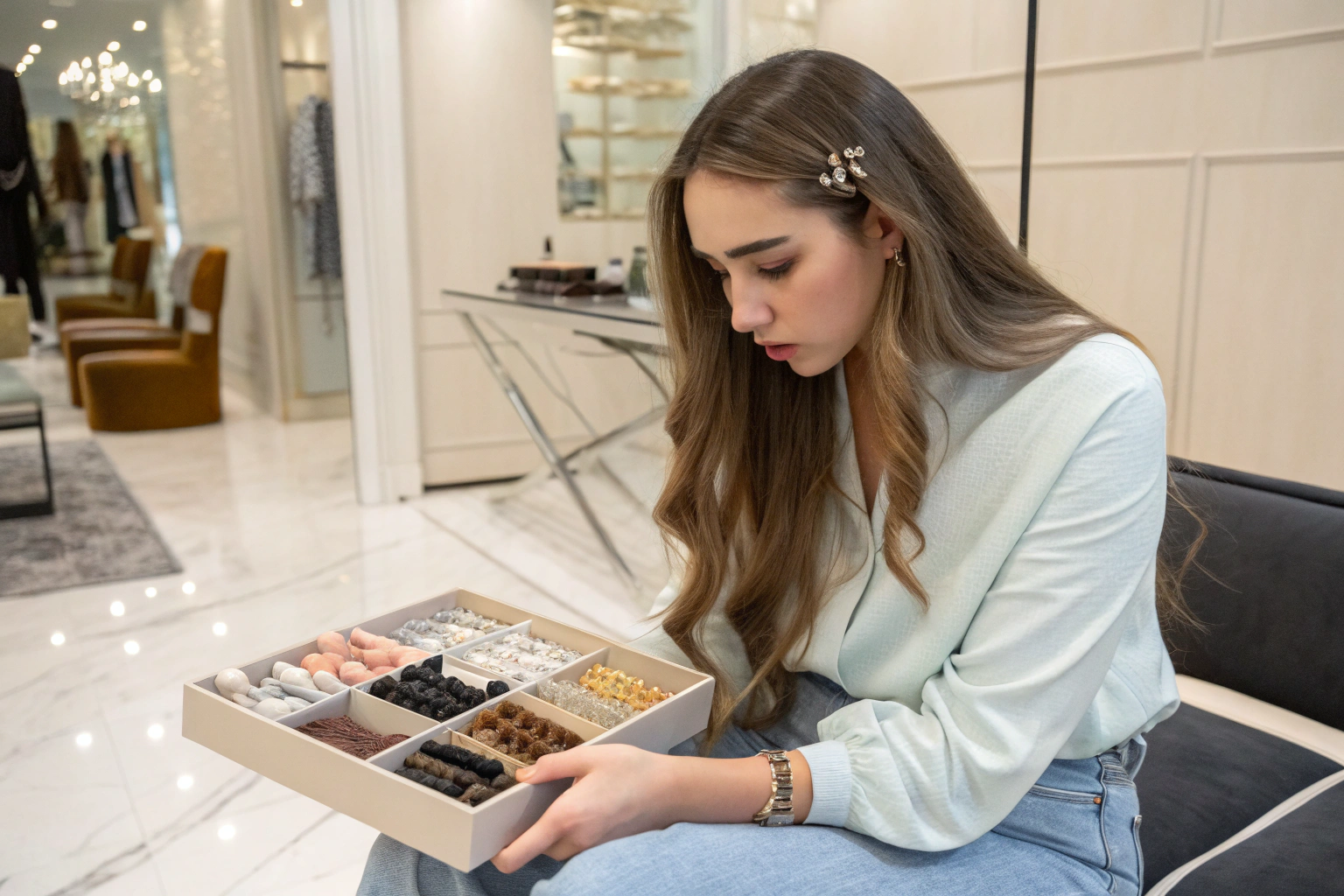
A beauty influencer with fine, silky, waist-length hair sat in my showroom last April, and she was practically despondent. She had accumulated a drawer full of beautiful hair claw clips, tortoiseshell, pearlized, matte pastel, but almost none of them worked for her hair type. The standard large claw clips, the ones that looked so stunning on social media, would slide out of her hair within minutes. The teeth were too widely spaced to grip her fine strands. The spring tension was too weak to hold the weight of the clip itself. The jaw opening was too narrow to capture enough hair to anchor the clip. She had been faking her claw clip photos, clipping them in for the shot and then immediately taking them out because they would not hold. She wanted to know if there was a claw clip shape that was actually engineered for fine hair, not just a standard design labeled "for all hair types." I showed her our range of fine-hair-specific jaw clips, and for the first time, she found clips that held.
The top five hair claw clip shapes for fine, thin hair in 2026 are the mini teardrop jaw clip, a small, compact clip with tightly spaced, interlocking teeth designed to grip fine strands without slipping, the slim rectangle snap clip, a low-profile, elongated clip with a gentle curve that distributes tension evenly across a larger section of hair, the octopus grip clip, a round, multi-pronged clip with flexible silicone-tipped teeth that create friction and hold on slippery, fine hair textures, the micro spring tension clip with a specifically calibrated, lighter spring that provides enough hold for fine hair without being so loose that it slips or so tight that it breaks delicate strands, and the contoured banana clip with an inward-curving shape that hugs the natural curve of the head and holds fine hair securely in an updo without requiring thick, heavy hair to anchor it. These shapes prioritize grip mechanics, weight reduction, and tension distribution over pure aesthetic size, making them functionally superior for fine hair while still being beautifully designed.
Fine hair is a specific, underserved category in the hair accessories market. Women with fine hair have been told for years to just use bobby pins, to accept that claw clips are not for them, or to buy children’s clips that look juvenile. The 2026 trend is a rejection of that exclusion. Fine-haired consumers are demanding claw clips that work for their hair type, and brands are responding with engineered solutions. At AceAccessory, we produce claw clips for brands across the spectrum, from drugstore mass market to high-end fashion. Our design team has analyzed the specific biomechanical requirements of fine hair and developed a range of shapes that genuinely work. Let me walk you through the five winning shapes and the engineering behind them.
Why Do Standard Claw Clips Fail on Fine Thin Hair
Understanding why standard claw clips fail on fine hair is the foundation for understanding why the 2026 shapes are different. Fine hair is not just smaller in diameter. It has fundamentally different physical properties than thick or coarse hair. The individual strands are lighter. The collective mass of a section of fine hair is significantly less than the same volume of thick hair. The surface texture is often smoother, with less cuticle roughness to create friction. The hair is more flexible and less rigid. These properties combine to create a perfect storm of grip failure for standard claw clips. The clip’s teeth cannot get enough purchase on the fine, smooth strands. The weight of the clip overcomes the friction holding it in place. The clip slides out.
Standard claw clips fail on fine, thin hair due to four interrelated design flaws. Excessive weight, where a large, heavy clip made from thick acetate or heavy resin requires a significant amount of hair mass to anchor it. The gravitational force pulling the clip downward exceeds the frictional force holding the clip in the hair. Fine hair simply does not have the collective bulk to counterbalance the clip’s weight. Insufficient tooth density, where standard clips have widely spaced, thick teeth that are designed to penetrate large sections of thick hair. Fine hair strands slip between the widely spaced teeth without being gripped. The teeth essentially comb through the hair rather than clamping it. Inadequate spring tension calibration, where standard clips use a one-size-fits-all spring that is often too strong. The high spring tension compresses fine hair, but the compression reduces the contact area between the teeth and the hair strands, and the strong spring can cause the clip to pop open when the hair shifts. Conversely, a spring that is too weak will not hold the clip closed. The spring tension must be precisely calibrated for the lower resistance of fine hair. Poor jaw geometry, where standard clips have a jaw opening that is either too narrow to capture enough hair to anchor the clip, or too wide, requiring the user to gather more hair than they have available. The jaw opening must be optimized for the typical amount of hair that a fine-haired person can gather in one section.
The failure of standard clips is not the user’s fault. It is an engineering problem. The clip was designed for a different hair type and was simply labeled as universal. The 2026 fine-hair-specific shapes address each of these four failure modes through deliberate, engineered design choices. Let me detail the two most critical failure mechanisms.
How Does Tooth Design Affect Grip on Fine Hair Strands?
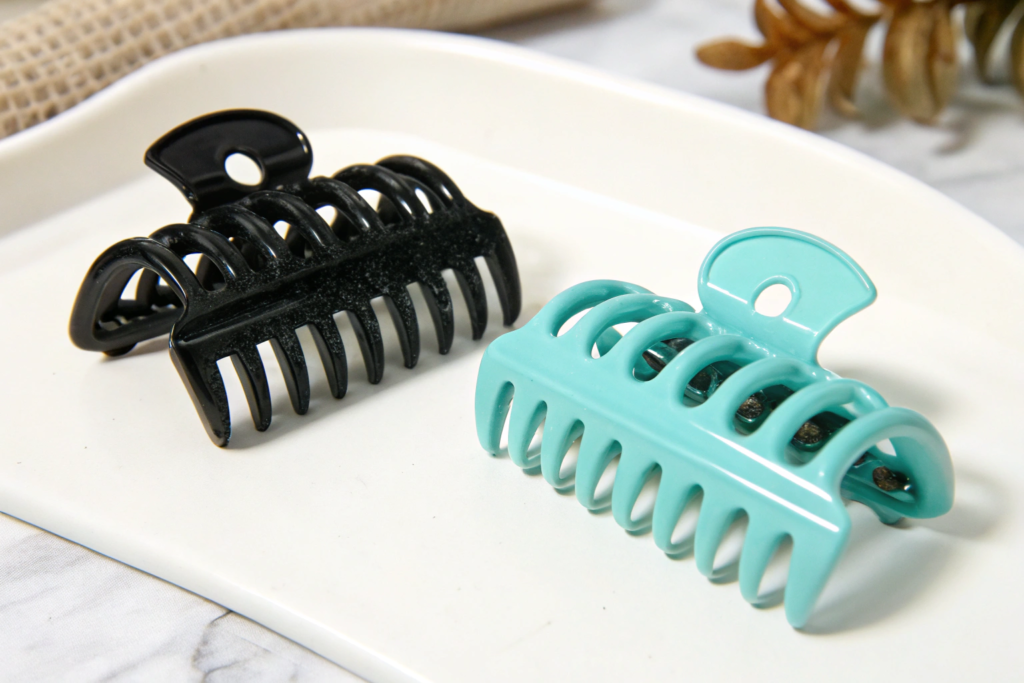
Tooth design is the single most important factor in claw clip performance for fine hair. The teeth are the interface between the clip and the hair. If the teeth cannot grip the hair, nothing else matters. The tooth design parameters that affect grip on fine hair are tooth density, tooth shape, tooth length, and tooth surface texture. Tooth density refers to the number of teeth and the spacing between them. Fine hair requires high tooth density, meaning more teeth, spaced closer together. The teeth should be close enough that a typical section of fine hair cannot easily slip between them. A standard clip might have 6 to 8 teeth with 5 to 6 millimeters of space between them. A fine-hair clip should have 10 to 14 teeth with 2 to 3 millimeters of space. The higher tooth count captures more individual hair strands and distributes the holding force more evenly. Tooth shape refers to the cross-section and the tip geometry. Fine hair responds best to teeth that are slightly curved or hooked at the tip. The curve creates a gentle capture zone that holds the hair strands without requiring them to be tightly compressed. The tips should be rounded and smooth to prevent snagging or breaking fine, delicate strands. Tooth length refers to how far the teeth penetrate into the hair section. Fine hair does not require long teeth that pass all the way through the hair and out the other side. Overly long teeth add weight and can create pressure points on the scalp. A tooth length of 12 to 15 millimeters is typically sufficient for fine hair, compared to 18 to 22 millimeters for thick hair clips. Tooth surface texture refers to the friction coefficient of the tooth surface. Smooth, polished plastic teeth have low friction and can slide through fine hair. Teeth with a matte texture, a micro-ribbed surface, or silicone tips have higher friction and grip fine hair more effectively. The silicone tip is a particularly effective innovation for fine hair. A small, soft silicone cap on each tooth tip creates a high-friction contact point that resists slipping without damaging the hair.
Why Does Clip Weight Matter More for Thin Hair?
Clip weight is the gravitational force that the hair must resist. For thick, heavy hair, the hair’s own mass and structural rigidity provide a strong anchoring force. The weight of the clip is a small fraction of the hair’s holding capacity. For fine, thin hair, the hair’s anchoring force is much lower. The weight of the clip becomes a significant percentage of the hair’s holding capacity, and it can easily exceed it. A standard large acetate claw clip might weigh 40 to 60 grams. A section of fine hair might be able to hold 30 to 50 grams before the clip begins to slip. The clip is at the very limit of the hair’s holding capacity. Any movement of the head, any shift in the hair, and the clip slides out. The solution is weight reduction. The fine-hair clips for 2026 are designed with weight as a primary design constraint. The body of the clip is slimmed down, with thinner walls and strategically placed cutouts that reduce material without compromising structural integrity. The material itself is chosen for low density. Bio-resins, polycarbonate, and lightweight acrylics are preferred over heavy acetate. The spring mechanism is miniaturized. The target weight for a fine-hair claw clip is 15 to 25 grams, roughly half the weight of a standard clip. This weight reduction brings the clip well within the holding capacity of fine hair, allowing it to stay in place securely through normal daily movement. The weight reduction also improves comfort. A heavy clip pulling on fine hair can cause scalp tenderness and headaches. A lightweight clip is barely noticeable. The consumer with fine hair who has always found claw clips uncomfortable is often experiencing the discomfort of weight, not the discomfort of the clip’s grip. A lightweight clip solves both the functional and the comfort problems.
How Does the Mini Teardrop Clip Secure Fine Hair
The mini teardrop jaw clip is the hero product of the 2026 fine-hair claw clip category. Its shape is not merely aesthetic. The teardrop geometry, the narrow top tapering to a rounded, slightly wider bottom, is an engineering solution to the specific challenges of fine hair. The shape mimics the natural curve of the head at the nape of the neck and the crown. It sits flush against the scalp, distributing its weight over a larger contact area and reducing the leverage that would cause it to pull away and slip. The mini size, typically 5 to 7 centimeters in total length, reduces weight and concentrates the gripping force on a smaller, denser section of hair.
The mini teardrop clip secures fine hair through a combination of its compact, weight-optimized shape, its high-density tooth configuration, and its ergonomic jaw curve. The teardrop shape is not just decorative. The narrow top allows the clip to be placed close to the scalp without creating a bulky protrusion. The wider bottom provides a stable base that anchors the clip against the curve of the head. The high-density teeth, typically 10 to 12 teeth in a clip that is only 6 centimeters long, are spaced 2 to 3 millimeters apart. This tight spacing prevents fine hair strands from slipping between the teeth. The teeth are often interlocking, meaning the upper teeth mesh between the lower teeth, creating a zigzag capture pattern that holds the hair securely. The jaw curve is engineered to match the natural convex curve of the head, so the entire length of the clip makes contact with the hair section, rather than just the two end points. This distributes the holding force and eliminates pressure points that can cause the clip to pivot and slip. The spring tension is calibrated specifically for fine hair, providing enough force to keep the teeth engaged without crushing the delicate strands.
The mini teardrop is the clip that the influencer with fine hair finally found success with. It is small enough to not overwhelm her hair, light enough to not slide out, and tooth-dense enough to actually grip. Let me detail the specific design features that make it work.
What Tooth Configuration Works Best in a Small Claw Clip?
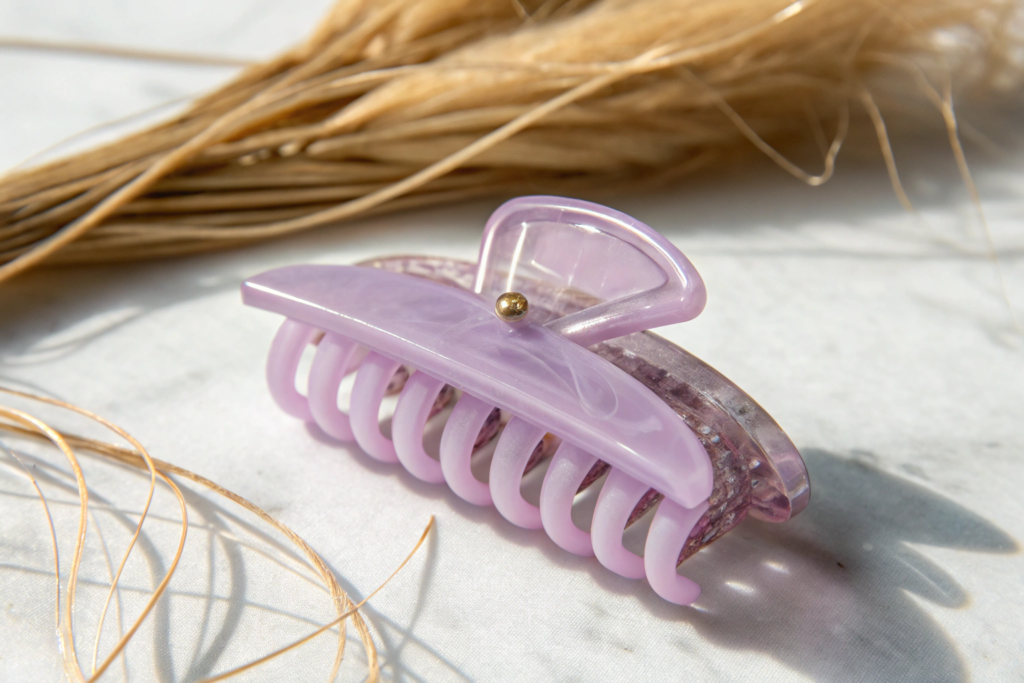
The tooth configuration in a mini teardrop clip is a carefully engineered system. The primary feature is the interlocking tooth pattern. In a standard clip, the upper teeth and the lower teeth meet tip to tip, or they sit in the same vertical plane. In an interlocking design, the upper teeth are offset from the lower teeth. When the clip closes, the upper teeth pass between the lower teeth, creating an alternating, zigzag pattern through the hair. This interlocking pattern has several advantages for fine hair. It increases the effective contact area between the teeth and the hair, because each tooth is in contact with hair on both of its sides. It creates a tortuous path for the hair strands, making it mechanically more difficult for the hair to slide out. It evenly distributes the holding force across the entire section of hair, rather than concentrating it at a few pinch points. The tooth tips are rounded and polished to a smooth finish, but the body of the tooth may have a subtle matte texture or micro-ridges to increase friction. The tooth length is proportionally shorter than in a large clip, typically 10 to 12 millimeters, because the mini clip captures a smaller section of hair. The shorter teeth reduce weight and reduce the risk of the teeth pressing into the scalp. The tooth base, where the tooth meets the body of the clip, is reinforced with a small fillet to prevent the tooth from snapping off under the repeated stress of opening and closing. The tooth configuration is tested extensively on fine-hair mannequins and on live models. The test protocol involves placing the clip in a half-up hairstyle, having the model move her head through a standard range of motion, and timing how long the clip stays in place without slipping. A well-designed mini teardrop clip will hold securely for hours, even through walking, light exercise, and head movement.
How Does the Teardrop Shape Distribute Tension Evenly?
The teardrop shape is an ergonomic innovation. The human head is curved, not flat. A clip that is straight, a standard rectangular jaw clip, only makes contact with the head at its two ends. The middle of the clip arches away from the scalp. This creates two pressure points, one at the top and one at the bottom, where all the holding force is concentrated. The clip acts like a lever, and any movement of the hair can cause it to pivot around these two points and slide out. The teardrop shape, with its curved inner profile, is designed to match the natural convex curve of the occipital region, the back of the head, and the parietal region, the sides of the head. When placed against the head, the entire length of the curved inner jaw makes contact with the scalp. The holding force is distributed evenly across the entire contact area. There are no isolated pressure points. The clip is stable against pivoting. The teardrop shape also has a directional quality. The narrow top of the teardrop points upward, toward the crown of the head. The wider bottom points downward, toward the nape. This orientation aligns the clip with the natural direction of hair growth and the natural contours of the head. The clip feels intuitive to place and stays in its intended orientation. The weight of the clip is centered low, in the wider bottom portion. This low center of gravity further stabilizes the clip and prevents it from tipping outward. The teardrop shape is a product of iterative design, refined through multiple prototype rounds with feedback from fine-haired testers. The exact curvature, the ratio of top width to bottom width, and the thickness of the profile are all optimized for fine-hair stability.
What Makes the Octopus Grip Clip Unique for Fine Hair
The octopus grip clip, also known as a spider clip or a multi-prong grip clip, is a radical departure from the traditional hinged jaw clip. It does not have a top jaw and a bottom jaw that open and close like a mouth. It is a single, round or oval body with multiple flexible prongs radiating outward. The prongs are pressed into the hair, and they flex to accommodate the hair volume. The hair is held by the friction and the spring-back force of the individual prongs. This design is inherently well-suited to fine hair because it does not rely on clamping force, which fine hair cannot resist effectively. It relies on entanglement and distributed friction.
The octopus grip clip is uniquely suited for fine hair because its flexible, multi-prong design creates a distributed grip network that holds fine hair through friction and mechanical entanglement rather than compressive clamping. Each of the 8 to 16 prongs acts as an independent gripping element. The prongs are made from a flexible, springy plastic, typically a modified polycarbonate or a flexible nylon, that bends when pushed into the hair and then springs back, pressing the prongs against the hair strands. The silicone tips on each prong provide a high-friction contact point that resists slipping. The prongs are arranged in a circular or oval pattern, and they interweave with the hair strands in multiple directions. This multi-directional grip is more secure than the single-plane grip of a traditional jaw clip. The clip does not have a single hinge or a single spring. The holding force is distributed across all the prongs. If one prong loses its grip, the others remain engaged. The clip is also extremely lightweight, typically 10 to 15 grams, because it has no metal spring and minimal body structure. The low weight makes it ideal for fine hair, which cannot support heavy clips.
The octopus grip clip is particularly effective for fine hair that is also slippery, such as hair that is very straight or that has been treated with smoothing products or silicones. The silicone tips grip the slippery surface where smooth plastic teeth would slide. Let me explain the two key features.

How Do Silicone Tips Improve Hold on Slippery Fine Hair?
Silicone is a remarkable material for hair grip. It has a naturally high coefficient of friction against keratin, the protein that makes up human hair. When a silicone surface presses against a hair strand, it resists sliding much more effectively than a smooth plastic surface. The silicone tips on an octopus grip clip are small, typically 1 to 2 millimeters in diameter, and are molded onto the ends of each plastic prong. When the prong is pressed into the hair, the silicone tip deforms slightly, creating a conformal contact with the hair strands. The soft silicone wraps around the individual strands at a microscopic level, increasing the contact area and the friction. The silicone is also chemically inert and does not react with hair products. It will not be degraded by leave-in conditioners, serums, or heat protectants. The silicone tips are securely bonded to the plastic prongs through a co-molding process. They will not peel off or detach with normal use. The durability of the silicone tips is tested through repeated insertion and removal cycles. The tips must maintain their friction coefficient after hundreds of cycles. The silicone formulation is chosen for its balance of softness, for grip, and tear strength, for durability. The silicone tips are particularly beneficial for fine hair that has been chemically treated, colored, permed, or relaxed, because treated hair has a more open cuticle structure that is rougher at a microscopic level. The soft silicone conforms to this rough surface, creating an even stronger grip. The silicone tips also provide a gentle, non-damaging hold. They do not crease or dent the hair the way that tight metal clips or hard plastic teeth can. This is an important consideration for fine hair, which is more prone to breakage than thick hair.
Can Flexible Prongs Adapt to Different Fine Hair Densities?
Fine hair is not a monolithic category. There is a spectrum of density, from very sparse, low-density fine hair to moderately dense fine hair. The octopus grip clip accommodates this spectrum through the flexibility of its prongs. The prongs are designed to bend under a specific amount of force. When the clip is pressed into a small amount of hair, only a few of the prongs engage, and they bend slightly. The spring-back force is gentle, appropriate for a small hair section. When the clip is pressed into a larger amount of hair, more prongs engage, and they bend more. The spring-back force is greater, appropriate for a larger hair section. The clip self-adjusts to the volume of hair. The prong flexibility is calibrated through the choice of plastic material and the prong geometry. A prong that is too stiff will not engage with a small amount of fine hair. It will simply push the hair aside. A prong that is too flexible will not provide enough grip for a larger amount of hair. It will feel loose and insecure. The optimal prong material is a flexible engineering plastic, such as a modified polycarbonate or a thermoplastic polyurethane, with a flexural modulus that provides the right balance of stiffness and give. The prong thickness tapers from the base to the tip, providing a progressive flex that is stiffer at the base and more flexible at the tip. The octopus grip clip is forgiving of imprecise placement. A traditional jaw clip must be positioned precisely, and the correct amount of hair must be gathered. The octopus clip can be pushed into a twist, a bun, or a loose ponytail without requiring precise sectioning. This ease of use is a significant consumer benefit.
Why Are Banana Clips Making a Comeback for Fine Hair
The banana clip is the most dramatic comeback story in the 2026 hair accessories market. This iconic 1980s and 1990s shape, long and curved with interlocking teeth along its entire length, was largely abandoned in the 2000s and 2010s as smaller, more minimalist clips took over. Its return is driven by two factors. The Y2K and 90s nostalgia trend, which has revived interest in the banana clip silhouette among younger consumers who are discovering it for the first time. And, more importantly for this discussion, the realization that the banana clip is exceptionally well-suited to fine hair. The long, curved shape distributes the weight of the hair along the entire length of the clip, rather than concentrating it at a single point. This makes it one of the most secure and comfortable ways for fine-haired individuals to create an updo or a ponytail effect.
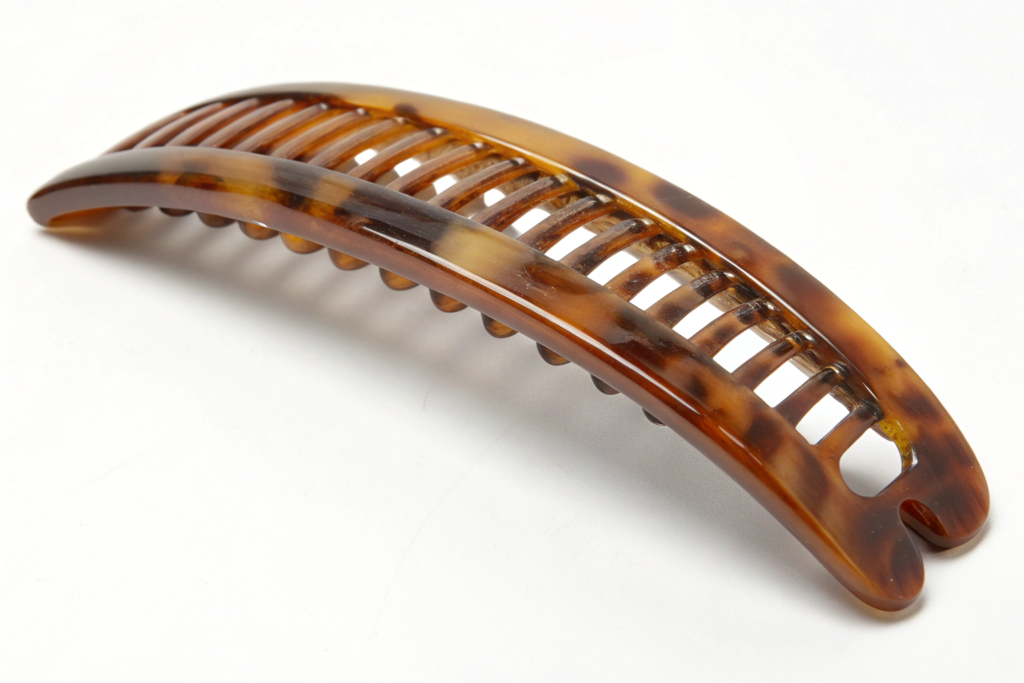
Banana clips are making a comeback for fine hair because their elongated, contoured shape provides unmatched weight distribution and volume creation for hair types that struggle with traditional jaw clips and hair ties. The clip spans the entire width of the gathered hair, from one side to the other, typically 10 to 15 centimeters in length. The two rows of interlocking teeth run the full length of the clip, gripping the hair continuously from end to end. This distributed grip is fundamentally more secure than the single-point grip of a standard claw clip. The inward curve of the banana clip follows the natural curve of the back of the head, allowing the clip to sit flush and comfortably. The clip gathers the hair into a vertical fan shape, creating the illusion of more volume and fullness, which is a highly desirable effect for fine, flat hair. For fine-haired consumers, the banana clip offers the ability to create a secure, comfortable ponytail without the tension and breakage that can be caused by elastic hair ties, which are a known source of damage for fragile fine hair.
The 2026 banana clip is an evolution of the original. It is slimmer, lighter, and made from modern materials. The teeth are finer and more closely spaced, optimized for fine hair rather than the thicker hair that the original 1980s clips were designed for. Let me detail the two key performance features.
How Does the Curved Shape Create Volume for Thin Hair?
The volume creation effect of the banana clip is a matter of geometry. A traditional ponytail, secured with an elastic, gathers the hair at a single point on the back of the head. The hair falls from that point in a straight line. The silhouette is sleek and close to the head. For fine hair, this can look flat and thin. A banana clip gathers the hair along a vertical line, the length of the clip. The hair is fanned out across the clip, from the crown of the head down to the nape. The clip holds the hair away from the scalp along this entire vertical line. The result is a lifted, voluminous shape that creates the illusion of thicker, fuller hair. The volume is structural, not dependent on teasing or backcombing, which can damage fine hair. The clip itself acts as a support structure that holds the hair in a voluminous position. The curve of the clip is engineered to maximize this effect. The inward curve pushes the hair outward from the head. The top of the clip is positioned closer to the crown, lifting the hair at the root. The bottom of the clip is positioned at the nape, anchoring the style. The overall effect is a cascade of hair that looks much more abundant than it actually is. The banana clip is particularly effective for creating the illusion of a thick, bouncy ponytail on fine hair. The hair is gathered and displayed in a fan, and the clip is hidden behind the hair, so the style looks like a naturally voluminous ponytail, not a clip-assisted one. This is a powerful consumer benefit that is driving the resurgence of the banana clip on social media platforms.
What Modern Updates Improve the Classic Banana Clip Design?
The classic banana clip of the 1980s and 1990s had several design flaws that made it less than ideal for fine hair. The 2026 version addresses these flaws with modern materials and engineering. The original banana clips were often made from thick, heavy plastic or even metal. They were heavy, and the weight pulled on fine hair, causing slippage and discomfort. The 2026 banana clip is made from lightweight bio-resin, polycarbonate, or a thin, flexible nylon. The weight is reduced by 40 to 60 percent compared to vintage versions. The original teeth were often widely spaced and blunt, designed for thick, voluminous hair. The 2026 teeth are finer, more numerous, and more closely spaced. The tooth tips are rounded and polished. Some versions include silicone-tipped teeth for extra grip on fine, slippery hair. The original hinge and spring mechanism was often exposed and could snag hair. The 2026 hinge is enclosed and snag-free. The spring tension is calibrated for the lighter load of fine hair. The original clip had a single, continuous curve. The 2026 version often has a compound curve, with a slightly tighter curve at the top for crown lift and a gentler curve at the bottom for nape comfort. Some versions have a segmented or articulated body that flexes slightly to conform to the individual wearer’s head shape. The original clip was purely functional, with minimal aesthetic appeal. The 2026 banana clip is a fashion accessory in its own right, available in a wide range of colors, finishes, and patterns. The modern banana clip is a fusion of retro silhouette and contemporary engineering, and it is one of the most effective tools available for fine-haired consumers.
Conclusion
The top five hair claw clip shapes for fine, thin hair in 2026, the mini teardrop, the slim rectangle, the octopus grip, the micro spring tension clip, and the contoured banana clip, represent a new era of inclusive design in the hair accessories market. For too long, fine-haired consumers were an afterthought, offered scaled-down versions of clips designed for thick hair that did not actually work. The 2026 shapes are engineered from the ground up for the specific biomechanical requirements of fine hair. They prioritize the factors that matter for fine hair grip. Low weight, so the clip does not overcome the hair’s holding force. High tooth density, so the fine strands cannot slip between the teeth. Calibrated spring tension, so the clip holds securely without crushing or slipping. Silicone friction elements, so even the silkiest, most slippery hair is gripped. Distributed tension through curved, contoured shapes that follow the head. And volume creation, turning the fine hair’s lack of bulk from a liability into an aesthetic opportunity.
At AceAccessory, we design, mold, and produce all five of these fine-hair claw clip shapes for brands across the market spectrum. Our in-house mold-making capability allows us to create custom tooth configurations, custom spring tensions, and custom shapes that are optimized for specific hair types and specific brand aesthetics. Our material science expertise allows us to select the right resin, the right silicone, and the right metal alloy for the spring to achieve the precise performance characteristics that fine hair requires. And our quality control process includes specific fine-hair grip testing, using standardized fine-hair mannequins and a defined motion protocol, to ensure that every clip we produce actually works.
If you are developing a hair claw clip collection and you want to include shapes that genuinely work for fine, thin hair, I invite you to contact us. Reach out to our Business Director, Elaine, at elaine@fumaoclothing.com. Tell her about your brand, your target customer, and the hair types you want to serve. She can provide samples of our fine-hair clip shapes, discuss custom tooth configurations and spring calibrations, and provide a quotation for a production run. Let us help you create claw clips that finally make fine-haired customers feel seen, valued, and beautifully styled.