You have a great design for custom fleece gloves, but the factory’s Minimum Order Quantity (MOQ) feels like a daunting barrier. This is a common pain point for brands and importers, especially when launching a new product line or testing the market. High MOQs can lock up capital in inventory and increase your business risk before you even know if the product will sell.
The MOQ for custom fleece gloves from Chinese factories typically ranges from 500 to 5,000 pairs per style/color, but the key to negotiating a lower MOQ lies in understanding the factory’s cost structure and offering strategic compromises on design complexity, materials, or payment terms. It’s a balancing act between feasibility for the factory and viability for your business.
This article will demystify MOQs and give you a clear action plan. We will break down what factors drive MOQ up or down, provide you with concrete strategies for negotiation, explore the trade-offs you can make, and show you how to structure your order for long-term partnership success. To ensure your final product is worth the order quantity, partnering with a factory that has strong design services can help you create a glove that truly stands out in the market.
What Factors Determine the MOQ for Custom Fleece Gloves?
The MOQ is not a random number; it’s a financial calculation for the factory. Understanding the components of this calculation is your first step toward finding common ground. MOQ ensures the factory covers its fixed setup costs and achieves a minimum profit margin on the production run.
The primary factors are material sourcing costs, production line setup and efficiency, and the complexity of your custom design. Each element adds a layer of cost that must be distributed across a certain number of units to make the order worthwhile for the manufacturer.
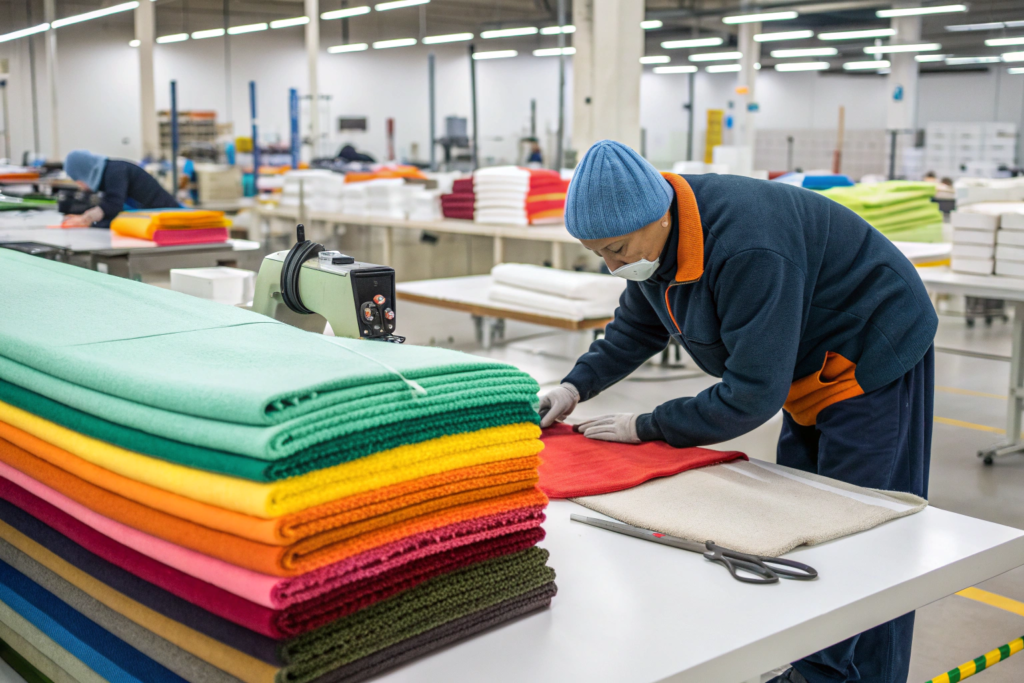
Let's dissect these factors. Material Sourcing: High-quality, specialized, or custom-dyed fleece fabric often comes with its own MOQ from the mill. If you want a unique color, the factory may need to purchase an entire bolt of fabric, directly impacting your glove MOQ. Production Setup: This includes creating or modifying patterns, programming cutting machines, and setting up the assembly line for your specific glove design (e.g., touchscreen-compatible fingertips, special embroidery). These are fixed costs. Running a small batch means these costs represent a larger percentage of the unit price. Complexity: A simple, unlined fleece glove has a lower MOQ than a glove with silicone grips, conductive thread, branded embroidery, or complex color blocking. At Shanghai Fumao, we explain this breakdown transparently to our clients, helping them make informed decisions that align their vision with a practical MOQ.
How Do Material Choices Directly Impact MOQ?
Your fleece selection is the single biggest MOQ driver. Options include:
- Stock Fleece: Using the factory's existing, common fleece colors and weights. This has the lowest MOQ (potentially 500 pairs) as there is no extra fabric purchase.
- Custom-Color Fleece: Dyeing fleece to your specific Pantone color. This often requires a fabric MOQ of 500-1000 kg from the mill, pushing your glove MOQ to 2,000+ pairs.
- Specialty Blends: Fabrics like Polartec® or anti-pill fleece are premium and ordered in larger quantities. MOQs here start higher.
- Accent Materials: Adding leather palms, terry cloth thumbs, or other materials introduces additional sourcing and cutting setups, increasing the MOQ.
A practical strategy is to first choose from the factory's stock fabric library for your initial order to minimize MOQ and lead time.
Why Does Production Setup Cost Justify a Minimum Order?
The factory’s production line is optimized for efficiency. Setting up for a custom order involves:
- Pattern Making & Grading: Creating the size templates for your design.
- Cutting Dies/Machine Programming: Preparing to cut the fabric layers efficiently.
- Line Configuration: Arranging sewing stations for the specific construction of your glove.
- Quality Control Setup: Establishing checkpoints for your product's unique features.
These are Non-Recurring Engineering (NRE) costs. An order of 100 pairs cannot absorb this cost, but an order of 1,000 pairs can spread it thinly. This is why factories have MOQs—to ensure the per-unit price after setup is competitive and profitable. The American Apparel & Footwear Association (AAFA) provides resources that often discuss global sourcing economics, including setup and scaling.
How Can You Negotiate a Lower MOQ with Your Supplier?
"Take it or leave it" is not the only option. MOQ is often a starting point for negotiation, not a final decree. Your goal is to present yourself as a valuable, low-risk partner and structure a deal that works for both sides.
You can negotiate a lower MOQ by increasing the unit price, combining orders across product categories, committing to a long-term partnership with forecasted orders, or being flexible on production scheduling (allowing the factory to fit your order into a slack period).
Successful negotiation is based on empathy and value exchange. Understand the factory’s constraints and offer solutions. For instance, propose a slightly higher price per pair for a smaller initial order to cover their setup costs. Alternatively, if you also need beanies or scarves, ask if the total MOQ can be combined across these items. Presenting a realistic 12-month forecast showing growing order volumes can incentivize them to accept a lower starting MOQ. We often work with startups by offering a phased approach: a small pilot run (with a price premium) followed by larger seasonal orders at standard pricing, building a relationship step by step.

What Negotiation Tactics Are Most Effective for Startups?
As a new brand, your leverage is future potential, not past volume. Effective tactics include:
- The Pilot Order Proposal: Frame the low-MOQ order as a "pilot" or "market test." Be explicit: "This initial run is to validate demand. Our forecast for Fall 2024 is 5,000 pairs if this sells well."
- Flexibility on Timeline: Offer a longer production window. "We don't need these for 90 days instead of 60. Can this help?"
- Minimize Custom Elements: Start with the simplest version of your glove (no embroidery, standard colors) for the first order to reduce setup.
- Offer Prompt Payment: Propose paying a higher deposit (50%) or using faster payment terms to improve the factory's cash flow on the small order.
Always be professional, transparent, and respectful of their time. Building a relationship is key.
When Is Agreeing to a Higher Price Per Unit a Smart Move?
Paying a premium for a lower MOQ is a smart strategic move when:
- Market Testing: You need to validate product-market fit before investing heavily.
- Cash Flow Management: It allows you to launch without tying up excessive capital.
- Building a Track Record: It lets you establish a sales history, which is valuable for securing retail partners or investors.
- Seasonal or Niche Products: For a very specific event or niche market where total volume will always be limited.
Calculate your landed cost (product cost + shipping + duties) and ensure your retail price still yields a healthy margin. The cost of carrying dead inventory is often higher than paying a small production premium.
What Are the Common Trade-Offs for a Lower MOQ?
Getting a lower MOQ usually involves making concessions. The art is in choosing the trade-offs that least impact your brand's core value proposition while giving the factory the efficiency it needs. It's about finding the right balance.
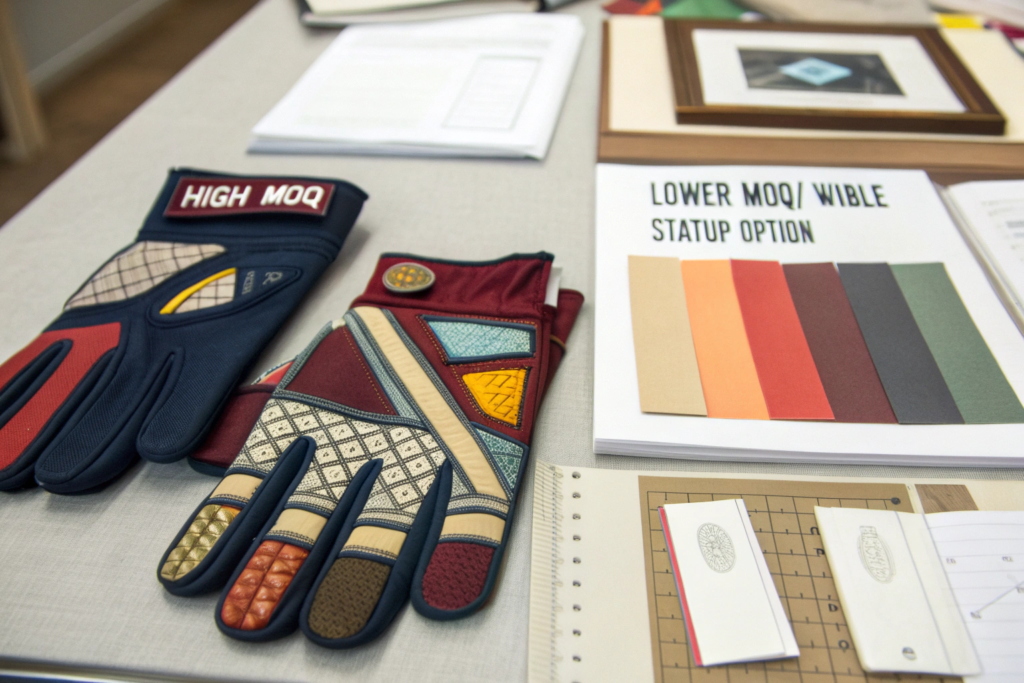
Common trade-offs include reducing the number of custom colors, simplifying design details (like omitting embroidery or special features), using stock components (like standard fleece instead of custom), or agreeing to a longer production lead time that allows the factory to schedule your order more flexibly.
Think of it as a menu of options. You can mix and match to hit your target MOQ. For example:
- Trade-Off 1: Color. Instead of 4 custom colors at 500 pairs each (2,000 total MOQ), choose 2 stock colors at 300 pairs each (600 total).
- Trade-Off 2: Decoration. Skip the embroidered logo for the first run and use a printed tag or hangtag instead.
- Trade-Off 3: Packaging. Use a standard polybag instead of a custom-printed box.
- Trade-Off 4: Flexibility. Allow the factory to produce your order in the last two weeks of the month when their schedule is lighter.
A transparent factory will guide you through these choices. At Shanghai Fumao, we present clients with clear "good-better-best" scenarios, showing how each decision affects both MOQ and unit cost, empowering them to make the best choice for their business stage.
How Does Simplifying Design Reduce MOQ?
Complexity is the enemy of low MOQ. Each design element requires additional setup. Simplifying can mean:
- Uniform Size Ratios: Accepting the factory's standard size run (e.g., S/M, L/XL) instead of a custom size breakdown.
- Minimal Sewing Operations: Opting for a basic glove construction without convertible flaps, additional panels, or complex seams.
- Standardized Features: Using a stock cuff style or a pre-sourced touchscreen conductive patch instead of a custom one.
By stripping the design back to its essential, most marketable features, you significantly reduce the factory's setup effort, making a smaller order more palatable for them.
Can You Use Stock Components to Meet Lower MOQ Targets?
Absolutely. This is one of the most effective strategies. Inquire about the factory's stock components:
- Fleece: Choose from their in-stock fabric colors.
- Thread: Use their standard thread colors.
- Labels & Tags: Select from their existing tag designs or blank tags you can stamp later.
- Elastic, Drawcords, etc.: Use their standard options.
Using stock components eliminates the MOQ and lead time associated with sourcing custom materials. You can then add your brand identity through a simple custom-printed sticker on the polybag or a unique hangtag, which has a much lower MOQ itself.
How to Structure Your First Order for Future Success?
Your first order is the foundation of your supplier relationship. Structuring it strategically can lock in favorable terms for the future and turn a low-MOQ start into a high-volume partnership. Think beyond the immediate transaction.
Structure your first order as a partnership launch: be clear about your growth plans, agree on a pricing roadmap for future volumes, and ensure the quality and processes established are scalable. This builds trust and gives the factory confidence to invest in the relationship from the start.
A forward-thinking approach involves documentation and clear agreements. During negotiations, discuss and get in writing a pricing tier schedule. For example: "MOQ 500 pairs: $X.XX/pair. MOQ 2,000 pairs: $X.XX/pair. MOQ 5,000 pairs: $X.XX/pair." This protects you from price hikes on reorders and gives the factory a clear volume incentive. Also, treat the first order as a full production test. Meticulously inspect the quality, provide detailed feedback, and work with the factory to perfect the process. This ensures that when you scale, the product remains consistent. A reliable partner will appreciate this diligence.

What Should Be Included in a Long-Term Partnership Agreement?
While a formal legal contract may come later, a mutual understanding or Letter of Intent (LOI) should cover:
- Pricing Tiers: Agreed-upon FOB prices at specific volume milestones.
- Quality Standards: Reference to approved samples and specific AQL inspection levels.
- Communication Protocol: Key contacts, preferred methods, and regular review meetings.
- Forecast Commitment: A non-binding but good-faith forecast of your expected order volume over the next 12-18 months.
- Right of First Refusal: An understanding that they will be your primary supplier for this product category as you grow.
This framework transforms a one-time buyer into a strategic account, giving you more leverage and stability.
How Does a Successful First Order Lead to Better MOQ Terms Later?
A successful first order demonstrates you are a serious, reliable, and professional partner. When you:
- Provide clear, timely feedback.
- Pay invoices promptly.
- Communicate issues constructively.
- Place a reorder on schedule.
You build immense trust. For the factory, a reliable client with predictable reorders is far more valuable than a large, one-time client. This trust is the currency you use to negotiate. For your second season, you can realistically ask, "Based on our successful partnership, can we lower the MOQ for our new glove style?" or "Can we get the 2,000-piece price for an order of 1,500?" A strong track record makes them much more likely to say yes.Conclusion
Navigating MOQ requirements for custom fleece gloves is a critical skill in global sourcing. By understanding the cost drivers behind MOQ, employing smart negotiation tactics, being willing to make strategic trade-offs, and structuring your initial order as the start of a partnership, you can find a path that works for your business. The goal is not just to secure the lowest possible number, but to establish a sustainable and scalable supplier relationship.
Remember, a flexible and collaborative approach often yields better long-term results than a rigid fixation on a single number. The right factory partner will work with you to grow.
If you are looking for a reliable accessory manufacturer that offers transparent MOQ discussions and values building partnerships from the ground up, contact us. Reach out to our Business Director, Elaine, at elaine@fumaoclothing.com to discuss your custom fleece glove project and how Shanghai Fumao can support your brand's growth with practical, collaborative solutions.