I remember a conversation with a product developer for an outdoor gear company. He was launching a new line of backpacks, designed for city commuters who might get caught in the rain. He had chosen a high-quality, water-resistant nylon for the bags. But when the first samples arrived, he had a simple test: he put a paper towel inside each bag and held it under a gently running faucet for a minute. To his dismay, the paper towels were damp. The fabric, which was supposed to be water-resistant, had failed his simple test. His story highlights a critical point: "water-resistant" is not a simple yes/no property. It’s a matter of degree, and it must be rigorously tested to ensure it meets real-world expectations.
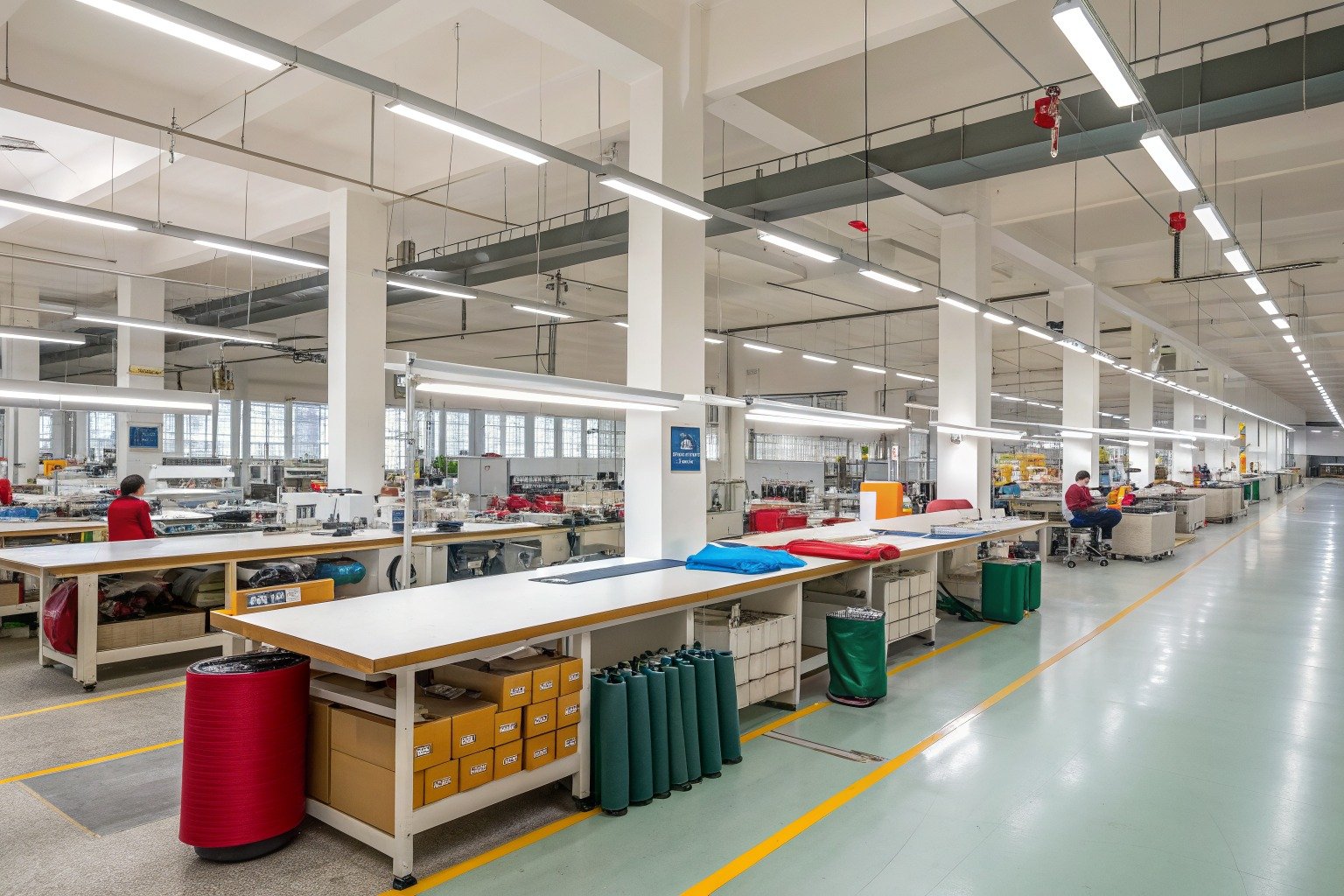
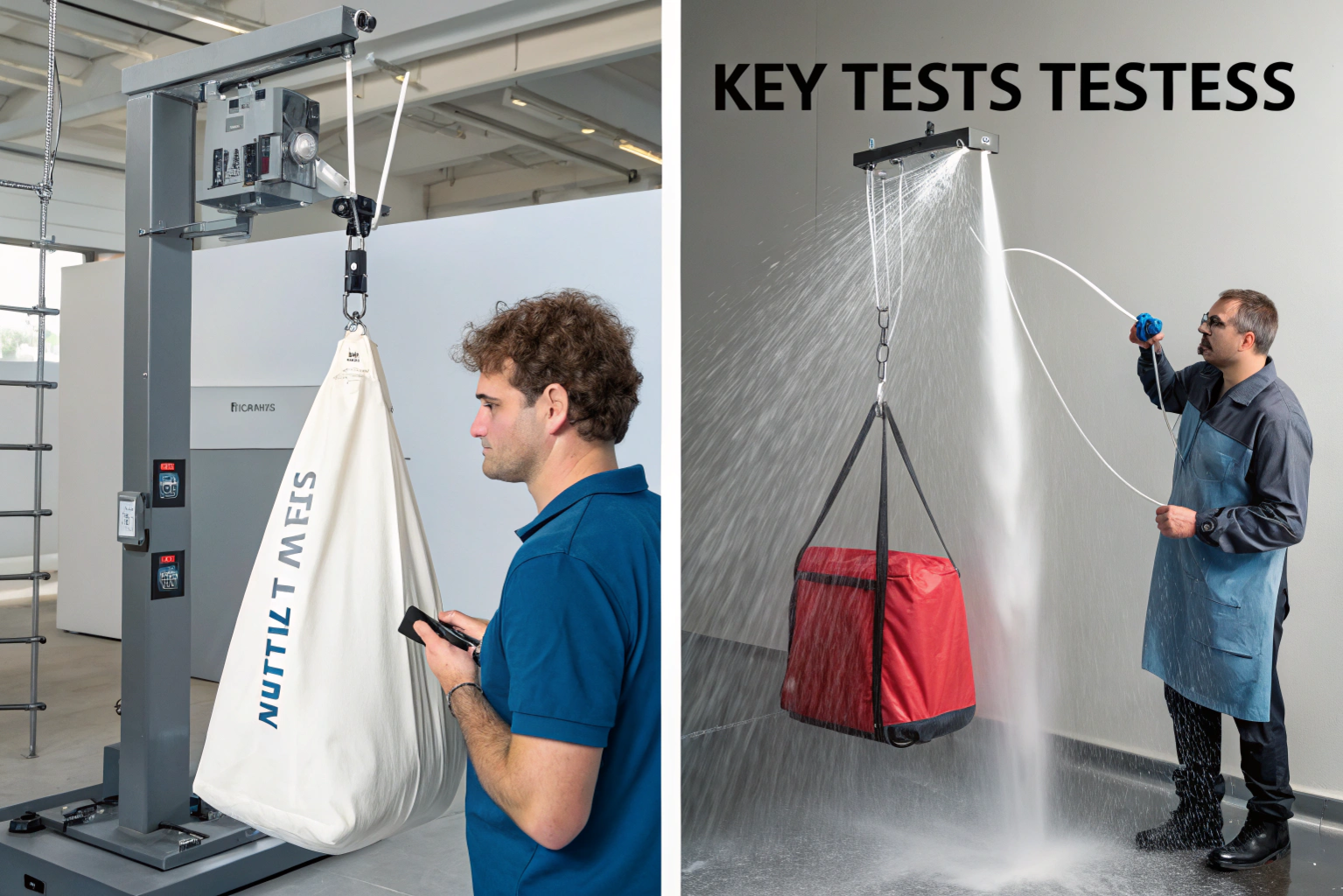
The key tests for water resistance in nylon and polyester bags are designed to measure a fabric’s ability to resist water penetration under different conditions. The most important tests include: the spray test, which measures resistance to wetting by simulating light rain; the hydrostatic head test, which measures the pressure of water a fabric can withstand before leaking; the water immersion test, which checks for leakage when a bag is partially submerged; and the simulated rain test, which replicates a more realistic, sustained downpour. At Shanghai Fumao Clothing, we perform these tests in our in-house lab to ensure every bag we produce meets our clients’ specifications for water resistance.
That product developer’s simple faucet test, while not scientific, revealed a real problem. The fabric he had chosen might have been "water-resistant" under a light mist, but it failed under the direct pressure of a faucet. Understanding the different types of water resistance tests is essential for choosing the right fabric for the right application. A bag for a light drizzle has different requirements than a bag for a torrential downpour. Let me walk you through the four key tests used in the industry.
What Is the Spray Test and What Does It Measure?
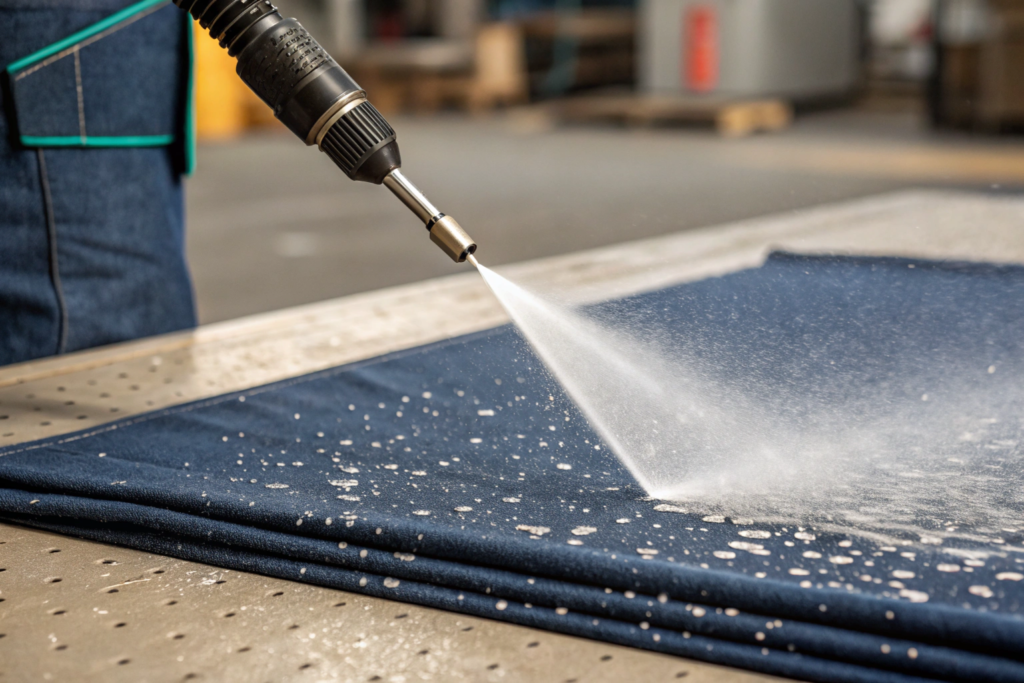
The most common and fundamental test for water resistance is the spray test. It is designed to simulate the effect of light rain or a sudden shower. It measures a fabric’s resistance to surface wetting—how easily water soaks into the material—rather than its ability to withstand water pressure. It is a simple, quick test that provides a baseline measure of a fabric’s water-repellent finish.
The spray test is typically conducted according to standardized methods like AATCC Test Method 22 or ISO 4920. A fabric sample is stretched taut and mounted at a 45-degree angle. A specific amount of water (usually 250 ml) is sprayed onto the fabric from a standardized nozzle at a controlled distance and duration. The fabric’s surface is then visually compared to a set of standard photographs and rated on a scale, typically from 0 to 100 or 0 to 5. A rating of 100 (or 5) means no water adheres to the surface, with perfect beading. A low rating means the fabric is completely wet. This test is excellent for checking the effectiveness of a durable water repellent (DWR) finish.
The spray test is a valuable quality control tool. It can quickly reveal if a fabric’s water-repellent finish has been properly applied or if it has worn off after washing. It is also used to compare different finishes. However, it’s important to understand its limitations. The spray test does not measure a fabric’s ability to withstand water under pressure (like sitting on a wet bench) or its resistance to water penetration over time. It is purely a measure of surface wetting. A fabric that scores perfectly on the spray test could still leak if water pools on it or if it is subjected to pressure. This is why other tests are also necessary. This is a core principle of textile testing and quality assurance. At Shanghai Fumao Clothing, we use the spray test to verify the quality of the DWR finish on all our water-resistant bag fabrics.
What is a "good" spray test rating?
For a bag intended to be water-resistant, you would typically want a rating of 90 or above (on the 0-100 scale), or 4-5 (on the 0-5 scale). This indicates that water beads up and rolls off the surface effectively, with little to no wetting. Imagine a gentle rain shower or a sudden downpour—droplets dance across the fabric, forming perfect, glistening spheres that slide away like liquid pearls, leaving the bag’s surface dry and unmarred.
The material repels moisture with a satisfying slickness, ensuring that even after being caught in a drizzle or brushed against a damp surface, the contents inside remain safe and the exterior retains its crisp, fresh appearance.
How does the spray test relate to the DWR finish?
The spray test stands as the primary method for assessing the effectiveness of a durable water repellent (DWR) finish. Picture this: a fresh, high-quality DWR-treated fabric, when subjected to the test, will make water droplets dance and bead up like tiny, glistening pearls upon its surface. These droplets, round and taut, roll off effortlessly, leaving no trace of moisture behind—a visual testament to the fabric’s ability to repel water with grace.
This results in a high spray test rating, a clear indicator of the DWR’s robust performance. However, as the DWR finish gradually wears off through repeated use, exposure to harsh elements, or washing, its protective magic fades.
What Is the Hydrostatic Head Test and Why Is It Critical?
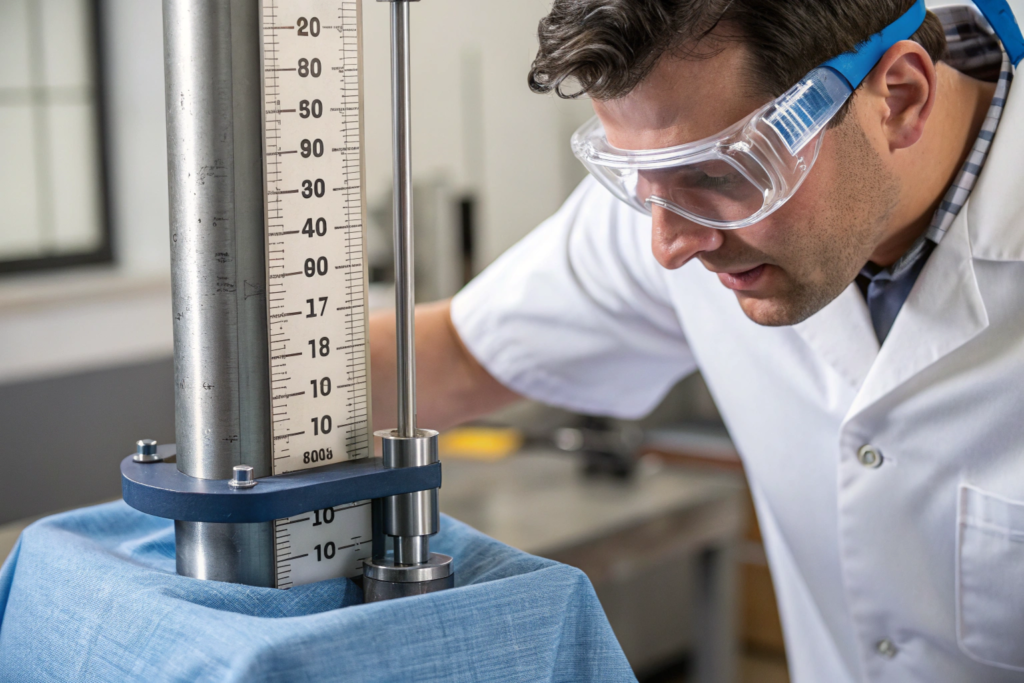
While the spray test measures surface wetting, the hydrostatic head test measures a fabric’s resistance to water penetration under pressure. This is a much more rigorous test, and it is critical for any bag that might be subjected to rain, snow, or being set down on a wet surface. It answers the question: "How much water pressure can this fabric withstand before it leaks?"
The hydrostatic head test is conducted according to standards like ISO 811 or AATCC 127. A fabric sample is clamped securely under a column of water. The water pressure is gradually increased, either by raising the water level or by applying air pressure. The test measures the height of the water column (in millimeters or centimeters) at the moment when the first three drops of water penetrate the fabric. This measurement is the fabric’s hydrostatic head rating. A higher rating means the fabric can withstand more water pressure. For example, a fabric with a 1,000mm rating can withstand the pressure of a 1-meter column of water. This test is essential for fabrics that will be used in waterproof or highly water-resistant bags.
The hydrostatic head rating is a crucial specification for any bag that needs to be genuinely waterproof. For a simple rain cover, a rating of 1,500mm might be sufficient. For a bag that will be used in heavy, persistent rain, a rating of 5,000mm or higher is often required. For a bag that might be fully submerged, even higher ratings are needed. The test also reveals weaknesses in seams or zippers, which are often the first points of failure. This is why it’s important to test not just the fabric, but the finished bag as well. This is a key principle of waterproof fabric testing and standards. At Shanghai Fumao Clothing, we use the hydrostatic head test to verify that the fabrics we use, as well as the finished seams and constructions, meet the required water resistance levels for our clients’ products.
What is a good hydrostatic head rating for a city backpack?
For a city backpack that will be used in rain, a rating of 1,500mm to 3,000mm is generally considered good. This provides reliable protection against rain without being overly heavy or expensive. For more serious outdoor use, higher ratings are needed.
How does seam construction affect the hydrostatic head rating?
Seams are often the silent vulnerabilities, the hidden weak points where even the sturdiest fabric can falter. A fabric boasting a high waterproof rating, its threads woven with the promise of impenetrable defense against rain and moisture, can be rendered utterly useless if those seams—those delicate intersections of thread—leak. Water, relentless and insidious, finds its way through the tiniest gaps, seeping in like a quiet thief to dampen contents and compromise integrity.
For a truly waterproof bag, one that stands as an unyielding fortress against downpours and puddles, seams need to be meticulously taped or sealed with a robust, flexible waterproof seam tape. This is not a mere afterthought; it is a critical, sacred part of the manufacturing process, a step that transforms potential weakness into unbreakable strength. The tape, often a glossy, adhesive strip infused with polymers, is applied with precision, smoothing over each stitch line to create a seamless barrier, ensuring that no drop of water can penetrate, preserving the bag’s contents dry and secure.
What Is the Water Immersion Test and What Does It Simulate?
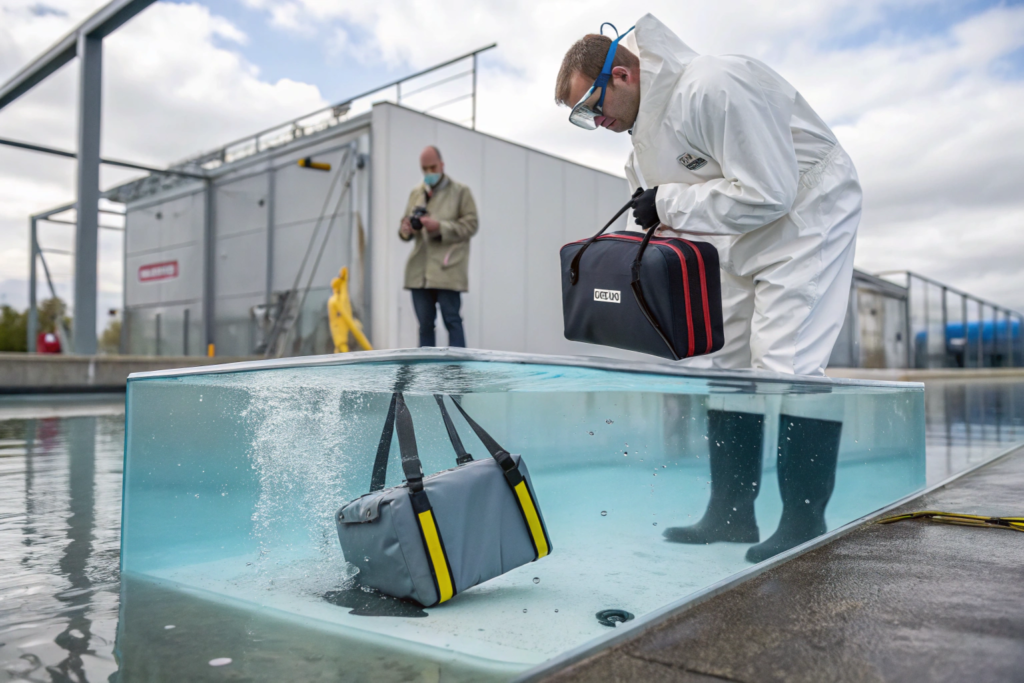
Sometimes, a bag’s worst enemy is not a pounding rain, but a moment of carelessness—setting it down in a puddle, having it knocked into a stream, or getting splashed by a wave. The water immersion test simulates these scenarios. It tests a bag’s ability to resist water ingress when it is partially or fully submerged for a period of time. It’s a test of the bag’s overall construction, including its seams, zippers, and closures.
The water immersion test is a simple but effective way to check a bag’s water resistance. The bag is typically partially or fully submerged in a tank of water for a set period (e.g., 30 minutes to a few hours). Sometimes, a weighted object is placed inside the bag to keep it submerged. After the test, the bag is removed, dried on the outside, and then opened to check for any water ingress inside. This test is excellent for revealing leaks around zippers, seams, and attachment points that might not be apparent in a spray test. It is often used for bags that might be used in wet environments, like boat bags, beach bags, or coolers.
The water immersion test is particularly important for assessing the effectiveness of waterproof zippers and sealed seams. A zipper that is not waterproof can be a major point of failure. The test will quickly reveal if water is seeping through the zipper teeth or through the fabric around the zipper. It also tests the integrity of any taped or sealed seams. For bags that claim to be "waterproof" or "submersible," this test is non-negotiable. It provides a realistic assessment of the bag’s performance in a worst-case scenario. This is a key part of product validation and quality control. At Shanghai Fumao Clothing, we perform immersion tests on bags that require a high level of water resistance, ensuring they can withstand accidental submersion.
How long should a bag be tested in an immersion test?
The duration depends on the bag’s intended use. For a bag that might only encounter occasional splashes, a 30-minute test might be sufficient. For a bag designed for boating or other water activities, a longer test of 1-2 hours or more is appropriate. We always discuss the test parameters with our clients.
What should I look for when inspecting a bag after an immersion test?
Look for any signs of moisture inside the bag. Pay special attention to corners, seams, the areas around zippers, and any attachment points (like D-rings or handles). Even a small amount of dampness indicates a failure. A truly waterproof bag should be completely dry inside.
What Is a Simulated Rain Test and Why Is It the Most Realistic?
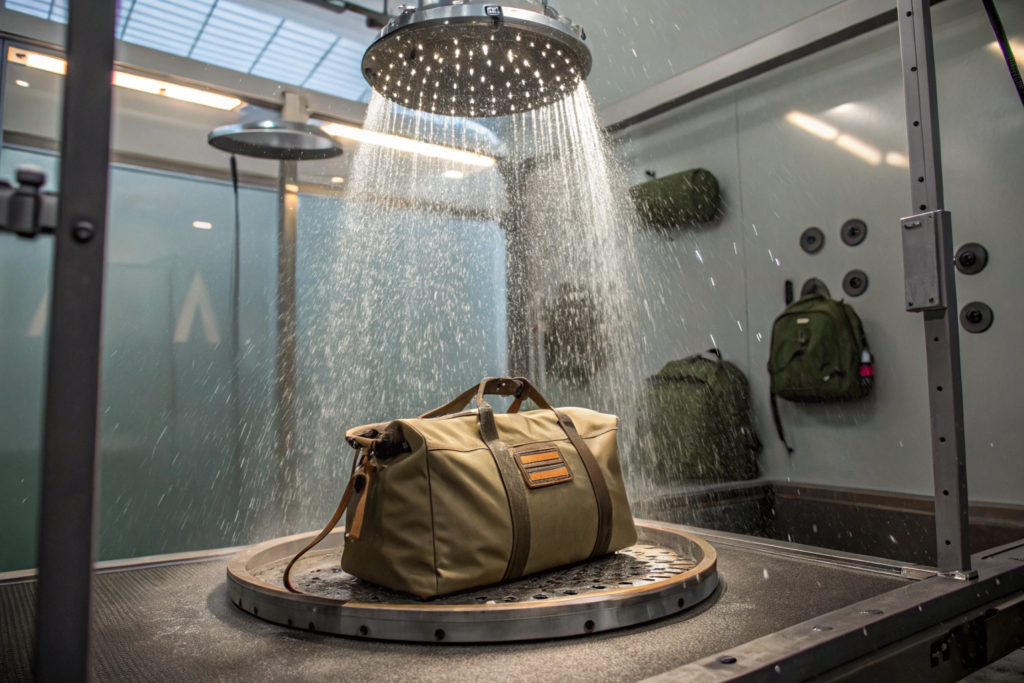
The most realistic and comprehensive test for water resistance is the simulated rain test. Unlike the focused spray test or the static immersion test, this test replicates the complex conditions of a real rainstorm. It subjects the bag to sustained, multi-directional water exposure, testing its ability to withstand a real-world downpour over time. It is the ultimate validation for any bag that claims to be rain-resistant.
A simulated rain test is conducted in a specialized chamber equipped with multiple spray nozzles that can simulate different rainfall intensities and angles. The bag is often placed on a rotating stand to ensure even exposure from all sides. The test can run for a set duration, from 30 minutes to several hours, simulating everything from a light drizzle to a torrential downpour. After the test, the bag is carefully inspected for any water ingress. This test is the closest thing to real-world conditions and provides the most complete picture of a bag’s water resistance. It tests not only the fabric but also all the seams, zippers, and closures under sustained, realistic stress.
The simulated rain test is particularly valuable for bags that have complex designs with multiple pockets, zippers, and attachment points. It can reveal weaknesses that other tests might miss. For example, water might run down a strap and seep into the bag at the attachment point, a failure mode that a simple spray test on flat fabric wouldn’t reveal. It also tests the performance of water-resistant zippers under sustained exposure. This test provides the highest level of confidence that a bag will perform as expected in a real rainstorm. It is the gold standard for weather-resistant product testing. At Shanghai Fumao Clothing, we use simulated rain testing for our most demanding clients, ensuring their bags can withstand the worst that nature can throw at them.
Is a simulated rain test necessary for all bags?
No, it is typically reserved for bags that need to withstand significant and sustained exposure to rain, such as outdoor backpacks, commuting bags, and motorcycle bags. For bags intended only for occasional light drizzle, a spray test and a hydrostatic head test on the fabric may be sufficient.
How do I interpret the results of a simulated rain test?
The primary result is a simple pass/fail based on whether any water entered the bag. However, the test also provides valuable diagnostic information. If water does enter, the test can reveal the exact point of failure—a specific seam, a zipper, a strap attachment—allowing you to fix the design or construction.
Conclusion
Ensuring a nylon or polyester bag is truly water-resistant requires a multi-faceted testing approach. The spray test checks the surface repellency. The hydrostatic head test measures the fabric’s resistance to water pressure. The immersion test simulates accidental submersion. And the simulated rain test replicates the complexity of a real downpour. Each test provides a different piece of information, and together they give a complete picture of a bag’s ability to protect its contents from water.
At Shanghai Fumao Clothing, we take water resistance seriously. Our in-house testing lab is equipped to perform all of these tests, from the simple spray test to the most complex simulated rain test. We work with our clients to determine the right level of water resistance for their products and then test rigorously to ensure it is achieved. We don’t just claim our bags are water-resistant; we prove it.
Are you ready to create bags that can confidently face the elements? Let’s talk about the right level of water resistance for your next collection. Contact our Business Director, Elaine, at elaine@fumaoclothing.com to start the conversation.