You're building a luxury brand where every stitch tells a story, but finding a factory that matches your vision for craftsmanship, quality, and ethical integrity feels like searching for a needle in a haystack. The fear of poor workmanship, inconsistent leather, and misaligned values can stall even the most promising luxury startup. The gap between a beautiful design and a physically impeccable product is vast.
The most effective way to find a supplier for high-end leather goods is to target specialized OEM/ODM manufacturers with proven expertise in full-grain leathers, implement a rigorous multi-stage vetting process focused on craftsmanship and ethics, and build the relationship through a collaborative, sample-driven approach that treats the factory as a strategic partner, not just a vendor. This path prioritizes quality and partnership over the lowest cost.
This guide will outline the proven steps to identify and secure the right manufacturing partner. We'll explore where to look for specialized suppliers, the non-negotiable criteria for vetting them, how to master the sampling and communication process, and how to structure a partnership for long-term success. For brands that require integrated design support, understanding the difference between OEM and ODM services is a crucial first step in this journey.
Where to Look for Specialized High-End Leather Goods Manufacturers?
For luxury goods, mainstream B2B platforms are often the wrong starting point. High-end manufacturers rarely compete on price-alibaba.com; they compete on craftsmanship, reputation, and exclusive partnerships. Your search must be targeted towards industry-specific channels that attract serious brands.
Specialized manufacturers are found through luxury trade shows, industry-specific sourcing directories, deep LinkedIn networking with technical professionals (not just sales), and referrals from within the luxury supply chain (e.g., from your tannery or hardware supplier). These channels filter for suppliers who understand the language of quality, lead times, and confidentiality.
Begin with the pinnacle events. Attend Première Vision Leather in Paris or Milan's Lineapelle. These are not public fairs but professional trade shows where tanneries and top-tier manufacturers showcase. The factories there supply globally recognized brands. Secondly, use directories like Messe Frankfurt's specific leather goods sections or Moda Made which cater to a higher standard. On LinkedIn, search for titles like "Production Manager," "Technical Designer," or "Master Craftsman" in regions known for leather heritage (e.g., Italy, Spain, Turkey, certain Chinese clusters like Guangzhou's high-end district). When you find a potential partner, like the artisans we collaborate with at Shanghai Fumao for our premium lines, their portfolio should tell a story of complexity and refinement, not just volume.

Why Are Trade Shows Like Première Vision Essential?
Première Vision is the world's benchmark for materials and manufacturing intelligence. It is exclusive and trend-setting. Attending allows you to:
- Meet Tanners and Manufacturers Under One Roof: You can source your leather and your maker in the same visit, ensuring they have experience working with the specific material you choose.
- Assess Capability Firsthand: See physical samples of construction techniques—hand-stitching, edge painting, hardware application—that are impossible to judge online.
- Gauge Professionalism: The cost and effort to exhibit at such shows filters out small, unreliable workshops. You are engaging with established businesses.
It is an investment, but for high-end leather, it is the most efficient way to access the top tier of the global supply network.
How to Use LinkedIn and Industry Networks Effectively?
Go beyond the company page. Use advanced search: "[Your Product, e.g., Minimalist Leather Bags] AND [Title, e.g., Factory Manager] AND [Location, e.g., Florence]." Connect with a personalized message referencing a specific piece of their work you admire. Join niche groups like "Luxury Leather Goods Professionals." More importantly, ask for referrals from your material suppliers. A respected Italian calfskin tannery will know which factories in their region best handle their leather. This referral carries immense weight, as the tannery's reputation is also on the line. The Leather Working Group (LWG), an auditor of sustainable leather manufacturing, also maintains a list of certified tanneries and manufacturers, which is a valuable starting point for ethically-minded brands.
What Are the Non-Negotiable Criteria for Vetting a Luxury Leather Supplier?
Vetting for high-end is a forensic process. It moves far beyond price and MOQ to an examination of material philosophy, artisan skill, quality systems, and ethical alignment. Each criterion is a pillar supporting the integrity and value of your final product.
The non-negotiable criteria are: 1) Proven expertise with full-grain and exotic leathers, 2) Transparent and tiered material sourcing, 3) Mastery of hand-finishing techniques, 4) A robust, documented quality management system, and 5) Ethical certifications and social compliance. The factory must be an extension of your brand's ethos.
Due diligence is multi-layered. First, material mastery: Can they explain the differences between vegetable-tanned and chrome-tanned leather, and the implications for patina and durability? Do they have relationships with top tanneries (e.g., Horween, Conceria Walpier, Bonaudo)? Second, craftsmanship proof: Request videos or in-person viewing of their stitching (hand vs. machine saddle stitch), edge painting (how many layers?), and skiving. Third, systematic quality: Do they have a First Article Inspection process? What is their AQL (Acceptable Quality Level) standard for luxury goods? It should be stricter than common industrial standards. Finally, ethics: Demand audit reports like SMETA or LWG certification for the leather itself. At our partner facilities for luxury goods, we welcome this level of scrutiny, providing clients with dossiers that cover all these points, because we understand that trust is the true currency of luxury manufacturing.

How to Assess True Craftsmanship and Technical Skill?
Move beyond finished product photos. Ask for:
- "In-Process" Photos/Videos: Of pattern cutting, hand-stitching, edge painting, and hardware mounting.
- Technical Specifications for a Sample: Request a detailed breakdown of the SPI (stitches per inch), thread weight (e.g., Lin Cable or Fil Au Chinois), edge paint brand (e.g., Uniters, Fenice), and type of reinforcement used.
- Sample of Stitching and Edging: Ask them to send a simple leather swatch demonstrating their standard hand-stitch and edge finish. This small item reveals more than a catalog.
A factory that cannot or will not provide this granular detail likely lacks the technical depth you need. True craftsmen are proud to discuss their techniques.
What Ethical and Transparency Certifications Are Mandatory?
For a true high-end claim, your supply chain must be clean. Mandatory verifications include:
- Leather Working Group (LWG) Certification: Audits the environmental performance of leather manufacturers. Using LWG-certified leather is a minimum standard for responsibility.
- Social Accountability Audit (e.g., SMETA, BSCI): Verifies safe working conditions, fair wages, and no forced or child labor.
- Material Traceability: The factory should provide documentation tracing the leather batch back to the tannery, and ideally, the origin of the hide.
- REACH Compliance: For products sold in the EU, proving the absence of restricted chemicals.
The absence of these certificates is a major red flag. In luxury, provenance and ethics are part of the product's value.
How to Navigate the Sampling and Communication Process?
The sampling phase is your partnership's trial by fire. It's where abstract criteria meet tangible reality. A professional sampling process is structured, iterative, and transparent. Poor communication here is the leading cause of failed partnerships, regardless of the factory's skill.
Successful navigation requires a clear, comprehensive tech pack, an agreed-upon, paid sampling protocol with multiple stages (prototype, fit sample, pre-production sample), and established communication rhythms using collaborative tools. Expect to invest significant time and money; quality sampling is not cheap or fast.
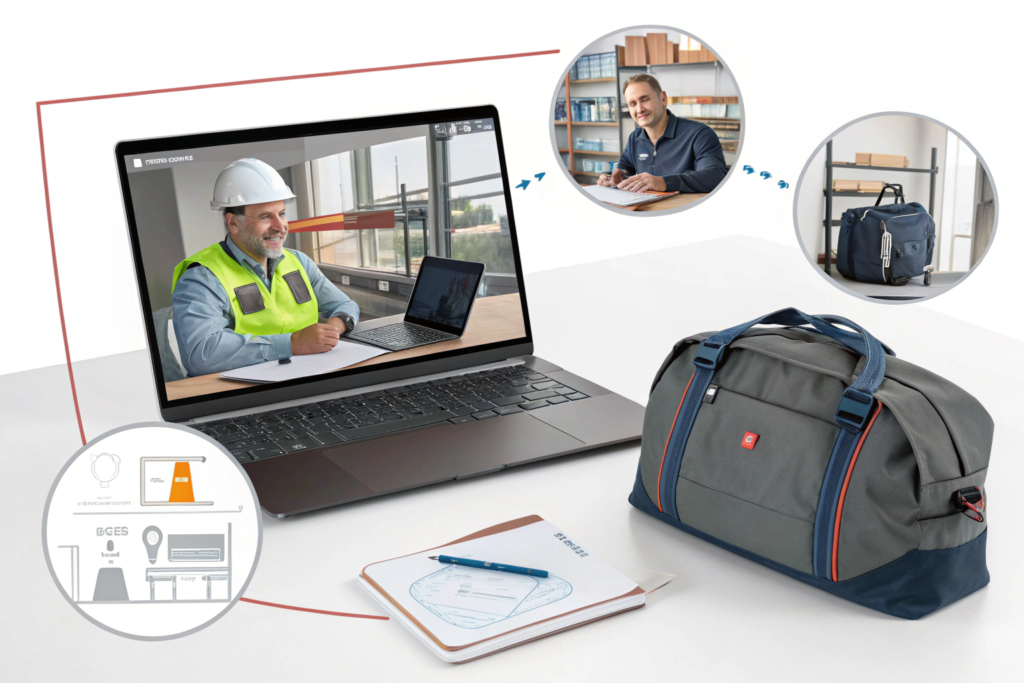
Treat the first sample as a collaborative prototype, not a final product. Start with a Developmental Sample made from substitute leather to validate pattern and construction at lower cost. Provide a bullet-proof tech pack with: 1) Detailed CAD drawings with all dimensions, 2) Specified materials list (leather type, thickness, finish, supplier; thread; hardware brand and finish), 3) Bill of Materials (BOM), 4) Step-by-step construction callouts, and 5) High-resolution photos of inspiration and details. Use mark-up tools (like Adobe Acrobat or GoVisually) to give precise feedback on samples with arrows and notes directly on the images. Schedule weekly video calls during sampling to review progress. We manage this process for our clients with a dedicated project manager, ensuring no detail is lost in translation and that feedback loops are tight and actionable.
What Should a Luxury-Grade Tech Pack Include?
A luxury tech pack is an exhaustive blueprint. It must specify:
- Leather: Not just "Italian calfskin," but the tannery, article number, finish, thickness (in mm), and chosen panel from the hide (e.g., "use butt section for front panel for tight grain").
- Construction: Stitch type (hand saddle stitch, machine lockstitch), SPI (e.g., 9-10 SPI for hand-stitching), seam allowance, reinforcement (e.g., thermoplastic for structure).
- Edge Finishing: Process (e.g., sanded, painted with Uniters edge paint, 3 coats, polished).
- Hardware: Supplier (e.g., YKK, Riri, Lampo), product code, finish (e.g., palladium plating), and attachment method (rivet type, screw size).
- Quality Checkpoints: Explicit quality standards for each stage.
This level of detail signals your professionalism and sets unambiguous expectations.
How to Manage Feedback and Iterations Without Conflict?
Structure and positivity are key.
- Use the "Praise, Critique, Suggest" Model: Start with what they did well, then state the issue factually ("The stitch length on the flap is 8 SPI, but the spec is 10 SPI"), and end with a clear request ("Please re-stitch this panel to 10 SPI").
- Document Everything: All feedback should be in writing (email) with supporting photos, following up on verbal calls.
- Be Reasonable on Revisions: Understand which changes require a new sample (structural changes) versus which can be noted for the next round (minor color matching). Agree on the number of revision rounds included in the sample fee.
- Respect Their Expertise: If they push back on a design detail for structural reasons, listen. A good partnership is a dialogue between your vision and their technical reality.
How to Structure a Long-Term Partnership with Your Supplier?
Finding the right supplier is only half the battle; structuring the relationship for mutual success is the other. A long-term partnership in luxury is built on shared growth, transparent costing, intellectual property protection, and consistent quality assurance. It moves from transactional to strategic.
Structure the partnership with a clear manufacturing agreement covering IP, quality standards, cost adjustment mechanisms, and exclusivity terms. Foster growth by providing realistic forecasts, being a reliable partner with timely payments, and collaborating on continuous improvement. Visit the factory regularly to strengthen the relationship and oversee production.
The foundation is a solid contract. Key clauses should address:
- Intellectual Property: Clearly state that all designs, tech packs, and samples remain your sole property.
- Quality and Inspection Rights: Define the AQL, your right to conduct in-process and final inspections (or hire a third party like SGS), and the protocol for rejecting defective goods.
- Cost Structure Transparency: Understand the FOB cost breakdown: material cost, labor cost, overhead, and profit. Agree on how cost changes (e.g., leather price hikes) will be handled, with notice.
- Exclusivity (Optional): For unique designs, you may request that the factory not produce the same or substantially similar product for other clients for a period.
Beyond the contract, act as a partner. Share your brand's vision and growth plans. Pay deposits and final balances on time. When you succeed, they succeed. We at Shanghai Fumao value partners who view us as an integral part of their brand's journey, not just a service provider, as it allows for better planning, investment in quality, and true collaboration.

What Key Elements Must Be in a Manufacturing Agreement?
A robust agreement protects both parties and ensures clarity. Essential elements include:
- Parties and Scope: Clearly define who is making what.
- Specifications: Incorporate the final approved tech pack and sample as contractual exhibits.
- Pricing and Payment Terms: Detailed cost, payment schedule (e.g., 50% deposit, 50% before shipment), and currency.
- Delivery and Shipping: Incoterms (typically FOB), delivery schedule, liability for delays.
- Warranty: Defect liability period (e.g., 1 year for workmanship issues).
- Termination: Conditions under which either party can terminate the agreement.
Having a lawyer experienced in international manufacturing review this is a wise investment.
How Can You Grow Together and Ensure Consistent Quality?
Proactive partnership management ensures consistency as you scale.
- Provide Forecasts: Even rough 12-month rolling forecasts help the factory plan capacity and material purchases.
- Conduct Joint Reviews: After each production run, have a call to discuss what went well and what could be improved for next time.
- Invest in Their Growth: If they suggest a more efficient machine or a better material source that requires investment, be open to discussions that might involve slight cost adjustments for long-term gain.
- Maintain Quality Vigilance: Never assume quality will auto-maintain. Schedule regular third-party inspections, especially as order volumes grow. The International Safe Transit Association (ISTA) standards can be referenced for packaging and shipping tests to ensure products arrive perfectly.
This collaborative approach turns your supplier into a true ally, invested in your brand's enduring success.
Conclusion
Finding and partnering with a supplier for high-end leather goods is a meticulous journey of discernment, deep verification, and relationship building. It requires moving beyond conventional sourcing channels to seek out specialists, vetting them against uncompromising standards of craft and ethics, mastering the detailed dialogue of sampling, and finally, structuring a true partnership for the long term.
The reward is a manufacturing alliance that protects your brand's integrity, elevates your product, and grows with your vision. In the world of luxury, your supplier is not a cost center but a cornerstone of your brand's identity.
If you are seeking a manufacturing partner with the technical expertise, ethical foundation, and collaborative spirit to bring your high-end leather accessory vision to life, we invite you to start a conversation. Contact our Business Director, Elaine, at elaine@fumaoclothing.com to discuss how Shanghai Fumao and our network of specialized ateliers can become the trusted cornerstone of your luxury brand.