A new accessories brand founder from Austin, Texas called me last year, and she was genuinely bewildered. She had spent weeks contacting factories on Alibaba, sending her tech packs, explaining her brand vision, and requesting samples. She was serious. She had funding. She had a clear launch plan. But every factory she contacted asked her to pay for the samples and the shipping. The sample fees were reasonable. The shipping costs were outrageous. She was quoted 45 dollars for a set of hair clips that cost 5 dollars to produce, and 80 dollars for express shipping. She told me, "I am ready to place a 5,000-dollar order, but I cannot afford to spend 500 dollars just on samples from different factories. It is killing my budget before I even start." She asked me, "Are there factories that offer free sample shipping for serious buyers, or is that a myth?"
To find a factory that offers free sample shipping for serious buyers, you need to look beyond the mass-market sourcing platforms and target manufacturers who view sampling as an investment in a long-term partnership, not as a profit center. These factories typically have a formal sample policy that distinguishes between speculative inquiries and genuine procurement opportunities. A serious buyer is defined by specific behaviors. They have a registered business with a verifiable online presence. They communicate professionally with clear specifications and a defined timeline. They demonstrate knowledge of the product category and the supply chain. They provide a realistic order projection. And they are willing to sign a non-disclosure agreement and share their business credentials. Factories that offer free sample shipping typically require the buyer to pay for the samples themselves, the production cost, and the factory covers the shipping cost by using their corporate courier account, which benefits from deeply discounted rates. Some factories offer a full refund of the sample and shipping costs against the first production order. The key is to approach the factory as a professional buyer, to communicate your serious intent clearly, and to understand the factory’s perspective on sample economics.
Sample shipping costs are a major friction point in the early stages of a buyer-factory relationship. The buyer sees an 80-dollar shipping charge for a 20-dollar sample and feels like they are being gouged. The factory sees the same 80-dollar charge as a direct cost they have to pay to the courier, and they are reluctant to absorb it for a buyer who may never place an order. The reality is that international express shipping from China to the US or Europe is expensive for individuals but significantly cheaper for businesses with high-volume courier accounts. A factory that ships hundreds of samples per month pays a fraction of the retail shipping rate. The difference between the factory’s cost and the quoted price is not profit. It is the difference between a corporate rate and a walk-up rate. At AceAccessory, we have a structured sample policy that is fair to both parties. I have been on both sides of this equation, as a factory owner and as a buyer earlier in my career. Let me walk you through how to find a factory that will work with you on sample shipping.
Why Do Most Factories Charge for Sample Shipping
Understanding why factories charge for sample shipping requires understanding the economics of factory sampling. A factory’s sample room is a cost center. The sample makers are paid for their time. The materials used for samples are pulled from production inventory. The courier charges for shipping. For a factory operating on thin margins, these costs add up quickly. If the factory absorbs all sample and shipping costs for every inquiry, they would lose money on sampling. The factory must distinguish between the majority of inquiries, which never lead to an order, and the minority that do. The sample shipping charge is a filtering mechanism. A buyer who is not willing to pay for shipping is often not a serious buyer.
Most factories charge for sample shipping because international courier costs are a real, out-of-pocket expense that the factory must pay to the carrier. Unlike the sample production cost, which the factory can absorb internally as a marketing expense, the shipping cost is a cash payment to a third party. A factory that receives ten sample requests per day, each costing 30 dollars to ship on a corporate account, would spend 300 dollars per day, or 9,000 dollars per month, on sample shipping alone. If only 10 percent of those sample requests convert to orders, the factory loses 8,100 dollars per month on samples that did not lead to business. The factory must charge for sample shipping to protect their business from this loss. The factory’s quoted shipping cost is based on the courier’s rate. A small factory with low shipping volume pays a higher rate. A large factory with high volume pays a lower rate. The quoted cost may include a small handling fee to cover the cost of packaging materials and the labor to prepare the shipment. The handling fee is typically a few dollars. The factory is not profiting from the shipping charge. They are passing on their cost. The buyer who pays for sample shipping is demonstrating their seriousness and their willingness to invest in the relationship. This is a signal that the factory values. A buyer who demands free shipping on the first contact is signaling that they are price-sensitive and may not be a long-term, high-value partner.
The factory’s sample policy is a business decision that balances the cost of sampling against the potential return from new client acquisition. Factories that are actively seeking new clients may have a more generous sample policy. Factories that are operating at full capacity may have a stricter policy. Let me explain the two key factors that determine the shipping cost.
How Do Factory Courier Rates Compare to Retail Shipping Costs?
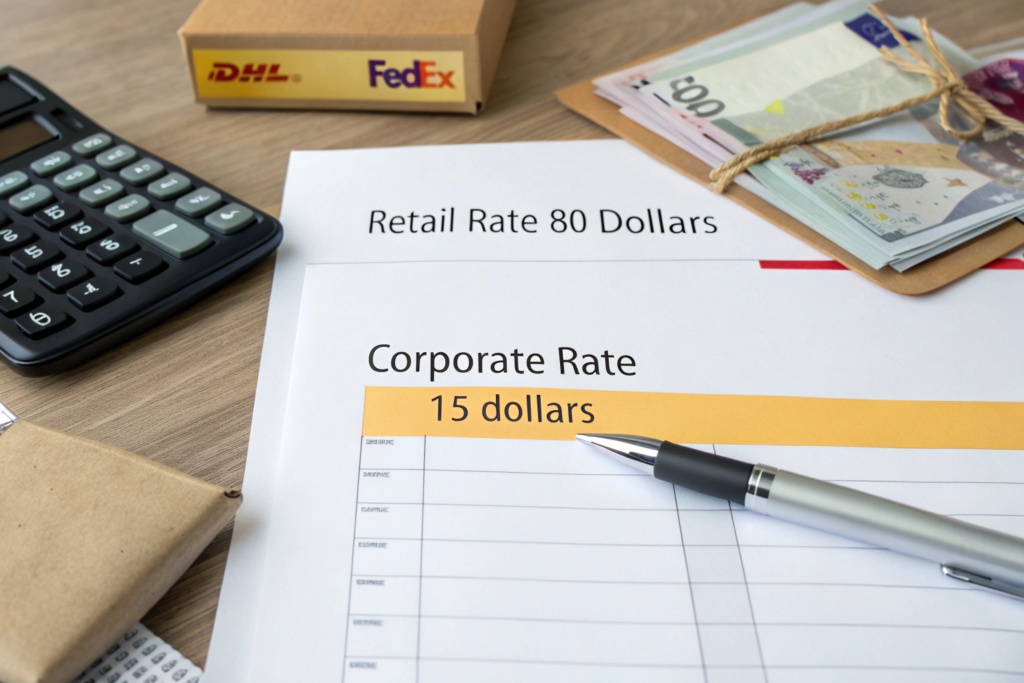
The difference between the shipping cost a factory pays and the shipping cost an individual buyer would pay for the same package is substantial. International couriers like DHL, FedEx, and UPS operate on a volume discount model. A customer who ships one package per month pays the published rate, the highest rate. A customer who ships ten packages per day negotiates a deeply discounted corporate rate. The corporate rate can be 60 to 80 percent lower than the published rate. A package that would cost an individual 80 dollars to ship from China to the US might cost a high-volume factory 15 to 25 dollars. The factory’s shipping cost is based on the dimensional weight or the actual weight of the package, whichever is greater. A sample package of hair clips or a scarf is usually small and light. It might weigh 0.5 kilograms. At a discounted corporate rate, the shipping cost might be 10 to 15 dollars. The factory quotes the buyer a shipping charge of 30 to 40 dollars. The buyer, who is accustomed to domestic shipping costs, sees this as expensive. The buyer may not realize that the factory is already absorbing a significant portion of the true cost through their corporate rate. The remaining charge covers the factory’s out-of-pocket cost plus a small buffer for packaging and handling. Some factories use a freight forwarder or a shipping agent who consolidates packages and gets even lower rates. The shipping agent picks up the sample from the factory, handles the customs documentation, and dispatches it via the courier. The agent’s rate can be lower than the factory’s direct courier rate. The shipping charge quoted to the buyer reflects this agent rate. The transparency of the shipping charge varies by factory. Some factories quote a flat rate regardless of the actual cost. Others quote the exact cost with a handling fee. A professional factory will provide a shipping cost breakdown if asked.
What Is the Difference Between Sample Fee and Shipping Fee?
The sample fee and the shipping fee are two separate charges that are often confused. The sample fee is the cost to produce the sample itself. This includes the materials, the labor, and the machine time used to make the sample. For a standard product that is in the factory’s sample inventory, the sample fee may be zero or a nominal charge. The factory already has the sample, and sending it costs them nothing in production terms. For a custom product that requires new molds, new printing screens, or special materials, the sample fee can be significant. The factory must recover the cost of the custom work. The sample fee is a one-time charge. The shipping fee is the cost to transport the sample from the factory to the buyer. This is a recurring charge for every sample shipment. The sample fee goes to the factory. It covers their production cost. The shipping fee goes to the courier. It covers the transportation cost. Some factories combine the two into a single charge. Others separate them. A buyer who asks for "free samples" is usually asking for the sample fee to be waived, not the shipping fee. A factory that offers "free samples" may be offering stock samples at no charge, with the buyer paying the shipping. A factory that offers "free sample shipping" is offering to pay the courier cost, usually because they have a high-volume corporate account and the incremental cost is low. A serious buyer should always clarify what is included in the quoted charges. Ask, "Is the 50 dollars for the sample production, the shipping, or both?" A clear breakdown allows for a more productive negotiation.
How to Qualify as a Serious Buyer for Free Shipping
A factory’s decision to offer free sample shipping is based on their assessment of the buyer’s potential. The factory is asking themselves a single question. "Is this buyer likely to place a production order that will generate enough profit to justify the cost of the free sample shipping?" If the answer is yes, the factory will invest in the relationship. If the answer is no or maybe, the factory will ask the buyer to share the cost. The buyer’s job is to make the answer an unambiguous yes. This is done by presenting themselves as a professional, prepared, and credible business partner. The first contact with the factory is the most important. An inquiry that is vague, unprofessional, or clearly a price-shopping exercise will be met with a request for full payment. An inquiry that is detailed, professional, and demonstrates a clear intention to purchase will be met with a more accommodating attitude.
To qualify as a serious buyer for free sample shipping, you must present yourself as a credible business with a defined project and a realistic purchase timeline. The elements of a serious buyer presentation are a professional email from a company domain, not from a free Gmail or Yahoo address. A clear subject line that indicates the nature of the inquiry. A brief introduction of your company, your brand, your target market, and your distribution channels. A specific description of the product you are inquiring about, with reference to the factory’s product codes or images from their catalog. An indication of your expected order quantity, both for the initial order and for the projected annual volume. A defined timeline for sampling, approval, and production. A willingness to sign a non-disclosure agreement and to provide your business registration or website for verification. A professional signature with your full name, title, company name, website, and direct contact information. This presentation immediately distinguishes you from the hundreds of generic inquiries that factories receive daily. The factory’s salesperson reads your email and sees a real business opportunity, not a casual inquiry. They are far more likely to authorize free sample shipping for this kind of buyer. The investment of a few minutes to craft a professional inquiry pays for itself many times over in saved sample shipping costs and in the quality of the factory’s response.
The serious buyer presentation is not about pretending to be larger than you are. It is about demonstrating that you are organized, professional, and genuinely ready to do business. A small startup with a clear plan is a more attractive client than a large company with a vague inquiry. Let me detail the two most important qualification elements.

What Business Credentials Do Factories Look For?
Factories look for evidence that you are a legitimate, operating business, not an individual buying a single sample for personal use. The credentials they look for are a company website. A professional, functioning website with your brand’s products, your story, and your contact information is the single most important credential. It proves that you are a real business. A factory will almost always check your website before responding to your inquiry. A social media presence. An active Instagram, Facebook, or LinkedIn presence for your brand provides additional verification. It shows that you are engaged with customers and that your brand has a following. A business registration number. In some cases, particularly for larger sample requests or for credit terms, a factory may ask for your business license or registration number. This is a standard due diligence request. A professional email address. An email from a domain that matches your website is a strong signal. A trade reference. If you have worked with other factories before, a reference from a previous supplier can be very persuasive. The factory can contact the reference and verify your payment history and your professionalism. A clear purchase history. If you have purchased from other suppliers on Alibaba or similar platforms, your transaction history is visible and serves as a credential. A factory that sees a history of completed transactions with positive feedback is more likely to extend favorable terms. The credentials do not need to be extensive. A new brand with a beautiful website, an active Instagram following, and a professional communication style can qualify as a serious buyer. The key is that you appear to be a real business with a genuine intention to purchase.
Should You Share Your Purchase Projections Upfront?
Yes, sharing your purchase projections upfront is one of the most effective ways to establish your seriousness and to negotiate favorable sample terms. A purchase projection is a simple statement of your expected order volume. For example, "We are planning an initial order of 500 pieces for our launch collection, with projected reorders of 1,000 pieces per quarter thereafter." This projection tells the factory the potential value of the relationship. The factory can calculate the lifetime value of you as a client. A buyer with a 10,000-dollar annual projection is worth investing in. A buyer with a 200-dollar one-time projection is not. The projection should be realistic. Do not inflate your numbers to get free samples and then place a tiny order. The factory will remember, and the relationship will be damaged. It is better to be honest about a small initial order with growth potential than to exaggerate and lose credibility. The projection should be framed as an estimate, not a commitment. "Based on our market research, we estimate" is the appropriate language. The factory understands that projections are not guarantees. The projection is also a conversation starter. It allows the factory to offer guidance. "For 500 pieces, we recommend this material and this printing method. For larger volumes, we can offer a better price on this alternative." The projection moves the conversation from "Can I have a sample?" to "How can we work together on this project?" This is the conversation that serious buyers and good factories want to have. The purchase projection is a standard part of a professional inquiry. It should be included in the initial email or in a follow-up communication after the initial contact.
What Sample Shipping Policies Do the Best Factories Offer
The best factories have clear, written sample policies that are communicated to the buyer at the start of the relationship. The policy removes ambiguity and prevents misunderstandings. It states what is free, what is chargeable, and under what conditions charges are refunded. A factory with a transparent, fair sample policy is a factory that values its client relationships and understands the buyer’s perspective. A factory with no written policy, or with a policy that changes depending on who you talk to, is a factory with weak internal controls. The sample policy is a window into the factory’s overall management quality.
The best factories offer sample shipping policies that are transparent, fair, and designed to support genuine buyer relationships. The most common and fairest policy is that the buyer pays the sample production cost, and the factory ships the samples using their corporate courier account at no charge to the buyer. The factory’s incremental shipping cost is low, and they absorb it as a marketing expense. The buyer pays for the product, which covers the factory’s direct costs. Another common policy is that the buyer pays the full sample and shipping cost upfront, and the factory refunds the full amount against the first production order. This policy is fair because the buyer’s investment is returned when they become a paying client. The factory is effectively providing a free sample to their actual customers. A third policy is that the factory provides free samples and free shipping for a limited number of pieces, typically one to three pieces per style, from their existing sample inventory. Custom samples, which require new production work, are charged at cost plus shipping. A fourth policy is a sample subscription or a sample club, where the buyer pays an annual fee and receives a certain number of free samples and free shipping throughout the year. This is for high-volume buyers who sample frequently. The best factories state their sample policy clearly on their website, in their catalog, or in their initial communication. They do not hide the policy or make the buyer ask. They are upfront about the costs and the conditions for refunds. This transparency builds trust.
The sample policy is a reflection of the factory’s business philosophy. A factory that views samples as a profit center is not a good long-term partner. A factory that views samples as a relationship-building investment is. Let me detail the two most common and fair policies.
How Do Sample Cost Refunds Against Production Orders Work?
The sample cost refund policy is the most buyer-friendly arrangement that is also fair to the factory. It works as follows. The buyer places a sample order and pays the full cost of the samples, including the production cost of any custom work, plus the shipping cost. The factory produces and ships the samples. The buyer receives the samples, evaluates them, and if satisfied, places a production order. The total amount the buyer paid for the samples is deducted from the production order invoice. The buyer effectively receives the samples for free, but only after they have committed to the production order. The factory is protected because if the buyer does not place an order, the factory has been paid for their sample costs and is not out of pocket. This policy aligns the interests of both parties. The buyer has an incentive to place the production order to recover their sample investment. The factory has the assurance that their sample costs are covered, and they can afford to provide a high-quality sampling experience. The policy details should be confirmed in writing. The specific items covered by the refund should be listed. The refund should be stated as a credit against the first production order. Some factories limit the refund to the sample production cost and do not refund the shipping. Others refund both. This should be clarified upfront. The refund policy should also specify what happens if the buyer places a production order that is smaller than the sample order. For example, if the buyer paid 200 dollars for samples and then places a 500-dollar production order, does the full 200 dollars get refunded, or is the refund capped at a percentage of the order value? These details should be discussed and agreed upon. The sample cost refund policy is a mark of a confident factory that believes in the quality of their samples and their ability to convert samples into orders.
When Do Factories Offer Free Shipping on Custom Samples?
Free shipping on custom samples is the most generous sample policy, and it is typically reserved for the most promising buyer relationships. A factory offers free shipping on custom samples when they have a high degree of confidence that the buyer will place a production order, and when the potential value of that order justifies the investment. The specific circumstances that trigger a free custom sample shipping offer include a buyer with a strong, verifiable purchase history with the factory or with other known suppliers. A buyer who has placed multiple orders previously is a known quantity, and the factory is willing to invest in their continued business. A buyer with a very large projected order. If the buyer’s initial order projection is 10,000 units or more, the potential profit from that order dwarfs the cost of sample shipping. The factory will absorb the shipping cost without hesitation. A buyer who is a well-known brand or retailer. If the buyer represents a recognized brand, the factory gains prestige and potential future business from being associated with that brand. The factory will invest in the relationship. A buyer who has visited the factory or has an established personal relationship with the sales team. A face-to-face meeting builds trust and makes the factory more willing to extend favorable terms. A buyer who is working on a long-term, exclusive project. If the buyer commits to an exclusive supply arrangement for a specific product line, the factory has a guaranteed revenue stream and will invest in the development. The free shipping offer is usually made by the factory, not requested by the buyer. The buyer presents their case as a serious, high-potential partner, and the factory responds with the offer. A buyer who demands free shipping upfront, without establishing their credentials, is unlikely to receive it. The offer is a privilege earned through professional presentation and demonstrated potential.
How to Approach a Factory About Free Sample Shipping
Approaching a factory about free sample shipping is a negotiation. Like any negotiation, it requires preparation, the right timing, and the right tone. A demanding or entitled approach will fail. A collaborative, professional approach can succeed. The goal is not to extract a concession from the factory. It is to build a relationship that makes the factory want to invest in you. The conversation about sample shipping should occur after you have established your credibility as a serious buyer. It should not be the first thing you ask. The first communication should focus on the product, your brand, and your project. Once the factory is engaged and interested, the sample shipping discussion is a natural next step.
To approach a factory about free sample shipping effectively, follow a three-step communication strategy. Step one, establish credibility. Your first message should introduce your company, describe your project, and ask product-related questions. Demonstrate your knowledge of the product category. Show that you have done your research. This message should not mention sample costs or shipping. The goal is to get the factory interested in your project. Step two, request samples professionally. Once the factory has responded positively to your inquiry and you have discussed the product specifications, request the samples you need. Ask about the sample production cost and the shipping cost. Frame your question in a collaborative way. "We are very interested in moving forward. Could you please let me know the cost for the samples and the shipping? We are happy to pay for the sample production. Regarding shipping, do you have a corporate courier account that might offer a better rate than the standard retail rate?" This question opens the door to a shipping cost discussion without demanding anything. Step three, propose a fair arrangement. If the quoted shipping cost is high, propose an arrangement that shares the cost or defers it. "We understand that sample shipping is a cost. Would it be possible to use your corporate courier account for a better rate? We are also open to the option of a refund against our first production order." Present the options as a collaborative search for a fair solution. The factory is more likely to accommodate a buyer who approaches the conversation as a partner, not as an adversary.
The approach is as important as the content. A respectful, professional tone opens doors. A demanding tone closes them. Let me detail the two most important approach strategies.

What Should You Say in Your First Sample Request Email?
The first sample request email sets the tone for the entire relationship. It should be concise, professional, and information-rich. The subject line should be clear. "Sample Inquiry – [Your Brand Name] – [Product Type] – [Potential Order Quantity]" is a strong subject line. It tells the factory exactly what the email is about and signals that you are a serious buyer with a project in mind. The opening should introduce your company. One or two sentences about your brand, your market, and your distribution channels. "My name is [Name], and I am the founder of [Brand Name], a [description] brand selling through [channels]. We are launching a new collection and are interested in your [product]." The product specification should be detailed. Reference the factory’s product code or the image from their catalog. Describe any customizations you require. This shows you have done your homework. The purchase context should be included. Mention your expected order quantity and timeline. "We are planning an initial order of approximately [quantity] pieces, with delivery required by [date]. If the quality and pricing meet our requirements, we anticipate regular reorders." The sample request should be clear. "We would like to request samples of the following items to evaluate the quality and to use in our buyer presentations." List the specific samples. The closing should be professional. "Please let me know the sample cost, the shipping cost, and the estimated delivery time. We are ready to proceed immediately upon your confirmation. Our company website is [URL] for your reference." The email should be signed with your full name, title, company name, and direct contact information. The email should be free of spelling and grammatical errors. It should be formatted clearly, with paragraphs and bullet points where appropriate. A well-crafted first email makes a powerful impression.
How Can You Negotiate Shipping Costs Without Damaging the Relationship?
Negotiating shipping costs is a delicate conversation. The factory’s shipping charge is based on their actual cost. Pushing too hard for a reduction can signal that you are a difficult, price-obsessed buyer who will haggle over every detail. The negotiation should focus on fairness and partnership, not on squeezing the factory. The most effective negotiation technique is to ask about the factory’s corporate rate. "I understand the quoted shipping cost is based on the standard courier rate. Do you have a corporate account with DHL or FedEx that might offer a lower rate? I have found that other factories with corporate accounts can ship a package of this size for significantly less." This question is non-confrontational. It acknowledges that the factory’s rate may not be the best available rate, and it asks for their help in finding a better one. Another effective technique is to offer to pay the sample production cost and ask the factory to cover the shipping. "We are happy to pay the 20 dollars for the sample production. Would you be willing to cover the shipping on your corporate account? This would be a great help to our sampling budget, and we are confident that this will lead to a production order." This offer shares the cost. The buyer is not asking for everything for free. A third technique is to propose the refund arrangement. "We understand that sample shipping is a cost you need to cover. Would you consider refunding the sample and shipping costs against our first production order? This way, your costs are covered if we do not proceed, and we recover our investment when we place the order." This is a fair, logical proposal. A fourth technique is to consolidate samples from multiple products into a single shipment. "We are requesting samples of five different items. Could all five be shipped together in one package? This would reduce the per-item shipping cost." Consolidation is always cheaper than multiple small shipments. The negotiation should always be polite and respectful. Thank the factory for their time and their willingness to work with you. A positive, collaborative attitude builds the relationship, even during a negotiation about costs.
Conclusion
Finding a factory that offers free sample shipping for serious buyers is a matter of presenting yourself as the kind of buyer that factories want to invest in. The factory’s decision to absorb a shipping cost is an investment decision. They are investing in the future business they believe you will bring. The return on that investment is the profit from your production orders. Your job is to make the expected return clear, credible, and compelling. We have explored why factories charge for sample shipping, the real, out-of-pocket courier costs that they must cover, and the filtering function that the charge serves in separating serious buyers from casual inquiries. We have detailed how to qualify as a serious buyer, by presenting a professional company profile, a clear product specification, a realistic purchase projection, and a collaborative, partnership-oriented communication style. We have examined the sample policies that the best factories offer, the sample cost refund against production orders, and the free shipping on a corporate courier account. And we have discussed how to approach the conversation about sample shipping, with a respectful, professional tone that builds the relationship rather than damaging it.
At AceAccessory, our sample policy is designed to be fair and transparent. We charge for custom sample production when new tooling or special materials are required. We ship samples using our corporate courier accounts, and our shipping charges reflect our cost, not the retail rate. We offer a full refund of sample and shipping costs against the first production order for all new clients. We believe that this policy aligns our interests with our clients’ interests. We invest in the relationship when you invest in us.
If you are a serious buyer looking for a reliable, quality-focused manufacturing partner for your accessory collection, I invite you to start a conversation with us. Contact our Business Director, Elaine, at elaine@fumaoclothing.com. Tell her about your brand, your project, and the samples you need. She will explain our sample policy, provide a transparent cost breakdown, and work with you to find a sampling arrangement that fits your budget. We look forward to building a partnership with you.