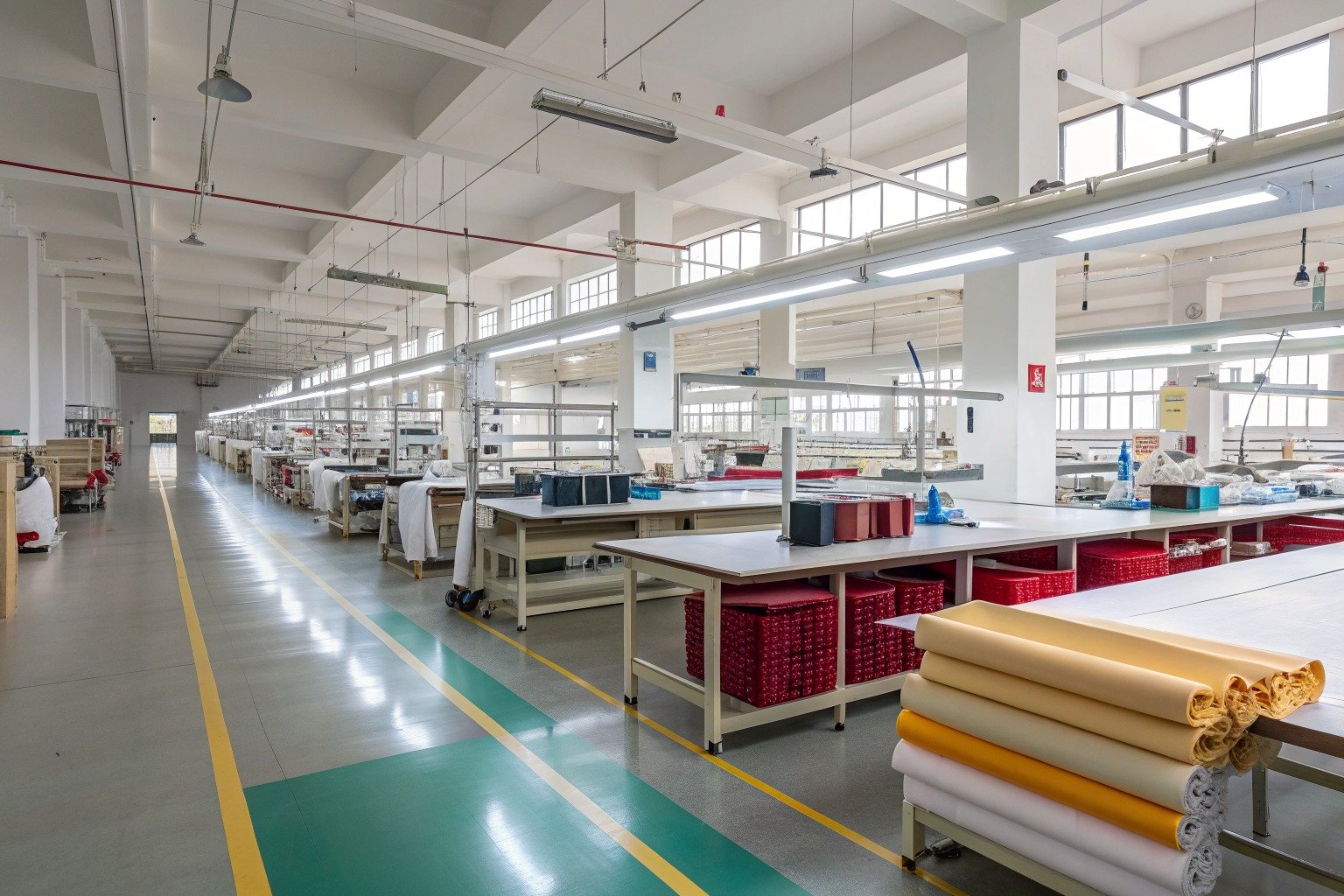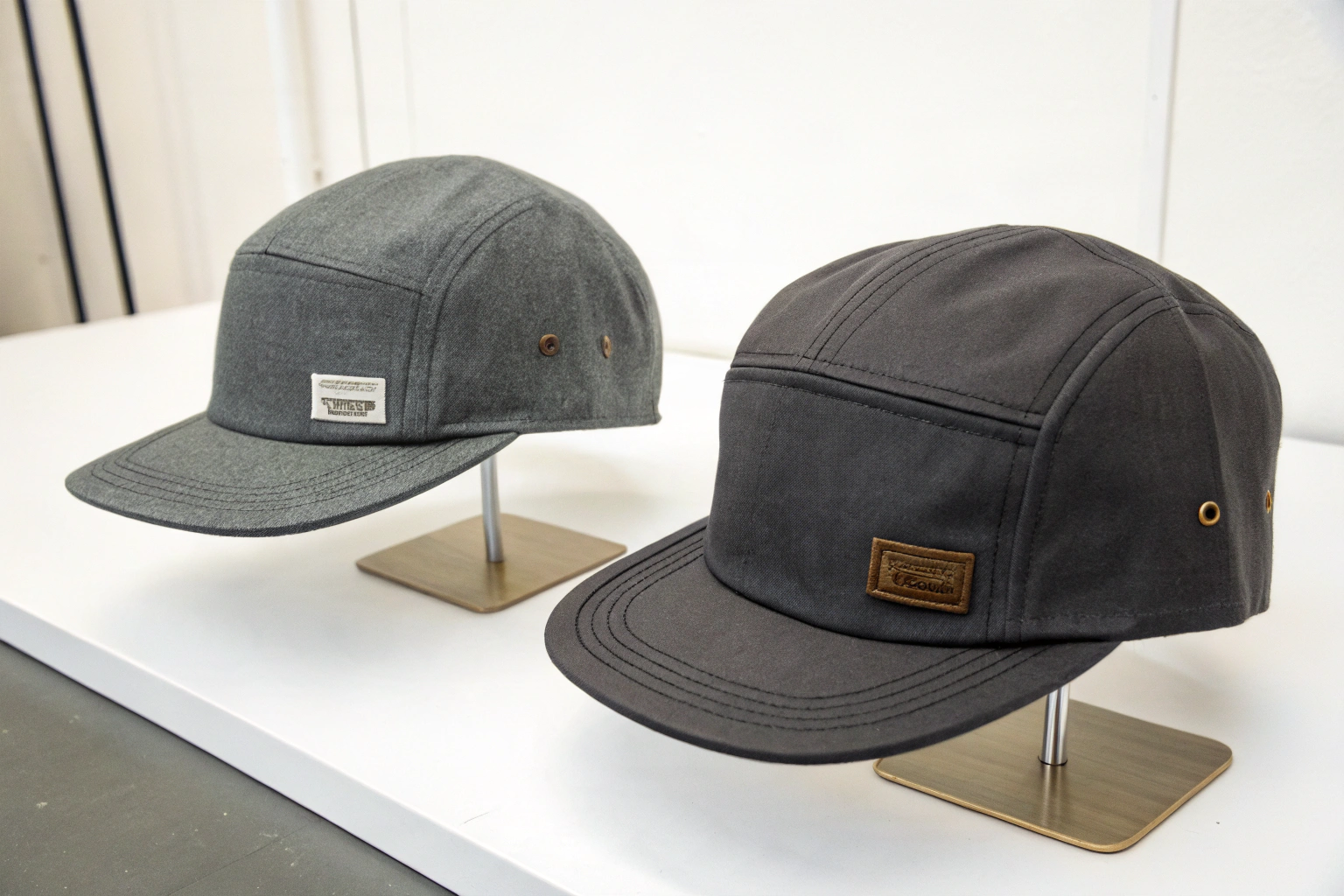
I had a streetwear brand owner sit across from me at a trade show in Berlin last year. He pulled out two caps from his bag. One was a 5-panel camp cap with a flat brim and a woven label on the front seam. The other was a 6-panel structured cap with a curved brim and a 3D puff embroidery logo on the front two panels. He had been sourcing these from two different factories. The 5-panel factory couldn’t do structured crowns. The 6-panel factory couldn’t do the clean front seam that a 5-panel demands. He was paying double freight, managing two supplier relationships, and dealing with color mismatches between the two styles. He asked me if I could produce both in one order. I told him I do it every week.
Yes, a professional headwear factory can absolutely produce both 5-panel and 6-panel baseball caps for streetwear in a single consolidated order. The 5-panel cap, sometimes called a camp cap, is constructed from five fabric panels with a distinctive center front seam and typically features an unstructured or low-profile crown. The 6-panel cap is constructed from six fabric panels with a center front panel pair that provides a seamless surface for large logo embroidery. The two styles share the same cutting tables, sewing lines, brim pressing stations, and closure attachment equipment. The only differences are the panel pattern pieces, the sewing sequence, and the front panel preparation. A factory with both pattern sets and trained sewing operators can switch between styles in minutes.
I run a headwear factory in Zhejiang. Streetwear brands are my largest customer segment. They demand both 5-panel and 6-panel caps because their customers want both. The 5-panel is the retro, skate-inspired, casual silhouette. The 6-panel is the classic, structured, statement-piece silhouette. A brand that offers only one is missing half the market. I want to explain exactly how we construct each style, what makes them different, and how combining them in one order saves money, guarantees color consistency, and simplifies logistics.
What Are the Structural Differences Between 5-Panel and 6-Panel Baseball Caps?
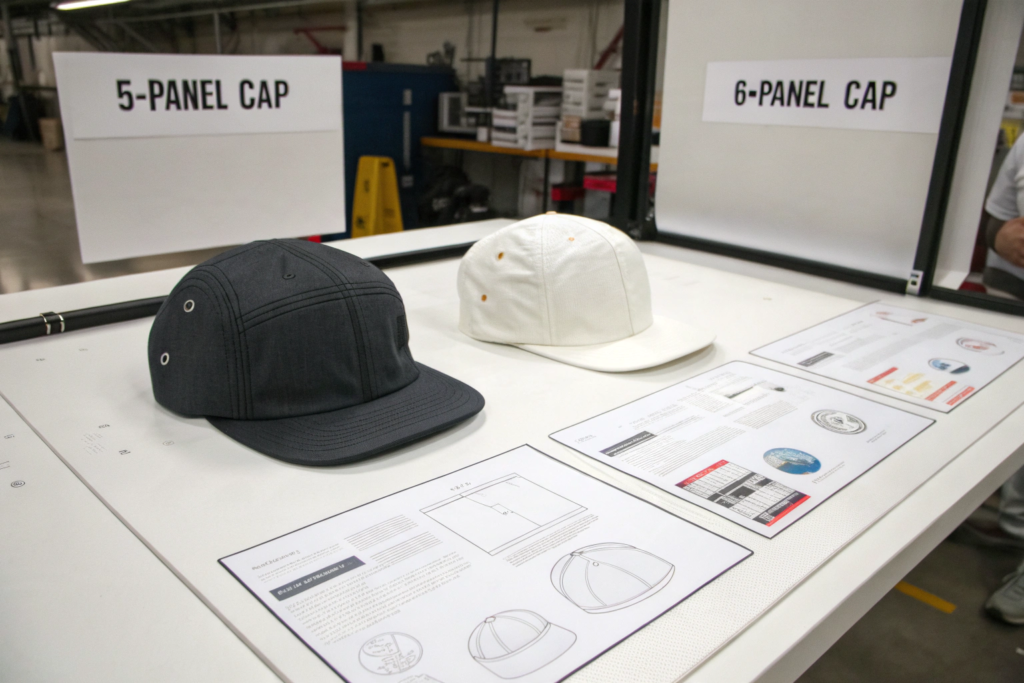
The number of panels is the obvious difference, but the structural implications run deeper. A 5-panel cap has a seam running straight down the center of the front. This seam is not a hidden construction detail. It is a design feature. It gives the cap its distinctive retro, utilitarian look. A 6-panel cap has two front panels that meet at a center seam, creating a smooth, uninterrupted front surface. This surface is the billboard for the brand’s logo. The choice between 5-panel and 6-panel is not just about aesthetics. It is about where the brand wants to place its logo and what silhouette it wants to project.
The structural differences between 5-panel and 6-panel caps are defined by panel count and seam placement, crown structure, and closure style. Panel count: the 5-panel cap consists of one center front panel, two side panels, and two back panels. The 6-panel cap consists of two center front panels, two side panels, and two back panels. Crown structure: the 5-panel is typically unstructured or lightly structured, with no buckram backing on the front panels, creating a relaxed, slouchy silhouette. The 6-panel streetwear cap is typically structured with a buckram-backed front two panels, creating a tall, crisp, vertical silhouette. Closure: the 5-panel often features a strapback closure with a metal or plastic buckle. The 6-panel often features a snapback closure. Both styles can also be made in fitted sizes.
I keep both pattern sets in my factory’s pattern library. The 5-panel pattern has five pieces plus the brim, sweatband, and closure. The 6-panel pattern has six pieces plus the same components. When an order switches from one style to the other, my cutting team pulls the correct pattern file, loads it into the automated cutting machine, and begins cutting within minutes.
Why Does the 5-Panel Center Front Seam Define the Streetwear Camp Cap Aesthetic?
The center front seam on a 5-panel cap is a reference to vintage military and outdoor caps from the mid-20th century. It was originally a practical construction method that allowed the cap to be made from narrower pieces of fabric. Streetwear adopted this utilitarian detail and transformed it into an aesthetic signature. The seam is often emphasized with a contrast stitch, a woven label placed directly over it, or a subtle tonal stitch that is visible on close inspection.
The seam also changes how the cap wears. Without the stiff buckram backing found in a 6-panel, the 5-panel crown molds to the wearer’s head over time. It develops a personal shape. It looks better with age. This lived-in quality is central to the streetwear ethos. A 5-panel cap is not meant to look pristine. It is meant to look like it has been worn, skated in, and lived in. The cultural history of the 5-panel camp cap in streetwear documents how this utilitarian silhouette became a streetwear staple.
How Does the 6-Panel Structured Crown Provide a Better Canvas for Logo Embroidery?
A 6-panel cap has two front panels that are sewn together at a center seam, then backed with a stiff buckram interfacing. The buckram is a woven fabric impregnated with a stiffening agent. It is fused or sewn to the inside of the front panels. The result is a flat, rigid surface that stands vertically even when the cap is not on a head.
This flat, rigid surface is the ideal substrate for embroidery. The embroidery machine hoops the front panels flat. The needle penetrates the fabric and the buckram, creating stitches that are uniform in depth and tension. The logo stands crisp and sharp. There is no center seam to interrupt the design. The entire front of the cap is a continuous canvas. Puff embroidery, which places a foam layer under the stitches to create a raised, three-dimensional effect, is particularly dependent on this flat, stable surface. Any warping or flexing of the substrate during embroidery causes the puff to distort. The embroidery substrate requirements for structured caps explain why the 6-panel structured crown is the preferred choice for bold, dimensional logo work.
How Does Combining 5-Panel and 6-Panel Caps in One Order Reduce Costs?
Splitting a cap order between two factories is a false economy. The unit price from each specialist might appear lower, but the hidden costs accumulate fast. Two fabric purchases at lower volumes. Two sets of shipping charges. Two sets of customs brokerage fees. Two sets of quality inspections. Two bank transfers. The combined landed cost is almost always higher than sourcing both styles from one factory.
Combining 5-panel and 6-panel caps in a single factory order reduces costs through fabric consolidation, shipping consolidation, and administrative consolidation. Fabric for both styles is purchased in a single order from the mill, qualifying for volume pricing. The caps are packed in a single shipment, eliminating duplicate freight, handling, and customs fees. A single quality inspection covers both styles. A single bank transfer covers the entire order. The total savings typically range from 8% to 15% compared to splitting the order. Most importantly, both styles are cut from the same fabric dye lot, guaranteeing perfect color consistency between the 5-panel and 6-panel caps in the retail display.
I show my buyers the landed cost comparison on every quotation. A recent order for a UK streetwear brand combined 400 5-panel canvas caps and 400 6-panel canvas caps in the same black and sand colorways. The single consolidated shipment via air freight cost approximately $320. Two separate half shipments would have cost approximately $480. The single inspection cost $350. Two would have cost $700. The savings exceeded $500. The buyer applied those savings to upgrade from standard embroidery to puff embroidery on the 6-panel caps.

How Does Shared Fabric Purchasing Guarantee Color Consistency Across Both Cap Styles?
A streetwear brand displays 5-panel and 6-panel caps on the same retail rack, often in the same colorway. If the black canvas on the 5-panel is slightly different from the black canvas on the 6-panel, the display looks inconsistent. The customer notices. The brand looks like it does not control its supply chain.
When both styles are produced in one factory, the fabric is ordered in a single purchase from the mill. A single dye lot means the black canvas used for the 5-panel caps is the exact same black as the canvas used for the 6-panel caps. The color consistency is guaranteed at the material level. The factory’s QC team also verifies the color match on finished caps from both styles under a D65 light booth before packing. The color consistency management across multiple product styles is a technical requirement that a single-factory approach solves inherently.
What Are the Logistics Savings from a Single Consolidated Streetwear Cap Shipment?
Streetwear brands often operate on tight margins and seasonal drops. Every dollar spent on freight is a dollar not spent on marketing, photography, or the next production run. Consolidating 5-panel and 6-panel caps into one shipment generates savings at multiple points in the logistics chain.
The factory packs both styles into a single pallet or a single set of cartons. The freight forwarder charges for one pickup, one handling, one ocean or air freight charge, and one delivery. The customs broker charges for one entry. The receiving warehouse processes one inbound shipment, not two. For a typical order of 500 to 1,000 caps, the logistics savings from consolidation are $300 to $600. The freight consolidation benefits for small to medium fashion brands are a standard logistics optimization strategy.
What Quality Control Checks Are Specific to 5-Panel and 6-Panel Caps?
The defect profiles of 5-panel and 6-panel caps overlap but have distinct differences. Both styles are checked for seam strength, colorfastness, brim warp, closure function, and logo placement accuracy. But the 5-panel cap has a critical inspection point that the 6-panel does not: the center front seam. The 6-panel cap has a critical inspection point that the 5-panel does not: the buckram backing alignment and the front panel symmetry. The QC checklist must address the failure modes specific to each construction.
Quality control for a mixed 5-panel and 6-panel order uses a unified inspection protocol with style-specific checkpoints. The shared checkpoints include fabric color match, seam strength, brim flatness or curvature, sweatband stitch integrity, closure function, and logo placement. The 5-panel-specific checkpoints include center front seam straightness measured against a straightedge, center front seam stitch tension, and the absence of puckering along the seam. The 6-panel-specific checkpoints include buckram backing alignment, front two-panel symmetry, and the absence of buckram show-through on the front panel surface. A single QC inspector applies the appropriate checklist to each style within the same sampling session.
I train my QC inspectors on both checklists. When a mixed order is ready for inspection, the inspector pulls the AQL random sample from the combined lot, separating the 5-panel and 6-panel caps into two groups. The shared checks are performed on all caps. The style-specific checks are performed on each group. A single inspection report is issued covering both styles.
How Is the 5-Panel Center Front Seam Inspected for Straightness and Stitch Integrity?
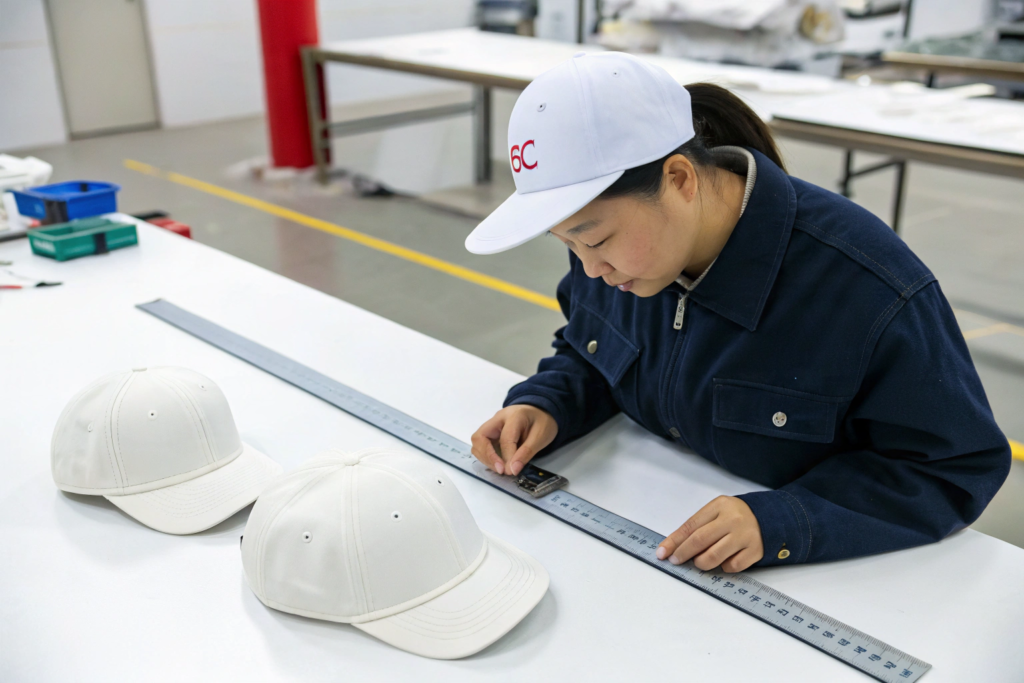
The center front seam on a 5-panel cap is the focal point of the cap’s design. A seam that waves, puckers, or drifts off-center is immediately visible and renders the cap unsellable. The inspection must verify that the seam is dead straight and that the stitching is consistent in tension and appearance.
The inspector places the cap on a flat inspection surface with the front panel facing up. A steel straightedge is aligned along the center seam. The inspector visually checks for any gap between the seam and the straightedge. A deviation greater than 1.0 millimeter at any point is a defect. The stitch tension is checked by gently pulling the fabric on either side of the seam. The stitches should not gap open or create visible holes. The stitch line should be a consistent distance from the fabric edge, typically 3 to 5 millimeters. Any waviness in the stitch line is a defect. The seam quality inspection standards for sewn products provide the objective criteria.
How Is Buckram Alignment and Front Panel Symmetry Checked on 6-Panel Caps?
The buckram backing on a 6-panel cap must be positioned precisely behind the front two panels. If the buckram is shifted, one front panel appears flatter than the other, the center seam between the two front panels is distorted, or the buckram edge creates a visible ridge on the front panel surface. The cap looks lopsided.
The inspector checks buckram alignment by feeling the front panels with both hands, pressing gently to locate the buckram edges. The edges should be symmetrical relative to the center seam. The inspector also holds the cap at eye level and views it from the front. The two front panels should be mirror images in width, height, and curvature. A panel width difference greater than 2.0 millimeters is a defect. The buckram should not be visible through the face fabric. Any show-through, where the white buckram is visible through a dark fabric, is a defect. The structured cap quality standards for buckram alignment define the acceptable tolerances.
How Do You Structure a Mixed 5-Panel and 6-Panel Purchase Order?
A vague purchase order is the root cause of production errors on mixed-style orders. The factory receives a quantity, a color, and a logo file. They don’t know which style gets the 5-panel construction and which gets the 6-panel. They don’t know which gets the strapback closure and which gets the snapback. They guess. The guess is wrong. The order is delayed. A structured purchase order eliminates the guessing.
A mixed 5-panel and 6-panel purchase order must list each cap style as a separate line item with a distinct SKU. Each SKU specifies the panel count, crown structure, brim type, closure type, fabric reference, color, logo application method and placement, size, and packaging. A summary table at the bottom of the PO confirms the total quantity of each style, the carton count, and the shipping method. A visual reference sheet with photographs of the approved pre-production samples for each style eliminates any ambiguity about the expected finished product.
I provide a mixed cap PO template to every streetwear brand buyer. The template has separate columns for 5-panel and 6-panel specifications. When the template is filled out completely, my production team knows exactly what to cut, sew, press, and pack. When the template arrives with blanks, the order sits in the clarification queue.
What Information Must Each Cap SKU Include to Prevent Construction Confusion?
A 5-panel cap and a 6-panel cap can look similar on a line drawing, especially if the fabric and color are the same. The SKU description must make the construction differences explicit so the cutting team, the sewing team, and the QC team all know which style they are handling.
A 5-panel cap SKU should specify "5-panel construction," "unstructured" or "lightly structured," "center front seam," "strapback closure with metal buckle" or specific closure type, and "flat brim" or "curved brim" as specified. A 6-panel cap SKU should specify "6-panel construction," "structured with buckram backing," "no center front seam," "snapback closure" or specific closure type, and "curved brim" or "flat brim" as specified. The SKU description should also specify the fabric, color, logo application method, and logo placement. The purchase order specification best practices for apparel manufacturing ensure that the production team does not confuse the two constructions.
How Should Packaging and Labeling Differentiate the Two Cap Styles for Retail?
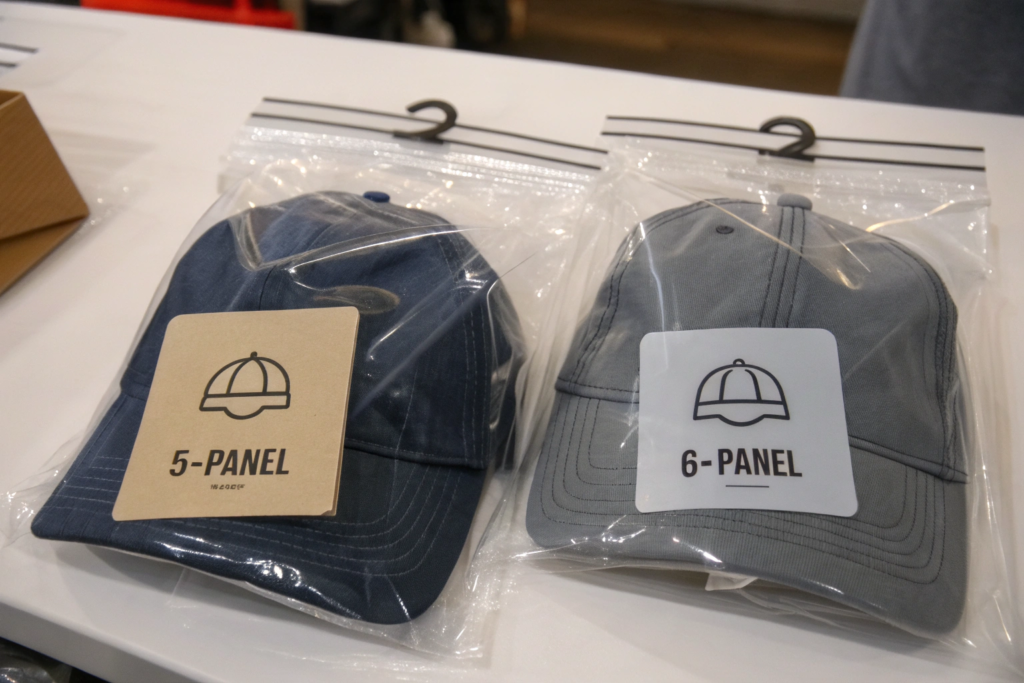
When 5-panel and 6-panel caps in the same colorway arrive at a retail stockroom, the staff cannot tell them apart without removing them from the packaging and examining the front seam. This causes mis-shipments to retail locations and incorrect online orders.
The packaging specification for a mixed order should include distinct hang tag designs for each style. The 5-panel tag could feature a small camp cap icon. The 6-panel tag could feature a structured cap icon. The poly bag or carton label should clearly state the style name. The inner carton packing list should separate the two SKUs. The warehouse staff should be able to pick the correct style at a glance without opening packaging. The retail packaging and labeling for multi-SKU product lines best practices apply here.
Conclusion
Producing both 5-panel and 6-panel baseball caps in one order is not a factory limitation. It is a supply chain advantage. You learned that the structural differences are real. The 5-panel cap with its center front seam, unstructured crown, and strapback closure delivers the retro, lived-in streetwear aesthetic. The 6-panel cap with its buckram-backed front panels, seamless logo surface, and snapback closure delivers the bold, structured statement piece. A factory that understands both constructions can switch between them in minutes.
We walked through the cost advantages. Shared fabric purchasing guarantees color consistency across both styles and qualifies for volume pricing. Consolidated shipping, inspection, and bank transfers save 8% to 15% on the total landed cost. These savings are not theoretical. They are documented on every mixed order I ship.
We detailed the quality control differences. The 5-panel center front seam is checked for straightness with a steel straightedge. The 6-panel buckram alignment is checked for symmetry by feel and by eye. A single inspector applies both checklists in one sampling session. One report. One approval.
And we covered the purchase order structure that prevents confusion. Separate SKUs with explicit construction descriptions. Distinct packaging and labeling so retail staff can tell the styles apart at a glance. The details are small, but they prevent the mis-shipments and mix-ups that frustrate retail partners.
At AceAccessory, I produce mixed 5-panel and 6-panel orders for streetwear brands every week. My pattern library has both pattern sets. My sewing team is trained on both constructions. My QC team applies both checklists. My shipping team builds consolidated pallets with clearly marked cartons. I do not ask my buyers to split their orders between factories. I ask them to send me the complete order and let me manage the production.
If you are a streetwear brand that wants to offer both 5-panel and 6-panel caps without the cost and complexity of managing two suppliers, I invite you to contact our Business Director, Elaine. She can send you our mixed cap PO template, fabric swatch cards, and a detailed quotation for your specific breakdown. Reach her at elaine@fumaoclothing.com. Let’s produce caps for every silhouette your customer wants, in one order, with one shipment, and perfect color consistency.