A buyer from a major French supermarket chain sat across from me at a trade show in Lyon last spring. She pulled out a printed policy document and slid it across the table. It was her company’s sustainable packaging mandate. By the first quarter of 2027, every hair clip, every headband, every hair accessory sold in their stores must be packaged in material that is certified home compostable. Not recyclable. Not made from recycled content. Compostable. She told me that suppliers who could not meet this requirement would be delisted. No exceptions. No extensions. She was visiting every supplier in her portfolio, and she was visibly stressed. Several of her long-term Asian suppliers had told her they simply could not do it. They did not have access to certified compostable materials. They did not understand the certification process. They were not willing to invest in the change. She asked me if we could. I told her we were already developing compostable packaging solutions for our European retail clients and that we would be fully compliant well before her deadline. Her relief was visible.
European supermarkets are requiring compostable packaging for hair clips by 2027 because of a convergence of regulatory mandates, corporate sustainability commitments, and consumer pressure. The regulatory driver is the EU Packaging and Packaging Waste Regulation, which sets binding targets for packaging waste reduction, recycled content, and recyclability, and which is being transposed into national laws across EU member states. France’s AGEC Law, one of the most aggressive in Europe, explicitly bans single-use plastic packaging for many consumer goods and mandates compostable alternatives. The corporate driver is the voluntary commitments that major European retailers, including Carrefour, Tesco, Aldi, and Lidl, have made to eliminate problematic plastics from their supply chains by 2025 to 2027. These retailers are using their purchasing power to enforce compliance throughout their supply base. The consumer driver is the growing demand from European shoppers, particularly in France, Germany, and Scandinavia, for plastic-free, biodegradable packaging that aligns with their environmental values. A hair clip packaged in compostable material is a visible, tangible demonstration of the retailer’s and the brand’s commitment to sustainability.
This is not a distant future trend. It is a business reality that is already reshaping the global hair accessories supply chain. Factories and brands that act now to develop compostable packaging solutions will secure their position with the largest and most stable retail accounts in Europe. Those that delay will find themselves locked out of a significant portion of the market. At AceAccessory, we made the strategic decision to invest in compostable packaging research, material sourcing, and certification two years ago. Today, we offer fully certified home compostable packaging for our entire range of hair accessories. Let me walk you through the regulations, the materials, the certification process, and the practical steps to transition your packaging before the 2027 deadline.
What EU Regulations Are Driving Compostable Packaging Mandates
The shift to compostable packaging is not being driven by voluntary goodwill. It is being driven by law. The European Union has enacted the most ambitious packaging waste legislation in the world, and individual member states, particularly France, have added their own, even more stringent requirements. These laws set binding targets, impose bans on specific materials, and create enforcement mechanisms that include fines, product withdrawal orders, and market access restrictions. For any factory or brand that supplies European retailers, understanding this regulatory landscape is not optional. It is a business requirement.
The EU regulatory framework driving compostable packaging mandates is anchored by the Packaging and Packaging Waste Regulation, or PPWR, which entered into force in 2024 and sets binding targets for all EU member states. The PPWR requires that all packaging placed on the EU market be recyclable or reusable by 2030, with specific targets for recycled content in plastic packaging. It also mandates that certain types of single-use packaging, including packaging for small consumer goods, be replaced with compostable alternatives where recycling is not technically or economically feasible. France’s AGEC Law, the Anti-Waste for a Circular Economy law, is the most aggressive national legislation. It bans single-use plastic packaging for a wide range of products and mandates that packaging for certain consumer goods be home compostable by 2025, with the scope expanding through 2027. The French decree specifically targets small plastic items, including packaging for hair accessories, cosmetics, and personal care items. Italy and Spain have similar, though slightly less aggressive, legislation in development. Germany’s Packaging Act, or VerpackG, imposes extended producer responsibility obligations and high recycling targets, which indirectly drive compostable packaging adoption. The key takeaway is that by 2027, selling a hair clip in a conventional plastic blister pack or polybag will be illegal in France and potentially other EU markets, and will be in violation of the sustainability policies of every major European supermarket chain.
The regulatory pressure is not theoretical. It is being enforced. Rospotrebnadzor in Russia, we discussed in a previous article, enforces consumer protection. In Europe, the enforcement is through customs inspections, retailer audits, and the threat of fines that can reach millions of euros for large-scale non-compliance. Let me explain the two most impactful regulations in more detail.
How Does the EU Packaging and Packaging Waste Regulation Affect Small Accessories?
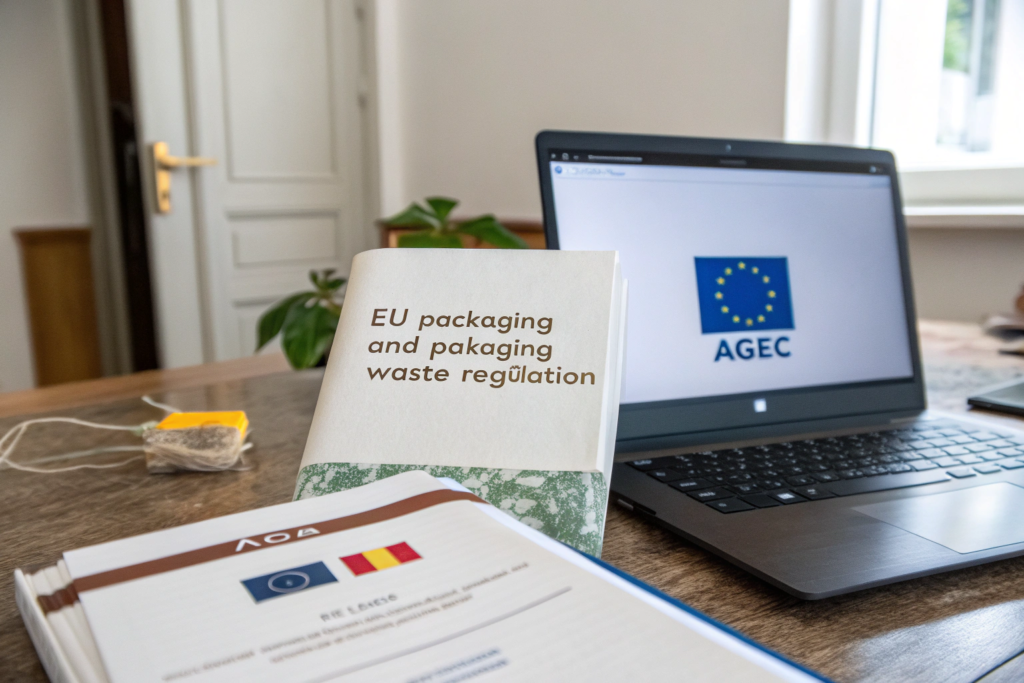
The PPWR is the umbrella legislation that sets the framework for all packaging regulation in the EU. It applies to all packaging placed on the EU market, regardless of the country of origin. A hair clip manufactured in China and shipped to a retailer in Germany is subject to the PPWR just as much as a hair clip manufactured in France. The PPWR has several provisions that directly affect small accessories packaging. First, it mandates that by 2030, all packaging must be designed for recycling. This means the packaging material must be collected, sorted, and recycled at scale in the EU. Conventional mixed-material blister packs, a plastic blister glued to a cardboard backer, are a nightmare to recycle because the materials cannot be easily separated. Compostable packaging is recognized as a valid alternative where recycling is not feasible. Second, the PPWR sets minimum recycled content targets for plastic packaging. By 2030, plastic packaging must contain at least 10 to 35 percent recycled content, depending on the plastic type. This requires a supply chain for recycled plastics that is currently underdeveloped. Compostable bioplastics, which are made from renewable resources rather than recycled fossil plastics, offer an alternative compliance pathway. Third, the PPWR empowers member states to impose their own, stricter requirements. France’s AGEC Law is an example of a member state using this empowerment to go further and faster than the EU baseline. Fourth, the PPWR includes provisions on packaging minimization. Packaging must be reduced to the minimum necessary to protect the product and ensure hygiene. Oversized blister packs with excessive empty space are targeted. A small, form-fitting compostable wrapper meets the minimization requirement more effectively than a large, rigid plastic blister. The PPWR is not a suggestion. It is a regulation, which means it is directly binding on all economic operators in the EU. Non-compliance can result in fines, product recalls, and market access bans.
What Is the French AGEC Law and Why Is It the Benchmark?
The French AGEC Law, enacted in 2020 and progressively implemented through a series of decrees, is the most aggressive anti-plastic-waste legislation in Europe. It is the benchmark that other European countries are watching and, in many cases, beginning to emulate. The AGEC Law has several provisions that directly mandate compostable packaging for products like hair clips. The most relevant is the ban on single-use plastic packaging for a progressively expanding list of consumer products. The initial ban covered items like plastic straws, cutlery, and cotton buds. Subsequent decrees have extended the ban to packaging for fruits and vegetables, and to packaging for a range of small consumer goods. The specific decree that affects hair accessories is the one targeting "small plastic items" and "unnecessary plastic packaging." A conventional plastic polybag or blister pack for a hair clip is classified as unnecessary single-use plastic packaging. The law mandates that such packaging be replaced with a reusable, recyclable, or compostable alternative. The AGEC Law explicitly favors home compostable packaging for small items because home composting does not rely on industrial composting infrastructure, which is not yet universally available. A home compostable wrapper can be disposed of in the consumer’s home compost bin, where it will biodegrade within 12 months under ambient conditions. The AGEC Law also includes extended producer responsibility provisions that make the producer, meaning the brand or the importer, financially responsible for the end-of-life management of their packaging. This creates a direct financial incentive to choose packaging that is less expensive to manage at end of life. Compostable packaging, which can be composted at home at zero cost, is more economically attractive than plastic packaging that requires collection, sorting, and mechanical recycling. The enforcement of the AGEC Law is carried out by the DGCCRF, the French consumer protection and anti-fraud agency. They conduct inspections at retail stores and at import points. Non-compliant products can be ordered off the market, and fines of up to 15,000 euros per violation can be imposed. For a brand selling thousands of units, the financial risk of non-compliance is existential.
What Materials Qualify as Compostable Hair Clip Packaging
The term "compostable" is not a generic descriptor. It is a certified, tested, and legally defined claim. Not all materials that are marketed as biodegradable or eco-friendly are compostable. A material can only be called compostable if it meets specific standards for biodegradation, disintegration, ecotoxicity, and heavy metal content. For the European market, the relevant standard is EN 13432 for industrially compostable packaging and the more stringent OK Compost HOME standard for home compostable packaging. Home compostable certification is the gold standard for small accessories packaging because it does not rely on the consumer having access to an industrial composting facility.
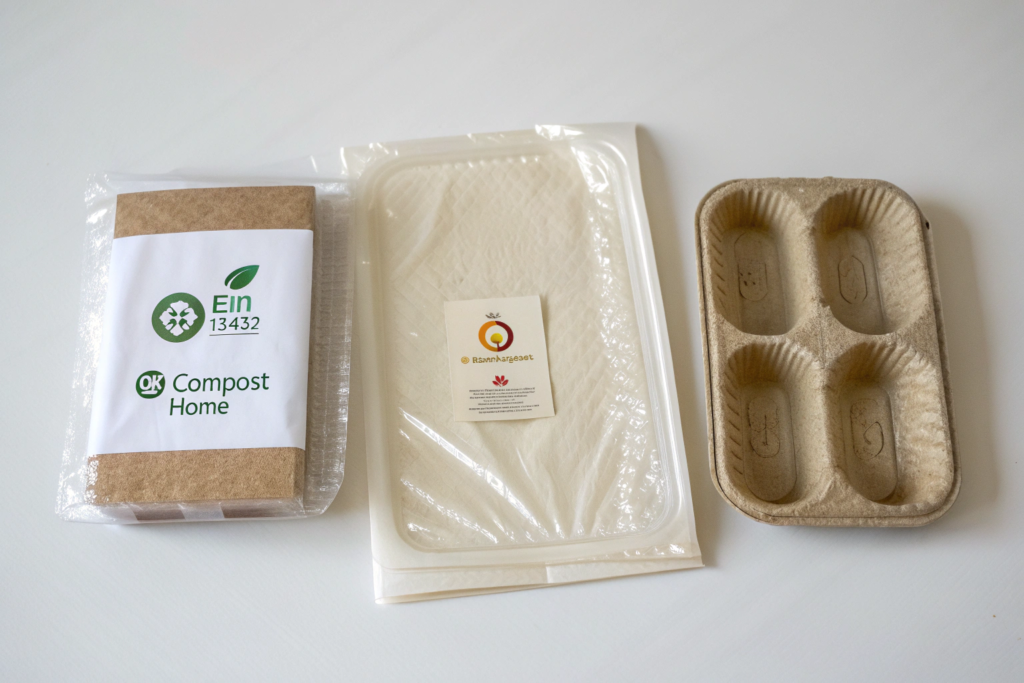
The materials that qualify as compostable hair clip packaging are those that have been certified to the EN 13432 standard for industrial compostability or, preferably, the TÜV Austria OK Compost HOME standard for home compostability. The most common materials are PLA, polylactic acid, a clear, biobased plastic made from fermented corn starch or sugarcane, which looks and feels similar to conventional clear plastic but is compostable under the right conditions. Cellulose-based films, made from wood pulp and often referred to as compostable cellophane, offer a clear, crisp material with excellent printability. PHA, polyhydroxyalkanoate, a biopolymer produced by bacterial fermentation, is a newer material that offers home compostability and marine biodegradability. Paper-based materials, including coated papers with compostable barrier coatings, are suitable for hang tags, header cards, and outer cartons. Molded fiber trays made from bagasse, sugarcane waste, or bamboo fiber can replace plastic blister trays. All of these materials must be certified by an independent laboratory and must carry the appropriate certification logo on the packaging to be legally marketed as compostable in the EU.
The choice of material depends on the specific packaging application, the required barrier properties, the print quality needed, and the target price point. For a simple hair clip wrapper, a PLA or cellulose film is typically the most cost-effective and practical solution. Let me explore the two most widely used materials.
What Is PLA and How Is It Used for Accessory Wrappers?
PLA, polylactic acid, is the most widely available and economically viable compostable bioplastic. It is made by fermenting plant sugars, typically from corn or sugarcane, to produce lactic acid, which is then polymerized into a plastic resin. The resin can be extruded into film, injection molded into shapes, or thermoformed into trays. For hair clip packaging, PLA film is the primary application. PLA film looks remarkably similar to conventional polypropylene or cellophane film. It is clear, glossy, and can be heat-sealed. A hair clip can be placed inside a PLA bag, and the bag can be sealed, creating a package that looks and functions like a conventional plastic polybag. The difference is that a PLA bag, when disposed of in a home compost bin, will begin to biodegrade. The microorganisms in the compost break down the PLA polymer into lactic acid, which is further broken down into water, carbon dioxide, and biomass. The process takes several months under home composting conditions, which is slower than industrial composting but still acceptable under the OK Compost HOME standard. PLA has some limitations. It has a lower heat resistance than conventional plastics, so it can soften or deform if left in a hot car on a summer day. It has moderate moisture barrier properties, which is adequate for a non-food product like a hair clip. It is slightly more expensive than conventional polypropylene, typically 20 to 50 percent more per unit, but the price premium is decreasing as production scales up. The critical requirement for PLA packaging used in the EU is that it must be certified. We source our PLA film from suppliers who provide the TÜV Austria OK Compost HOME certificate for the specific film grade we use. We maintain a copy of the certificate in our technical file, and we provide it to our retail clients for their own compliance records.
Can Kraft Paper and Cardboard Be Certified as Compostable?
Kraft paper and cardboard are, in their natural state, compostable. They are made from wood pulp, an organic material that microorganisms in a compost heap can readily digest. However, not all paper and cardboard products can be legally marketed as compostable. The certification depends on what has been added to the paper. Many conventional papers are coated with a thin layer of polyethylene plastic to provide water resistance or heat sealability. A polyethylene-coated paper is not compostable because the plastic coating does not biodegrade. Printing inks can also affect compostability. Conventional petroleum-based inks contain heavy metals and other compounds that can be toxic to the compost ecosystem. For paper and cardboard packaging to be certified as compostable, all components, the paper substrate, the coatings, the printing inks, and the adhesives, must individually meet the compostability criteria. We use uncoated kraft paper or kraft paper with a certified compostable barrier coating, such as a water-based dispersion coating, for header cards and outer cartons. The printing is done with soy-based or water-based inks that are certified compostable. The adhesive used to assemble the carton is a certified compostable hot melt or water-based adhesive. The finished packaging is then submitted for certification as a complete product. The OK Compost HOME certification for a paper product verifies that the entire assembled package, not just the paper, will biodegrade safely in a home compost environment. Kraft paper and cardboard have a significant aesthetic advantage for hair clip packaging. The natural, matte, earthy look of kraft paper aligns beautifully with the natural, sustainable brand positioning that many European retailers are cultivating. A hair clip on a kraft paper header card, inside a clear PLA bag, with all packaging certified home compostable, is a very compelling retail presentation. It communicates sustainability at a glance, before the consumer even reads the label.
What Certification Is Required for Compostable Packaging in the EU
Certification is the bridge between a material claim and a legal claim. In the EU, a packaging product cannot be marketed as compostable without independent, third-party certification. The certification provides legal protection for the brand and the retailer. If a consumer or a regulator challenges the compostability claim, the certificate is the proof that the claim is valid. The certification process involves laboratory testing according to a defined standard, an audit of the manufacturing facility, and ongoing surveillance to ensure continued compliance.
The certification required for compostable packaging in the EU is based on the harmonized standard EN 13432, which defines the requirements for packaging recoverable through composting and biodegradation. For home compostable packaging, the TÜV Austria OK Compost HOME certification is the most widely recognized and trusted mark. The certification process involves four key tests. Biodegradation testing measures the percentage of the material that is converted to carbon dioxide by microorganisms over a defined period. For home compostable certification, at least 90 percent biodegradation must be achieved within 12 months at ambient temperature, typically 20 to 30 degrees Celsius. Disintegration testing measures the physical breakdown of the material. After 12 weeks in a controlled compost environment, no more than 10 percent of the material fragments should be larger than 2 millimeters. Ecotoxicity testing verifies that the compost produced from the biodegraded material is not toxic to plants. A plant growth test using cress or barley seeds is conducted, comparing growth in compost with the test material to growth in control compost. Heavy metal testing verifies that the material does not contain levels of heavy metals, such as lead, cadmium, mercury, and chromium, above the strict limits set by the standard. Only when all four tests are passed is the certification granted. The certification must be renewed annually, and the certifying body conducts periodic audits of the manufacturing facility.
The certification is specific to the material, the thickness, the printing, and the construction. A certificate for a 30-micron clear PLA film with no printing is not valid for the same film with soy-based printing. The printing ink must also be certified. This means every specific packaging configuration must be individually certified. This is a significant administrative and financial undertaking, but it is an absolute requirement for legal compliance in the EU market. Let me explain the two certification standards in more detail.
What Is the Difference Between EN 13432 and OK Compost HOME?
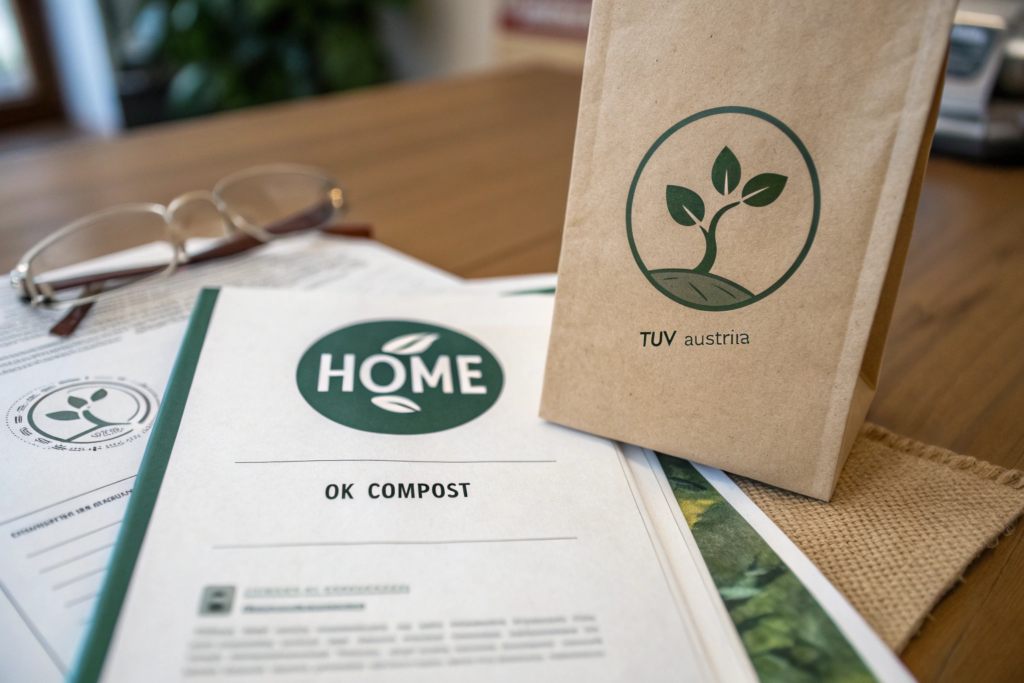
EN 13432 is the harmonized European standard for packaging recoverable through composting and biodegradation. It was originally developed for industrial composting, which occurs in dedicated facilities at elevated temperatures, typically 50 to 60 degrees Celsius, and under controlled conditions. A material certified to EN 13432 is guaranteed to biodegrade in an industrial composting facility within a specified timeframe, typically 90 days. The limitation of EN 13432 for consumer packaging is that it does not guarantee compostability in a home compost bin. Home compost bins operate at lower, fluctuating temperatures, with less controlled moisture and aeration. A material that composts perfectly in an industrial facility may not compost at all in a home bin. The French AGEC Law and the policies of several major European retailers specifically require home compostability because the consumer is expected to dispose of the packaging in their home compost bin. The OK Compost HOME certification, developed and managed by TÜV Austria, addresses this gap. It uses a modified test protocol based on EN 13432 but with lower test temperatures, 20 to 30 degrees Celsius, and a longer test duration, 12 months for biodegradation. The OK Compost HOME certification guarantees that the material will biodegrade in a typical home compost environment. The logo is a circular seedling symbol with the word "HOME" underneath. This logo is recognized by European consumers and retailers as the definitive mark of home compostability. For hair clip packaging destined for the EU market, OK Compost HOME is the certification to pursue. EN 13432 alone is not sufficient for the French market and is increasingly not accepted by retailers in Germany and Scandinavia. Our packaging materials are certified to OK Compost HOME, and we include the logo on the packaging itself and on the outer carton.
How Do You Verify a Supplier’s Compostable Packaging Certification?
Verifying a supplier’s certification is a critical step in the sourcing process. A supplier may claim their packaging is compostable, but without a valid, current certificate from an accredited certifying body, the claim is legally worthless and potentially risky. The verification process is straightforward. Ask the supplier to provide a copy of the certification certificate. The certificate must be issued by an accredited certification body, such as TÜV Austria, DIN CERTCO, or the Biodegradable Products Institute, though BPI is a North American standard and is not directly equivalent to EU requirements. The certificate must state the certification standard, EN 13432 or OK Compost HOME. The certificate must list the specific product that is certified, including the material type, the thickness, and any coatings or printing. A generic certificate that does not match the specific packaging being used is not valid. The certificate must be within its validity period. Certifications typically expire after one year and must be renewed. Check the expiration date. The certificate must include a certification number. This number can often be verified on the certifying body’s website. TÜV Austria, for example, has an online database where you can enter the certification number and confirm its validity. The certificate should be accompanied by the test reports from the laboratory that performed the testing. These reports provide the detailed data behind the certification. A supplier that is reluctant to provide the certificate, that provides a certificate that does not match the product, or that provides a certificate that has expired, should not be trusted. We maintain a current certification file for every compostable packaging material we use, and we provide the complete file to our clients. The file is updated annually when certifications are renewed. This transparency is essential for building trust with European retail buyers who are personally accountable for the compliance of the products they purchase.
How to Transition Your Hair Clip Packaging Before the 2027 Deadline
The 2027 deadline is not as far away as it seems. Developing and implementing a compostable packaging solution takes time. Materials must be sourced and tested. Tooling for heat sealing or packaging machinery may need to be adjusted for the different thermal properties of compostable films. Certifications must be obtained. Retailer approvals must be secured. A gradual transition, starting now, is far less risky and less expensive than a last-minute panic conversion. Brands and factories that begin the transition in 2025 will have time to test, iterate, and optimize. Those that wait until late 2026 will face material shortages, capacity constraints, and the very real possibility of missing the deadline and losing their retail listings.
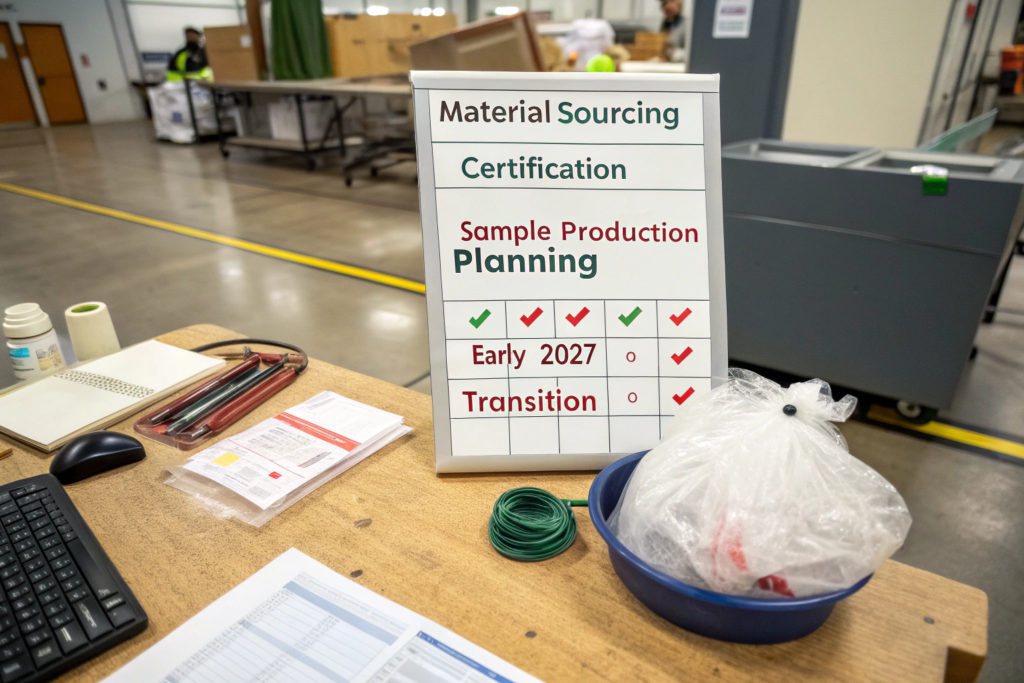
Transitioning hair clip packaging to certified compostable materials before the 2027 deadline requires a phased plan. Phase one, initiation, involves identifying the specific packaging formats that need to change, researching certified compostable material suppliers, obtaining material samples, and beginning the certification process. This phase should begin immediately. Phase two, testing and validation, involves producing sample packages with the new materials, testing the packaging performance, seal strength, clarity, print quality, and durability, sending the samples to retailers for approval, and completing the formal certification. This phase should be completed by mid-2026. Phase three, pilot production, involves running a small production batch with the new packaging, training the packing team on the new materials, and monitoring the packed products for any quality issues during storage and transit. This phase should be completed by late 2026. Phase four, full transition, involves converting all production for the affected products to the certified compostable packaging, depleting existing inventory of conventional packaging, and updating all marketing and product information to reflect the new packaging material. This phase should be completed by early 2027, well ahead of any specific retailer deadline. The transition cost includes the higher per-unit cost of compostable materials, the certification fees, and any equipment modifications. These costs should be factored into the product pricing for 2026 and 2027 orders.
The transition is a project, and it should be managed as such. Assign a project manager. Create a timeline with milestones. Allocate a budget. Communicate regularly with retail clients about progress. Let me explain the two most critical steps.
What Is the Cost Difference for Compostable Packaging Materials?
The cost of compostable packaging materials is currently higher than conventional plastic materials, but the gap is narrowing. A conventional clear polypropylene bag for a hair clip might cost a fraction of a cent per unit. A certified home compostable PLA bag of the same dimensions costs roughly two to three times that. The absolute cost difference per unit is small, often less than one cent. For a product that retails for several euros, this is a manageable increase. The cost drivers for compostable materials are the raw material cost, the manufacturing scale, and the certification cost. PLA resin is currently more expensive than polypropylene resin because the production capacity is smaller and the raw material, corn starch, is an agricultural commodity with its own price volatility. As PLA production capacity expands, driven by the European regulatory demand, the price is expected to decrease. The manufacturing scale is the second factor. Compostable film extrusion lines are less common than conventional film lines, and the throughput is sometimes lower. As more converters invest in these lines, the conversion cost will decrease. The certification cost is the third factor. The initial product certification can cost several thousand euros, and the annual renewal and audit add ongoing costs. For a factory producing millions of units, the certification cost per unit is negligible, a tiny fraction of a cent. For a factory producing smaller volumes, the per-unit certification cost is higher, which is a competitive disadvantage that may drive consolidation in the supply base. The most important perspective on cost is the cost of non-compliance. The cost of losing a major European retail account, with annual purchase volumes in the hundreds of thousands or millions of units, is infinitely greater than the incremental cost of compostable packaging. The cost of a regulatory fine, product recall, or market withdrawal dwarfs the packaging material cost increase. Compostable packaging is an investment in continued market access.
How Long Does the Certification Process Take?
The certification process is the pacing item in the transition timeline. It cannot be rushed, because the biodegradation test takes 12 months for home compostable certification. This is a biological process that requires real time. The test material is placed in a controlled compost environment, and the carbon dioxide evolution is measured over a 12-month period. There is no accelerated version of this test. The disintegration test takes 12 weeks. The ecotoxicity test takes several weeks. The entire testing process, from submitting samples to receiving the certificate, typically takes 12 to 18 months. This timeline has a critical implication. To have certification in hand by the 2027 deadline, the testing process must begin no later than mid-2025. Factories that have not yet submitted materials for testing are already cutting it close. There is a shortcut, but it is limited. If a material supplier already holds a valid OK Compost HOME certificate for a specific film grade, that certificate can be used as the basis for the packaging certification. The packaging converter still needs to certify the final printed packaging, but the biodegradation and ecotoxicity data from the film certificate can be referenced, eliminating the need to repeat those tests. This can shorten the certification timeline to a few months, covering only the disintegration testing and the heavy metal analysis of the printed material. We have partnered with film suppliers who already hold the necessary certifications, and we are leveraging their certificates to accelerate our own packaging certifications. This is the fastest path to compliance for factories that are starting the process now.
Conclusion
The requirement for compostable packaging on hair clips by 2027 is not a prediction. It is a regulatory and commercial reality that is already in motion. European supermarkets are not making a philosophical statement about sustainability. They are complying with laws that have been passed, that are being enforced, and that carry real financial and legal consequences for non-compliance. The EU Packaging and Packaging Waste Regulation and the French AGEC Law have created a legal framework that mandates the transition away from single-use plastic packaging. The retailers, in turn, are using their purchasing power to push those requirements upstream to their suppliers, including factories in China and throughout Asia. The 2027 deadline is the point at which non-compliant products will begin to be systematically removed from shelves and delisted from supply chains.
We have walked through the materials that meet the requirements, PLA, cellulose films, and certified compostable papers, each with its own properties, costs, and applications. We have detailed the certification process, with the OK Compost HOME standard as the benchmark for the European market, and the critical 12-month testing timeline that means action must be taken now. We have outlined the transition plan, from material sourcing to pilot production to full conversion, and the cost implications that are manageable when viewed in the context of continued market access. And we have emphasized the importance of verification, of demanding current, product-specific certificates from suppliers and not accepting vague claims.
At AceAccessory, we have made the investment in compostable packaging because we see it as a competitive advantage, not a burden. We have partnered with certified material suppliers. We have trained our packing team on the specific handling requirements of compostable films. We have obtained the necessary certifications and we maintain them annually. We are ready to supply European retailers and brands with hair clips and other accessories packaged in fully certified home compostable materials, meeting the 2027 requirements today.
If you are a brand or a retailer facing the 2027 compostable packaging deadline, and you need a manufacturing partner who understands the requirements and has the solutions in place, I invite you to contact us. Reach out to our Business Director, Elaine, at elaine@fumaoclothing.com. Tell her about your product categories, your packaging formats, and your timeline for transition. She can provide samples of our compostable packaging, copies of our certifications, and a quotation for production with compliant packaging. Let us ensure your products stay on European shelves, not in the landfill.