I was on a video call with a new brand owner a few months ago, reviewing the first sample of her custom resin hair clip. She held it up to the camera, turned it over in her hand, and gave me a look I have seen many times. The sample was good, but it was not exactly what she had envisioned. The curve of the top edge was slightly too sharp. The spring tension felt a fraction too tight. She nervously asked how much it would cost to fix these two small things and see a revised sample. I told her there would be no charge. She was visibly relieved. She told me that her previous factory had charged her $150 for every single sample revision, which had forced her to accept a design she was never fully happy with. That moment clarified for me exactly why our policy exists.
We offer free design changes within the first sample round because we believe the initial sample is a translation tool, not a final product. It is the first physical expression of a design concept that previously existed only on a screen or a sketch. The process of translating a 2D digital rendering into a 3D physical object inevitably reveals small refinements that can only be identified by holding the product in your hand. We absorb the cost of these routine first-round adjustments, pattern tweaks, color reformulations, or mechanism changes, because it is how we build a product that meets the brand’s true vision, and it eliminates the financial barrier that prevents brand owners from perfecting their designs. This approach aligns our interests entirely with yours from the very first prototype.
What Types of Changes Are Typically Made During the First Sample Round?
When a brand owner receives that first physical sample, they are not just looking at it. They are touching it, flexing it, putting it on, and comparing it against the Platonic ideal they have held in their mind throughout the design process. This evaluation leads to a specific, identifiable set of common adjustments. These are not fundamental design overhauls. They are the fine calibrations that move a product from being a close approximation to being the exact expression of the brand’s creative identity.
How Do You Adjust 2D Artwork to Fit a 3D Form?
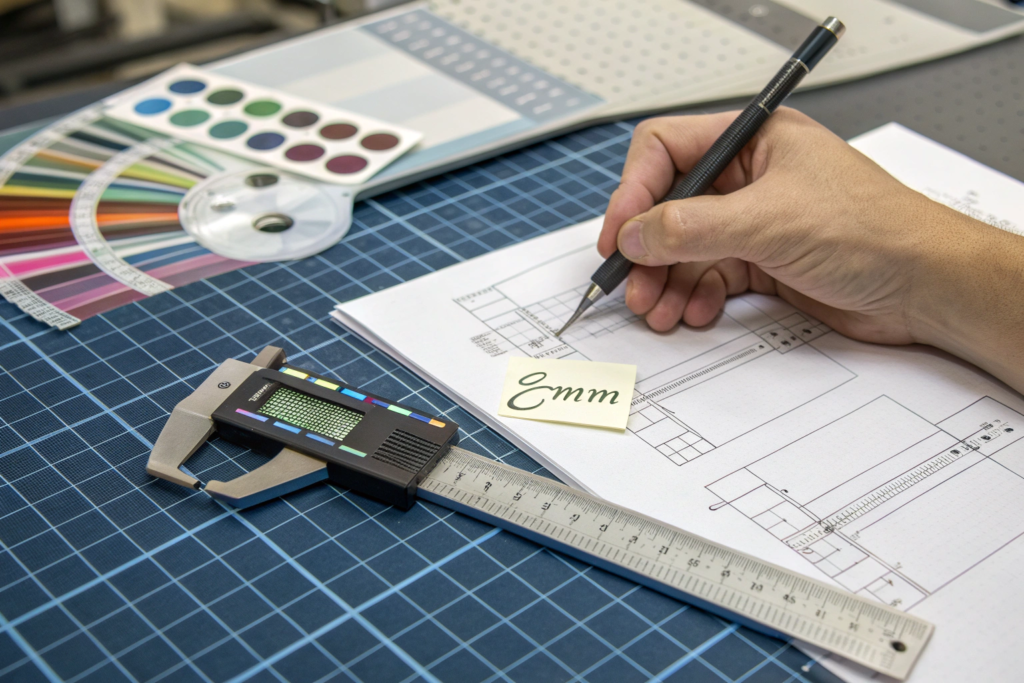
Digital artwork looks perfect on a flat, backlit screen. When it is printed onto a contoured, shaped product, the visual perception changes completely. A pattern that looks perfectly scaled on a flat tech pack may appear too large, too small, or visually unbalanced when it is wrapped around the three-dimensional curve of a baseball cap crown or printed onto the domed surface of a resin hair clip. The first sample is often the moment a designer realizes that a logo, which seemed ideally placed in the center of a digital template, is sitting slightly too high or too low in relation to the product’s physical edges.
This type of "art-to-object" adjustment is the most common revision we see. The design is not wrong. It simply needs to be optically re-centered. Moving a print file by two millimeters, reducing the scale of a repeating pattern by 5% so it repeats exactly three times across a hair band, or adjusting the placement of a woven label so it sits exactly in the center of a folded scarf edge are all routine revisions that our design team executes within a day. There is no new material cost, no mold change, just a precise digital adjustment and a re-print or re-embroidery. This is exactly the kind of refinement that no one can specify until they see the first physical object, and it falls squarely within our free revision scope. This iterative refinement is a cornerstone of our custom product development philosophy.
What Are Common Physical Adjustments to Mechanisms and Fit?
The tactile feedback of a sample reveals what no rendering can simulate. A hair clip snaps shut with a crisp, secure click, or it feels loose and flimsy. A snapback cap closure requires a firm, satisfying press to snap into place, or it feels gritty and requires too much force. These physical, mechanical, and fit-related responses are subjective at the edge, and the first sample round is when they are dialed in. Our technicians can recalibrate the spring tension on a metal hair clip mechanism or an auto-open umbrella, substituting a spring from our standard graded inventory with the next higher or lower tension rating.
Fit adjustments are equally critical and equally standard. We may adjust the elastic tension in a knit beanie to eliminate a slight tightness at the forehead band. The sweatband in a cap might need a millimeter more padding, or its curve might need to be adjusted to prevent a pressure point. The length of a belt strap might be increased slightly relative to the buckle placement to ensure the prong sits naturally in the center hole for a medium-sized fit model. These adjustments do not require new molds or major tooling changes. They are the small, skilled interventions of an experienced sample room technician based on specific, actionable feedback. They are part of what you pay for in the initial sample development cost, and re-doing them to get it right the first time is simply part of our job.
How Does a Free First Revision Align Factory and Brand Interests?
Offering free design adjustments in the first round is not a loss leader or a promotional tactic. It is a strategic alignment of our interests with those of the brand owner. When a brand owner hesitates to request a needed change because they are worried about a hidden cost, the relationship operates from a foundation of financial tension. When that barrier is removed, the conversation shifts from being about cost control to being about design excellence. Our goal becomes fully unified with yours: to produce a sample that you are genuinely, unhesitatingly excited to sell.
Why Does Eliminating Revision Costs Lead to a Better Final Product?
The economics of paid revisions create a perverse incentive. A brand owner paying $100 or $200 per sample round will often be forced into a position of "good enough." They will accept a small color mismatch, a slightly stiff mechanism, or a less-than-perfect drape because they do not want to spend another few hundred dollars on a revision that their budget cannot accommodate. This directly harms the final product. A consumer who picks up that product on a retail shelf will not know about the budget constraints. They will simply feel that the product is not quite right, and they will put it back.
By removing that cost barrier, we empower the brand owner to be uncompromising. If the color is two shades off from the season’s palette, they say so, and we fix it. If the edge polish on an acetate clip needs a higher gloss, they say so, and we re-polish. This results in a final product that is the best possible version of the design, the one the brand owner truly wanted, not the one they felt they could afford to settle for. This leads to a more successful, differentiated accessory in the market, reflecting our commitment to offering AceAccessory clients the space to refine their designs without financial pressure.
How Does This Policy Build a Long-Term, High-Trust Supplier Relationship?
The free first-round revision is a powerful signal. It tells a brand owner, especially a new one who may have been burned by hidden costs in the past, that our factory is not trying to extract every possible dollar from the development process. We are trying to earn their production business. Trust in a sourcing relationship is built during the development process, not during the smooth, uneventful production runs. When a brand owner sees that we collaboratively, efficiently, and at no extra charge solved a design problem that they know another factory would have charged for, that memory cements the relationship.
The long-term value for us is clear. A brand owner who has a positive, collaborative development experience with us, and who ends up with a product they love, will return with their next design. They will increase their order quantities. They will refer other brand owners to us. The cost of an extra hour of sample room time, a re-printed fabric yard, or a small reformulation of a resin color is a fraction of the lifetime value of a loyal, growing, and referring client. The free revision policy is, in this sense, one of the most calculated and highest-return investments we make.
What Clear Boundaries Define a Free Adjustment vs. a New Design?
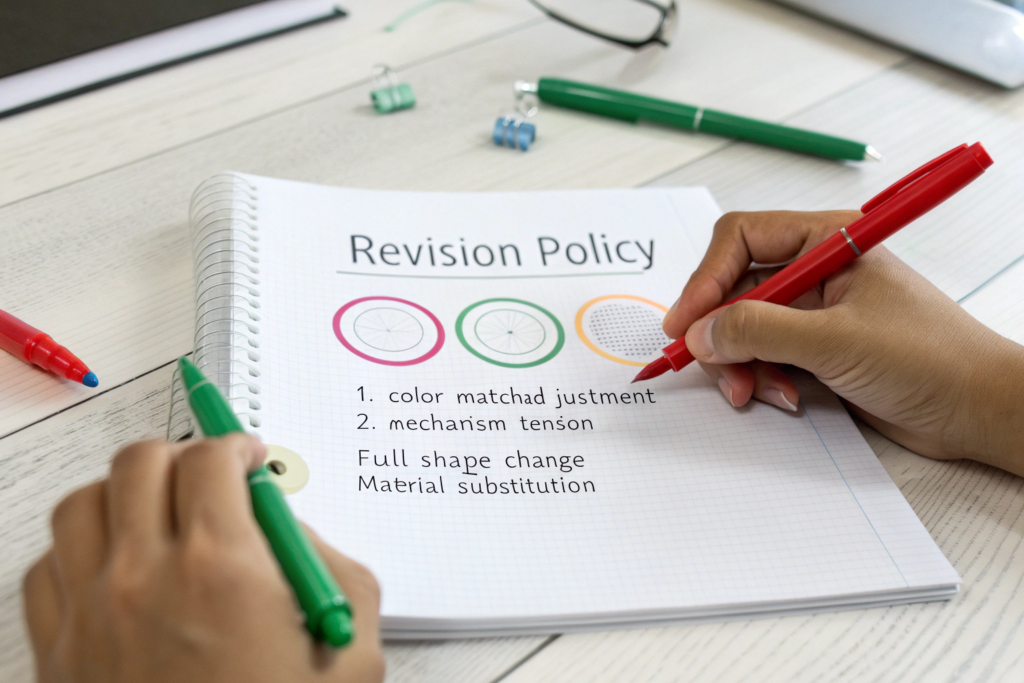
For a policy like this to work sustainably, it must have clear, fair boundaries that both parties understand from the beginning. A free design change is an adjustment to an existing design within the first sample round. It is not a complete redesign, a material substitution that changes the cost structure, or an unlimited series of explorations. Defining this boundary protects us from scope creep and protects the brand owner from misunderstandings about what is included.
When Does a "Change" Become a Costed "Second Sample"?
A change is a refinement of the approved design. It is a dimension adjustment, a color recalibration, a mechanism tweak, or a logo placement shift. It does not fundamentally alter the product’s identity or its manufacturing bill of materials. A new sample is required when the requested alteration is so substantial that it represents a departure from the original design brief. The most common examples are a complete change of the product’s silhouette, such as requesting a 5-panel cap silhouette after sampling a 6-panel version. A material substitution that requires a new costing exercise, such as switching from cotton to a cashmere blend. Or a change to a completely different decoration technique, such as moving from a simple deboss to a complex, multicolor printed decal.
When one of these boundaries is crossed, our project manager communicates this transparently. They respond to the request not with a flat "no," but with a clear explanation of the additional work required, a quote for the new sample cost, and a timeline for its delivery. This way, the brand owner retains complete control. They can choose whether the alteration is important enough to their vision to justify the additional investment, or whether it can be saved for a future collection. This boundary is what makes the policy fair to both sides. It protects our sample room from being used as an unlimited, no-cost R&D lab, while protecting the brand owner from unexpected charges for the routine, iterative fine-tuning that makes all the difference.
How Does the Process Formalize After the First Round of Samples?
The official sample process we follow is sequential and documented. Round 1 is the Initial Sample. Our factory produces a physical prototype based on the approved design brief. For all the routine dimensional and color adjustments identified in the review of this sample, we provide a Revised Round 1 Sample at no cost. Round 2 is the Approval Sample. Once the free adjustment round is complete and the revised sample is approved, this sample is sealed and signed off. This becomes the official "golden sample," the standard against which mass production is measured. Any further changes requested after the approval sample has been signed off are managed as a formal engineering change order. They are scoped, costed, and scheduled like any other new development work.
This structured process ensures that the development phase has a clear exit gate. The free revision policy accelerates the path to that gate by removing financial friction during the critical design iteration phase. It ensures that when the approval sample is finally signed, it is done so with the complete confidence of the brand owner.
Conclusion
We offer free design changes within the first sample round because we view the initial sample as the final, critical stage of the design process, not the first stage of production. It is the point where a digital concept is tested in the physical world, and inevitable small refinements in pattern scale, mechanism tension, or color matching are identified. We absorb the cost of these routine adjustments because removing the financial penalty from perfecting a design leads to a better final product, a more satisfied brand owner, and a stronger, trust-based partnership.
The policy operates within a clear and fair framework. It covers the iterative adjustments that are a normal part of translating a design to a 3D object, and it distinguishes these from fundamental design changes, which are managed transparently as a separate scope of work. By structuring our development process in this way, we align our commercial interest with your creative vision from the very beginning. We want you to approve a sample that you are genuinely proud to put your brand name on.
If you have a design concept that you are ready to see as a physical sample and want to experience a development process that prioritizes getting the design right over charging for every iteration, contact our Business Director Elaine at elaine@fumaoclothing.com. Send her your design brief, your reference images, and your target aesthetic. She can coordinate the first sample round with our development team and walk you through our collaborative revision process. Let us show you how we turn a first sample into the exact product you envisioned, together.