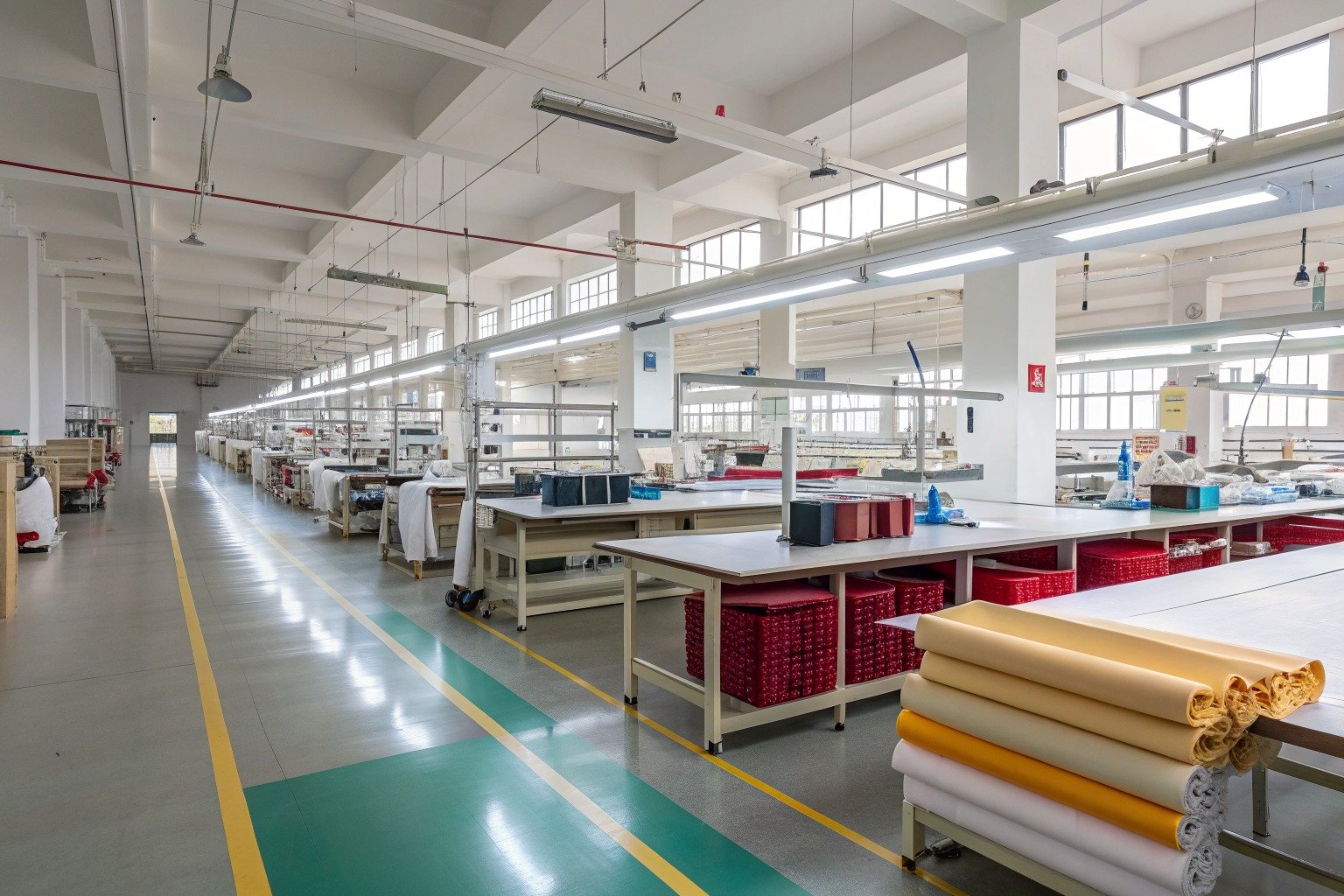
A brand owner I work with called me in a state of near panic in early 2024. He had built his entire menswear accessories line around a specific woven cotton belt with a distinctive brass buckle, produced at our factory in Zhejiang. His landed cost calculations, his wholesale pricing, and his retail margins all assumed a standard duty rate. Then US Customs and Border Protection issued an updated ruling that reclassified his belt’s HTS code into a heading that carried an additional 25% Section 301 tariff. His margin evaporated overnight. He asked me if there was any way around it. I walked him through the legal options, and we restructured his belt production across two countries. His tariff exposure dropped, his shipments cleared customs without additional duties, and his business survived what could have been a terminal financial blow.
You do not avoid US tariffs on Chinese-made fabric belts by hiding the origin or misclassifying the product. Both are illegal and carry severe penalties. You manage and potentially reduce tariff exposure through three legal strategies. First, accurate and favorable HTS classification, ensuring your fabric belt is classified under the most specific and most appropriate tariff heading that carries the lowest applicable duty rate. Second, utilizing de minimis entry if your shipment value is under the $800 threshold, though this only works for direct-to-consumer shipments, not wholesale pallets. Third, legitimate country-of-origin restructuring through substantial transformation, where a material component of the belt is manufactured in a country other than China, altering the belt’s origin for customs purposes under the specific rules of origin that govern textile accessories. I will explain each of these strategies in detail, what they can and cannot achieve, and how to implement them legally and sustainably.
What Is the Legal Way to Classify Fabric Belts Under a Lower Duty Rate?
The Harmonized Tariff Schedule of the United States is the legal document that assigns a duty rate to every product entering the country. The HTS is structured with thousands of specific product descriptions organized under chapters, headings, and subheadings. The correct classification of your product determines the base duty rate and, critically, whether additional Section 301 tariffs apply. The classification is not a matter of opinion or a negotiation with your freight forwarder. It is a legal determination based on the physical characteristics of the product and the terms of the HTS headings. Getting it right can save you 25% or more. Getting it wrong can trigger a CBP audit and back-duty assessments.

How Do You Determine Whether a Belt Is Classified as Apparel or Accessory?
The HTS treats belts differently depending on their material composition, their construction, and, in some cases, their intended use. Fabric belts made of textile materials, including cotton, polyester, nylon, and blends, are generally classified in Section XI of the HTS, which covers textiles and textile articles. Within Section XI, the relevant heading for most fabric belts is Heading 6217, which covers made-up clothing accessories and parts of garments, nestled under Chapter 62, articles of apparel and clothing accessories, not knitted or crocheted.
The specific subheading for fabric belts under the 6217 heading depends on the fiber composition. A 100% cotton woven fabric belt is classified under 6217.10. A synthetic fiber woven belt, such as polyester or nylon, is classified under a different subheading. The base duty rate for most textile belts under these subheadings is in the single-digit percentage range, generally much lower than the 25% Section 301 additional duty that applies to many other Chinese-origin goods. The Section 301 lists, specifically List 4A, originally covered apparel and clothing accessories, including textile belts, from China. The status of these tariffs can change, and exclusions can be granted or expire. Checking the current USTR Section 301 tariff list is the first step in determining whether any additional duty currently applies to your specific HTS subheading.
Leather belts with fabric elements and fabric belts with leather trim present a classification challenge. The HTS classification of a composite product is determined by the material that gives the article its essential character. A belt whose visible surface is primarily a woven fabric but which has a leather backing and a leather buckle strap would be analyzed for essential character. If the fabric predominates by surface area, weight, and visual impact, the belt may be classified as textile. If the leather is the primary structural material, the belt may be classified as leather. The difference matters because leather belts fall under a different HTS chapter with different duty rates and different Section 301 applicability.
What Documentation Proves Your Belt’s Classification to US Customs?
Customs compliance is a documentation exercise as much as a product exercise. When your goods clear US Customs, the entry documents include the HTS code you have declared. If CBP reviews the entry and questions the classification, you must be able to support your declared code with evidence. A fabric composition test report from an accredited textile testing laboratory is the foundational evidence. The report states the fiber content by percentage for each material component of the belt. If the belt is declared as 100% cotton, the lab report must state 100% cotton. If the belt is a blend, the blend percentages must be accurate.
A physical sample of the belt may be requested by CBP for their own laboratory analysis. The sample should match the production units in every material respect. A belt breakdown document, sometimes called a product specification sheet for customs purposes, describes the belt’s construction layer by layer, including the face fabric, the interlining, the backing, the buckle material and finish, and the method of assembly of the belt tip and the buckle attachment. Photographs of the belt in production showing the material layers are helpful supporting evidence.
If you are claiming a specific classification that is favorable relative to a potentially higher-duty classification, you should also retain a written classification analysis that explains why your product fits the heading you declared and not a different heading. This analysis can be prepared by a licensed customs broker or a customs attorney. If CBP subsequently challenges the classification, this contemporaneous documentation demonstrates that you exercised reasonable care in classifying the product, which is a mitigating factor in any penalty determination. The official US HTS search tool is the authoritative source for looking up current duty rates and verifying that the subheading you plan to use is correct and current at the time of shipment.
Can the De Minimis Rule Remove Tariffs on Small Belt Shipments?
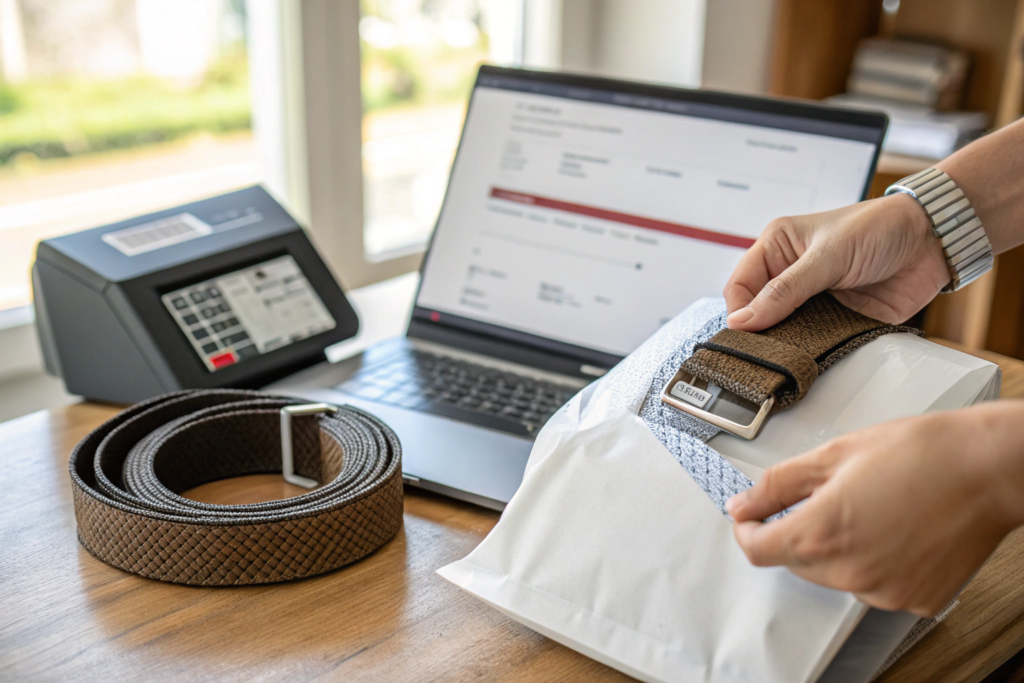
The de minimis rule, officially known as Section 321 entry, allows goods valued at $800 or less to enter the United States duty-free, provided the shipment is imported by one person on one day. This exemption applies to both the standard duty and any additional Section 301 China tariffs. For a brand that ships fabric belts directly to individual consumers, the de minimis rule is a powerful tariff avoidance tool. But it has strict limitations, and attempting to circumvent the $800 threshold by splitting a wholesale shipment into multiple small packages is illegal and will result in CBP enforcement action if detected.
What Is the $800 De Minimis Threshold for Direct Shipments?
The $800 threshold applies to the aggregate fair retail value of the goods in the shipment. For a direct-to-consumer shipment of one or two fabric belts with a declared value comfortably under $800, the shipment qualifies for duty-free entry. The shipment must be imported by an individual for personal use, not for resale, and the shipments cannot be part of a series of shipments that are arranged or split to evade the threshold. The de minimis process is designed for genuine ecommerce orders from individual consumers.
The practical application for a brand that manufactures belts in China is that direct-to-consumer fulfillment from the factory to the end customer in the US, with the shipment declared as a Section 321 de minimis entry, avoids all US tariffs, including Section 301. The consumer receives the product, the brand pays no duty, assuming the per-shipment value is under $800, and the transaction is fully legal and compliant.
The de minimis privilege is subject to a shipment volume limit per importer and is currently under regulatory scrutiny, with ongoing discussions about tightening the exemption for goods subject to Section 301, particularly goods imported from China by ecommerce platforms. The eligibility landscape for de minimis entry can change, and brands that rely on it as a central part of their logistics strategy need to stay current with proposed rule changes and consult with a customs attorney who specializes in ecommerce imports. Checking the current CBP de minimis regulations provides the most current information on thresholds and documentation requirements before you commit to a fulfillment model that depends on this exemption.
What Are the Limits on Splitting Bulk Orders Into Small Packages?
The critical legal boundary with de minimis is the prohibition on structured transaction splitting. Importing a commercial quantity of belts by breaking the shipment into multiple packages, each valued under $800, and sending them to the same consignee or related consignees on the same day or over a short period, is not de minimis. It is a violation of the prohibition against structuring and can result in seizure of the goods, civil penalties, and referral for criminal investigation.
CBP’s automated targeting systems are designed to identify related shipments that appear to be part of a series intended to evade the threshold. Shipments with the same shipper, same consignee address, similar declared values, and close-in-time arrival dates are flagged. A brand that ships 50 belts in 50 separate packages, each declared at $16 to stay under the threshold, but all arriving at the same fulfillment center on the same day, will raise a red flag. The consequences of a structuring violation are far more expensive than the duties the shipper was attempting to avoid.
The de minimis rule is a legitimate tool for direct-to-consumer ecommerce sales to individual end-use consumers. A single customer orders a belt on your website, and we ship that single belt from our factory to the customer’s residential address. This is exactly the type of transaction Section 321 was designed to facilitate. It is not a tool for avoiding duties on wholesale commercial shipments. If your business model is wholesale, you need a different strategy, such as the legitimate origin restructuring described in the next section.
How Can Substantial Transformation Change a Belt’s Country of Origin?
Substantial transformation is a legal doctrine in US customs law that determines the country of origin of a product. When a product is manufactured from materials sourced from multiple countries, the country of origin is the last country in which the product underwent a substantial transformation. A substantial transformation is a manufacturing process that results in a new and different article of commerce with a new name, character, and use. This doctrine is the legal basis for restructuring a supply chain so that a belt’s country of origin is a country other than China, even though some or all of its raw materials originated in China.
What Manufacturing Steps Constitute a Real Transformation?
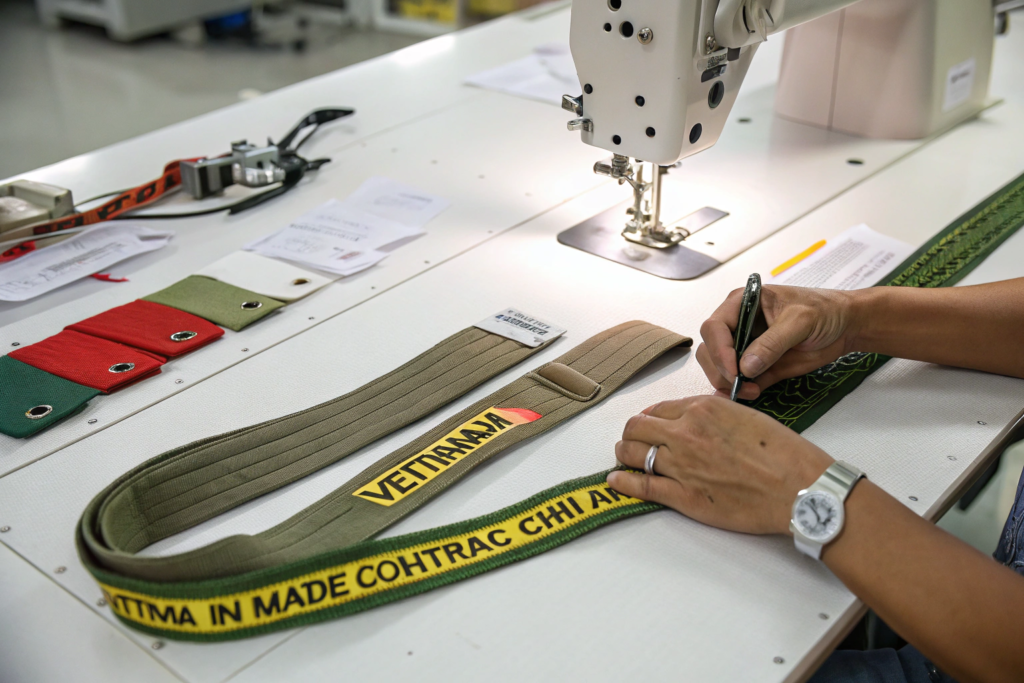
For textile belts, the manufacturing steps that US Customs generally considers to constitute a substantial transformation are the cutting of the fabric to the belt shape, the assembly sewing that constructs the belt body, the attachment of the buckle and any other hardware, and the finishing steps including tipping, edging, and quality inspection. The key principle is that the fabric roll, which is a material that can be used for many purposes, is transformed into a belt, which is a specific finished article with a specific use.
If a roll of cotton webbing is produced in China and shipped to Vietnam, and in Vietnam the webbing is cut to belt lengths, the ends are tipped, the buckle is attached, the belt is finished and inspected, and the finished belt is packaged for retail, then Vietnam is the country of origin for customs purposes. The Vietnamese manufacturing process substantially transformed the Chinese webbing into a new and different article, a finished fabric belt. The belt is marked as a product of Vietnam, and the applicable duty rate is determined by the tariff treatment of Vietnamese-origin goods at the time of importation.
However, a minimal assembly operation that does not change the fundamental character of the product does not qualify. Simply attaching a hangtag to a fully finished belt in a third country, or repackaging belts that were fully manufactured in China, does not change the origin. The transformation must be genuine and substantial, and the factory in the third country must have the actual production capability, meaning cutting tables, sewing lines, and finishing equipment, to perform the assembly work. A paper entity in a third country that simply invoices Chinese-made belts is a transshipment scheme, and CBP aggressively investigates and penalizes transshipment as customs fraud.
Which Countries Offer Favorable Trade Treatment for Belt Assembly?
The selection of a manufacturing partner country must consider labor costs, logistics, quality of available textile workers, and the current tariff treatment of that country’s exports to the US. Vietnam is a leading choice for the cut-and-sew assembly of textile belts. Vietnam has a well-developed garment and textile accessory manufacturing sector, a skilled sewing workforce, and was party to the Comprehensive and Progressive Agreement for Trans-Pacific Partnership, which influences tariff treatment. The duty rates for Vietnamese-origin textile belts are generally the Most Favored Nation rates, and critically, Vietnamese-origin goods are not subject to the Section 301 China-specific additional duties.
Bangladesh and Cambodia are other major textile and garment manufacturing countries with developed sewing capacity, competitive labor costs, and preferential duty treatment for certain textile and apparel products under various trade preference programs, although eligibility for accessory products like belts must be confirmed on a specific product basis. India, with its established leather and textile accessory industries, is another option, particularly for belts combining textile and leather elements.
Mexico, under the United States-Mexico-Canada Agreement, USMCA, offers the possibility of duty-free entry for qualifying textile and apparel goods that meet the agreement’s specific rules of origin. A belt assembled in Mexico from US or Mexican-origin yarns and fabrics could qualify for duty-free treatment under USMCA. The rules of origin for textile products under USMCA are specific and detailed, and a customs attorney should review the proposed supply chain to confirm eligibility before production commitments are made.
The practical implementation of an origin restructuring strategy for fabric belts requires identifying and qualifying a factory in the partner country, establishing the material flow from the Chinese fabric mill to the partner country factory, implementing the cut-and-sew assembly operation, and managing the logistics from the partner country to the US. At AceAccessory, we have experience coordinating this type of multi-country production for branded clients whose tariff exposure made single-country China production commercially unviable. The supply chain becomes more complex, but the tariff savings can justify the additional logistics management. Researching the general principles of US import rules of origin helps you understand whether the specific processing step you plan to undertake meets the substantial transformation threshold.
Conclusion
Avoiding US tariffs on Chinese-made fabric belts is a compliance exercise, not an evasion exercise. The legal path begins with accurate HTS classification. A fabric belt classified under the correct textile accessories subheading in Chapter 62 may carry a manageable base duty rate and may be excluded from certain Section 301 tariffs depending on the current status of the USTR 301 lists. Your classification must be supported by a fiber composition lab report and a product specification that documents the belt’s material construction layer by layer.
The de minimis entry rule under Section 321 is a powerful duty-free pathway for direct-to-consumer shipments valued under $800. It is a compliant tool for ecommerce fulfillment to individual end-use consumers either from our factory or from a US-based fulfillment center after importation, and cannot be structured to evade duties on wholesale commercial quantities. The structuring rules are enforced by CBP, and violations carry severe penalties.
Substantial transformation through legitimate multi-country production restructures the belt’s legal origin. By cutting and sewing Chinese-origin fabric webbing into finished belts in a third country such as Vietnam, Bangladesh, India, or Mexico, the belt’s country of origin shifts to that country. The belt is no longer Chinese-origin for customs purposes, and the Section 301 China-specific duties do not apply. This requires a genuine manufacturing operation in the partner country, with documented production processes, and a fully compliant supply chain with verifiable origin documentation. Transshipment, simply routing Chinese-made goods through a third country to change the label without substantial assembly work, is customs fraud.
If you are currently importing fabric belts from China and your tariff exposure is threatening your margins, contact our Business Director Elaine at elaine@fumaoclothing.com with your product specifications, current HTS classification, and current landed cost breakdown. She can discuss your options for compliant tariff management, whether through classification review, de minimis-eligible fulfillment models, or multi-country production structuring. The tariffs are a legal reality, but they are not a mandatory cost on every Chinese-sourced component. The cost of non-compliance is far higher than the cost of getting the compliance right.