Three years ago, I received a photo from a client that made my stomach drop. It was a pallet of our handmade ceramic cups, just arrived at his warehouse in Los Angeles. The cartons were crushed. The sound of broken pottery rattling inside was audible through the phone’s speaker. The bill of lading said "Shipper Load and Count," which meant the fault was ours. We had used standard double-wall cartons and bubble wrap. It wasn’t enough. The ocean voyage, the container stacking, the trucking from the port—it had destroyed 30% of the shipment. That day, I learned a hard lesson: shipping ceramics by sea is not like shipping t-shirts. It requires a completely different engineering mindset. If you are like Ron, importing fragile goods, the fear of opening a container and finding a box of expensive dust is a constant source of anxiety. The financial loss is one thing. The lost selling season while you reorder is another.
The best way to ship fragile ceramic cups by sea is a multi-layered defense system: an engineered inner packaging suspension (often die-cut foam or molded pulp) that isolates the cup from carton wall impacts, combined with a palletizing strategy that uses edge protectors and high-specification double-wall or triple-wall corrugated outer cartons. Relying solely on bubble wrap and peanuts is insufficient for ocean freight. The goal is to eliminate any empty space inside the individual box and to prevent carton collapse during container stacking.
I run AceAccessory in Zhejiang Province. While we are known for fashion accessories , we also produce and ship ceramic items like custom mugs and cups. I have spent years perfecting our breakage rate. We have reduced it from that disastrous 30% down to under 0.5% . This was not achieved by magic. It was achieved by applying principles of physics and investing in better packaging engineering. The ocean is a brutal environment. The container ship rolls. The truck hits potholes. The warehouse forklift drops the pallet the last inch. Your packaging must be a fortress. Let me walk you through exactly how to build that fortress.
Why Is Inner Carton Suspension More Critical Than Outer Carton Strength?
Most people think the solution to breakage is a "stronger box." They order triple-wall corrugated and think the job is done. Then the shipment arrives broken. Why? Because a strong box only protects the outside shape. It does not protect the contents from shock and vibration.
Here is the physics problem: When a carton is dropped or jostled, the outer wall stops moving instantly. If the ceramic cup inside is touching that wall, the cup also stops instantly. This sudden deceleration is what causes impact fracture. The ceramic experiences a G-force spike.
The solution is Suspension Packaging. The cup must not touch the outer carton wall. There must be an air gap of at least 1 inch (2.5 cm) on all six sides (top, bottom, left, right, front, back). This gap acts as a "crumple zone."
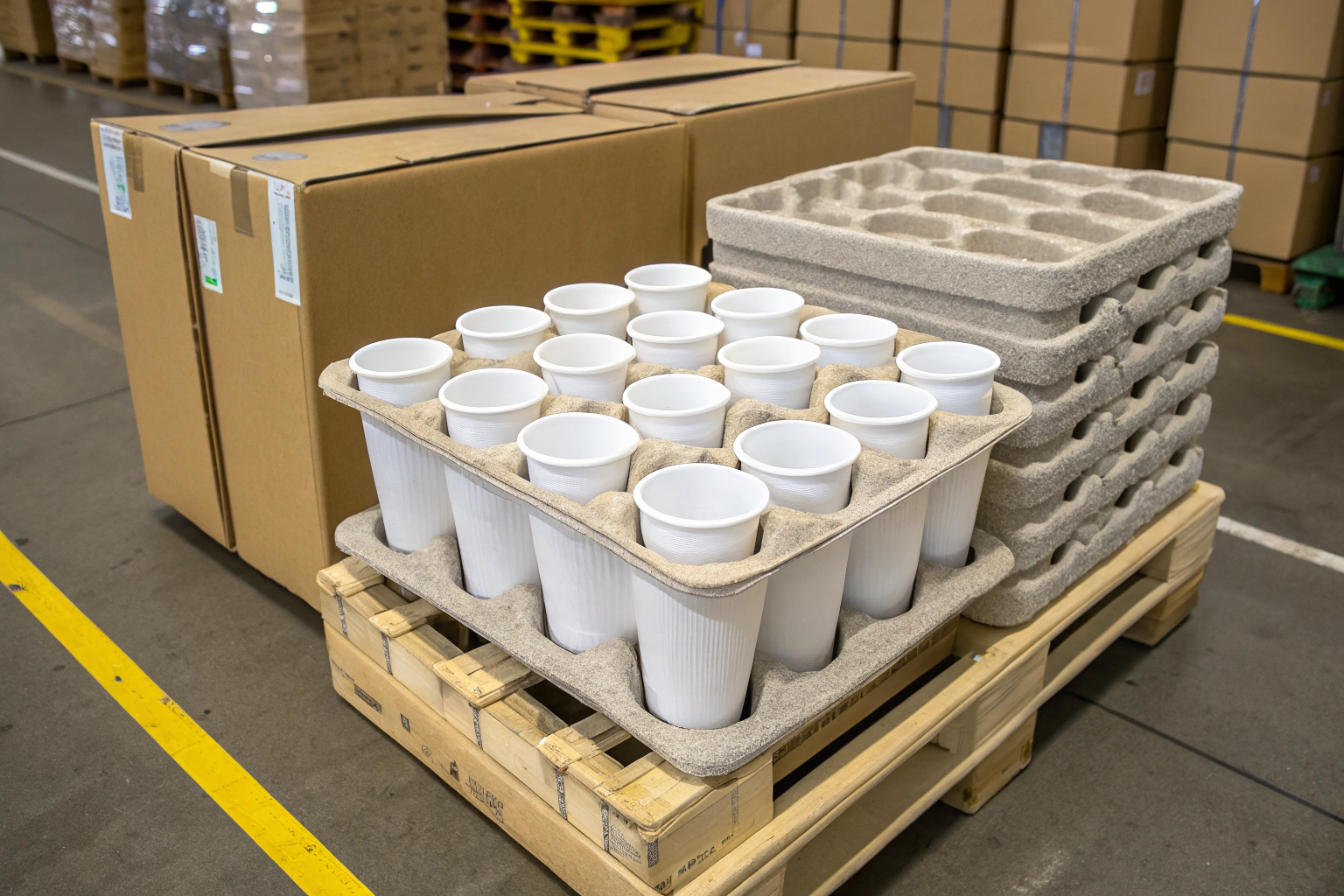
Inside that gap, you need an Energy-Absorbing Medium. This is where the innovation happens. The material in the gap must cushion the blow. It must deform so the cup doesn’t have to. This is why molded pulp trays (like egg cartons) and die-cut foam inserts are far superior to loose fill peanuts. Loose fill shifts during transit. The cup migrates to the bottom corner of the box and ends up touching the wall. Suspension packaging locks the cup in the center of the void.
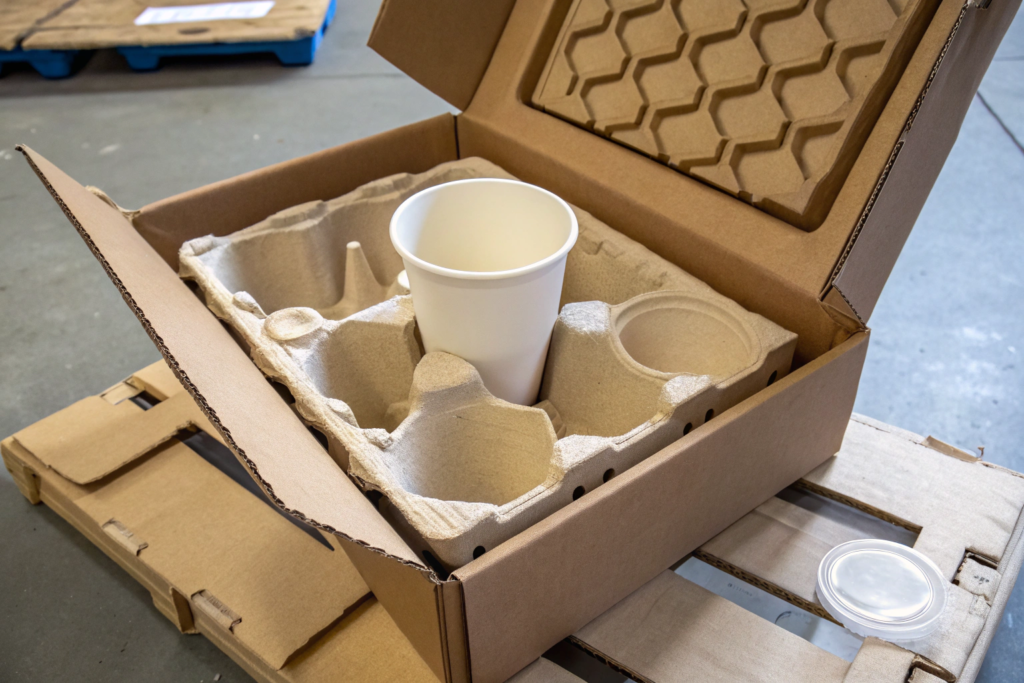
At AceAccessory, we design custom End Cap Trays. Two molded pulp caps slide over the top and bottom of the cup. The caps are slightly larger than the inner carton dimensions. When the box is closed, the cup is suspended in mid-air, held only by the soft pulp. This is the gold standard for ceramic shipping .
How Does Molded Pulp or Die-Cut Foam Absorb Ocean Freight Vibration?
Ocean freight presents two distinct threats: Impact (dropping the carton) and Vibration (constant micro-shaking from the ship’s engine and road transport).
Bubble wrap is decent at absorbing a single impact. But it is terrible at handling long-duration vibration. Over a 20-day ocean voyage, the constant buzzing of the container can cause bubble wrap to deflate or shift. The bubbles pop from the repetitive stress. The cup settles and starts rubbing against the carton.
Molded Pulp (made from recycled paper) is viscoelastic. It has a slight "give" that dampens vibration. It acts like a shock absorber, converting kinetic energy into tiny amounts of heat within the paper fibers. It does not deflate.
Die-Cut Polyurethane Foam is even better for high-end products. It is available in various densities. For a ceramic cup, we use a 1.5 lb to 2.0 lb density charcoal foam. This foam provides a "pillow" effect. It cradles the cup and prevents any surface abrasion.
The choice between pulp and foam usually comes down to cost and sustainability perception. Pulp is cheaper and screams "eco-friendly" to the consumer. Foam is more expensive but offers superior protection for highly polished or glazed surfaces. At AceAccessory, we offer both options and guide clients based on the fragility of the specific cup design.
What Is the Correct Gap Distance Between Cup Wall and Outer Carton?
I cannot stress this enough: Do not pack tight. A common mistake is making the inner box a "snug fit." Snug means impact transfer. You need deliberate air gap.
Based on our drop-testing at AceAccessory using ISTA 3A standards (which simulate parcel and LTL shipping), the minimum effective gap is:
- Side Walls: 1.0 inch (25 mm)
- Top/Bottom: 1.5 inches (38 mm)
The top and bottom need more space because those are the primary drop orientations. When a box is dropped flat on its bottom, the cup inside wants to keep moving downward. The bottom cushion compresses. If the gap is only 0.5 inches, the cushion "bottoms out" and the cup hits the floor through the box.
We use CAD software to design the inserts. We model the exact cup shape. We then create a "virtual box" with 1.5 inches of clearance. The software generates the cutting path for the foam mold. This precision engineering is what separates a professional packaging solution from guesswork. This is the level of detail we apply to all our fragile items .
How Should Ceramic Cups Be Palletized and Loaded into the Container?
You have perfected the individual box. Now you multiply that by 5,000 cups. If the pallet collapses, the individual boxes get crushed from the weight above. Palletizing is structural engineering.
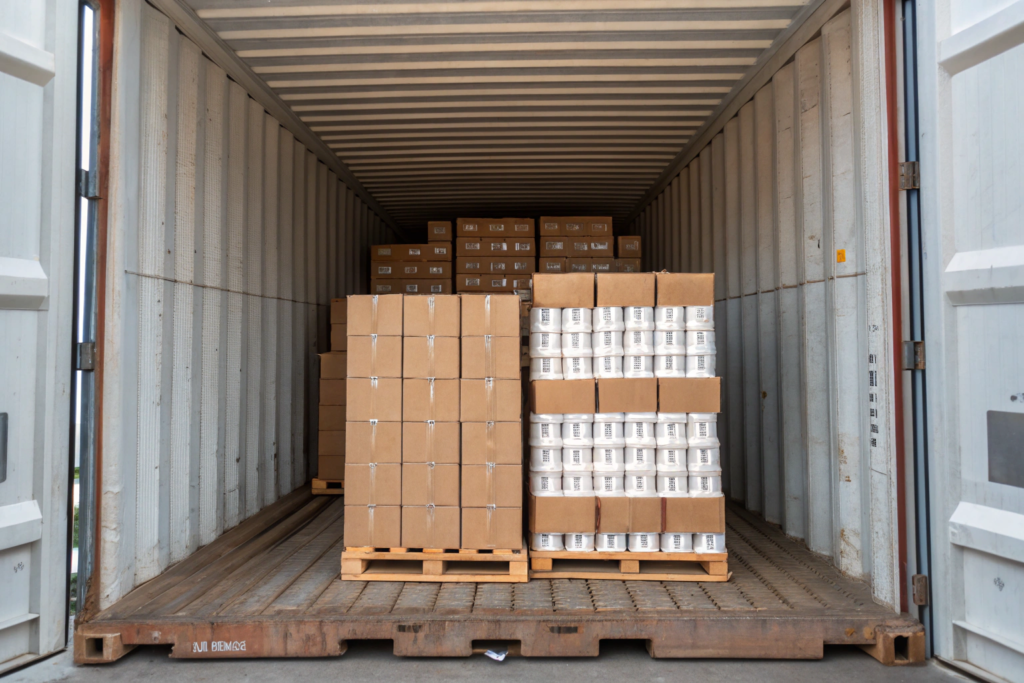
The first rule is Column Stacking, not Interlocking. In warehousing, boxes are often interlocked (like bricks) for stability. But in a vibrating container, interlocking edges get crushed. The best method for fragile goods is Straight Column Stacking. The corners of the boxes must align perfectly from the bottom of the pallet to the top. This transfers the weight vertically down the strongest part of the box (the corners).
The second rule is Edge Protectors and Strapping. The pallet load must be compressed so it moves as a single, solid block. We use heavy-duty plastic or fiberboard edge protectors (3" x 3" x 0.12" thick) on all four vertical corners. Then we apply polyester (PET) strapping, not steel. Steel strapping can snap under tension and cut the boxes. PET strapping has a slight elasticity that absorbs shock.
The third rule is Container Blocking and Bracing. A pallet that shifts inside the container will slam into the wall. We use Dunnage Air Bags. These are inflatable kraft paper bags placed in the gaps between pallets and between the pallet and the container wall. We inflate them to 2-3 PSI. This locks the pallet in place.
At AceAccessory, we photograph the loaded container before the doors close. We send this "Load Plan Photo" to the client. It shows the airbags inflated and the strapping tight. This is proof that we followed the logistics protocol .
Why Are Double-Wall vs Triple-Wall Cartons Necessary for Stacking?
The bottom carton on a pallet of ceramics might be supporting 500-800 lbs (225-360 kg) of weight above it. A standard single-wall carton (commonly used for light apparel) will crumple like a soda can under that load. The cup inside will be crushed.
Here is the specification guide we use at AceAccessory for ocean freight of ceramics:
| Carton Type | Burst Strength | Max Stacking Height (Approx) | Use Case |
|---|---|---|---|
| Single-Wall (32 ECT) | 200 PSI | Do Not Stack Heavy | Light clothing, void fill only. |
| Double-Wall (48 ECT) | 275 PSI | Up to 6 ft (1.8m) | Standard for Ceramic Cups. |
| Triple-Wall (60+ ECT) | 400+ PSI | Up to 10 ft (3.0m) | Heavy stoneware, large platters. |
ECT stands for Edge Crush Test. It measures the stacking strength of the box. For a standard ceramic cup order, we use a Double-Wall 275# Kraft carton. This provides the necessary rigidity to prevent the box from bulging under pressure.
Furthermore, we use H-Flute or B-Flute corrugation. These are finer, denser flutes that provide better puncture resistance and a smoother printing surface. This is the detail that ensures your branded box arrives looking crisp, not like it survived a war.
How Do Dunnage Air Bags Prevent Load Shift During Rough Seas?
The ocean is not flat. A container ship can roll 20-30 degrees in heavy weather. If your pallet is not secured, it will slide. A 1,000 lb pallet sliding 3 inches builds up tremendous kinetic energy. When it hits the container wall, the shock is transmitted through every cup in the stack.
Dunnage Air Bags are the solution. They are essentially heavy-duty paper balloons. We insert them deflated into the side voids (gaps between pallets and walls) and the center voids (gaps between pallets). Then we use an air compressor with a long wand to inflate them.
Critical Best Practice: Do not over-inflate the airbags. Over-inflation pushes the container walls outward, which can cause the doors to jam or the wall panels to bow. We inflate just until the bag makes firm contact and the pallet no longer shifts by hand. A properly inflated airbag should have a slight "give" when you push on it with your palm.
At AceAccessory, our shipping clerk is trained specifically on Container Dunnage Standards. We use Level 2 or Level 3 Kraft Paper Bags (thicker paper) for heavy ceramic loads to prevent bag rupture from sharp box corners. This attention to detail is what ensures the container arrives in the US exactly as it left our warehouse .
What Are the Risks of Moisture and Condensation in Ocean Containers?
Breakage is the obvious risk. Moisture is the silent killer. You can have zero breakage, but if the cups arrive covered in mold or with ruined, peeling labels, the shipment is just as worthless.
The phenomenon is called Container Rain. During the ocean voyage, the container heats up during the day and cools down at night. The air inside holds moisture. When the temperature drops, that moisture condenses on the coldest surface—usually the ceiling of the container. It then drips down onto the top cartons. This water is often contaminated with salt and industrial residue from the container walls. It will stain cardboard and grow mold.
The second risk is Hygroscopic Packaging. Cardboard absorbs moisture from the air. If the humidity inside the container is 80%, the cartons will get soft. Their stacking strength drops by 50-60% . This is why a perfectly stacked pallet sometimes collapses mid-voyage. The box didn’t fail; the humidity weakened the paper fibers.
At AceAccessory, we combat moisture with a two-pronged approach: Desiccants and Barriers.
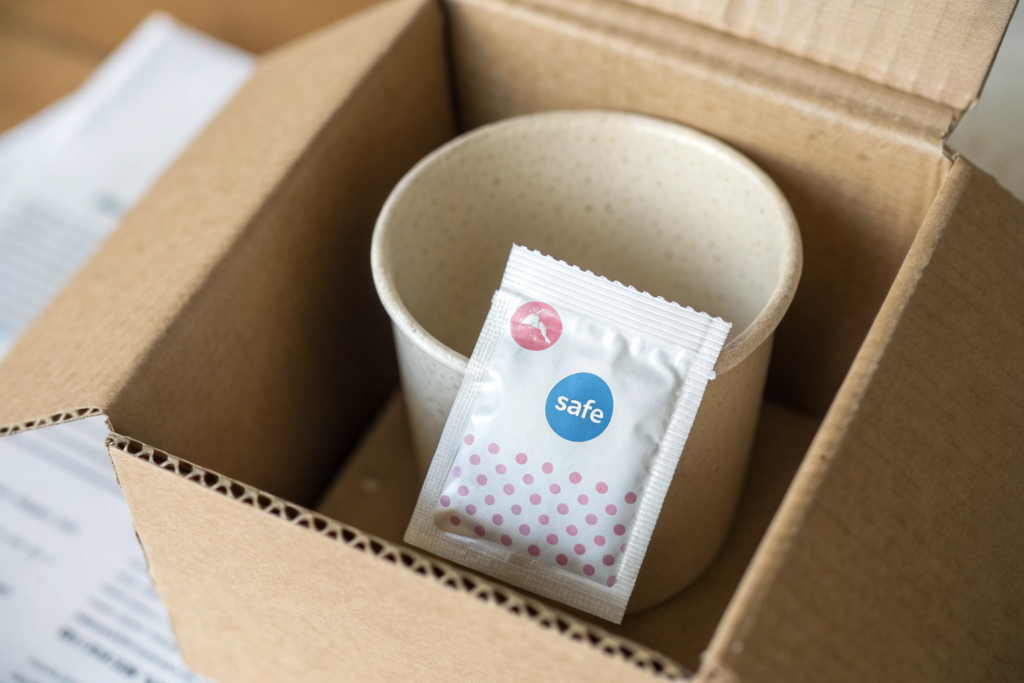
- Desiccants: We place Clay Desiccant Packs (500g or 1000g size) inside the container. These absorb ambient moisture from the air. We hang them from the lashing rings on the container walls.
- VCI Barrier Bags (Optional): For long-term storage or highly sensitive shipments, we seal the inner cartons in a Vapor Corrosion Inhibitor (VCI) poly bag. This creates a micro-climate that prevents rust on metal lids and mold on paper.
How Many Desiccant Packs Are Needed for a 20ft vs 40ft Container?
This is a science, not a guess. The amount of desiccant needed depends on the volume of air in the container and the moisture content of the cargo (wood pallets and cardboard both release moisture).
Here is the general guideline we follow at AceAccessory based on industry standards (Japanese Industrial Standard JIS Z 0301):
| Container Size | Total Desiccant Recommended (Clay) | Typical Configuration |
|---|---|---|
| 20ft Dry Van | 8 kg – 10 kg | 10 x 1kg bags or 8 x 1.25kg bags |
| 40ft Dry Van | 16 kg – 20 kg | 16 x 1kg bags or 4 x 4kg bags |
| 40ft High Cube | 20 kg – 24 kg | 20 x 1kg bags |
Placement is key. The bags must be hung high, near the ceiling, where the condensation forms. We use self-adhesive hooks or tie-wraps to attach them to the corrugated wall rails. We also place a few Humidity Indicator Cards (HICs) on the pallets. These cards have a dot that changes from blue to pink if humidity exceeds 60%. When the client receives the container, they can look at the card and immediately see if moisture was a problem during transit. This is a simple, visual proof of quality care .
Should Ceramic Cups Be Shrink-Wrapped Individually for Sea Freight?
This is a question I get often. The answer is nuanced.
No, do not shrink-wrap the ceramic cup itself. Tight plastic wrap can trap residual moisture from the ceramic firing process or the factory environment. If the cup is sealed in plastic and the container temperature fluctuates, the cup will "sweat" inside the bag. This can lead to efflorescence (white salt deposits blooming on the glaze) or mold growth on the unglazed foot ring.
Yes, shrink-wrap the inner carton. We often wrap the individual gift box in a polyolefin shrink film. This protects the printed paper box from scuffing and from absorbing moisture from the air. The ceramic inside the box is not sealed in plastic; it is protected by the box and the inner pulp tray.
Yes, wrap the pallet. After the pallet is strapped, we wrap the entire load in stretch wrap from top to bottom. This stabilizes the boxes and provides a final barrier against dust and light moisture spray (like from a leaking container roof). However, we leave the bottom 6 inches of the pallet unwrapped or we use ventilated stretch wrap. This allows air to circulate under the pallet and prevents moisture from wicking up from the container floor.
How to Test Packaging Before Shipping a Full Container Load?
You do not want to find out your packaging failed when 20,000 cups arrive broken. You find out before you seal the container. This is done through Pre-Shipment Package Testing.
The industry standard for e-commerce and LTL freight is ISTA 3A. The standard for ocean container shipments is ISTA 3E or a customized sequence derived from it. These tests simulate the entire journey: warehouse handling, truck vibration, container stacking, and final delivery.
At AceAccessory, we perform these tests in-house on every new ceramic product design before we approve bulk packing.
Test 1: The Drop Test (ISTA 1A/3A)
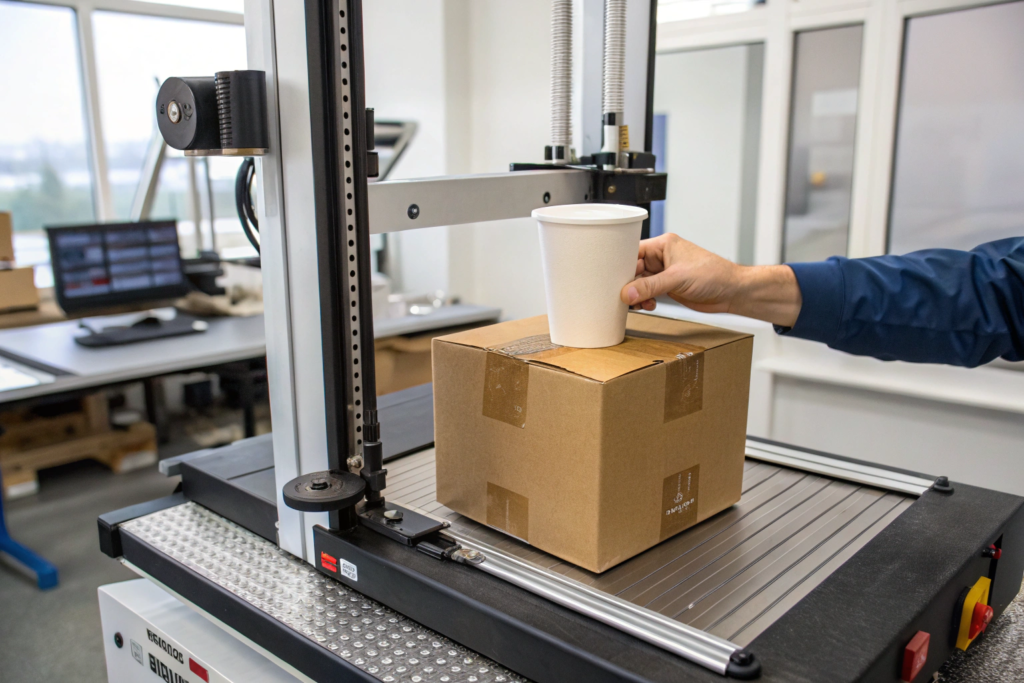
We take a fully packaged carton (with cup inside). We drop it from a height of 30 inches (76 cm) onto a concrete floor. We do 10 drops on various corners, edges, and faces. Then we open the box. The cup must be intact.
Test 2: The Vibration Test
We place the packaged carton on a Vibration Table for 30-60 minutes. The table simulates the constant shaking of a truck and ship engine. This test reveals if loose fill will settle or if the cup will rub against the foam.
Test 3: The Compression Test
We place weights on top of the carton to simulate the weight of 6-8 feet of stacked cartons. We leave it for 24 hours. Then we measure the deflection of the box. It must not crush the inner suspension gap.
These tests are not expensive to run. They just require discipline. And they save tens of thousands of dollars in potential damage claims and lost inventory .
What Is the ISTA 3A Drop Test Sequence for Packaged Ceramics?
Let me give you a specific, actionable sequence. This is the exact test our QC team performs on a sample carton.
Equipment Needed: Concrete floor, Tape measure, Box cutter.
Procedure:
- Edge Drop (Bottom Short Edge): Raise one short bottom edge 30 inches off the ground. Drop.
- Edge Drop (Bottom Long Edge): Raise one long bottom edge 30 inches. Drop.
- Corner Drop (Bottom Corner): Raise one bottom corner 30 inches. Drop.
- Face Drop (Bottom): Raise entire bottom face 30 inches. Drop flat.
- Face Drop (Top): Flip box over. Raise top face 30 inches. Drop flat.
- Face Drop (Side 1): Drop on narrow side face.
- Face Drop (Side 2): Drop on opposite narrow side face.
- Face Drop (Side 3): Drop on wide side face.
- Face Drop (Side 4): Drop on opposite wide side face.
- Corner Drop (Top Corner): Drop on a top corner.
Pass/Fail Criteria: Open the box. Remove the cup. Inspect under bright light. Zero damage allowed. No cracks, no chips, no scuffs.
If the carton passes this sequence, we are 99% confident it will survive the journey. This is the standard we hold ourselves to for every ceramic shipment .
How Can You Simulate Container Compression in a Warehouse Setting?
You don’t need a fancy lab machine. You can do a Static Load Test with simple gym weights or bags of sand.
Here is how we do it for a small batch check:
- Take the carton you intend to ship. Seal it.
- Calculate the weight it will bear. (e.g., Carton is 8 inches tall. Pallet stack is 6 feet / 72 inches tall. 72 / 8 = 9 cartons high. Bottom carton bears weight of 8 cartons above it. 8 cartons x 15 lbs each = 120 lbs).
- Place a flat piece of plywood (same footprint as carton) on top of the test carton.
- Stack 120 lbs of weight plates or sandbags on the plywood.
- Leave for 24 hours.
- Remove weight. Measure the height of the carton. It should not have compressed more than 0.25 inches.
- Open the carton. The cup should be exactly where it was. The suspension foam should not be crushed flat.
This simple test predicts exactly what will happen at the bottom of the container stack. We do this for every new carton specification we develop. It is a cornerstone of our packaging engineering .
Conclusion
Shipping fragile ceramic cups by sea is a challenge that rewards meticulous planning and punishes wishful thinking. The ocean environment is unforgiving, subjecting cargo to constant vibration, crushing stack weights, and insidious moisture. The key to success lies in shifting your mindset from "packing a box" to "engineering a protective system."
That system begins with inner suspension—using molded pulp or die-cut foam to isolate the cup from impact and vibration. It extends to structural carton design, specifying double-wall corrugated with sufficient edge crush strength to support the stack. It includes container loading discipline, employing column stacking, edge protectors, and properly inflated dunnage air bags to create a solid, immobile block. And it requires active moisture management with correctly sized and placed desiccants.
Finally, the entire strategy must be validated through pre-shipment testing. The ISTA drop and compression tests are not optional formalities; they are the proof that your engineering works. A few hours of testing can prevent a season of lost sales and shattered customer trust. You don’t have to leave the safety of your ceramics to chance. With a factory partner who understands these principles and executes them with discipline, breakage rates below 1% are not just a goal—they are the standard.
If you are sourcing ceramic drinkware or other fragile items and want to ensure they arrive intact, we can share our packaging specifications and testing protocols with you. Contact our Business Director, Elaine. She can provide detailed photos of our molded pulp inserts and carton configurations. Email Elaine at: elaine@fumaoclothing.com