For fashion importers and brands, choosing the right pattern is about predicting timeless appeal, not just following fleeting trends. If you’ve ever wondered why certain scarf patterns consistently sell year after year, while others fade after a single season, you’re touching on the core of sustainable inventory planning. The challenge is identifying designs that transcend time and connect with a broad consumer base.
Plaid patterns remain a classic choice for scarves because they possess a unique combination of historical depth, versatile aesthetic appeal, cultural resonance across multiple regions, and inherent design flexibility that allows them to bridge casual and formal styles effortlessly. This multifaceted strength makes plaid a low-risk, high-reward staple in any accessory line.
This article will unravel the threads of plaid’s enduring success. We will explore its rich heritage and symbolism, its powerful psychological and aesthetic impact on consumers, its remarkable adaptability across seasons and styles, and its continued relevance in contemporary fashion cycles. For insights into building a diverse and reliable product portfolio, consider our partner factory’s approach to developing a winning accessory collection.
What Is the Historical and Cultural Heritage of Plaid?
Plaid is far more than a simple checkered design; it is a fabric woven with history. For a brand or importer, understanding this heritage adds immense value and storytelling power to your product, elevating it from a mere accessory to an item with narrative depth. This history directly contributes to its perception as a "classic."
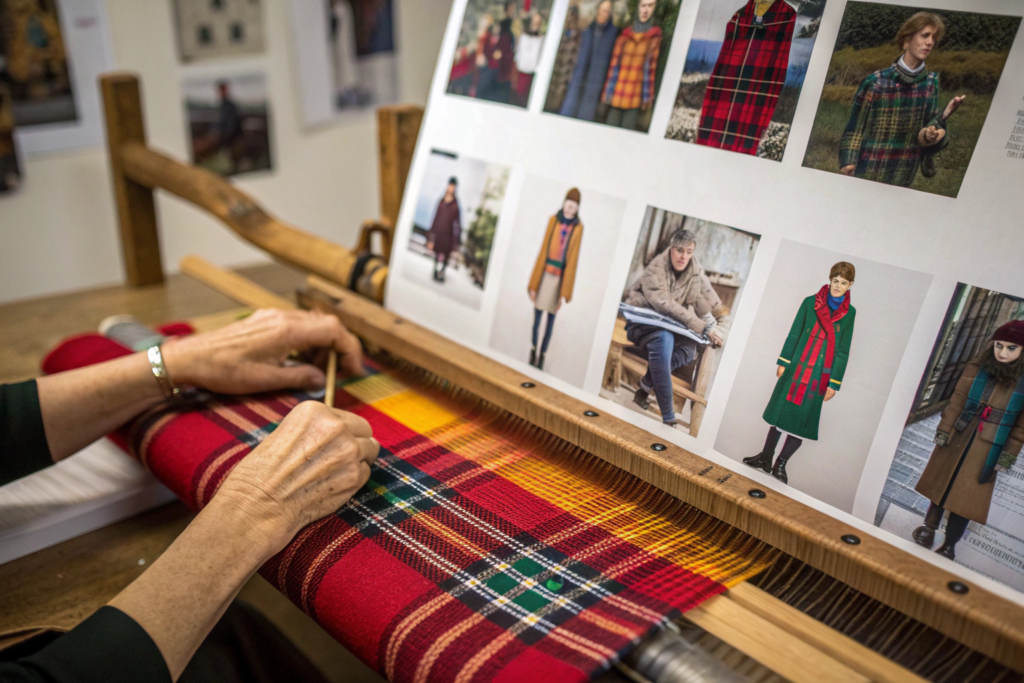
The plaid pattern, historically known as tartan, originates from the Scottish Highlands, where specific woven patterns represented clans, families, and regions. This deep-rooted association with identity, heritage, and craftsmanship laid the foundation for its classic status. Over centuries, it evolved from functional Highland dress to a global symbol of rebellion, tradition, and eventually, versatile style.
To truly appreciate plaid’s journey, we must look at its key transition points. In the 18th and 19th centuries, after political upheavals, tartan was romanticized and popularized by the British aristocracy and later through military uniforms. In the 20th century, it was adopted by American lumberjacks (creating the "buffalo check"), became a symbol of punk rock rebellion in the 1970s, and was eternally chicified by designers like Vivienne Westwood. Each era added a new layer to its meaning, from rugged workwear to anti-establishment statement to high-fashion staple. When you source a plaid scarf, you are tapping into this rich tapestry. At Shanghai Fumao, our design team studies these historical influences to create plaids that feel both authentic and fresh for markets in North America and Europe.
How Did Scottish Tartan Evolve into a Global Fashion Staple?
The transformation of Scottish tartan into a universal pattern is a story of adaptation. The key was its detachment from strict clan symbolism when it entered the broader British and later global wardrobe. The Victorian era’s fascination with all things Scottish played a huge role. When Queen Victoria adorned Balmoral Castle in tartan, it became a fashion craze. The pattern’s inherent structure—a repeating, crisscross of colored bands—proved to be visually pleasing and highly adaptable. It could be rendered in endless color combinations, scales, and fabric weights, from heavy wool to light cashmere scarves. This adaptability allowed it to be endlessly reinterpreted while retaining its core identity. Organizations like the Scottish Register of Tartans preserve the historical patterns, while fashion continuously reinvents them.
What Cultural Meanings Are Associated with Plaid Today?
Today, plaid carries a multifaceted symbolism that makes it appealing to diverse consumers. It can convey:
- Heritage and Authenticity: A connection to craftsmanship and history.
- Comfort and Ruggedness: Thanks to its association with outdoor workwear and cozy, cabin-style aesthetics.
- Academic and Preppy Style: Think of classic school uniforms and Ivy League fashion.
- Rebellious Edge: A legacy from its punk and grunge adoptions.
- Seasonal Comfort: It is intrinsically linked to autumn and winter, making it a perennial seasonal favorite.
This range of meanings allows a single plaid scarf to be marketed to different audiences—from someone seeking a traditional, warm winter scarf to a fashion-forward youth looking for a statement piece. This cultural versatility is a commercial powerhouse.
How Does Plaid Create Psychological and Aesthetic Appeal?
A pattern’s success is not accidental; it taps into fundamental principles of visual perception and emotional response. For buyers, understanding why plaid is inherently pleasing helps in selecting the most marketable colorways and designs. It’s a pattern that works on both a subconscious and conscious level.
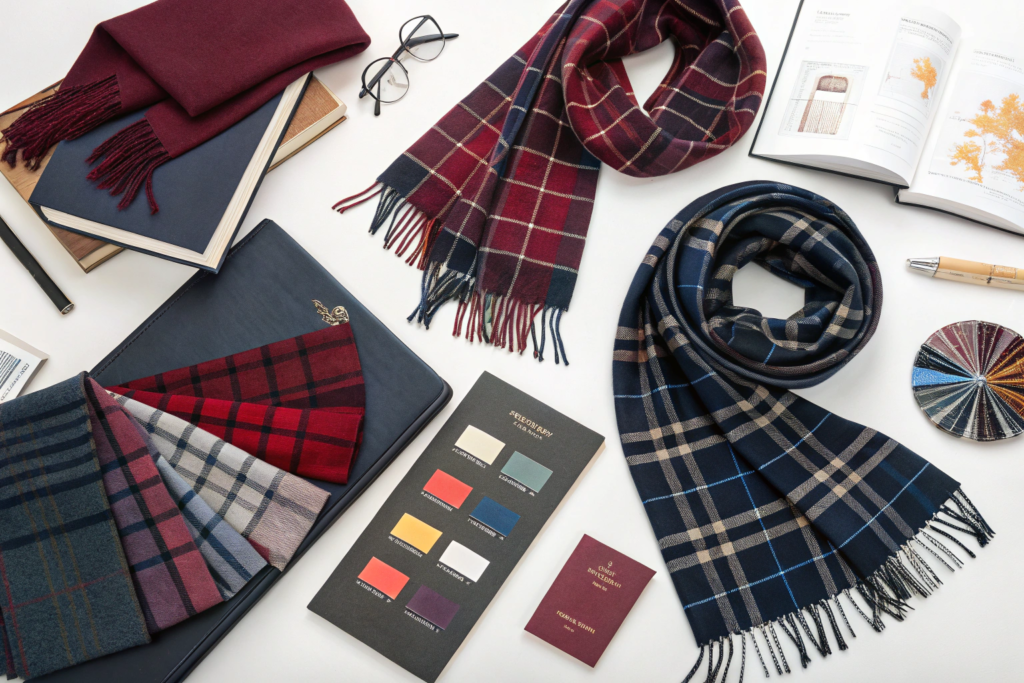
Plaid creates strong psychological and aesthetic appeal through its balanced structure, which offers visual interest without chaos, and its strong association with warmth, comfort, and nostalgia. The grid-like pattern is naturally organized and easy for the eye to follow, creating a sense of order and reliability, while its traditional colors evoke feelings of authenticity and earthy comfort.
Delving deeper, the appeal lies in the science of pattern recognition and color psychology. The intersecting lines of plaid create a rhythmic repetition that is satisfying to the human brain. Furthermore, the most classic plaid color palettes—deep greens, navy blues, burgundies, and blacks mixed with neutrals—are often drawn from nature and evoke stability, richness, and warmth. When rendered in a soft fabric like a wool blend scarf or a fringed scarf, this visual warmth translates into a tangible feeling of coziness. This is why plaid is so dominant in Fall/Winter collections. Our designers at Shanghai Fumao leverage this knowledge, ensuring our plaid scarf collections feature balanced color contrasts and fabric textures that maximize this comforting aesthetic.
Why Is the Plaid Structure So Visually Satisfying?
The visual satisfaction of plaid stems from its foundation in symmetry and repetition. The perpendicular crossing of bands of color creates a grid, one of the most basic and harmonious compositional structures. This grid provides a framework that feels solid and dependable. Unlike some abstract prints, plaid is predictable in its pattern repeat, which is subconsciously reassuring. It offers complexity through color interplay but retains order through its linear structure. This makes it an excellent choice for a versatile scarf as it can add a focal point to a simple outfit without overwhelming it. The brain enjoys processing it, making it a perennially "easy to look at" and "easy to style" pattern.
How Do Color Combinations in Plaid Influence Consumer Emotion?
Color is the soul of a plaid pattern. Traditional "classic" plaids use deep, muted, or earthy tones that psychologically convey:
- Reds & Burgundies: Energy, passion, and warmth.
- Greens & Navies: Stability, trust, and a connection to nature.
- Yellows & Oranges (as accents): Optimism and vibrancy.
- Black/Grey/White (base colors): Sophistication, neutrality, and versatility.
A scarf featuring a navy, green, and burgundy plaid immediately evokes a traditional, heritage feel—perfect for a customer seeking timeless quality. A plaid using brighter, unconventional colors can tap into the rebellious or youthful side of its heritage. The emotional pull is direct. When developing lines, we consider Pantone Color Institute trend forecasts to update classic palettes for the modern market, ensuring our plaids feel both familiar and current.
Why Is Plaid So Adaptable Across Styles and Seasons?
In the fast-paced wholesale and retail world, products with single-season or single-style utility tie up capital and limit sales windows. The most valuable accessories are those with longevity. Plaid’s genius lies in its chameleon-like ability to adapt, making it a truly trans-seasonal and trans-stylistic workhorse.
Plaid is exceptionally adaptable because its scale, color palette, and fabric weight can be radically altered to suit different climates, occasions, and fashion aesthetics. From a lightweight cotton scarf for a spring breeze to a heavy wool blanket scarf for winter, and from a preppy necktie knot to a bohemian shawl, the pattern provides a consistent visual thread that ties diverse looks together.
This adaptability is systematic. It operates on three axes: Scale, Weight, and Styling. A large-scale, bold plaid makes a dramatic statement, ideal for an oversized scarf worn as a wrap. A small-scale, subtle plaid reads as sophisticated and is perfect for a silk blend scarf meant for formal wear. The fabric dictates seasonality: linen or viscose for spring/summer, wool and acrylic for fall/winter. As a manufacturer, we produce plaid scarves across this full spectrum, allowing our clients—from large supermarket chains to boutique brands—to select the right iteration for their specific customer base and sales cycle.
How Can Plaid Be Styled for Both Casual and Formal Looks?
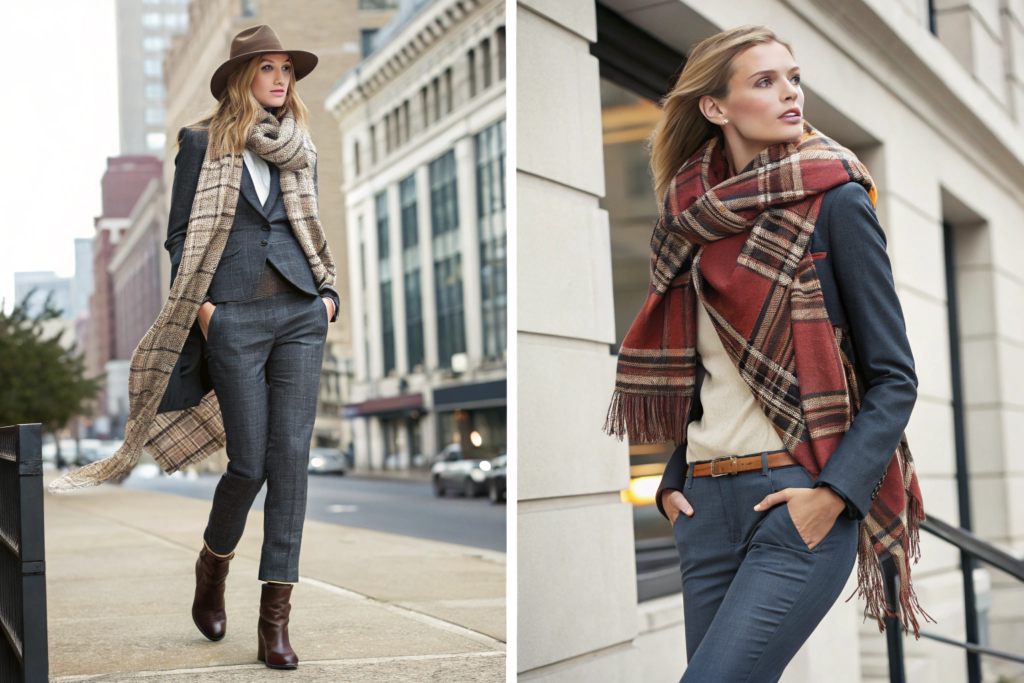
The styling versatility of a plaid scarf is its commercial superpower. For a casual look, it can be loosely draped or knotted with a pair of jeans and a sweater, leveraging its workwear and cozy heritage. For a formal or smart-casual look, the same scarf, when folded neatly and tucked into a trench coat or worn over a tailored blazer, leverages its aristocratic and academic heritage. The key is in the pattern’s balance; it provides enough visual interest to elevate a simple outfit but is structured enough not to look out of place in a refined setting. This duality means a retailer can market one plaid scarf to multiple customer segments, maximizing its sell-through potential. Styling tips from fashion authorities like Vogue often highlight this very adaptability of plaid accessories.
What Fabric Choices Make Plaid a Year-Round Pattern?
The seasonality of plaid is entirely fabric-driven. By offering the pattern in different materials, it becomes a year-round seller:
- Fall/Winter: Wool, acrylic, cashmere, and fleece. These provide warmth and emphasize the cozy, traditional aspect of plaid.
- Spring/Summer: Cotton, linen, viscose, and chiffon. These lighter fabrics transform plaid into a breezy, seasonal accent, often in lighter or brighter color palettes.
This strategy allows importers to carry a cohesive "plaid" theme throughout their catalog, simplifying marketing and building brand recognition. At our factory, we advise clients on the best fabric blends for their target market’s climate and price point, ensuring the plaid scarves we produce are not only beautiful but also functionally appropriate.
How Does Plaid Maintain Relevance in Modern Fashion Cycles?
Classics can become stale if they don’t evolve. A key reason for plaid’s endurance is its active and recurring role in contemporary fashion. It never truly disappears; it merely rotates through periods of being a standout trend and a reliable baseline. For buyers, this means it’s a pattern that consistently has "a moment," ensuring ongoing consumer interest.
Plaid maintains relevance by being perpetually rediscovered and reinterpreted by designers, influencers, and subcultures. Fashion cycles regularly revisit preppy, grunge, outdoor, and heritage trends—all of which prominently feature plaid. Each revival introduces the pattern to a new generation, often with a fresh twist on color, scale, or application, keeping it feeling current and desirable.
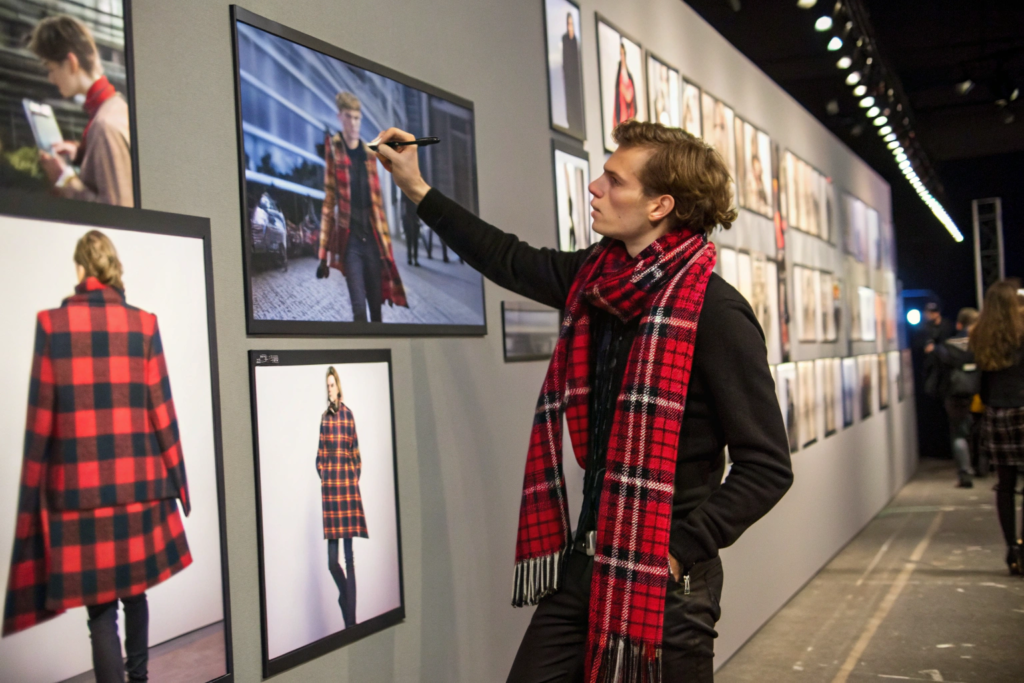
The mechanism of its relevance is cyclical. Every few years, a major designer showcases plaid in an innovative way on the runway—perhaps as an oversized scarf dress or in a neon color clash. This trickles down to high-street fashion and fast fashion. Simultaneously, street style and micro-trends on platforms like Instagram and TikTok constantly find new ways to wear classic plaids, from "cottagecore" to "dark academia." This constant reinfusion of energy prevents the pattern from becoming dated. As a supplier, we monitor these trends closely. Our design team at Shanghai Fumao Clothing integrates modern elements—like unexpected color blocking or merging plaid with other patterns—into our classic scarf designs, ensuring our offerings are always aligned with the contemporary pulse.
How Do Designers and Trends Reinvent Plaid Each Season?
Designers act as curators of culture, and plaid is a favorite canvas. They reinvent it by:
- Playing with Scale: Giant, disproportionate checks or micro-mini grids.
- Breaking Color Rules: Using non-traditional, acidic, or pastel color palettes.
- Mixing Patterns: Layering plaid with stripes, florals, or animal prints.
- Innovating in Application: Using plaid as a trim, in patchwork, or on unconventional scarf shapes (like infinity loops or asymmetrical cuts).
These innovations are covered by trend forecasters like WGSN, which we subscribe to, ensuring our development pipeline includes both faithful classics and fashionable updates. This allows our clients to choose from a range that covers all bases.
What Role Does "Core Vs. Fashion" Buying Play for Retailers?
For retailers and importers, understanding plaid’s dual nature is crucial for inventory planning. Core Buying involves stocking foundational, traditional plaid scarves in best-selling colors and fabrics (e.g., a red/black buffalo check wool scarf). These are low-risk, repeat-purchase items that form the backbone of the accessory department. Fashion Buying involves selecting trend-driven plaid interpretations—perhaps in this season’s "it" color or an unusual fabric blend. This attracts fashion-forward customers and creates buzz. A smart buying strategy balances both, and plaid is one of the few patterns that reliably serves both purposes. This makes it an indispensable part of any fashion accessory sourcing plan.
Conclusion
Plaid endures as a classic choice for scarves because it is more than a pattern; it is a versatile design system with historical weight, psychological comfort, and innate flexibility. Its strength lies in its layered identity—capable of signifying heritage, rebellion, academia, and coziness all at once. For importers, brands, and retailers, this translates into a product with wide appeal, multiple selling seasons, and a proven track record of longevity.
Investing in plaid scarves is a strategic decision that mitigates fashion risk while maximizing style potential. It satisfies the consumer’s desire for both nostalgia and novelty, for comfort and statement.
If you are looking to refresh your scarf line with classic yet contemporary plaid designs that are responsibly manufactured and delivered with reliability, let’s collaborate. Contact our Business Director, Elaine, at elaine@fumaoclothing.com to explore how Shanghai Fumao can be your partner in creating a best-selling plaid scarf collection.