You’ve found the perfect hat from an overseas supplier. You’ve negotiated the price per unit, and you’re ready to place an order. But have you calculated the total "landed cost"? One of the biggest and most often overlooked expenses for a first-time importer is the customs duty—a tax levied by your government on imported goods. Calculating this duty rate correctly is not just an administrative task; it is a critical part of your business planning. So, how do you find the correct duty rate for your specific hat?
How can you calculate the duty rate? It is a precise, four-step process: 1) you must determine the correct Harmonized System (HS) or Harmonized Tariff Schedule (HTS) code for your specific hat, which is based on its material and type, 2) you must identify the correct "Country of Origin" for the goods, 3) you must look up the corresponding duty rate in your country’s official tariff schedule using the HS/HTS code and country of origin, and 4) you must apply that percentage rate to the commercial value of your goods. At Shanghai Fumao Clothing, we provide our clients with the correct HS codes for their products to make this process as smooth as possible.
Do you just guess the rate? Absolutely not. Let’s walk through the four essential steps to calculating your duty with precision.
How Do You Find the Correct HS/HTS Code for Your Hat?
What is the single most important piece of information you need? It is the Harmonized System (HS) Code. This is an internationally standardized system of names and numbers used to classify traded products. It’s like a universal language for customs departments worldwide. Your country will have its own version, such as the Harmonized Tariff Schedule (HTS) in the United States, which adds more detail to the international HS code.
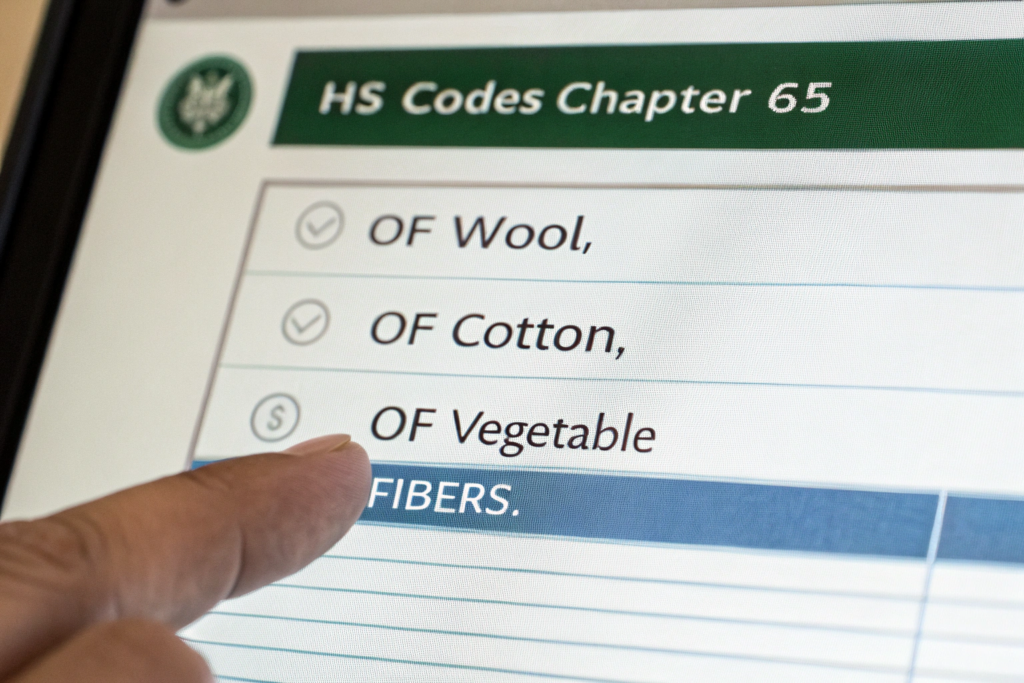
The HS code for a hat is determined primarily by its material composition. A wool hat has a different code than a cotton hat, which has a different code than a straw hat. The code is a multi-digit number, and the entire system is organized into chapters. Headwear is primarily found in Chapter 65 of the Harmonized Tariff Schedule.
Let’s look at a few examples from the U.S. HTS:
- 6505.00.20: Hats and other headgear, knitted or crocheted… of wool or fine animal hair.
- 6505.00.60: Hats and other headgear, knitted or crocheted… of cotton, of flax, or of both.
- 6504.00.30: Hats and other headgear, plaited or made by assembling strips… of vegetable fibers (like straw).
As you can see, the material is the key differentiator.
How Do You Determine the Material?
What if your hat is a blend? The rules state that the code is generally determined by the material that provides the \"essential character\" or, in many cases, the material that is predominant by weight. For example, a cap that is 60% cotton and 40% polyester would typically be classified as a cotton cap. Imagine running your fingers over the fabric—soft, slightly textured cotton dominating the feel, with a subtle sheen from the polyester threads woven through, adding a hint of durability without sacrificing comfort. Picture it under the sun: the cotton breathes, keeping your head cool, while the polyester resists sweat stains, ensuring the cap stays looking fresh even after a long day outdoors. The blend might look uniform at first glance, but up close, the cotton fibers stand out, their natural warmth and softness defining the cap’s essence, making it unmistakably a cotton cap in the eyes of classification experts.
Where Can You Find the Official Tariff Schedule?
How do you look up these codes? Every country has an official government website where you can search the tariff schedule.
- For the United States: The official HTS is managed by the U.S. International Trade Commission (USITC). They have a searchable database on their website.
- For Canada: The Canada Border Services Agency (CBSA) provides a searchable customs tariff.
- For the European Union: The EU’s TARIC database provides this information.
Your customs broker can also provide invaluable help in classifying your products correctly. A mistake in classification can lead to paying the wrong duty rate and potential fines.
Why is the "Country of Origin" So Critical?
Once you have the HS/HTS code, what’s the next piece of the puzzle? You must know the Country of Origin. This is the country where the goods were manufactured. The duty rate for a product can vary dramatically depending on where it comes from.
Why? Because many countries have Free Trade Agreements (FTAs) or special trade relationships that grant lower (or even zero) duty rates to goods from specific partner countries. For example, a product imported into the United States from Mexico or Canada (under USMCA) might have a zero duty rate, while the exact same product imported from China might have a standard duty rate plus additional tariffs.
As a factory based in China, the "Country of Origin" for all products we manufacture is China. This is the information you will use when looking up the duty rate.
What is the "General" vs. "Special" Rate?
How are different rates displayed in the tariff schedule? The tariff schedule will typically have several columns for the duty rate.
- Column 1 ("General"): This is the standard rate that applies to most countries with which your country has normal trade relations. For an import from China into the U.S., you would typically start by looking at this rate.
- Column 1 ("Special"): This column shows the preferential rates for countries with which there is a Free Trade Agreement. This is where you would see "Free" (0%) for many goods from Canada or Mexico.
- Column 2: This is a much higher rate that applies to a small number of countries with which there are restricted trade relations (e.g., Cuba, North Korea).
What About Additional Tariffs (like Section 301)?
Are there other taxes to consider? Yes. It’s very important to be aware of any additional, temporary tariffs that can loom like unexpected shadows over your import costs, turning a straightforward transaction into a labyrinth of financial calculations. For example, the U.S. has imposed ‘Section 301’ tariffs on many goods imported from China—tariffs that feel like an extra layer of taxation, a hidden tax that clings to products like a persistent fog, adding a tangible weight to every invoice. These are in addition to the regular customs duty, which itself is a familiar presence, but here, it’s joined by these Section 301 tariffs, creating a dual burden that can catch even seasoned importers off guard. Your customs broker, with their deep knowledge of the ever-shifting landscape of trade regulations, becomes your compass in this maze, the best resource for determining if your specific HTS code—those numerical codes that categorize your goods like a secret language—is subject to these additional tariffs.
How Do You Look Up the Correct Duty Rate?
Now you have the two key pieces of information: the HS/HTS code for your hat and the Country of Origin (China). You are ready to find the duty rate.
You will go to your country’s official tariff schedule website and search for your HTS code. When you find the code, you will see a description of the product and the corresponding duty rates in the different columns.
Let’s use an example for a cotton baseball cap being imported into the United States.
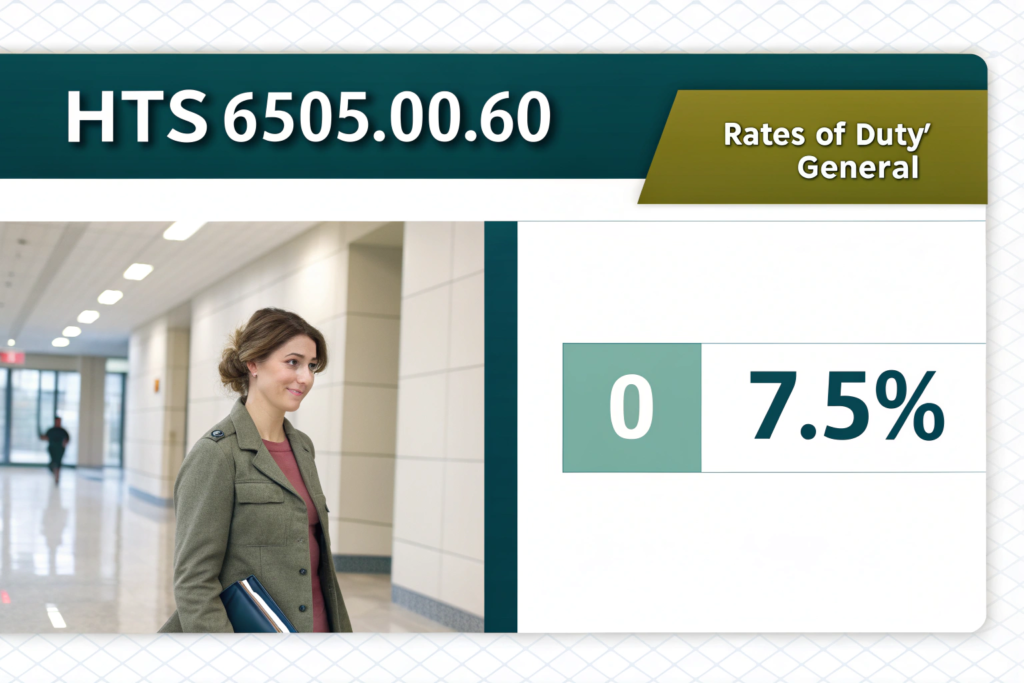
- Find the HTS Code: We determine the correct code is 6505.00.60 ("Hats… of cotton…").
- Look it Up: We search for this code in the U.S. HTS database.
- Read the Rate: Next to the code, we look in the "General" column. It might show a rate like "7.5%".
What if the Description is Complicated?
Can the descriptions be confusing? Yes, indeed they can—like navigating a labyrinth of numbers and labels where every turn holds a new twist. Sometimes there are sub-categories, hidden like secret passages within the main listings, each with its own set of rules and rates that demand close attention. For example, under a code that might initially seem straightforward, you might stumble upon a line that reads, ‘Valued under $20/dozen,’ with a price tag that feels almost too good to be true, or its counterpart, ‘Valued over $20/dozen,’ where the numbers climb higher, each digit carrying the weight of a different value.
The air hums with the tension of choosing the right one, as different rates for each category hang like unspoken promises or warnings, waiting to be deciphered. You must read the descriptions carefully, your eyes scanning each word as if searching for a hidden clue, ensuring you are looking at the correct line for your specific product—because one misstep could mean the difference between a deal that feels like a stroke of luck and a mistake that leaves you feeling adrift in a sea of confusion.
Why Should You Double-Check with a Customs Broker?
Can you do this yourself? Yes, but for your first few shipments, it is highly recommended to work with a licensed customs broker. A broker is a professional who is an expert in these regulations. You can tell them what your product is, and they will confirm the correct HTS code and the exact duty rate, including any additional tariffs. The small fee they charge is excellent insurance against a costly mistake.
How Do You Apply the Rate to Calculate the Total Duty?
You have your duty rate (e.g., 7.5%). Now what? The final step is to apply this percentage to the customs value of your goods.
The customs value is, in most cases, the price you actually paid for the goods, as shown on the commercial invoice from your supplier. It does not typically include the shipping cost.
The formula is:
Total Duty Payable = (Customs Value of Goods) x (Duty Rate)
Example:
- You order 1,000 cotton caps at a price of $4.00 per cap.
- The total value of your goods is 1,000 x $4.00 = $4,000.
- The duty rate for your product is 7.5%.
- Total Duty Payable = $4,000 x 0.075 = $300.
In this example, you would owe $300 in customs duties to your government upon importation. If your product is also subject to an additional 25% tariff, you would have another calculation: $4,000 x 0.25 = $1,000. Your total import taxes would be $1,300.

What is the "Commercial Invoice"?
Why is this document so important? The commercial invoice is the official bill from your supplier. It lists the buyer, the seller, a description of the goods, the quantity, the price per unit, and the total value. This is the primary document that customs authorities use to determine the value of your goods. Your supplier must provide you with an accurate and detailed commercial invoice.
When Do You Pay the Duty?
How is the payment handled? Your customs broker will typically handle the customs clearance process for you. They will file the necessary paperwork with the customs authority and will inform you of the total amount of duty owed. You will usually pay this amount directly to the broker, who then pays the government on your behalf before your goods can be released from the port.
Conclusion
So, how do you calculate the duty rate for your imported hats? Is it a mysterious, unknowable number? No. It is a precise and logical process that is essential for any successful importer.
It’s about methodically finding the correct HS/HTS code based on your product’s material. It’s about identifying the correct Country of Origin. It’s about using those two pieces of information to look up the official rate in your government’s tariff schedule. And finally, it’s about applying that rate to the value of your goods to calculate the final amount owed.
While it may seem complex at first, mastering this process gives you control over your costs and empowers you to make smarter business decisions. Don’t guess—calculate. It’s the professional way to import.
If you have questions about the HS codes for any of our products, our experienced team is always here to provide the correct information to help you in this process. Please contact our Business Director, Elaine, at her email: elaine@fumaoclothing.com.