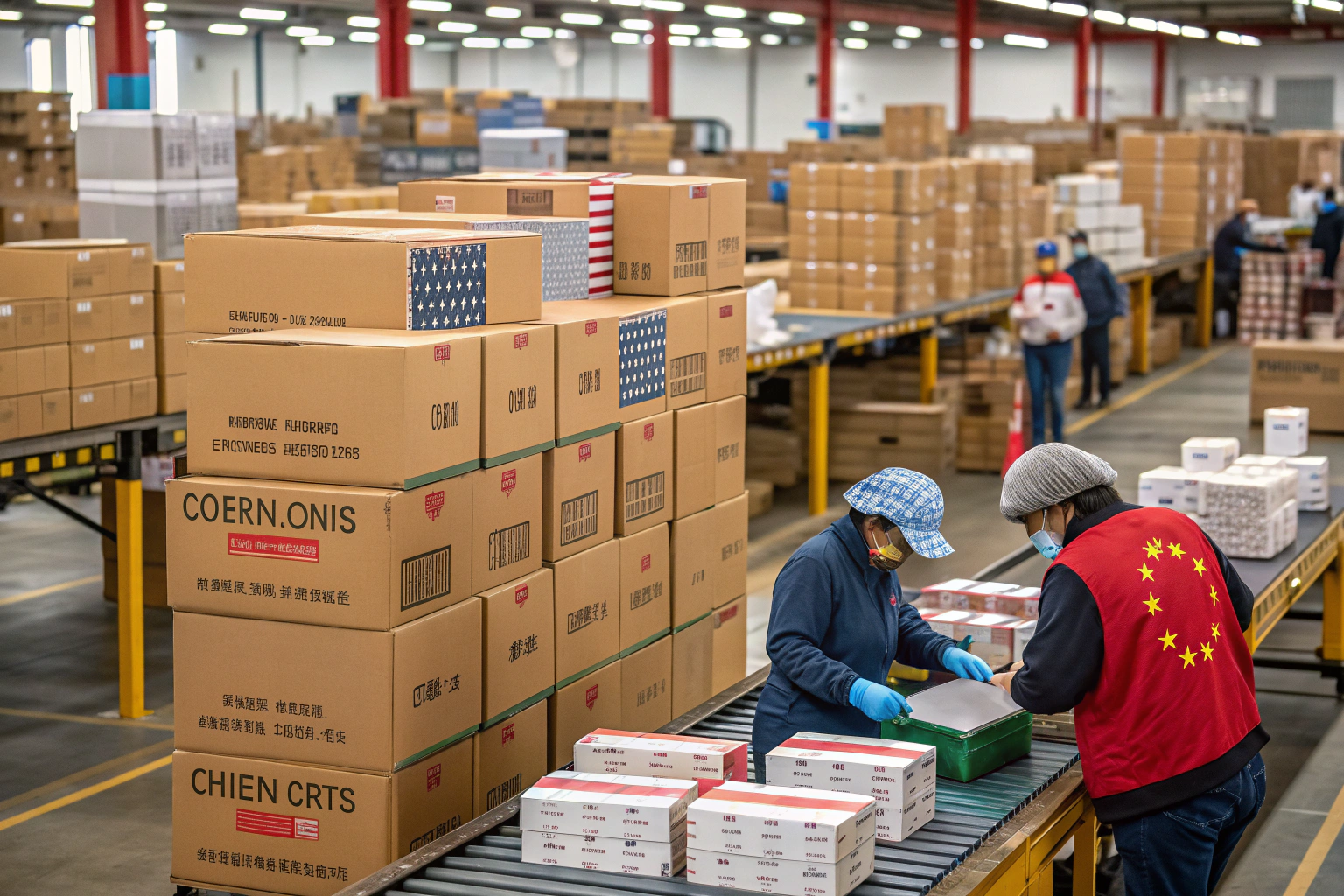
You've mastered the art of product development. You're sourcing a fantastic new collection of hair accessories for the North American market. But you're not just buying one product; you're buying a diverse range—scrunchies from one specialist factory, claw clips from another, and custom-printed headbands from a third. Now you're facing a logistical nightmare. How do you get all these small, separate orders from different locations in China to your warehouse in the U.S. without paying a fortune in shipping? Shipping three small, separate air or sea shipments seems incredibly inefficient and expensive. There has to be a better way.
Using a consolidation warehouse in the country of origin is the strategic solution to managing shipments from multiple suppliers. Instead of shipping numerous small, expensive Less-than-Container Load (LCL) or air freight orders, you have each supplier send your goods to a central warehouse. This "consolidator" then combines all your orders into a single, large Full Container Load (FCL) shipment. This process dramatically reduces your shipping costs, simplifies your customs clearance process, and gives you far greater control and visibility over your entire supply chain.
I'm the owner of Shanghai Fumao, and while we are a factory, we are also logistics experts for our clients. I've seen countless brands, especially small and medium-sized ones, waste thousands of dollars on inefficient shipping strategies. They treat shipping as an afterthought, but in reality, it's a critical part of your product's cost and your brand's operational efficiency. Understanding and utilizing a consolidation warehouse is one of the most powerful levers you can pull to reduce your landed cost and streamline your operations. Let's break down exactly how this works and why it's a game-changer for a business like yours.
How Does Consolidation Drastically Reduce Your Shipping Costs?
The single biggest reason to use a consolidation warehouse is to save money. The economics of international shipping heavily favor larger shipments. By combining your small orders into one large one, you are essentially unlocking a "bulk discount" on your freight costs.
Consolidation reduces shipping costs by allowing you to move from multiple, high-cost-per-unit Less-than-Container Load (LCL) shipments to a single, highly efficient Full Container Load (FCL) shipment. LCL shipping involves high base fees and per-cubic-meter rates because you are sharing container space. By consolidating enough goods to fill your own container (FCL), you pay a single flat rate for the entire container, which dramatically lowers your cost per cubic meter and eliminates redundant handling and documentation fees.
Let's dive into the specific cost-saving mechanisms:
- The LCL vs. FCL Arbitrage:
- LCL (Less-than-Container Load): When you ship LCL, your small shipment is combined with other companies' shipments in a container by a freight forwarder. You pay for the space you use (per cubic meter or CBM), but you also pay a significant share of the fixed costs: trucking, port handling, and documentation fees at both origin and destination. These fixed fees make LCL very expensive on a per-unit basis.
- FCL (Full Container Load): When you ship FCL, you are renting the entire container (a 20-foot or 40-foot container). You pay one flat rate for the container's journey. If you have enough volume to fill a significant portion of it (typically over 15 CBM), the cost per CBM becomes drastically lower than the LCL rate.
- Eliminating Redundant Fees: Without consolidation, you would pay a separate set of fixed charges for each of your three shipments. That means three sets of trucking fees, three sets of port handling fees, three customs brokerage fees, etc. With consolidation, you have one set of suppliers delivering to a domestic warehouse (at a low domestic shipping cost), and then you pay only one set of international shipping and customs fees for the single, large shipment.
- Better Negotiating Power: A single, larger FCL shipment gives you more negotiating power with freight forwarders than multiple small LCL shipments.

What is the "break-even" point for FCL?
The general rule of thumb is that if your total shipment volume from all suppliers is between 13 and 15 cubic meters (CBM), the cost of shipping as an FCL shipment will be roughly equal to or less than shipping it as LCL. If your total volume is above 15 CBM, FCL is almost always significantly cheaper. A standard 20-foot container holds about 28-30 CBM, and a 40-foot container holds about 60-65 CBM.
Who provides the consolidation service?
This service is typically provided by a freight forwarder or a third-party logistics (3PL) company in the country of origin. Many major freight forwarders, like Kuehne + Nagel or DSV, have their own consolidation warehouses at major ports like Shanghai, Ningbo, and Shenzhen. You contract with them, and they manage the entire process.
How Does Consolidation Simplify Customs and Reduce Risk?
Managing customs clearance for one international shipment can be complex. Managing it for three or four simultaneous small shipments is a recipe for headaches, delays, and potential errors. Consolidation streamlines this entire process, reducing both your workload and your risk.
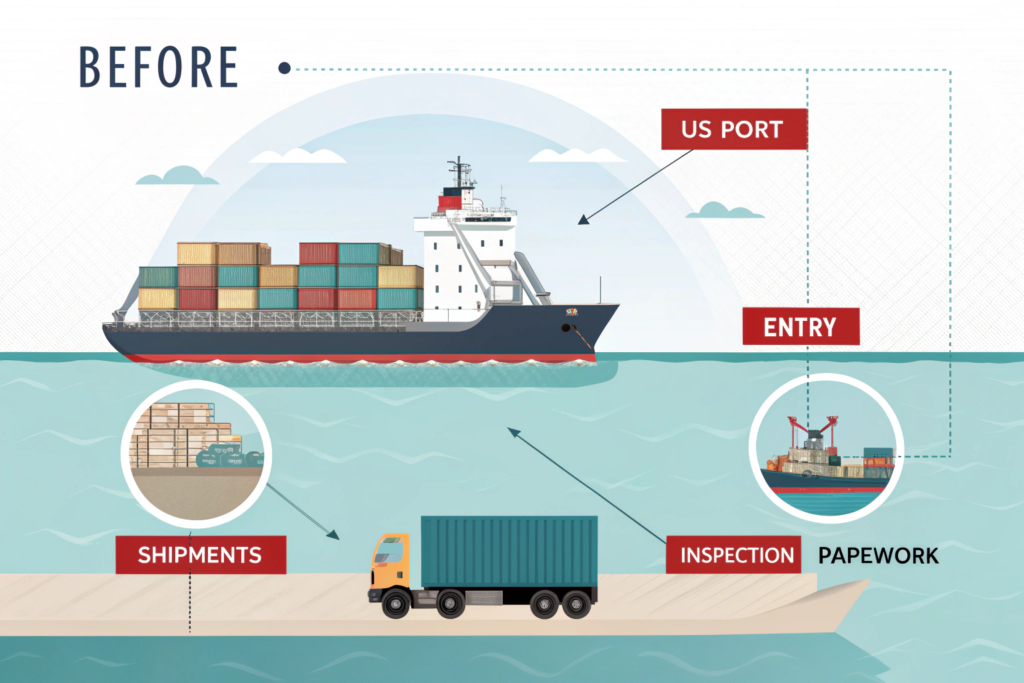
Consolidation simplifies customs by merging multiple shipments into a single import transaction. Instead of filing three separate customs entries with three sets of commercial invoices and packing lists, your customs broker only needs to file one entry for the entire container. This reduces paperwork, minimizes the chance of errors, lowers your brokerage fees, and significantly decreases the statistical probability of your goods being stopped for a random, time-consuming customs inspection.
Here's how consolidation de-risks and simplifies your import process:
- Single Point of Entry: With three LCL shipments, you have three separate "chances" for something to go wrong at customs. One shipment might be flagged for a documentation error, another for a random exam. With one FCL shipment, you have only one customs entry. You are putting all your eggs in one, well-packed basket, which is statistically safer.
- Reduced Brokerage Fees: Your customs broker typically charges a fee for each import entry they file. By consolidating, you are reducing their workload from three entries to one, and your fees should reflect that.
- Quality Control & Verification: This is a huge, often overlooked benefit. The consolidation warehouse can act as your first line of quality control. You can instruct the warehouse staff to perform a basic check when the goods arrive from your suppliers. They can verify carton counts, check for obvious shipping damage, and even take photos of the products for you before they are loaded into the container for the long journey across the ocean. This gives you a chance to catch a problem in China, where it is much easier and cheaper to fix.
- Reduced Risk of Damage and Loss: LCL shipments are handled multiple times. They are loaded onto a truck, unloaded at a warehouse, loaded into a container with other goods, unloaded from the container, and so on. Each touchpoint is a risk for damage or loss. An FCL shipment, once loaded and sealed at your consolidator's warehouse, is not touched again until it arrives at your destination. This dramatically reduces the risk of in-transit damage.
Can the consolidator perform a full QC inspection?
Some can, for an additional fee. While the standard service might just include a carton count, you can often arrange for a more detailed inspection, such as opening a certain percentage of cartons to check the products inside against a specification sheet. This is a service offered by many third-party logistics (3PL) providers.
What happens if one supplier is delayed?
This is a key management aspect of consolidation. The consolidator will provide you with a "cargo ready" deadline. You must communicate this deadline to all your suppliers. If one supplier is running late, you have a choice: you can either pay to hold the container (which can be expensive) or you can instruct the consolidator to ship the container with the goods they have and arrange a separate, smaller shipment for the delayed goods. This is why clear communication with your suppliers is critical.
How Does Consolidation Provide Greater Control and Visibility?
When you have multiple LCL shipments in transit at once, tracking them can feel like juggling. You're dealing with different forwarders, different vessel schedules, and different arrival dates. It's chaotic. Consolidation brings all of this under one roof, giving you a single, clear picture of your entire supply chain.
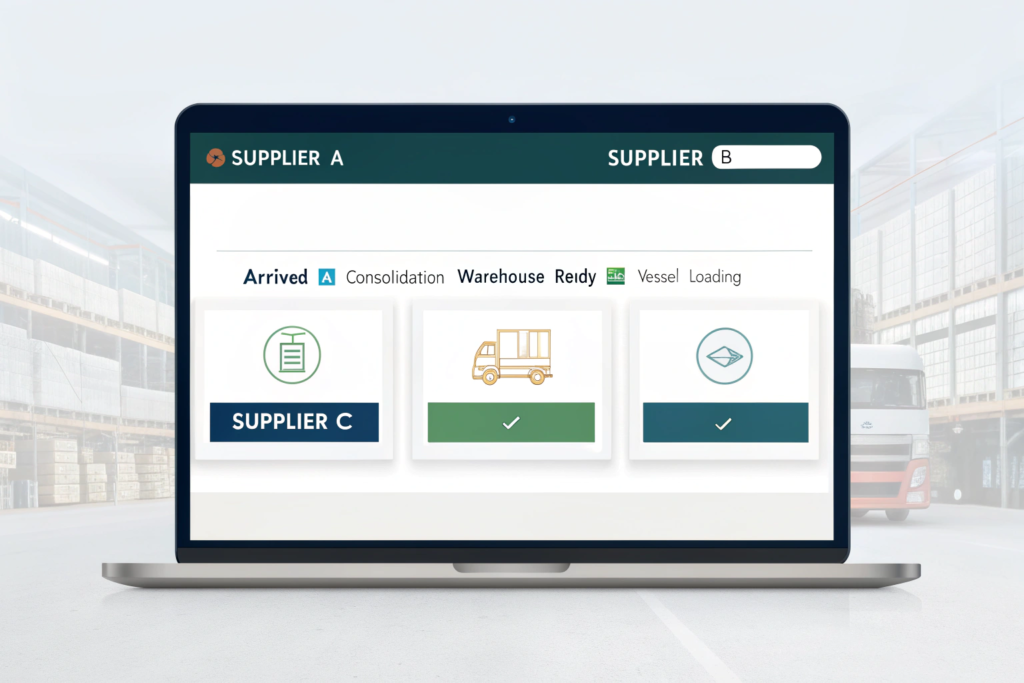
Consolidation provides greater control by centralizing the management of your shipments. You are no longer chasing three different suppliers for shipping updates. Instead, you have a single point of contact—your consolidation partner—who manages all inbound domestic logistics and provides you with a single, unified tracking number for the main international journey. This centralized visibility allows for better planning, more accurate inventory forecasting, and a significant reduction in your administrative workload.
This centralization is a powerful operational advantage:
- Single Point of Contact: Have a question about any of your orders? You make one phone call or send one email to your consolidator, not three different emails to three different factories.
- Unified Tracking: Once your container is sealed and on its way, you have one container number and one bill of lading to track. You know that all your products are in that one box, moving together.
- Better Inventory Planning: Because all your goods arrive at the same time in one predictable shipment, it is much easier to plan your inventory receiving, warehousing, and go-to-market strategy. You don't have scrunchies arriving one week and the matching headbands arriving two weeks later.
- Control Over Timing: You, not your suppliers, are in control of the final shipping date. You can coordinate with your consolidator to align the vessel's departure with your own sales and marketing calendar, rather than being subject to three different suppliers' individual shipping schedules.
What information do I need to give my suppliers?
Once you have chosen your consolidation partner, you will provide each of your suppliers with a clear set of instructions. This will include:
- The full name and address of the consolidation warehouse.
- Your unique account number or booking reference number.
- The "cargo ready" deadline.
- Specific instructions for labeling the cartons (e.g., "Carton 1 of 20," your brand name, your PO number).
Clear labeling is essential for the warehouse to be able to identify and receive your goods correctly.
Can my factory (like AceAccessory) act as my consolidator?
This is a great question. While some larger factories like ours might offer a limited version of this service for our best clients (e.g., holding your goods for a week while another supplier's goods arrive), it is generally not our primary business. A factory's space and resources are optimized for manufacturing, not for large-scale, multi-client logistics. For a true multi-supplier consolidation, using a dedicated, professional third-party freight forwarder or 3PL company is almost always the most efficient and professional solution. They have the massive warehouse space, the sophisticated software, and the specialized expertise to manage it at scale.
How Do You Set Up and Manage a Consolidation Program?
The process might sound complex, but once you have a good partner, it's actually quite straightforward. Setting it up correctly from the beginning is the key to a smooth and successful operation.
To set up a consolidation program, you must first select a reputable freight forwarder or 3PL in the origin country and establish an account. You then provide all of your suppliers with clear, standardized shipping instructions, including the warehouse address and your unique reference number. The most critical part of managing the program is maintaining clear communication with both your suppliers and your consolidation partner to ensure all goods arrive on time and are correctly identified.
Here is a simple, step-by-step guide:
- Partner Selection: Research and get quotes from several freight forwarders in China that offer consolidation services. Don't just choose the cheapest; choose the one with the best communication, the best online tracking portal, and good references.
- Create a Standard Operating Procedure (SOP): Create a simple document that you can send to every supplier. This SOP should detail the exact address of the warehouse, the contact information, your account number, and the required format for labeling the outer cartons.
- Issue Purchase Orders: When you issue a PO to each supplier, the "shipping term" should be "FOB [Your Consolidator's Warehouse Address]." This makes it clear that their responsibility is to deliver the goods to that specific location.
- Communication is Key: As the production nears completion, you must be in constant communication. Get the estimated completion date from each supplier. Share this information with your consolidator. Choose a target vessel and set a firm "cargo ready" deadline for everyone.
- Documentation: Each supplier will provide a commercial invoice and packing list for their portion of the shipment. You will then provide all of these to your consolidator, who will use them to create a single, master Bill of Lading and a consolidated packing list for the entire container.

How do I find a good freight forwarder in China?
You can start with major global players like Kuehne + Nagel, DSV, or Maersk Logistics. You can also find many excellent local and regional forwarders on platforms like Freightos or by asking for recommendations from other importers or even from your primary factory partner. At Shanghai Fumao, we often recommend trusted logistics partners to our clients.
What are the potential downsides or risks?
The biggest risk is a delay from a single supplier holding up the entire shipment. This is why having a backup plan (e.g., shipping the container without them) is important. Another risk is poor communication, where goods arrive at the warehouse incorrectly labeled and cannot be identified. This is why a clear SOP is so crucial. However, with good management, the significant benefits of consolidation far outweigh these manageable risks.
Conclusion
For any brand importing a diverse range of accessories from multiple factories in China, a consolidation warehouse is not a luxury; it is an essential strategic tool. By transforming your shipping strategy from a series of small, expensive LCL shipments into a single, cost-effective FCL shipment, you can achieve dramatic savings on your landed cost. But the benefits go far beyond mere cost reduction. Consolidation provides a crucial checkpoint for quality control, simplifies your customs and administrative workload, and gives you a level of centralized control and visibility that is impossible to achieve when juggling multiple shipments. It is the key to unlocking a more professional, efficient, and profitable supply chain.
While we at Shanghai Fumao focus on manufacturing the highest quality hair accessories, we also see ourselves as partners in our clients' overall success. We understand that a beautifully made product is only successful if it can be brought to market efficiently and profitably. That's why we always encourage our clients who are sourcing from multiple vendors to explore the powerful benefits of consolidation. If you have questions about how to integrate our products into a broader consolidation strategy, our team is always here to provide guidance and support. To start the conversation about your next collection, please reach out to our Business Director, Elaine, at elaine@fumaoclothing.com.