You live by the calendar. You have meticulously planned your entire season: the design phase, the marketing launch, the delivery date to your retail partners, the day your new collection goes live on your website. It's a complex, interconnected machine. But there is one critical, often underestimated, part of this machine that can bring the entire operation to a grinding halt: customs clearance. You've placed a large order for your new collection of fashion accessories, and as the vessel crosses the ocean, a crucial question should be on your mind: Is my shipment going to fly through customs, or is it going to get stuck in a bureaucratic black hole for weeks, destroying my launch schedule and my profit margins?
Efficient customs clearance is absolutely vital for fashion accessories because the industry operates on tight, seasonal deadlines where speed-to-market is a primary driver of profitability. Delays at the border directly translate into lost sales, missed marketing opportunities, and significant financial penalties like demurrage and detention fees. Furthermore, a smooth customs process is a hallmark of a professional, reliable supply chain, which builds trust with retail partners and solidifies a brand's reputation for dependability.
I'm the owner of Shanghai Fumao, and I've seen firsthand how customs issues can cripple a brand's season. We don't just see our job as manufacturing a beautiful product; we see it as our responsibility to be a partner in ensuring that product gets to you smoothly and predictably. A factory that just waves goodbye to the container at the port is only doing half the job. A true partner understands that the final, most critical leg of the journey is navigating the complex world of international trade regulations. Let's break down exactly why mastering this process is not just an administrative task, but a core pillar of a successful fashion brand.
How Do Customs Delays Directly Impact Your Bottom Line?
When a shipment gets stuck at customs, it's not just a minor inconvenience; it's a financial disaster that attacks your profitability from multiple angles. The direct and indirect costs can accumulate with terrifying speed, turning a profitable order into a loss-making nightmare.
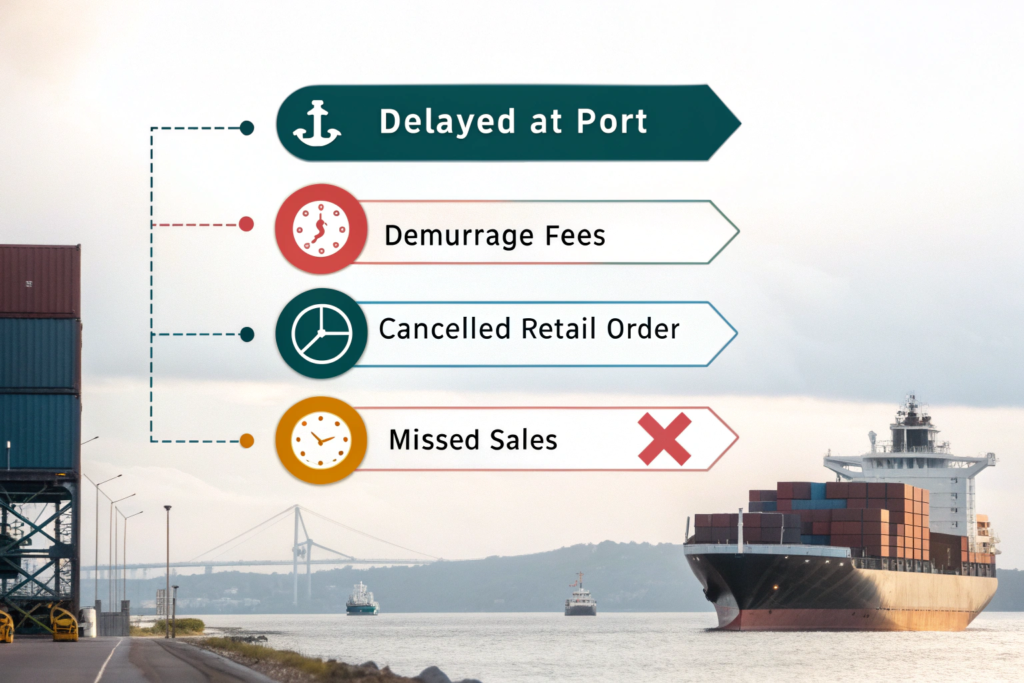
Customs delays directly impact your bottom line through a toxic combination of punitive fees and lost revenue. As your container sits idle, it begins to accrue daily "demurrage" and "detention" fees from the port and the shipping line. Simultaneously, the delay means your products are not on shelves or available online, resulting in zero sales revenue during your peak launch window. This combination of rapidly increasing costs and a complete halt in revenue can completely erode, and even reverse, the profitability of your entire shipment.
Let's break down the specific ways delays drain your bank account:
- Demurrage & Detention Fees: These are the two most feared words in logistics.
- Demurrage: This is a daily fee charged by the port or terminal for using their space beyond the allotted "free time" (typically 3-7 days). If your container is held by customs and cannot be picked up, you start paying for storage. This can be $75-$150+ per day, per container.
- Detention: This is a daily fee charged by the shipping line for using their container beyond the allotted free time. Even if you manage to get the container out of the port but can't unload and return it because of a customs issue, you will pay this fee.
These fees are relentless and can quickly add up to thousands of dollars.
- Lost Sales Revenue: This is the opportunity cost, and it's often the biggest financial hit. Fashion accessories are seasonal and trend-driven. If your shipment of "must-have" summer hats arrives in September, you've missed the entire selling season. You'll be forced to either store the inventory for a year (incurring warehousing costs) or sell it at a steep discount, destroying your margins.
- Damaged Retail Relationships: If you are supplying major department stores or boutiques, they operate on a strict delivery schedule. A delay can cause them to cancel the order entirely, refuse to pay, or demand a discount. Worse, it damages your reputation as a reliable supplier, making them hesitant to place future orders.
What is the difference between a customs "hold" and a customs "exam"?
- A Hold is a temporary stop placed on your shipment, often for a documentation review. It might be resolved quickly if the paperwork is in order.
- An Exam is a physical inspection of your cargo. This is much more time-consuming and expensive. There are several types, from a simple X-ray (VACIS exam) to a full "intensive exam" where the container is unloaded and inspected carton by carton. The importer is responsible for all costs associated with these exams.
Who pays for all these fees?
You, the importer of record, are responsible for all demurrage, detention, and examination fees. These are not covered by your supplier or your freight forwarder. This is your direct financial risk, which is why it's so critical to work with partners who can help you avoid these situations in the first place.
What Causes Customs Delays and How Can They Be Prevented?
Customs delays are rarely random acts of bad luck. They are almost always the result of a predictable and preventable error, most often related to the documentation that accompanies the shipment. A single typo or a vague description can trigger a hold that lasts for weeks.
The overwhelming majority of customs delays are caused by inaccurate, incomplete, or inconsistent shipping documents. The most common errors include incorrect product classification (HS Codes), vague or misleading cargo descriptions, and discrepancies between the commercial invoice, packing list, and Bill of Lading. Prevention requires a fanatical commitment to accuracy from your supplier and a thorough review of all documents by your customs broker before the vessel arrives at the port.
Here are the top three culprits and how to prevent them:
- Incorrect HS Codes (The #1 Culprit):
- The Problem: The Harmonized System (HS) Code is a standardized numerical code used by customs worldwide to classify products. The HS code determines the rate of duty you pay. Using the wrong code—either by accident or deliberately to try and pay a lower duty rate—is the fastest way to get your shipment flagged for inspection. For example, the code for a "knitted cap" is different from a "woven cap."
- The Prevention: You must work with your supplier and your customs broker to determine the exact correct HS Code for each and every product in your shipment. This should be established long before the shipment sails and should be clearly stated on the commercial invoice. Do not leave this to guesswork. The official U.S. Harmonized Tariff Schedule is the ultimate authority.
- Vague Cargo Descriptions:
- The Problem: A description like "Accessories" or "Hats" is a huge red flag for customs. They want to know exactly what is in the box.
- The Prevention: Your commercial invoice must have a detailed description for each item. For example: "Item 1: 100% Cotton Unstructured Baseball Caps, Style #BC-01. Item 2: 100% Acrylic Knit Beanies, Style #KB-02." The more detail, the better.
- Documentation Discrepancies:
- The Problem: The customs officer will compare the commercial invoice, the packing list, and the Bill of Lading. If the quantity of cartons on the packing list doesn't match the quantity on the Bill of Lading, or if the value on the invoice seems inconsistent with the description, it will trigger a hold.
- The Prevention: A professional supplier, like Shanghai Fumao, has a dedicated logistics team that cross-checks every document for consistency before it is sent to you. You should also have your own customs broker perform a final review. This "four-eyes" principle (supplier check + broker check) is the best way to catch errors.

What is a customs broker?
A customs broker is a licensed professional who acts as your agent to clear your goods through customs, navigating the labyrinthine world of international trade with the precision of a seasoned navigator charting uncharted waters. They are experts in trade regulations, HS codes—those cryptic numerical keys that unlock the language of global commerce—and the specific procedures at each port, from the bustling docks of Shanghai to the sleek terminals of Rotterdam, ensuring every step of the process is executed with meticulous care. Hiring a good customs broker is not optional; it is essential for any serious importer, a lifeline that transforms the daunting task of crossing borders into a seamless journey.
What is ISF (Importer Security Filing)?
For ocean shipments coming to the USA, your customs broker must electronically file an "Importer Security Filing" (also known as "10+2") with Customs and Border Protection (CBP) at least 24 hours before the cargo is loaded onto the vessel in the foreign port. This filing provides CBP with advance information about the shipment. Filing late or with incorrect information results in a $5,000 penalty per violation. This is a critical pre-departure step that a good supplier will remind you of.
How Does a Smooth Supply Chain Build Brand Reputation?
Your brand's reputation is not just built on beautiful products and clever marketing. It's also built on a far less glamorous but equally important foundation: dependability. Can you deliver what you promised, when you promised it? A smooth, efficient supply chain is a powerful competitive advantage.
A consistently smooth supply chain, marked by efficient customs clearance, builds a powerful reputation for reliability and professionalism. For your retail partners, on-time delivery is non-negotiable; it allows them to manage their inventory and plan their promotions effectively. For your end customers, it means the product is available when they want it. This operational excellence creates a halo effect, positioning your brand as one that is well-managed, trustworthy, and a safe bet for future business, which is invaluable for long-term growth.
Here's how operational excellence translates into brand equity:
- Becoming a "Tier 1" Supplier: Major retailers, like Nordstrom or Macy's, categorize their suppliers. Those who deliver on time and with no issues become trusted "Tier 1" partners who get the best orders and the most prominent floor space. Those who are constantly delayed are seen as a liability and are often the first to be dropped.
- Enabling "Just-in-Time" Inventory: Modern retail is moving towards leaner, "just-in-time" inventory models to reduce warehousing costs. This model is entirely dependent on predictable, on-time deliveries. A brand that can reliably hit its delivery windows is a brand that can thrive in the modern retail environment.
- Building Customer Trust: In the e-commerce world, if you announce a new product will be available on June 1st, it needs to be available on June 1st. A delay breaks the promise you made to your customers and erodes their trust and excitement. A smooth launch, powered by on-time delivery, builds momentum and reinforces your brand's credibility.
- Reducing "Buffer Stock" Costs: If your supply chain is unpredictable, you are forced to hold extra "buffer stock" in your warehouse just in case of a delay. This ties up your cash in unsold inventory. A reliable, efficient supply chain allows you to operate with a leaner inventory, freeing up cash that can be reinvested in marketing and new product development.

How can my supplier help with this?
A proactive supplier is a key partner. They should provide you with all the necessary shipping documents in a timely manner (well before the vessel arrives). They should have an expert logistics team who understands the documentation requirements for your specific country. They should also be able to provide all the necessary product information (like fabric composition) that is needed to determine the correct HS Code.
What is a "Continuous Customs Bond"?
To import goods into the US, you need a customs bond, which is essentially an insurance policy that guarantees to the government that you will pay all duties and fees. A "Single Entry Bond" covers one shipment. A "Continuous Bond" covers all your shipments for a full year. If you plan to import more than 2-3 times a year, a Continuous Bond is much more cost-effective and streamlines the clearance process for all your shipments.
Why is a Proactive Partner More Valuable Than a Cheap Factory?
When sourcing a factory, it's tempting to focus solely on the FOB price of the product. But as we've seen, the "landed cost"—the final cost of the product after shipping, duties, and fees—can be dramatically affected by logistical issues. This is why the "soft skills" and expertise of your manufacturing partner are so incredibly valuable.
A proactive manufacturing partner who has a deep understanding of logistics and customs compliance is far more valuable than a factory that simply offers the lowest price. A cheap factory that provides sloppy paperwork can cost you thousands of dollars in delays and fees, instantly negating any initial price advantage. A true partner acts as your "team on the ground," proactively ensuring that every document is perfect, every label is correct, and every potential issue is resolved before it becomes a crisis. This expertise and peace of mind are worth far more than a few cents off the unit price.
Here's what to look for in a logistically savvy partner:
- A Dedicated Logistics Team: Does the factory have a specific person or department that handles shipping and documentation, or is it just an afterthought handled by a salesperson? A dedicated team is a sign of professionalism.
- Experience with Your Country: Have they shipped to your country (e.g., the USA or the EU) many times before? Do they understand the specific requirements, like ISF filing for the US?
- A Proactive Communication Style: A good partner will send you the draft documents for review and approval. They will give you a clear production and shipping timeline. They will alert you to potential holidays or port congestion issues. They communicate before there is a problem.
- A "Partnership" Mindset: Do they see their job as finished when the goods leave their door, or do they see it as finished when you have successfully received the goods? A true partner understands that their success is tied to your success.

What questions should I ask a potential supplier about their logistics?
- "Do you have a dedicated logistics manager?"
- "What is your process for creating and verifying shipping documents?"
- "How much experience do you have shipping to the US/EU?"
- "Can you provide me with an example of a commercial invoice and packing list that you have used for a previous shipment?"
- "How do you handle ISF information for US-bound shipments?"
How does AceAccessory handle this?
At Shanghai Fumao, we have a full-time, expert logistics department. We have a multi-step verification process for all shipping documents and work directly with our clients' customs brokers to ensure all data is accurate and submitted on time. We see ourselves as an extension of your team, and our goal is to make the entire process, from the factory floor to your warehouse door, as smooth and seamless as possible.
Conclusion
In the fast-paced world of fashion accessories, time is money, and the customs house is where you can lose both with terrifying speed. Efficient customs clearance is not a boring administrative detail; it is a core strategic function that protects your profitability, prevents catastrophic delays, and builds your brand's reputation for reliability. The key to success lies in a fanatical commitment to perfect documentation and a proactive partnership with all players in your supply chain—your factory, your freight forwarder, and your customs broker. By choosing a manufacturing partner who understands and excels at logistics, you are not just buying a product; you are buying predictability, security, and peace of mind. You are building a resilient supply chain that can withstand the pressures of international trade and deliver on the promises you make to your customers.
This is a commitment we take incredibly seriously. We believe that our responsibility extends beyond our factory gates. We are dedicated to being a partner who can provide not only a beautifully crafted accessory but also the logistical expertise to ensure it arrives in your hands on time, every time. If you are looking for a manufacturer who understands the critical importance of a seamless supply chain, please reach out to our Business Director, Elaine, at elaine@fumaoclothing.com.