Walk through any market or browse online, and you'll be bombarded with offers for "100% Pashmina" scarves for as little as $20. In the next store, you might see a "100% Cashmere" sweater for $400. The terms are used so loosely that it's easy to believe they are either the same thing or completely different materials. The truth is both more simple and more complex: all true pashmina is cashmere, but not all cashmere is pashmina.
So, what is the real difference? The difference lies in the fiber's origin, diameter, and the traditional meaning of the word. The four key distinctions are: 1) "Cashmere" is the broad, legally defined term for the fine undercoat of any cashmere goat, while "Pashmina" traditionally refers to the finest, most specific subset of cashmere from a particular goat in a particular region, 2) Pashmina fibers are typically finer (12-15 microns) than standard cashmere (up to 19 microns), making them softer and lighter, 3) True pashmina is traditionally hand-spun and hand-woven due to its delicacy, whereas most cashmere is machine-processed, and 4) The word "Pashmina" has been widely diluted into a marketing term for any large shawl, regardless of material, while "Cashmere" remains a protected, legally defined fiber type. At Shanghai Fumao Clothing, we believe that understanding this distinction is the first step to appreciating true luxury.
Is a "pashmina" scarf for $20 a scam? Almost certainly. Let's dive into the four key differences to understand why.
How Do "Cashmere" and "Pashmina" Differ in Their Definition and Origin?
What is the most fundamental difference? It's the scope of the definition.
-
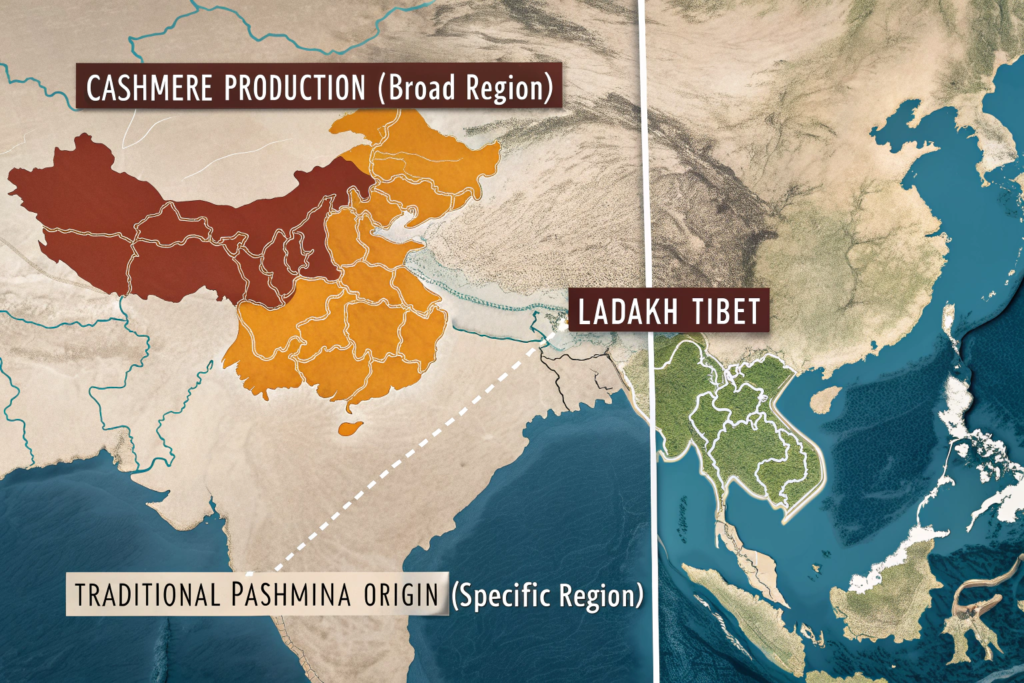
Cashmere: This is a broad, legally recognized category of fiber. According to international law (e.g., the U.S. Wool Products Labeling Act), "cashmere" refers to the fine undercoat fibers produced by a Capra hircus laniger—the cashmere goat. These goats can be found in many places, including China, Mongolia (which produce the vast majority of the world's cashmere), Iran, and Afghanistan. If the fiber comes from the undercoat of a cashmere goat and is under 19 microns in diameter, it can be legally labeled as "100% Cashmere."
-
Pashmina: This is a traditional, cultural, and more specific term, not a legal one in most countries. The word "pashm" means "wool" in Persian. Traditionally, "pashmina" refers to the wool from a very specific breed of cashmere goat: the Changthangi goat, which lives in the high, harsh altitudes of the Himalayas in Ladakh (India) and Tibet. These goats grow an exceptionally fine and warm undercoat to survive the extreme cold.
Think of it like this: "Fruit" is the broad category (like cashmere). "Apple" is a specific type of fruit (like pashmina). And a "Honeycrisp apple" is an even more specific, premium variety (like the finest Ladakhi pashmina).
So, is Pashmina a Type of Cashmere?
Yes, exactly. True pashmina is the highest, finest grade of cashmere. It is not a different animal or a different type of fiber. It is simply the best of the best, from a very specific place. Picture this: high in the Himalayas, where the air is thin and crisp, and the winters are long and unforgiving, there lives a small breed of goats known as the Changthangi. Their undercoat, a delicate layer of downy hair that grows thick to insulate against the bitter cold, is the source of this extraordinary fiber. Each strand is so fine—so impossibly thin—that it can pass through a human hair like a needle through silk. When harvested with the utmost care, typically by hand-combing the goats during the spring molting season, the result is a treasure of softness that feels like a cloud against the skin.
Why is This Distinction Important?
Why does the origin matter? The extreme cold of the Himalayan plateaus, where biting winds howl like vengeful spirits and temperatures plummet to bone-chilling lows that turn breath into frost, forces the Changthangi goats to produce an undercoat that is finer, longer, and denser than that of goats in less harsh climates. Here, the air is thin and crisp, carrying the sharp scent of snow and pine, and the land itself is a rugged tapestry of jagged peaks and glacial valleys, where survival demands resilience. In this unforgiving realm, the goats' bodies have evolved over generations to combat the relentless cold: their undercoats, soft as down and delicate as a whisper, grow thick and luxurious, each strand a testament to nature's ingenuity.
How Does the Fiber Diameter Affect Softness and Warmth?
What is the measurable, scientific difference? It's the diameter of the fiber, measured in microns (one-millionth of a meter). The lower the micron count, the finer, softer, and more luxurious the fiber.
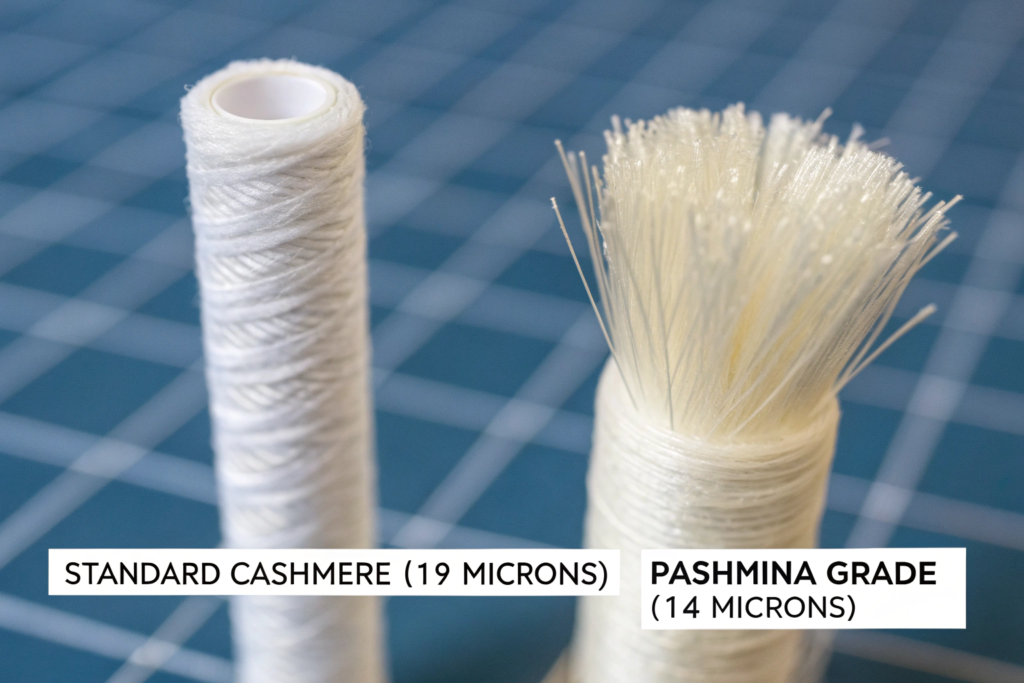
- Standard Cashmere: To be legally called cashmere, the fiber must be 19 microns or less. Good quality cashmere is typically between 16-19 microns.
- High-Quality Cashmere: Premium cashmere from Mongolia or China can be in the 14-16 micron range.
- True Pashmina: The fibers from the Changthangi goat are exceptionally fine, typically ranging from 12-15 microns.
This might seem like a tiny difference, but it has a massive impact on the final product. A fiber that is 14 microns has a much softer, more delicate feel against the skin than one that is 19 microns. It's the difference between feeling "soft" and feeling "impossibly, cloud-like soft." This extreme fineness also means that more fibers can be packed into a yarn of the same weight, trapping more air and providing more warmth with less bulk.
Is Finer Always Better?
Are there any downsides to a finer fiber? The only downside is that extremely fine fibers are more delicate. This is why true pashmina requires such careful handling and is often blended with a small amount of silk (e.g., a 70% pashmina, 30% silk blend) to add strength and durability, especially for machine-woven items.
How Does This Relate to Price?
Why is finer more expensive? Because it is much rarer. A single cashmere goat, with its soft, downy undercoat, produces only a few hundred grams of that precious fleece each year—a mere handful compared to the coarse outer hair that shields it from harsh winters. The portion of that fleece that is of the finest 'pashmina grade' is even smaller, a delicate whisper within the thicker undercoat, so fine it can be mistaken for silk at first touch. It is a material defined by its scarcity, each strand so thin it requires thousands of hours of meticulous combing to extract, turning what little nature provides into something truly extraordinary. The rarity of this golden down, harvested only once a year during the spring molt when the goats naturally shed their winter coat, makes every thread a treasure, driving up its value and ensuring that only the most luxurious garments are woven from it.
Why is the Manufacturing Process Traditionally Different?
How does the fiber's delicacy impact how it's made? The extreme fineness of true pashmina fibers makes them difficult to process with industrial machinery. The harsh carding and spinning machines can break the delicate fibers, ruining their unique softness.
-
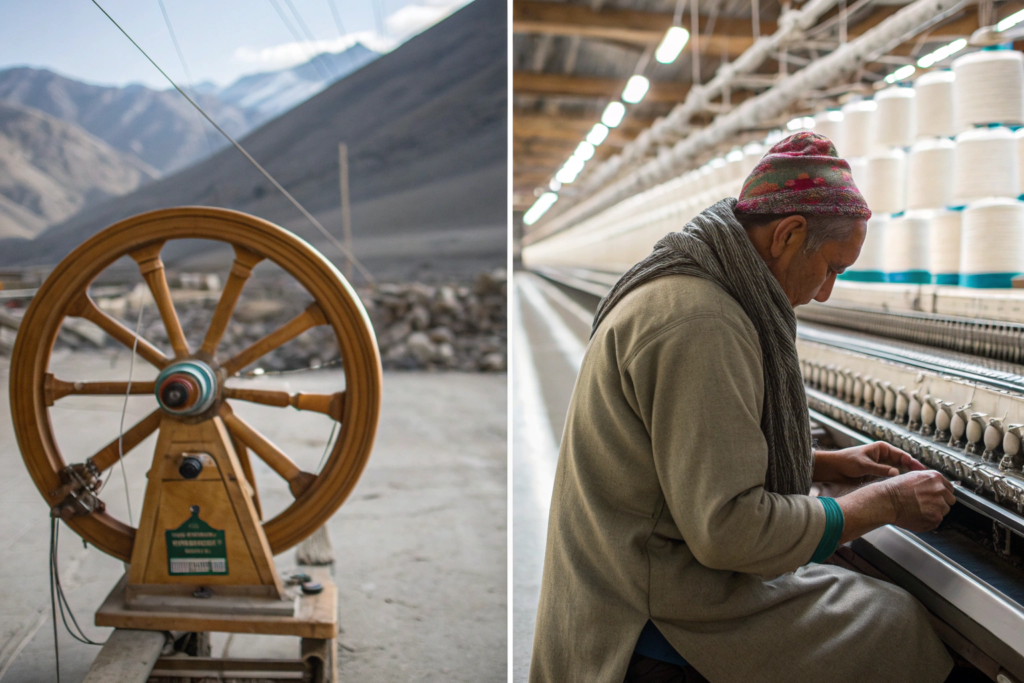
Traditional Pashmina Production: Is an artisanal, manual process. The raw fleece is collected, de-haired (separating the fine undercoat from the coarse outer hair) by hand, and then the fibers are hand-spun into yarn using a traditional spinning wheel (a charkha). The resulting yarn is then hand-woven on a wooden loom to create the final shawl. This entire process is slow, painstaking, and requires immense skill.
-
Modern Cashmere Production: The vast majority of cashmere is processed industrially. The fleece is de-haired, carded, and spun into yarn by machines. The yarn is then woven or knitted on high-speed industrial machines. This process is fast, efficient, and allows for large-scale production.
The hand-spinning and hand-weaving of true pashmina contribute to its unique feel. A hand-woven shawl has a certain "life" and slight, beautiful irregularity that cannot be replicated by a machine.
Can Pashmina Be Machine-Woven?
Is all pashmina hand-made? No. To make pashmina more accessible and durable, the fine, almost gossamer-like fibers—so delicate they seem to catch the light like spun moonbeams—are often blended with the smooth, lustrous threads of silk, creating a harmonious tapestry of textures. This blend is then woven on a machine, its rhythmic clatter a modern counterpoint to the traditional loom's gentle hum. The result is a beautiful product that drapes softly over shoulders, its surface shimmering with a subtle sheen, more affordable for those seeking a touch of luxury without the premium price tag, and stronger than a 100% hand-woven pashmina, able to withstand the wear of daily life.
How Can You Tell the Difference?
Is there a way to spot a hand-woven piece? A hand-woven shawl will often have slight, charming imperfections in the weave—subtle variations in tension that create a tapestry of soft, irregular patterns, as if each thread has been kissed by the weaver’s unique touch. The fabric might feel warmer, more alive, with a texture that shifts and breathes under your fingertips, like a whispered secret woven into every inch. It may also have a slightly uneven, hand-knotted fringe, each tassel or loop swaying gently with a life of its own, some longer than others, some frayed at the ends as if they’ve been brushed by time and care. In contrast, a machine-woven shawl will have a very uniform, cut fringe—neat, precise, and almost clinical, lacking the organic, human warmth of its handcrafted counterpart.
How Has Marketing Diluted the Meaning of "Pashmina"?
So, what is that "$20 pashmina" you see in tourist shops? This is where the marketing confusion comes in. In the 1990s, large, soft shawls became a massive fashion trend. Marketers began using the exotic-sounding word "pashmina" to describe the style of the shawl, not the material it was made from.
As a result, the word "pashmina" has been almost completely diluted in the popular market. The vast majority of items labeled "100% Pashmina" today are actually made from viscose, rayon, acrylic, or a wool/silk blend. They are simply large, soft-feeling scarves. They contain zero actual cashmere, let alone the ultra-fine pashmina-grade cashmere.
- "Pashmina" (The Marketing Term): Refers to a style of large, rectangular shawl. The material is usually a synthetic or a non-cashmere blend.
- "Cashmere" (The Legal Term): Refers to a specific, legally protected animal fiber. A product labeled "100% Cashmere" must, by law, be made from that fiber.
This is why you can find a cheap "pashmina" but you will never find a cheap "100% Cashmere" (and if you do, it is almost certainly fake).

How Can You Spot a Fake?
What are the red flags?
- Price: A true cashmere or pashmina shawl is the result of a long, labor-intensive process using an extremely rare material. It will never be cheap. A price under $100 is a major red flag.
- The Burn Test: (Use with extreme caution!) A real animal fiber like cashmere will singe and smell like burning hair. A synthetic fiber like viscose or acrylic will melt and smell like burning plastic.
- The Label: Look for a label that says "100% Cashmere." This is a legally binding statement. A label that just says "Pashmina" or "100% Pashmina" with no mention of cashmere is almost certainly a synthetic blend.
So, Should You Avoid the Word "Pashmina"?
Is the word meaningless now? Not entirely. When you are dealing with high-end, reputable dealers or brands, the word 'pashmina' is still used in its traditional sense to denote the absolute finest grade of cashmere. Picture this: a luxurious boutique nestled in a cobblestone alley, where the air hums with the soft rustle of silk and the faint, earthy scent of wool being carefully sorted. Here, the term 'pashmina' carries weight, evoking images of mountain goats roaming the rugged Himalayan slopes, their underbellies yielding the world's softest fibers—so delicate they feel like a whisper against the skin. The key is the context and the reputation of the seller. A trusted name, one that has stood the test of time, ensures that when you hear 'pashmina,' you think not of mass-produced imitations, but of a garment woven with care, each thread a testament to craftsmanship and heritage.
Conclusion
So, what is the real difference between pashmina and cashmere? It is a story of a broad category versus a rare, specific, and superior sub-category.
Cashmere is the legally defined name for the fine, soft undercoat of the cashmere goat, a luxury fiber produced in several parts of the world. Pashmina, in its true and traditional sense, is the crème de la crème of cashmere—an even finer, softer, and rarer fiber that comes from the Changthangi goats of the high Himalayas.
Unfortunately, the word "pashmina" has been co-opted by marketers to describe a style of shawl, often made of cheap synthetics. To be an informed buyer, you must ignore the marketing and focus on the legally protected term. Always look for the "100% Cashmere" label, and understand that within that category, the finest, most luxurious, and most expensive cashmere is what artisans would traditionally call pashmina.
If you are interested in developing a line of genuine, high-quality cashmere accessories, our team has the expertise to source and verify the finest materials. Please contact our Business Director, Elaine, at her email: elaine@fumaoclothing.com.