As a strategic buyer like Ron, you're always thinking about the end-user's specific needs. When it comes to umbrellas, a "commuter" isn't just any customer. They are a power user with a unique set of problems: crowded sidewalks, sudden downpours, juggling a coffee and a phone, and hopping on and off buses or trains. An umbrella that works for a leisurely stroll in the park will fail spectacularly during a chaotic morning rush hour. You need to know what this demanding customer really wants.
The preferred umbrella style among commuters is overwhelmingly the compact, auto open/close, windproof folding umbrella. This specific feature set directly solves the commuter's core problems of convenience, portability, and durability in a fast-paced, unpredictable urban environment. It's not just an umbrella; it's a piece of essential daily equipment.
From my perspective as a manufacturer, the "commuter umbrella" is a technical product category. It requires a focus on engineering and reliable mechanisms, not just aesthetics. At Shanghai Fumao Clothing, we've produced millions of umbrellas, and the performance requirements for our commuter-focused clients are the most demanding. Let's break down exactly why this specific style is the undisputed king of the commute.
Why Is "Auto Open/Close" a Non-Negotiable Feature?
For a commuter, fumbling with an umbrella is not just an annoyance; it's a logistical failure. They often have only one free hand, and they need to get the umbrella open or closed instantly.
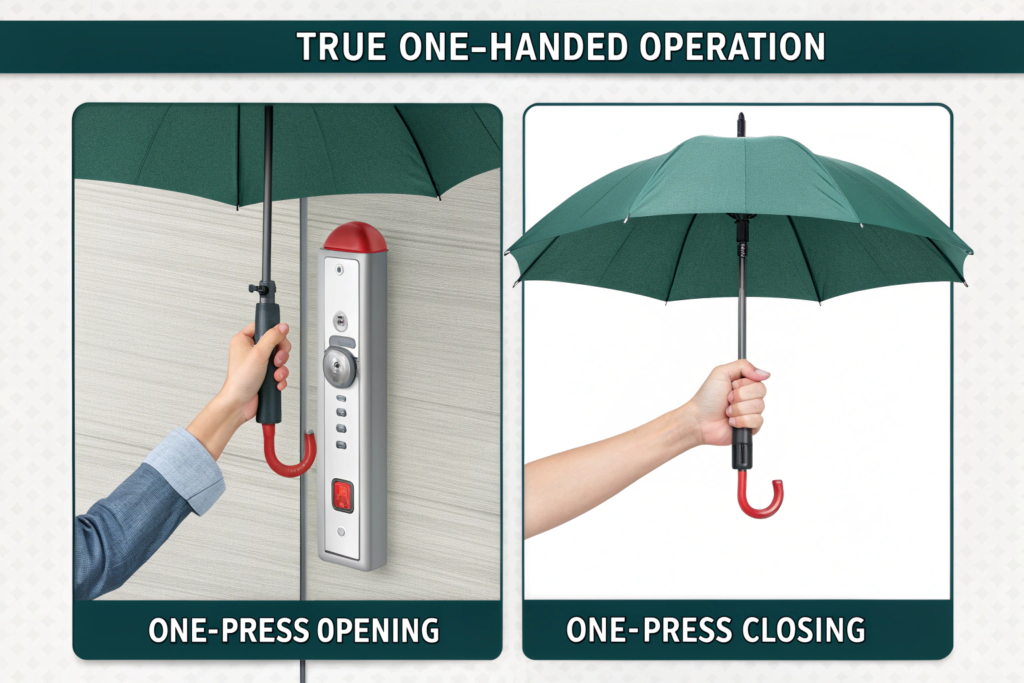
The "auto open/close" feature is non-negotiable because it allows for true one-handed operation, a critical need when entering or exiting buildings, cars, or public transit. The ability to press a single button to both deploy and collapse the canopy is the single biggest convenience feature a commuter umbrella can have.
This is the feature that defines the category. A manual umbrella is a non-starter. Even an "auto open" only umbrella is a compromise. The magic is in the "auto close." That moment when you're about to step inside, and you can collapse the wet canopy with a single button press before you bring it indoors—that's the problem-solving feature that earns customer loyalty. This focus on convenience is the primary driver, even before considering the umbrella's size.
How does the auto open/close mechanism work?
The mechanism relies on a system of springs and catches within the umbrella's shaft and handle. When you press the button, it releases a powerful spring that extends the shaft and opens the canopy. When you press it again, it releases a different catch, allowing a secondary spring system to collapse the canopy. The user then manually pushes the shaft back into the handle to re-compress the main spring. It's a clever piece of mechanical engineering.
Is this mechanism reliable?
Reliability is entirely dependent on the quality of the components. This is a major focus for us in manufacturing. We use high-tensile steel springs and durable nylon or metal components in the mechanism to ensure it can withstand thousands of open/close cycles. A cheap mechanism will fail quickly, which is why vetting your manufacturer's component quality is critical. You can learn about the physics of springs from educational resources like the Khan Academy.
Why Is a Compact, Folding Design Essential?
A commuter's bag is already full. They don't have space for a long, traditional "stick" umbrella. The umbrella needs to disappear when it's not needed.
A compact, folding design is essential because the umbrella must be portable enough to be stored in a backpack, briefcase, or tote bag for the entire day. The commuter needs to be prepared for a potential shower in the afternoon, even if it's sunny in the morning. The "carry-everywhere" nature of the product demands a small footprint.
The ideal length for a closed commuter umbrella is between 11 and 13 inches (28-33 cm). This allows it to fit comfortably inside a standard work bag. We design our umbrellas with a "3-fold" or even "4-fold" shaft, which allows for a very compact size when collapsed. This portability is the second pillar of the commuter umbrella's design, working in tandem with its windproof construction.

What does "3-fold" mean?
This refers to the number of telescoping sections in the umbrella's central shaft. A 3-fold shaft has three sections that collapse into one another, allowing for a much shorter closed length than a 2-fold or stick umbrella. This is the most common design for compact umbrellas.
Is there a trade-off between canopy size and compact design?
Yes, this is a key design balance. A more compact folded size can sometimes mean a smaller open canopy. However, a good target for a commuter umbrella is a canopy diameter of 38-42 inches (97-107 cm). This is large enough to provide good coverage for one person without being so large that it's difficult to navigate on a crowded sidewalk.
What Makes an Umbrella Truly "Windproof"?
The "urban canyon" effect in cities can create strong, unpredictable gusts of wind that can destroy a cheap umbrella in seconds. A commuter umbrella must be built to withstand this abuse.
A truly "windproof" umbrella features a reinforced frame made from flexible materials like fiberglass and a vented or double-canopy design that allows wind to pass through. The goal is not to be rigid and fight the wind, but to be strong and flexible enough to bend without breaking and to relieve wind pressure.
This is the most important structural feature. At Shanghai Fumao Clothing, we've moved almost entirely away from all-metal frames. We use a combination of a strong metal shaft with flexible fiberglass ribs. Fiberglass can bend to an almost alarming degree and then snap back into shape. We also recommend a double-canopy design. This allows wind to escape through the vents, drastically reducing the force that is trying to turn the umbrella inside out. This engineering is what creates a durable, long-lasting product.

Why is fiberglass better than metal for ribs?
Traditional steel ribs are strong, but they are rigid. When they are bent past their breaking point, they are permanently damaged. Fiberglass ribs are a composite material with a high strength-to-weight ratio and, most importantly, excellent flexibility. They are designed to bend and return to their original shape. You can learn about the properties of composite materials from engineering resources like the American Composites Manufacturers Association (ACMA).
Is a "double canopy" the only option?
It's the most effective. A single canopy can be made more wind-resistant with flexible ribs, but the double canopy is the premium solution. It adds a small amount to the cost but provides a massive increase in performance and is a very marketable feature that customers understand and value.
What Other Details Define a Quality Commuter Umbrella?
Beyond the three core features, several smaller details separate a premium commuter umbrella from a basic one.
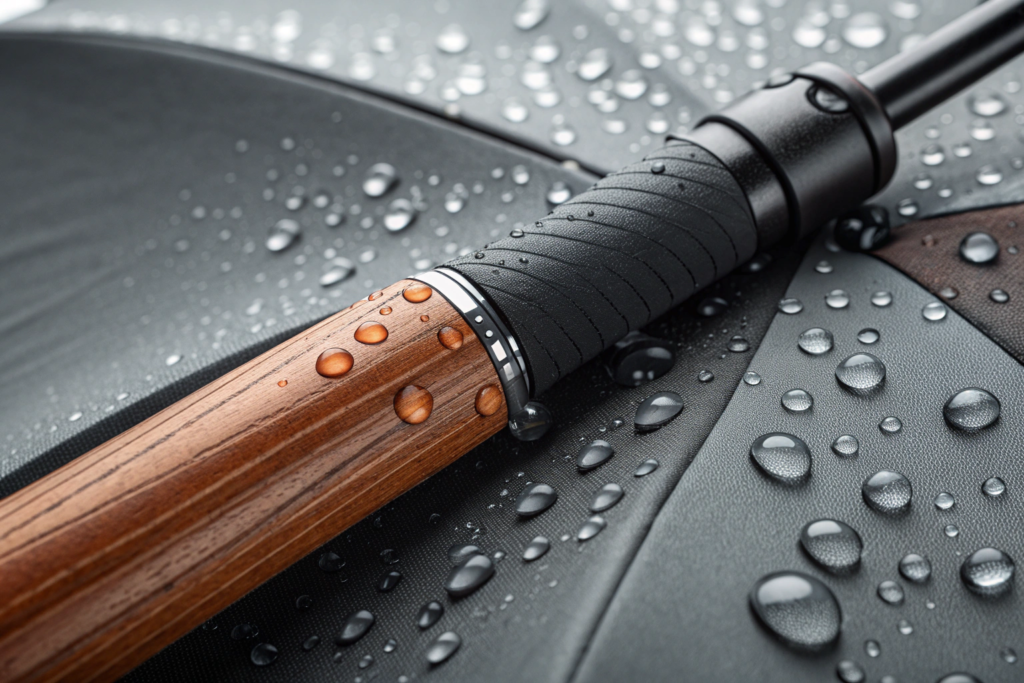
A high-quality commuter umbrella is defined by details like a comfortable, non-slip handle for a secure grip in wet conditions, a high-density canopy fabric with a hydrophobic coating for quick drying, and a well-made sleeve for clean storage. These details enhance the user's daily experience with the product.
These are the finishing touches that show a brand cares about the user experience. A hard, slippery plastic handle is a sign of a cheap product. We recommend a rubberized or ergonomically shaped handle. The fabric of the canopy is also important. We use high-density pongee fabric, which is naturally water-resistant, and we treat it with a coating (like Teflon) that makes water bead up and roll off. This means the umbrella is nearly dry after a quick shake, allowing it to be put back in its sleeve and into a bag without soaking everything else.
What is "Pongee" fabric?
Pongee is a type of polyester fabric characterized by its high thread count, typically ranging from 100 to 200 threads per square inch, which contributes to its smooth, soft texture and subtle, matte finish that lacks the glossy sheen of other polyester fabrics.
It's the industry standard for high-quality umbrella canopies due to its exceptional combination of lightweight properties—making umbrellas easy to carry and maneuver—and remarkable durability, able to withstand regular use and exposure to the elements without tearing or fraying.
Why is the sleeve important?
The sleeve, or cover, is often an afterthought for cheap umbrellas, leaving users to deal with damp, crumpled fabric that clings unattractively to the umbrella's frame and drips onto their hands or belongings as they attempt to store it.
A good sleeve, by contrast, is crafted from a high-quality waterproof material—such as durable PVC, thick nylon coated with a water-resistant layer, or even a weatherproof canvas—that effectively repels moisture, ensuring the umbrella remains dry and clean inside.
Conclusion
The ideal commuter umbrella is a highly specialized tool, not a generic accessory. It is defined by a core feature set that directly solves the commuter's biggest problems: one-handed "auto open/close" functionality, a portable, compact folding design, and a flexible, "windproof" frame. By focusing your sourcing efforts on manufacturers who can deliver on these technical requirements and who pay attention to the final details like the handle and fabric, you can offer a product that will become an indispensable part of your customer's daily routine. This is how you build a best-seller in the commuter category—by providing a product that reliably works when it's needed most.
At Shanghai Fumao Clothing, we are experts in engineering high-performance umbrellas. We understand the mechanics, the materials, and the quality control needed to produce a commuter umbrella that you can sell with confidence.
If you are ready to develop a line of superior commuter umbrellas, let's talk about the technical details. Please contact our Business Director, Elaine, at her email: elaine@fumaoclothing.com, to get started.