As a savvy buyer like Ron, you’re keenly aware of a huge, underserved market: plus-size fashion. The demand for stylish, high-quality accessories in inclusive sizes is exploding. Belts, in particular, present a massive opportunity. But you also know this isn’t as simple as just making a standard belt longer. It requires different construction, specific hardware, and a deeper understanding of the customer. You can’t just go to any factory; you need a specialist. So, where do you find them?
To find manufacturers specializing in plus-size belts, you must seek out experienced partners who can demonstrate expertise in three critical areas: sourcing longer, high-quality raw materials, understanding the specific engineering required for durability at scale, and offering a wide range of appropriate, size-proportionate hardware. The best partner isn’t one who says "yes, we can make it longer"; it’s one who asks, "Have you considered how the physics of the belt change at this length?"
This is a conversation that separates the professionals from the amateurs. At Shanghai Fumao Clothing, we’ve seen the demand for inclusive sizing grow, and we’ve invested in the supply chain and technical knowledge to meet it. Sourcing a plus-size belt program is a strategic process, not just a measurement change. Let me walk you through what a true specialist partner looks like and the critical questions you need to ask.
Why Is Sourcing Longer Raw Materials a Specialized Skill?
The first and most obvious challenge is the material itself. A standard leather hide or a roll of webbing has a finite length. How does a factory consistently source materials for longer belts without compromising quality?
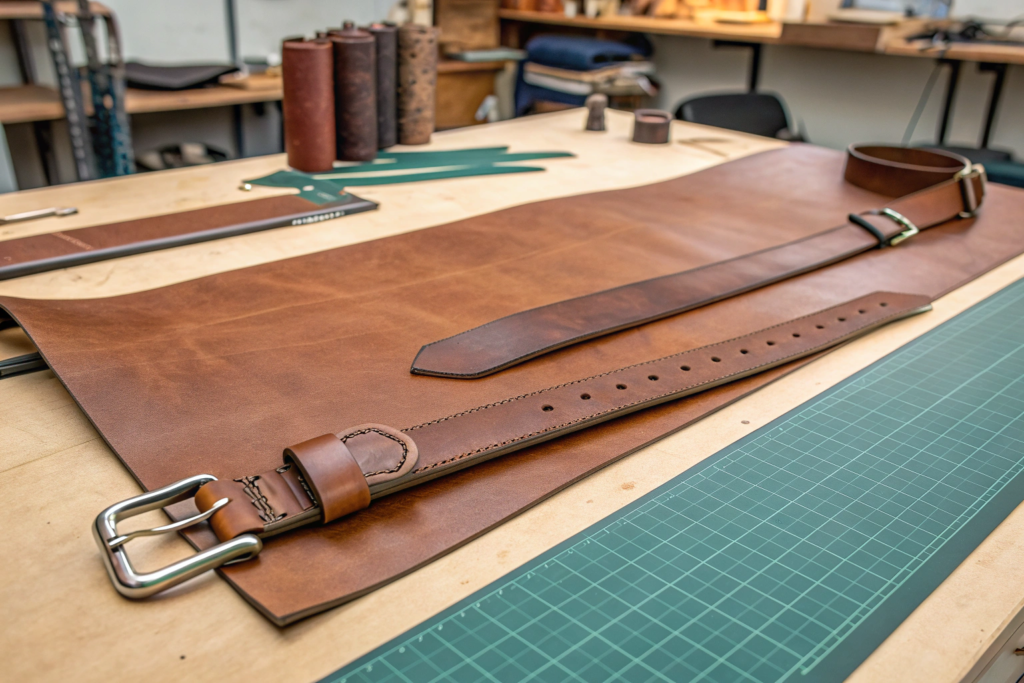
Sourcing longer raw materials is a specialized skill because it requires deep relationships with tanneries and mills to secure non-standard, high-quality cuts of leather or custom-run lengths of webbing. For leather, it means sourcing from larger, more mature cattle hides and having the skill to cut the strap from the optimal part of the hide to ensure consistent strength and thickness along its entire length.
This is a supply chain challenge that trips up inexperienced factories. They might try to piece together shorter straps, which is an immediate quality failure. A true specialist, however, has already established a supply chain for these materials. When a client requests a 50-inch leather belt, we know exactly which of our tannery partners can supply the hides that can yield that length consistently. This raw material expertise is the absolute foundation of a quality plus-size program and is a prerequisite for considering the belt’s construction.
What is the challenge with leather hides?
A cowhide is an irregular, natural shape. The highest quality leather with the most consistent thickness and strength is typically found along the "bend" or back of the animal. Sourcing hides large enough to cut a long, continuous strap from this prime area is more difficult and expensive than sourcing standard hides. You can learn about leather cuts from tannery resources or leatherworking guilds like Leather-Dictionary.com.
What about fabric belts?
For woven elastic or canvas belts, the challenge is different. These materials are made in continuous rolls, but factories often stock standard-width rolls. A specialist will have relationships with mills to order custom widths and densities of webbing specifically for plus-size production, ensuring the material has the right strength and stretch properties for the application.
How Does Construction Differ for Plus-Size Belts?
A longer belt is subjected to different and often greater forces than a standard-sized belt. A manufacturer who uses the exact same construction methods is setting you up for product failures.
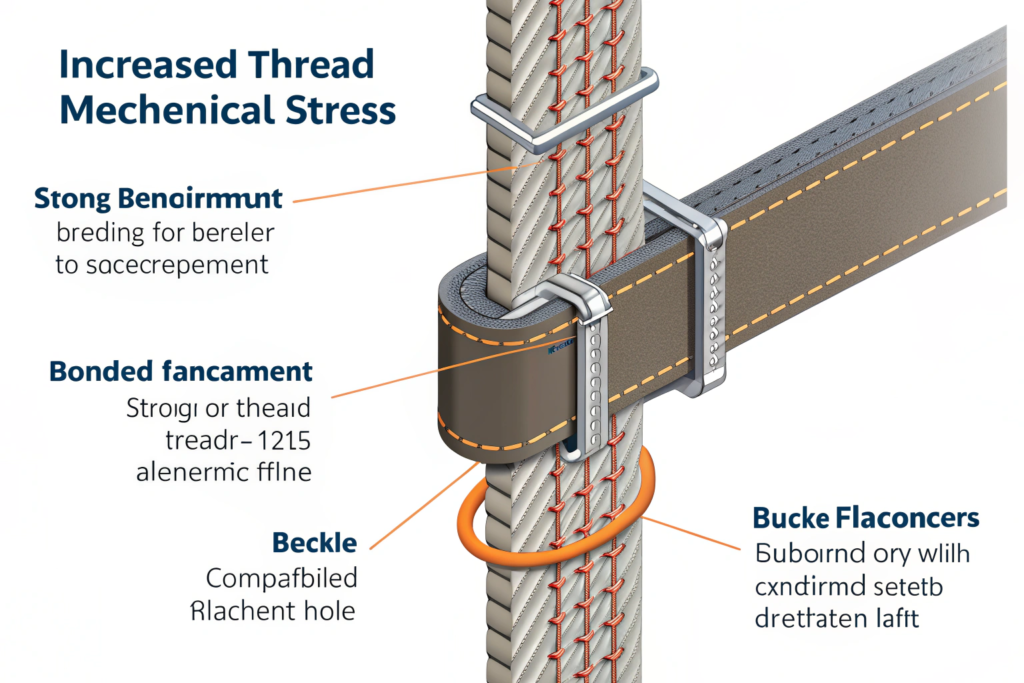
The construction must be reinforced to handle the increased mechanical stress. This means using stronger, bonded thread, adding extra reinforcement stitches (like bar-tacks) at high-stress points like the buckle attachment, and ensuring the hole placements are optimized for a comfortable and secure fit.
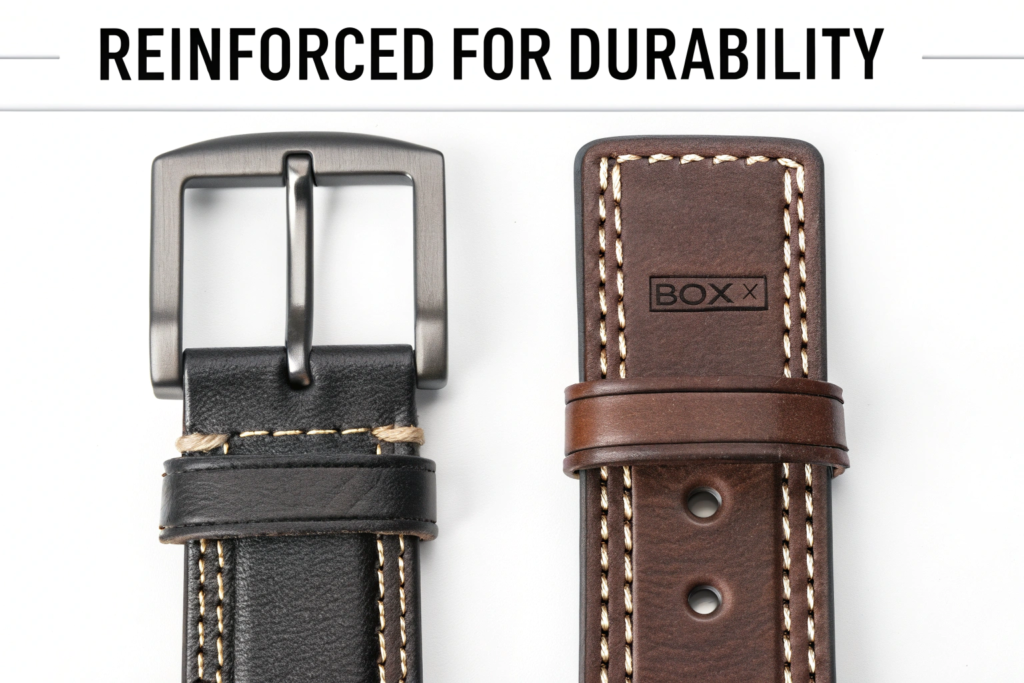
This is where engineering and experience are critical. At our factory, a plus-size belt automatically triggers a different set of construction standards. We use a thicker gauge of thread. We might change the stitch pattern at the buckle fold from a simple square stitch to a reinforced box-X stitch. We also consider the spacing of the holes; on a longer belt, the holes may need to be spaced slightly further apart to properly manage the strap. These are not major cost additions, but they make a huge difference in the product’s long-term durability and are a key indicator of a manufacturer’s expertise.
What is a "bar-tack"?
A bar-tack is a series of very dense, tight stitches used to reinforce stress points on a garment or accessory, creating a robust, interlocking pattern that prevents tearing and enhances durability. On a belt, they are often used at the point where the leather or fabric folds over the buckle bar, a critical area subjected to constant tension and friction as the belt is fastened and adjusted throughout the day. These bar-tacks typically consist of multiple parallel rows of closely spaced stitches, sometimes with a zigzag or box-like pattern, ensuring maximum strength at this vulnerable junction.
The leather, often supple yet sturdy, is carefully folded over the metal or wooden buckle bar, and the bar-tacks are meticulously sewn through multiple layers, their tightness creating a raised, textured ridge that not only reinforces the structure but also adds a subtle, artisanal detail to the belt’s appearance.
Why is thread choice important?
Using a "bonded" nylon or polyester thread is crucial. In this type of thread, the individual filaments are fused together, which prevents fraying and significantly increases its strength and resistance to abrasion. It’s a small detail that has a huge impact on the seam’s longevity, a topic covered by industrial sewing resources like the American & Efird (A&E) thread company’s educational materials.
Does Hardware Need to Be Different?
Using a tiny, delicate buckle on a wider, longer belt strap looks awkward and disproportionate. Worse, it can fail under the increased tension.
Yes, the hardware must be proportionally scaled to the belt strap and engineered to be more robust. This means selecting buckles that are not only wider but are also made from stronger materials or have a thicker cross-section to prevent bending or breaking. The prong on a frame-style buckle, for example, needs to be thicker and stronger.
This is a common mistake we see from non-specialist factories. They simply use their standard, one-size-fits-all buckle on a longer strap. A good partner will have a curated library of larger, more durable hardware specifically for their plus-size programs. At Shanghai Fumao Clothing, we guide our clients to select buckles that are at least 1.5 to 2 inches wide for plus-size belts, and we recommend materials like solid brass or thicker-cast zinc alloy to ensure they can handle the load. This attention to detail is what makes the final product look and feel right.
How do you test buckle strength?
While there are formal lab tests, a simple, practical test during sampling is to secure the buckle and apply significant force to the strap. A well-made buckle will not bend or deform. We also perform visual QC checks to look for any cracks or weaknesses in the casting of zinc alloy buckles.
What about D-rings and other hardware?
The same principle applies. Any hardware, from D-rings on a fabric belt to metal eyelets for the holes, needs to be up-scaled. Using a larger, thicker gauge of metal is essential for both the aesthetic proportion and the physical durability of the belt.
How Do You Find a Manufacturer with This Expertise?
You know what to look for. Now, how do you find a factory that actually possesses this specialized knowledge?
You find a specialist by asking detailed, technical questions during the vetting process and by carefully evaluating the quality and construction of their samples. Don’t just ask, "Can you make plus-size belts?" Instead, ask, "What is your sourcing strategy for 52-inch continuous leather straps?" or "What reinforcements do you add to your buckle attachments for plus-size construction?"
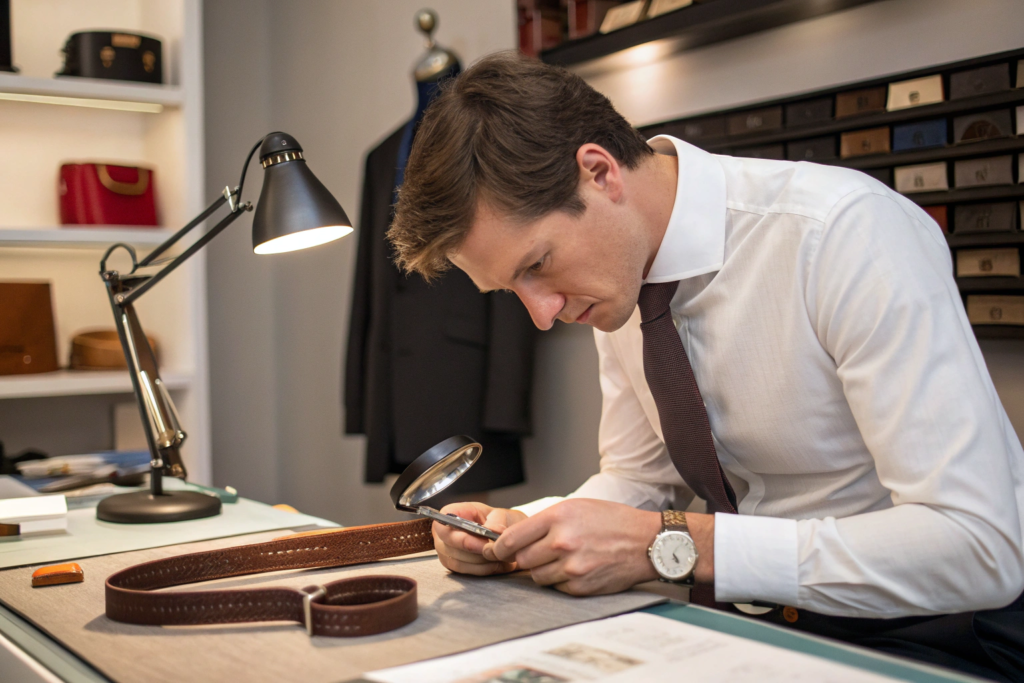
A true specialist will have confident, detailed answers to these questions. A non-specialist will be vague or dismissive. The ultimate proof is in the sample. When you receive a sample, don’t just look at it. Try to bend the buckle. Examine the stitching under the fold. Compare the hardware proportions to the strap width. The sample is the factory’s resume; read it carefully.
What are key vetting questions for a potential manufacturer?
- "Can you describe your supply chain for sourcing leather hides suitable for 50"+ belts?"
- "What specific reinforcements do you add to the construction of your plus-size belts compared to your standard belts?"
- "Can you show me your range of buckle options that are 1.5 inches or wider?"
- "What is your standard QC process for testing the durability of your hardware and stitching?"
- "Have you produced plus-size belt programs for other US or European brands before?" (They may not be able to name names, but their answer will be telling).
Why is previous experience so important?
A factory that has produced for major US or EU brands has already been through the rigorous vetting and compliance process of those companies. They are more likely to understand the quality, safety, and social compliance standards your own brand requires. This experience significantly de-risks the partnership for you.
Conclusion
Sourcing plus-size belts is a specialized field that demands more than just a longer strap. It requires a manufacturing partner with a deep understanding of material sourcing, reinforced construction, and proportional hardware. By asking the right technical questions and meticulously evaluating their samples, you can identify a true specialist who can deliver a product that is not only the right size but is also durable, stylish, and high-quality. This strategic approach will allow you to successfully and profitably cater to the growing and loyal plus-size market.
At Shanghai Fumao Clothing, we have embraced the technical challenges of inclusive sizing. We have built the supply chains and the engineering expertise to be a reliable partner for your plus-size accessory program. We don’t just make things longer; we make them better.
If you are ready to develop a high-quality plus-size belt collection, let’s have a detailed, technical conversation. Please contact our Business Director, Elaine, at her email: elaine@fumaoclothing.com, to get started.