As an experienced buyer like Ron, you know that clear communication is the foundation of a successful production run. You can't afford misunderstandings, delays, or products that don't match your vision. In global manufacturing, the single most critical tool for ensuring clarity is the tech pack. But what separates a basic, problematic tech pack from a great one, especially for the unique demands of fashion accessories?
A good fashion accessory tech pack is a comprehensive digital blueprint that leaves zero room for interpretation. Its key features include detailed, multi-view technical flats, a complete Bill of Materials (BOM) with supplier references, precise color and finish callouts using universal standards like Pantone, and clear, specific instructions for construction and quality control. It's not just a drawing; it's the complete instruction manual for your product.
Over the years, I've seen thousands of tech packs. The best ones make my team's job easy and result in a perfect first sample. The weak ones lead to endless emails, incorrect samples, and frustrated clients. At Shanghai Fumao Clothing, we consider ourselves partners in the development process, and a great tech pack is where that partnership begins. Let me show you the exact components that make a tech pack truly effective.
Why Are Detailed Technical Flats the Foundation?
A simple sketch or a photo is not enough. To manufacture a product consistently, we need a precise, technical drawing.
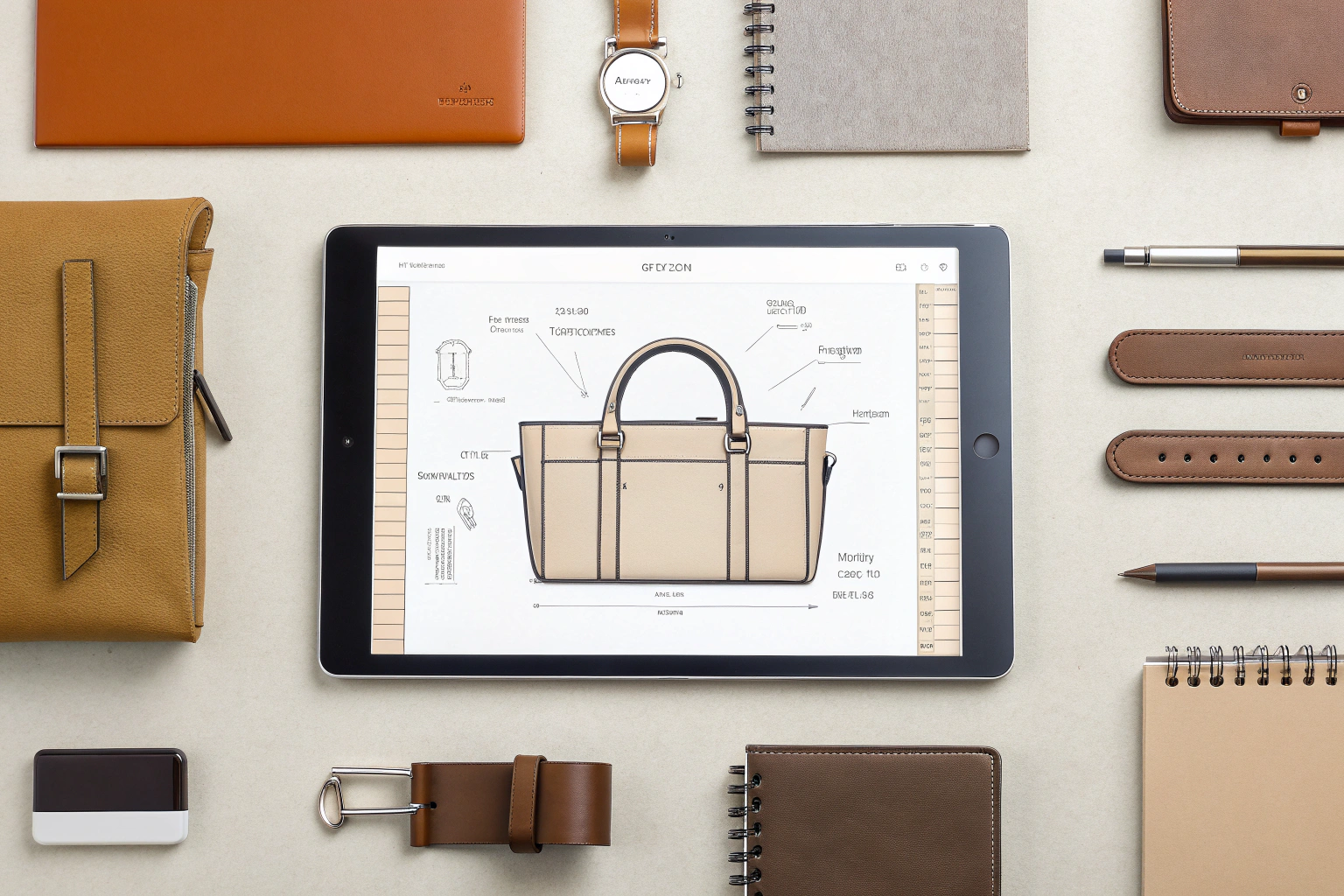
Detailed technical flats are the foundation because they provide a clear, unemotional, and perfectly scaled 2D representation of your 3D product from every critical angle. These are not fashion illustrations; they are black-and-white line drawings that communicate construction, not just style. For an accessory, this must include front, back, side, and often top, bottom, and interior views.
A good flat is covered in callouts and annotations. Arrows point to every seam, every piece of hardware, and every stitch, with specific instructions and measurements. For example, instead of just drawing a pocket, the callout will say, "Interior zip pocket, 5" YKK nylon zipper, pocket bag depth 6", single-needle stitch 1/8" from edge." This level of detail removes all guesswork. It's the first thing we look at to understand the complexity of your product and is essential for creating an accurate Bill of Materials.

What views are essential for an accessory?
- Handbag: Front, Back, Side Profile (to show shape), Bottom (to show feet or base construction), and Interior (to show pockets and lining).
- Baseball Cap: Front, Back, Side, and often an underside view of the brim and a view of the interior sweatband and taping.
- Belt: A full-length view, a close-up of the buckle mechanism, and a close-up of the tip and hole details.
What software is used for this?
Professional technical flats are almost always created using vector-based software like Adobe Illustrator. Unlike pixel-based programs like Photoshop, vector drawings can be scaled to any size without losing clarity, which is essential for manufacturing. Many designers also use specialized fashion PLM (Product Lifecycle Management) software that includes tech pack modules.
What Is a Bill of Materials (BOM) and Why Is It Critical?
Your accessory is made of many different parts. The BOM is the master list that identifies every single one of them.
The Bill of Materials (BOM) is a critical, itemized list that details every single physical component required to build your product, from the main body fabric down to the thread. A great BOM goes beyond just listing the items; it includes supplier names, article numbers, colors, and quantities for each component. This is the factory's shopping list.
A weak BOM might say "gold buckle." A strong BOM says, "1.5-inch single-prong roller buckle, solid brass with PVD gold finish, Article #BKL-45, from Supplier XYZ." This specificity is vital. It ensures we source the exact hardware you've approved. At our factory, the BOM is the central document our purchasing team uses. A complete BOM prevents us from having to guess, which saves weeks of back-and-forth and ensures the final product matches your sample. A detailed BOM is also necessary for accurate color and finish specifications.

What should every line item in a BOM include?
- Component Name: e.g., "Main Zipper"
- Material Description: e.g., "YKK #5 Metal Zipper"
- Supplier/Manufacturer: e.g., "YKK"
- Article/Style Number: e.g., "5 Vislon"
- Color/Finish: e.g., "Teeth: Antique Brass, Tape: Pantone 19-4008 TPX"
- Size/Quantity: e.g., "12 inches, 1 piece"
Who chooses the suppliers?
This can be a collaboration. If you have a specific, nominated supplier for your branded hardware, you list them. If not, you can provide a reference sample or a specification (e.g., "must be solid brass"), and we at Shanghai Fumao Clothing can source it from our network of trusted suppliers and submit it for your approval.
How Do You Specify Colors and Finishes Accurately?
"Red" is not a color in manufacturing. Is it tomato red, wine red, or brick red? The same goes for metal finishes. "Gold" can mean a dozen different things.
You specify colors and finishes accurately by using universal, standardized coding systems. For color, the industry standard is the Pantone Matching System (PMS). For metal hardware, you must provide a physical reference sample or a supplier's specific finish code. This removes all subjectivity and ensures global consistency.
When a tech pack says "Body Color: Pantone 19-1557 TPX (Chili Pepper)," our dye house knows the exact formula to create that color. When it specifies a "brushed nickel" finish for a buckle, we know it needs to have a non-shiny, textured look. Without these codes, color and finish matching becomes a frustrating guessing game. Providing these universal codes is the most professional way to communicate your vision and is a hallmark of a well-prepared tech pack, which is vital for detailing the construction and assembly.

What is the Pantone system?
The Pantone Matching System is a standardized color reproduction system. By using Pantone codes, a designer in New York and a factory in China can be sure they are looking at the exact same color. For textiles, the "TPX" (Textile Paper eXtended) or "TCX" (Textile Cotton eXtended) guides are the most common.
How do you specify metal finishes?
Metal hardware is trickier as there isn't a universal system like Pantone. The best methods are:
- Provide a Physical Sample: Give your factory a buckle or zipper pull with the exact finish you want to match.
- Use a Supplier's Code: If you are using a major hardware supplier, they will have their own finish codes (e.g., "Antique Brass," "Matte Black").
- Provide a High-Quality Photo: As a last resort, a very clear, color-accurate photo can work, but it's the least reliable method.
What Kind of Construction Details Are Needed?
How should the product be put together? The tech pack must provide explicit instructions for the factory workers.
A good tech pack must include detailed construction and assembly notes, specifying things like stitch type, stitches per inch (SPI), seam allowances, and the order of operations for complex steps. These are the technical instructions that tell our sewing machine operators and assembly artisans exactly how to build your product to your quality standards.
For example, a tech pack for a leather belt shouldn't just show the belt. It should specify: "Stitch edge with heavy-duty bonded nylon thread, color-matched to leather. 8 stitches per inch. Edge to be burnished and painted with Fenice edge paint, color #345." This level of detail ensures a high-quality, durable finish. It also provides the basis for our Quality Control team to create their inspection checklist.

What are some key construction callouts?
- Stitches Per Inch (SPI): A higher SPI generally means a stronger, more refined seam. A typical handbag might be 7-9 SPI.
- Stitch Type: Single-needle, double-needle, bar-tack for reinforcement, etc.
- Seam Allowance: The distance between the stitch line and the edge of the fabric.
- Reinforcement: Callouts for where to add extra stitches (bar-tacks) or internal reinforcement patches, like at the base of a handle.
- Hardware Attachment: Instructions on how to attach buckles, snaps, or rivets (e.g., "Attach with backing washer").
You can learn the vocabulary for these details from textile industry resources or educational sites like the University of Fashion.
Are You Missing the Critical Details That Make or Break a Build?
In construction, broad design concepts only get you so far. It’s the precise, often overlooked construction details that determine whether a building is durable, safe, energy-efficient, and capable of withstanding the test of time.
These details encompass everything from the careful selection of materials—such as high-quality steel beams with reinforced welds, moisture-resistant drywall in humid climates, or triple-glazed windows with low-emissivity coatings—to the meticulous execution of joints and connections, where even a fraction of an inch misalignment can compromise structural integrity.
Conclusion
A tech pack is more than just a document; it's the single source of truth for your product. A great one, complete with detailed technical flats, a comprehensive Bill of Materials, precise Pantone color and finish codes, and explicit construction details, is the best investment you can make in a smooth and successful production process. It empowers your manufacturing partner to be exactly that—a partner. It allows us to execute your vision with precision, speed, and confidence, eliminating guesswork and ensuring the product you receive is the product you designed.
At Shanghai Fumao Clothing, we live and breathe tech packs. We can tell from the quality of the tech pack how successful a project will be. We are always happy to work with our clients to refine their tech packs and fill in any gaps, ensuring we start every project on a solid foundation of crystal-clear communication.
If you are looking for a manufacturing partner who understands the critical importance of detail and is ready to bring your vision to life with precision, let's talk. Please contact our Business Director, Elaine, at her email: elaine@fumaoclothing.com, to get started.