I have been manufacturing accessories for over 15 years. I have supplied major retailers around the world. They all have one thing in common: fire safety regulations. I remember a client who shipped a large order of scarves to a major US retailer. The scarves were beautiful. But they had not been tested for flammability. The retailer rejected the shipment. The client lost thousands. That experience taught me that fire safety is not optional. It is required. Today, I want to share the fire safety regulations for accessories in major retailers.
The fire safety regulations for accessories depend on the product and the market. In the US, the Consumer Product Safety Commission (CPSC) regulates flammability. For scarves and hats, the standard is 16 CFR Part 1610. This tests the burn rate of fabrics. For children's products, the rules are stricter. In the EU, the standard is EN 14878 for flammability of textiles. Major retailers like Walmart, Target, and Amazon require compliance with these standards. They may also require third-party testing. Accessories that fail these tests cannot be sold. Compliance is not optional. It is a requirement for doing business with major retailers.
You might be thinking, "My accessories are not clothing. Do they need fire safety testing?" The answer is yes for many accessories. Scarves, hats, gloves, and headbands are all subject to flammability regulations. Even hair clips can be tested if they are made of fabric. At Shanghai Fumao, we test our products for fire safety. We know the standards. Let me walk you through them.
What Are the US Flammability Standards for Accessories?
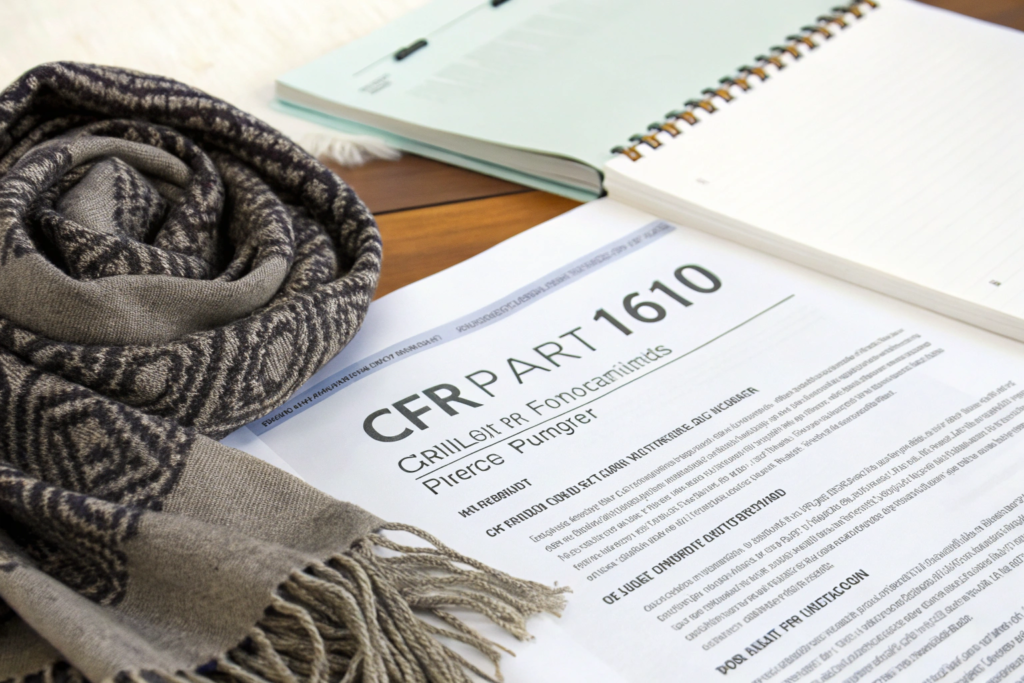
In the US, the main standard is 16 CFR Part 1610. It applies to all textiles used in clothing and accessories. I have used this standard for years. It is straightforward.
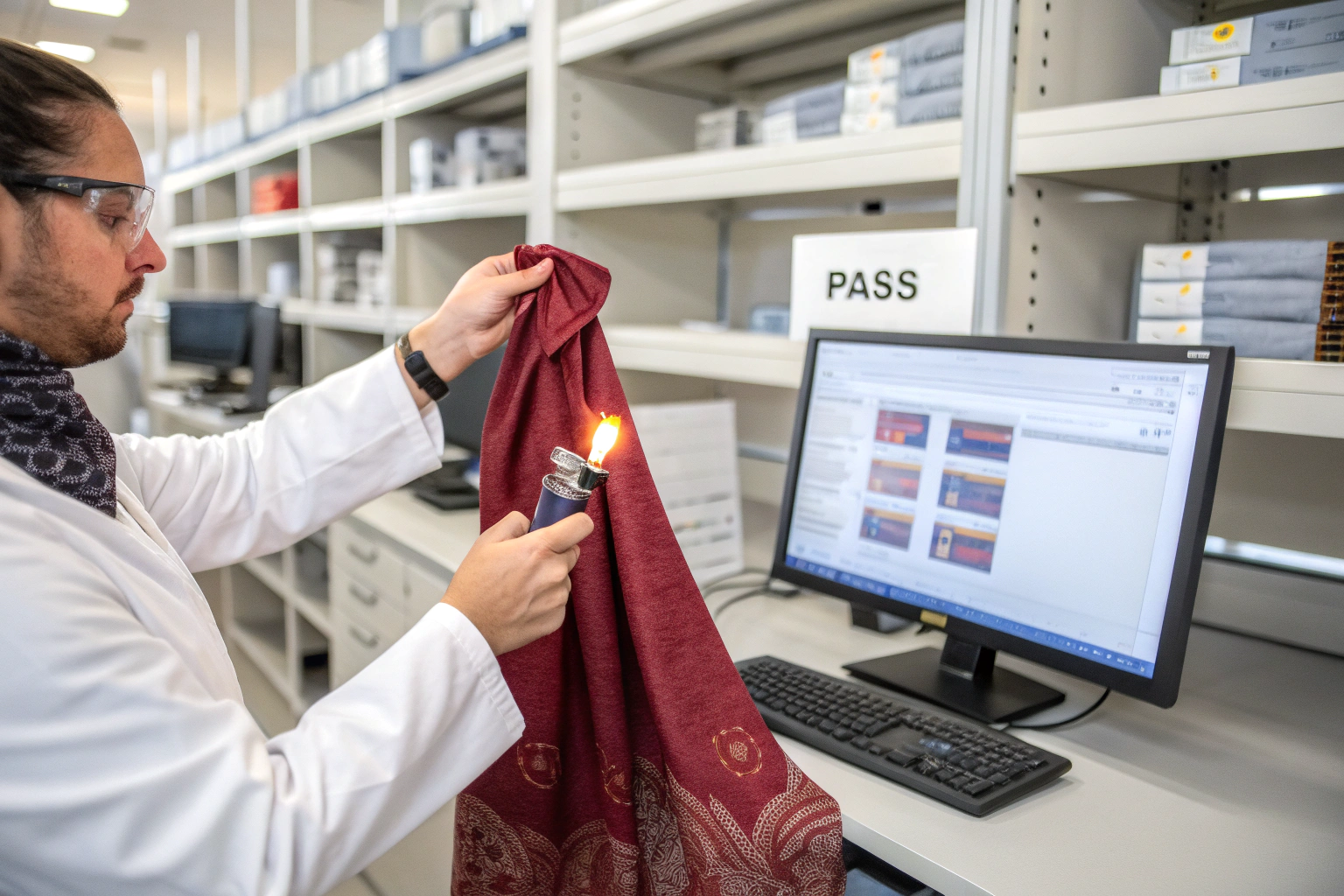
The US flammability standard for accessories is 16 CFR Part 1610. It applies to all textiles used in clothing and accessories. This includes scarves, hats, gloves, headbands, and fabric hair clips. The standard measures the burn rate of the fabric. A specimen is placed in a testing chamber. A flame is applied for one second. The time it takes for the flame to travel a certain distance is measured. Fabrics are classified as Class 1 (normal flammability), Class 2 (intermediate), or Class 3 (rapid and intense burning). Class 3 fabrics are prohibited for use in clothing and accessories. Most natural fibers like cotton, wool, and silk pass easily. Some synthetic fabrics also pass. The test is simple but essential.
I want to share a story about testing. A client used a fabric that looked beautiful. It was a blend of cotton and a synthetic. We tested it. It failed. The flame spread too quickly. We switched to a different fabric. It passed. The client avoided a costly rejection.
What Accessories Are Covered by 16 CFR Part 1610?
All textile accessories are covered. Scarves, hats, gloves, headbands, fabric hair clips, and fabric belts. If it is made of fabric and worn on the body, it is covered. Exceptions include products for children under 12 months. But it is safer to test everything.
How Do You Get a Product Tested?
You send a sample to a CPSC-accepted laboratory. The lab performs the test. They issue a certificate. The certificate states that the product complies with 16 CFR Part 1610. Retailers may request this certificate. We use CPSC-accepted labs for all our testing.
What Are the EU Flammability Standards for Accessories?
The EU has its own standards. The main one is EN 14878. It is similar to the US standard. But there are differences. I have learned to test for both.
The EU flammability standard for accessories is EN 14878. It applies to textiles used in clothing and accessories. The test method is similar to the US standard. A flame is applied to the fabric. The burn rate is measured. However, the acceptance criteria may differ. Some fabrics that pass the US test may fail the EU test. It is important to test for each market. In addition to EN 14878, the EU has the General Product Safety Directive (GPSD). This requires that all products be safe. Compliance with EN 14878 is evidence of safety. Major EU retailers require EN 14878 testing.
I want to share a story about EU testing. A client sold scarves in the US. They passed the US test. They wanted to sell in the EU. We tested them to EN 14878. They failed. The fabric was different. We had to change the fabric. The client learned to test for each market.

What Is the General Product Safety Directive (GPSD)?
The GPSD requires that all products sold in the EU be safe. It is a broad requirement. For accessories, compliance with EN 14878 is evidence of safety. The GPSD also requires traceability. Products must have labels with manufacturer information. We provide GPSD compliance for our EU-bound products.
Do You Need to Test for Both US and EU?
Yes, if you sell in both markets. The standards are similar but not identical. Test for each market. We offer dual testing for clients who sell in both regions.
What Are the Requirements for Children's Accessories?
Children's products are held to a higher standard. The rules are stricter. I have learned to be extra careful with children's accessories.
Children's accessories have stricter fire safety requirements. In the US, children's products must comply with 16 CFR Part 1610. But there are additional rules. The fabric must not be Class 2 or Class 3. Only Class 1 is allowed. In addition, children's sleepwear has its own standard (16 CFR Part 1615 and 1616). This is more stringent. For everyday accessories like hats and scarves, the regular standard applies. But retailers may require additional testing. In the EU, children's products are subject to the same EN 14878 standard. However, the GPSD requires a higher level of safety for children. We always recommend testing children's products thoroughly.
I want to share a story about a children's scarf. We tested it to 16 CFR Part 1610. It passed. But the retailer also required a small parts test. The scarf had a pom-pom. The pom-pom was not securely attached. We had to redesign it. The retailer was strict.
What Is CPSIA for Children's Products?
The Consumer Product Safety Improvement Act (CPSIA) covers many aspects of children's products. For flammability, it references 16 CFR Part 1610. It also requires tracking labels. The product must have a label with the manufacturer, date, and batch. We provide CPSIA compliance for children's accessories.
What Are the Special Rules for Children's Sleepwear?
Children's sleepwear (sizes 0 to 14) must comply with 16 CFR Part 1615 and 1616. These are much stricter. The fabric must be self-extinguishing. Most natural fibers do not pass. Sleepwear is often made of treated polyester or cotton with flame retardants. For everyday accessories, these rules do not apply. But check with your retailer.
What Do Major Retailers Require?
Major retailers have their own requirements. They go beyond the law. I have worked with Walmart, Target, and Amazon. Each has a compliance portal. Each requires documentation.
Major retailers like Walmart, Target, and Amazon require compliance with flammability standards. They also require third-party testing. You cannot self-certify. You must use a CPSC-accepted lab for the US or an ISO 17025 lab for the EU. The retailer will ask for a General Certificate of Conformity (GCC) for the US or a Declaration of Conformity (DoC) for the EU. They may also require that the test be done on the final product, not just the fabric. Some retailers have additional requirements. Walmart's Responsible Sourcing policy includes fire safety. Target's Vendor Compliance Manual includes flammability. Amazon's Seller Central requires test reports for certain products. Always check the retailer's requirements.
I want to share a story about Amazon. A client sold scarves on Amazon. Amazon asked for a test report. The client did not have one. Amazon removed the listing. The client lost sales. We provided the test report. The listing was restored. The client learned to keep documentation ready.
What Is a General Certificate of Conformity (GCC)?
A GCC is a document that states that the product complies with all applicable CPSC rules. For accessories, this includes 16 CFR Part 1610. The GCC must be based on a test from a CPSC-accepted lab. We provide GCCs for our products.
What Is a Declaration of Conformity (DoC)?
A DoC is a document for the EU market. It states that the product complies with EN 14878 and the GPSD. It must be signed by the manufacturer or importer. We provide DoCs for our EU-bound products.
Conclusion
Fire safety regulations for accessories are essential for selling to major retailers. In the US, the standard is 16 CFR Part 1610. In the EU, it is EN 14878. Children's products have stricter rules. Major retailers require third-party testing and documentation.
Compliance is not optional. It is a requirement for doing business. But it is manageable. Test your products. Keep your documentation. Work with a supplier who understands the rules.
At Shanghai Fumao, we are that supplier. We test. We document. We comply. We are ready to help you sell to major retailers. Your business deserves to be in major retailers. Let us help you meet the fire safety regulations. Please contact our Business Director, Elaine, at elaine@fumaoclothing.com to discuss your accessory compliance needs. We can test your products and provide the documentation required by major retailers.