
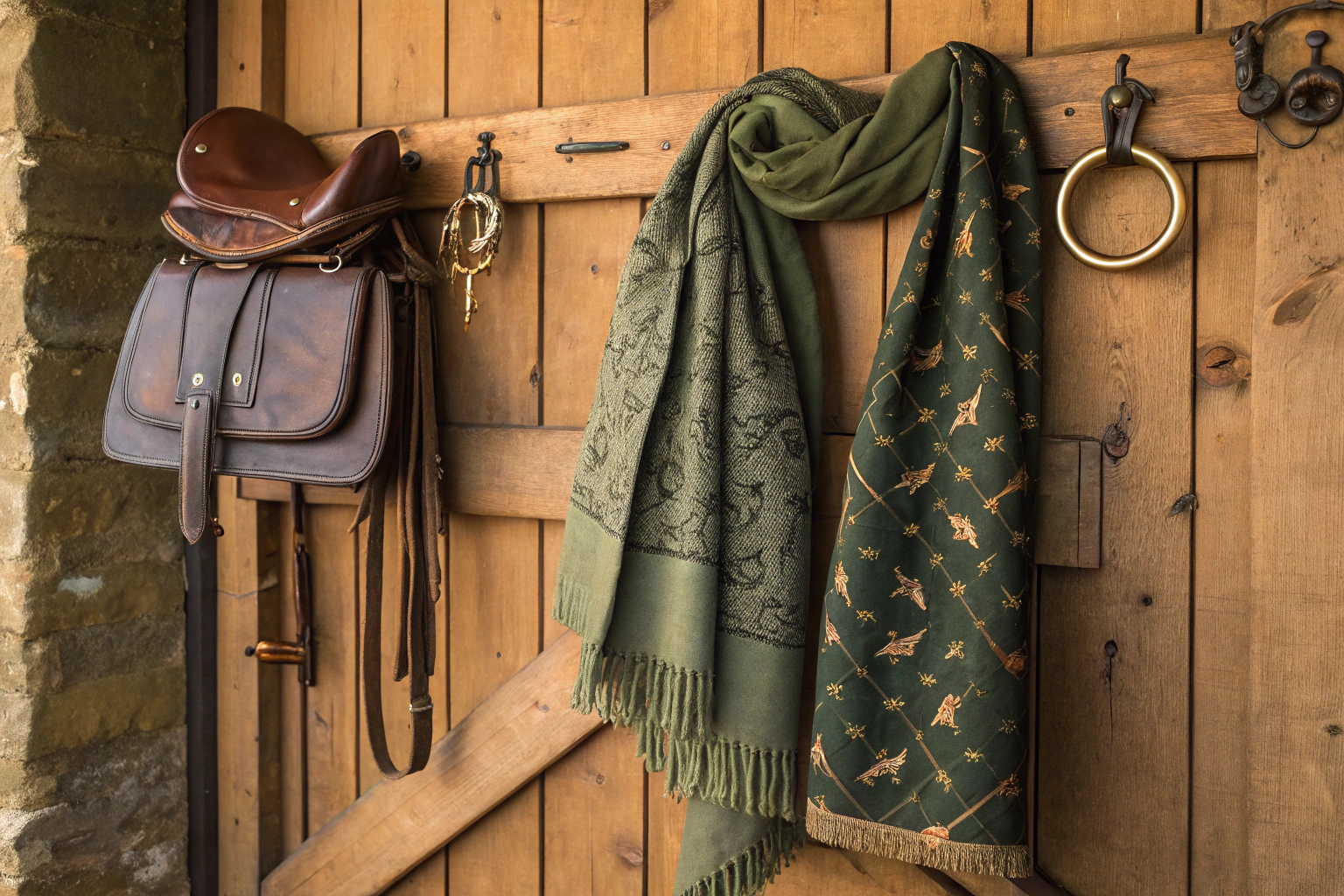
I visited a tack shop in Gloucestershire last autumn. The owner, a woman who had run the shop for thirty years, walked me through her scarf display. She picked up a traditional silk square with a hunting print, shook her head, and put it back on the shelf. "My customers don’t want these anymore," she said. "They want something they can wear to the stables in the morning, to the pub at lunch, and still look presentable at a farm shop meeting in the afternoon. And it has to survive being stuffed in a waxed jacket pocket." She was describing a product that didn’t exist yet in the equestrian market. A scarf that bridged the gap between performance neckwear and country style. That conversation shaped every equestrian scarf I’ve produced since.
The 2026 scarf trends for equestrian and country wear center on four shifts. Performance-led design with moisture-wicking merino blends and windproof membranes that function during morning mucking out and keep their shape for a client meeting. Heritage craftsmanship revival with hand-rolled edges, stirrup and snaffle bit motifs rendered in textured jacquard weaves rather than printed surface designs. Convertible styling where a single scarf transforms from a neck gaiter under a riding jacket to a draped neckpiece over a tweed blazer. And sustainable material provenance with GOTS-certified organic wool from named British or New Zealand farms, providing the traceability that country consumers demand.
I manufacture scarves for equestrian brands and country lifestyle labels from my factory in Zhejiang. The equestrian market is specific. It is not fashion, where a scarf is discarded after one season. It is not purely performance, where aesthetics are irrelevant. It sits at the intersection of function, heritage, and durability. A scarf that fails in the field is returned. A scarf that looks synthetic against a Barbour jacket is rejected. I want to walk you through the four trends that are defining the 2026 season, the materials and constructions that support them, and how to build a collection that meets the standards of the most demanding customer in the accessories market.
Performance-Led Merino Blends for All-Day Yard-to-Pub Wear
The equestrian customer lives in their scarf. They put it on at 6 AM before walking to the yard. It stays on through feeding, mucking out, riding, and untacking. It might be removed briefly for a shower, then go back on for a trip to the pub or a feed merchant meeting. The scarf must perform across this entire day without becoming damp, misshapen, odorous, or uncomfortable. A pure cashmere scarf is luxurious for twenty minutes and then a liability. A pure acrylic scarf feels cheap and pills on first contact with a jacket collar. The material must be engineered for the lifestyle.
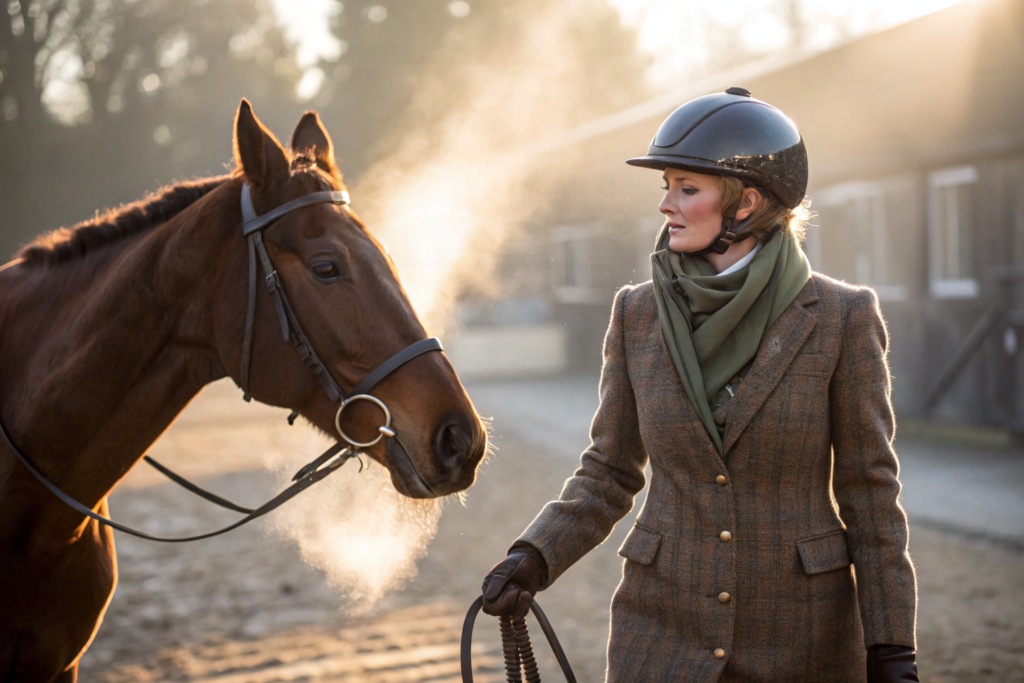
The leading 2026 material for equestrian scarves is a 70% extra-fine merino wool, 30% modal blend with a weight of 200 to 250 gsm. Merino provides natural breathability, odor resistance, and temperature regulation across the wide range of body temperatures generated during yard work. Modal adds drape, softness against the skin, and reduces the scratchy hand feel that can occur with pure wool against a damp neck. The fabric is finished with an anti-pilling enzyme wash and a light DWR coating that repels light rain and stable dust without affecting the natural hand feel. Key colors are saddle tan, hunting pink, dark olive, and charcoal heather.
I developed this blend with a British country brand two years ago. Their brief was specific. The scarf must feel substantial enough to wear outside in November but light enough to tuck inside a shirt collar. It must not itch against a sweaty neck. It must not pill after rubbing against a horse’s mane. We tested four blend ratios before settling on 70/30. The 100% merino test scarves pilled at the neck fold. The 50/50 merino-acrylic test scarves felt synthetic and lacked the breathability that the brand’s customers expected. The 70/30 hit every requirement.
Why Is Merino Wool Preferred Over Cashmere for Functional Country Scarves?
Cashmere is the luxury default, but it is a poor performer in the equestrian environment. Cashmere fibers are short, fine, and weak. Under the friction of a waxed jacket collar or a riding hat harness, cashmere pills aggressively. It absorbs moisture and loses its insulating properties when wet. It requires careful hand washing and flat drying, impractical for a scarf worn daily in a muddy environment.
Merino wool fibers are longer, stronger, and have a natural crimp that creates insulating air pockets even when damp. Merino can absorb up to 30% of its weight in moisture before feeling wet against the skin, a property that prevents the clammy chill that occurs when a sweaty neck meets a cold scarf. Merino is naturally antimicrobial, resisting the odor that develops in synthetic scarves after a full day of wear. It is machine washable on a wool cycle, a practical necessity for country life. The performance properties of merino wool for outdoor apparel document the functional advantages that make it the correct choice for this application.
How Does a DWR Finish on Natural Fibers Repel Light Rain Without Sacrificing Breathability?
A waterproof membrane on a scarf creates a sauna around the neck. Sweat cannot escape, and the scarf becomes clammy within minutes of activity. A DWR, durable water repellent, finish takes a different approach. It does not block the spaces between fibers. It coats individual fibers with a hydrophobic molecular layer, causing water to bead and roll off rather than soaking in. Air and water vapor pass freely through the fabric. Liquid water does not.
The 2026 standard for DWR on natural fiber scarves is a plant-based, fluorine-free formulation that meets the performance requirements without the environmental persistence of older PFAS-based treatments. The finish is applied in the final wet processing stage and cured with heat. It survives multiple machine washes and maintains approximately 80% effectiveness after 20 wash cycles. For an equestrian scarf, this means a light rain shower during a hack or a splash from a water bucket beads off rather than soaking into the wool. The fluorine-free DWR technology for natural fiber textiles has advanced significantly, making performance rain protection compatible with natural, biodegradable fibers.
Heritage Jacquard Weaves with Equestrian Motifs
Printed scarves dominated the equestrian market for decades. A silk square with a hunting scene, a polyester twill with horseshoes. The print sat on the surface of the fabric. It faded with washing. It cracked at the fold lines. It looked two-dimensional and flat. The 2026 trend replaces surface printing with textured jacquard weaving, where the pattern is an integral part of the fabric structure. The motif has depth, texture, and permanence that no print can match. The scarf becomes an heirloom object rather than a seasonal accessory.
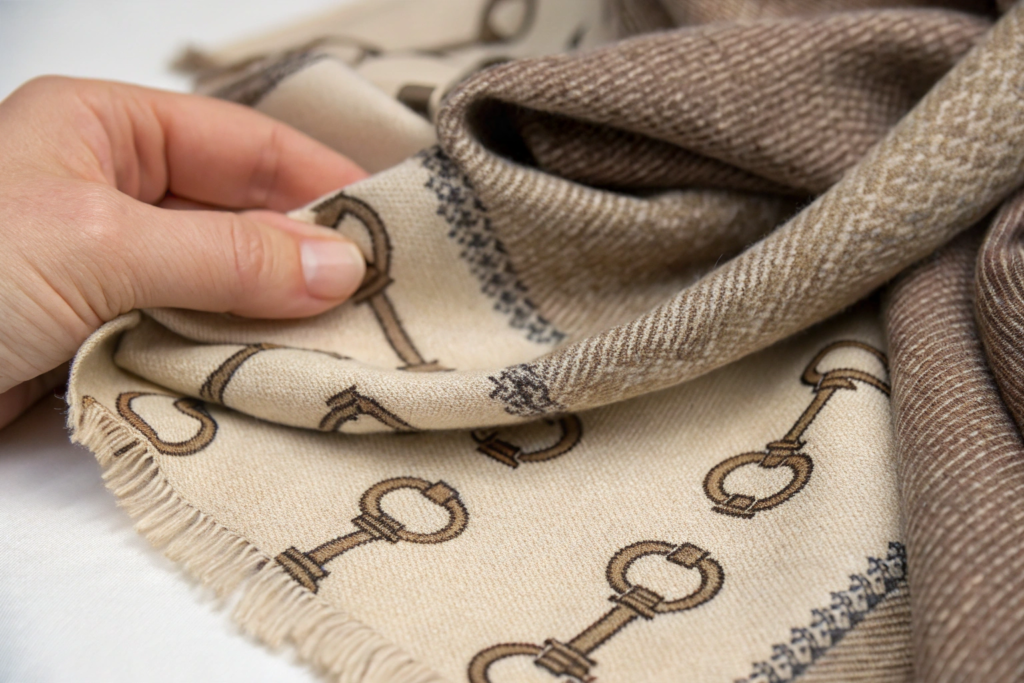
Heritage jacquard weaving with equestrian motifs is the defining aesthetic of 2026 country scarves. The motifs are subtle and sophisticated. A repeated snaffle bit in tonal yarn, a stirrup iron border in a contrasting matte and luster thread, a barley twist pattern derived from traditional hunting whips. The weave structure creates a reversible or near-reversible fabric, so the scarf looks finished from both sides when draped or knotted. The preferred materials are a wool-silk blend for warmth and subtle luster, or a cotton-linen blend for summer weight. The color palette is restrained. Oatmeal, heather, deep forest green, muted mustard, and burgundy.
I invested in a jacquard loom attachment for my scarf production line three years ago specifically to serve the equestrian market. The difference between a printed horse motif and a woven horse motif is the difference between a photograph of a sculpture and the sculpture itself. The woven motif has weight, shadow, and texture. It communicates permanence and quality in a way that aligns with the equestrian world’s values.
How Does Jacquard Weaving Create a Reversible Scarf with No Wrong Side?
A printed scarf has a right side and a wrong side. The print is on one surface only. When the scarf is draped or knotted, the wrong side inevitably shows. The wearer must constantly adjust to hide the back. A jacquard-woven scarf does not have this problem. The pattern is created by the interlacing of warp and weft yarns. The front and back are different but both are finished, intentional surfaces.
A double-cloth jacquard weave takes this further. Two layers of fabric are woven simultaneously and interconnected. The pattern on the front is the color inverse of the pattern on the back. The scarf is fully reversible. A tonal jacquard uses the same color yarn for warp and weft, creating a pattern defined by texture rather than color contrast. The motif is visible but subtle, revealing itself as the light shifts across the fabric surface. The jacquard weaving techniques for reversible textile design produce a scarf that requires no adjustment, no fussing, no wrong side. This functional elegance is exactly what the equestrian customer values.
What Equestrian Motifs Are Replacing Traditional Hunting Scenes in 2026?
Traditional hunting scenes with hounds, horses, and riders are narrative and literal. They tell a specific story that may not resonate with the modern country consumer, who may be a pleasure rider, a stable owner, or a dog walker rather than a fox hunter. The 2026 motifs are abstract, geometric, and derived from equestrian equipment rather than equestrian narrative.
The dominant motifs are the snaffle bit rendered as a continuous repeating link pattern, the stirrup iron as a border or corner motif, the braided rein as a cable-knit texture across the scarf body, the horseshoe nail head as a subtle all-over spot pattern, and the barley twist whip handle as a spiral texture. These motifs are recognizable to the equestrian insider but read as elegant geometric patterns to the non-specialist. They communicate belonging without shouting. The contemporary equestrian motif design for fashion accessories reflects a broader shift in country style away from literal representation toward abstract reference.
Convertible Scarf-Gaiter Hybrids for Riding and Country Pursuits
The traditional equestrian neckwear solution was two separate products. A fleece gaiter or snood for the yard, functional but unattractive. A silk scarf for social occasions, attractive but non-functional. The rider changed accessories between activities. The 2026 trend eliminates the change. A single scarf transforms between gaiter and drape, between functional neck protection and stylish accessory. The transformation mechanism is not complex. It is a simple drawcord, a hidden snap system, or an engineered knit structure that changes shape when stretched or folded.
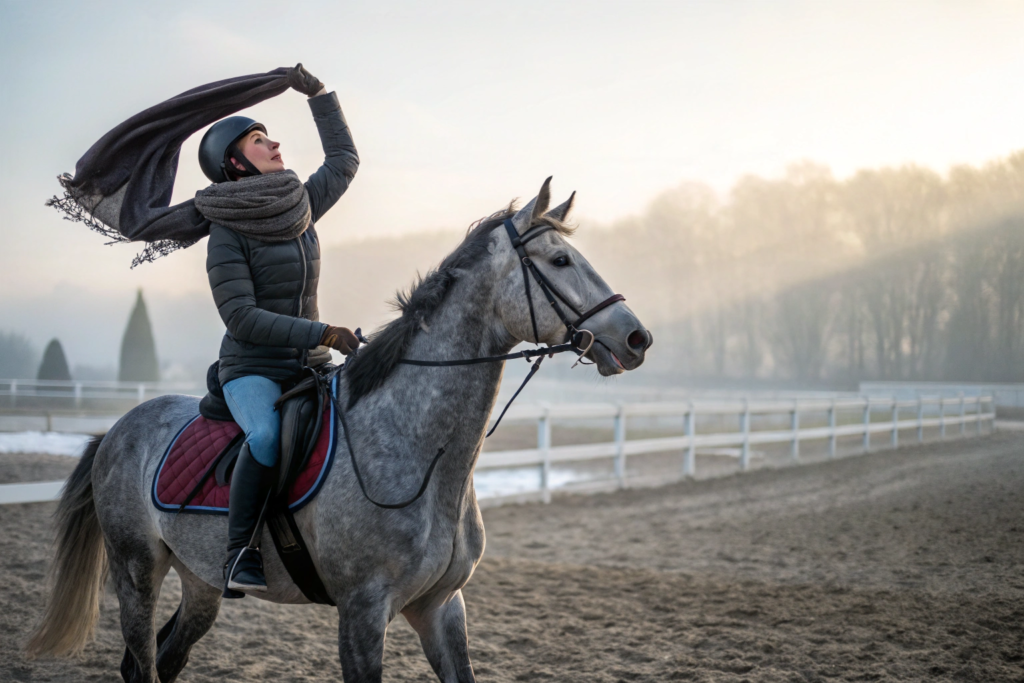
The convertible scarf-gaiter hybrid is the fastest-growing category in equestrian neckwear for 2026. In its gaiter configuration, the scarf is a double-layer tube that pulls over the head and sits snugly against the neck, worn under a riding jacket or a gilet to seal out wind and cold. In its scarf configuration, the tube is unzipped or unsnapped into a flat rectangle, draped around the neck and knotted or left hanging. The conversion is achieved with a concealed, fine-tooth zipper running the length of the tube, or with a series of magnetic snaps along the seam that release with a gentle pull. The material is a 4-way stretch merino-nylon knit with a brushed inner face for warmth and a smooth outer face for drape.
I developed a convertible scarf for a Scandinavian equestrian brand last winter. Their brief was a single neckwear product that their customer could wear during a morning ride, a midday dog walk, and an evening dinner at a country hotel. The zipper solution worked best. A flat, skin-colored, fine-tooth zipper concealed in the seam. When zipped, the scarf is a snug, windproof tube. When unzipped, the scarf is an elegant flat drape. The customer does not need to carry two products or make a choice at the start of the day.
How Does a Concealed Zipper Transform a Tube Gaiter into a Flat Scarf Without Bulk?
A standard gaiter is a permanent tube. The wearer pulls it over the head. Removing it musses the hair and requires removing the riding hat. A convertible gaiter with a zipper does not require overhead removal. The zipper is opened, and the tube becomes a flat piece of fabric that can be unwound from the neck without disturbing the hat or hairstyle.
The zipper specification is critical. It must be a molded plastic zipper, not metal, because metal conducts cold and can freeze against the neck in winter. It must be a fine-tooth, number 3 gauge zipper for minimal bulk. It must be installed with the slider at the bottom of the tube when worn, so the zipper pull does not contact the chin. The zipper tape is dyed to match the scarf fabric. When zipped, the zipper is functionally invisible. When unzipped, the scarf lays completely flat with no curling at the seam. The convertible garment construction techniques for outdoor apparel that originated in the hiking and ski industries are now being adapted for equestrian accessories.
What Magnetic Closure Systems Allow One-Handed Conversion While Holding Reins?
A rider has one free hand. The other hand holds the reins. Any scarf adjustment that requires two hands is impractical while mounted. A zipper can be operated one-handed but requires a specific pulling motion. A magnetic closure system requires no pulling at all. A gentle tug separates the magnets. Bringing the two edges together allows the magnets to self-align and snap closed.
The 2026 magnetic closure for convertible scarves uses a series of small, sealed neodymium magnets encased in a thin, flexible silicone housing sewn into the seam allowance. The magnets are strong enough to hold the gaiter closed during active riding but release with a deliberate downward pull. The silicone housing prevents the magnets from clicking audibly when they engage, which would be distracting. The magnets are positioned at 5-centimeter intervals along the seam. The rider can close as many or as few as desired, adjusting the gaiter tightness. The magnetic closure technology for adaptive and performance apparel is migrating from medical and adaptive clothing into performance sportswear.
Traceable Farm-to-Fiber Provenance for the Conscious Country Consumer
The country consumer understands land management. They know where their meat comes from, where their timber comes from, and increasingly, where their wool comes from. A scarf labeled "100% wool" with no further provenance is a missed opportunity. The 2026 consumer wants to know the breed of sheep, the name of the farm, the region where the sheep grazed. This traceability is not a marketing gimmick. It is a value alignment between the product and the consumer’s worldview. The person who buys a scarf from a named farm is buying into a story of land stewardship, animal welfare, and rural community support.
Traceable farm-to-fiber provenance is the premium differentiator in 2026 equestrian scarves. Leading brands are specifying wool from named farms in the British Isles, New Zealand, or Patagonia, with the farm name, sheep breed, and region printed on the hang tag and woven into a discreet selvedge label. The wool is GOTS-certified organic or certified by the Responsible Wool Standard. The traceability is verified by a transaction certificate that follows the fiber from shearing shed to scarf. This level of provenance supports a retail price premium of 30% to 50% over an equivalent untraceable wool scarf.
I source traceable merino for my premium equestrian clients from a specific farm group in New Zealand’s South Island. The wool is ZQ-certified, a standard that ensures animal welfare, environmental sustainability, and social responsibility at the farm level. Each bale of wool arrives with documentation identifying the farm of origin. I include a farm profile card with every scarf. The card has a photograph of the farm, the farmer’s name, and a brief description of the farming practices. The consumer buys a connection to a place and a person, not just a piece of fabric.
How Does ZQ or RWS Certification Provide Verifiable Wool Provenance for Country Brands?
A brand can print "British wool" on a label without any verification. The claim is unregulated and often meaningless. ZQ and the Responsible Wool Standard are independent, third-party audited certifications that verify every claim from farm to finished product.
ZQ certification covers fiber quality, animal welfare including a ban on mulesing, environmental sustainability including land management and biodiversity, and social responsibility including fair wages and working conditions for shearers and farm workers. The Responsible Wool Standard, administered by the Textile Exchange, requires chain of custody certification at every stage of processing, from farm to spinner to weaver to garment factory. Each stage issues a transaction certificate. The final product carries an RWS certification number that can be verified online. The ZQ merino certification standards and the Responsible Wool Standard provide the audit frameworks that make farm-to-fiber traceability legally defensible rather than a marketing claim.
What Hang Tag and Packaging Storytelling Communicates Farm Provenance at Retail?
The farm provenance story is the primary selling tool at retail. It must be communicated clearly on the hang tag because the retail staff may not know it to explain it verbally. The hang tag is not a technical specification sheet. It is a short story.
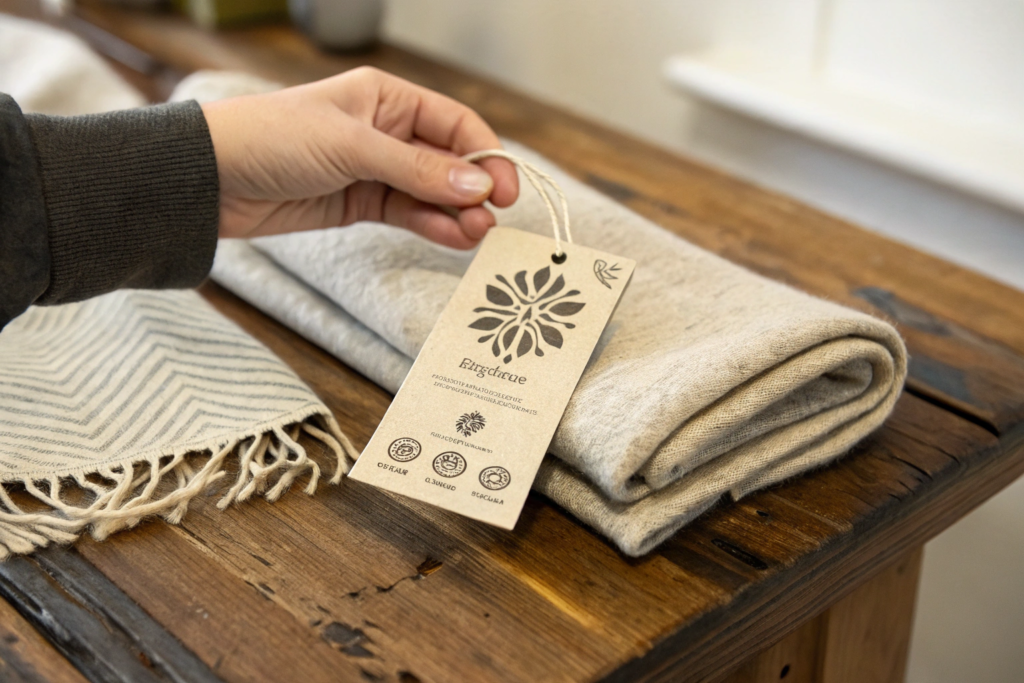
An effective farm provenance hang tag includes the name and location of the farm, the breed of sheep, a photograph of the farm landscape, a sentence or two about the farming philosophy, and the ZQ or RWS certification logo. The tag is printed on recycled, textured paper stock that communicates naturalness. For a British country brand, the farm might be a specific hill farm in the Yorkshire Dales. For a New Zealand brand, a specific merino station in the Mackenzie Basin. The story connects the scarf in the customer’s hand to a real place, a real farmer, and a real flock of sheep. This farm-to-fashion storytelling in retail transforms a commodity accessory into a meaningful purchase.
Conclusion
The 2026 equestrian and country scarf market rewards manufacturers and brands that understand the specific, demanding intersection of performance, heritage, versatility, and provenance. You learned that merino-modal blends with DWR finishes have replaced both pure cashmere and pure synthetic as the performance material of choice. The scarf that works from 6 AM yard duties to 8 PM pub dinner must manage moisture, resist odor, repel light rain, and maintain its shape through everything in between.
We walked through the aesthetic shift. Jacquard weaving with abstract equestrian motifs, snaffle bits, stirrup irons, barley twists, has replaced surface printing as the quality signal. The woven pattern has depth, permanence, and reversibility that a print cannot achieve. The motif is an insider reference, not a billboard.
We explored the convertible scarf-gaiter hybrid. The concealed zipper and the magnetic snap system that allow a single product to transform from a functional neck tube worn under a riding jacket to an elegant draped scarf worn over a tweed blazer. The rider no longer changes accessories between activities. The accessory changes itself.
And we covered the provenance revolution. ZQ and RWS certification provide verifiable traceability from named farm to finished scarf. The hang tag tells the story of the farm, the farmer, and the sheep. This story supports a 30% to 50% price premium because it transforms a commodity scarf into a meaningful connection to land, animal, and rural community.
At AceAccessory, I have invested in the materials, the jacquard weaving capability, the convertible construction techniques, and the certified supply chains that the 2026 equestrian market demands. I produce scarves for country brands that compete on quality, durability, and authenticity rather than price.
If you are an equestrian brand, a country lifestyle label, or a tack shop buyer looking to develop a scarf collection that meets the 2026 standards for performance and provenance, I invite you to contact our Business Director, Elaine. She can share our merino-modal fabric swatches, our jacquard motif library, our convertible scarf samples, and our ZQ and RWS supply chain documentation. Reach her at elaine@fumaoclothing.com. Let’s create scarves that belong in the field, the stable, and the country pub.




