For manufacturers and brands in the outerwear and accessories space, claiming a product is "waterproof" or "water-resistant" is a major selling point with significant performance and safety implications. However, these terms are not interchangeable in the eyes of standards bodies or informed consumers. A rigorous, multi-faceted testing protocol is essential to validate performance claims, ensure product reliability, and protect your brand from the reputational damage of a failing product in the field. For a factory like AceAccessory, developing a robust in-house testing regimen is a critical component of quality assurance and a competitive advantage.
To comprehensively test the water resistance of a raincoat, you must implement a three-tiered strategy: first, conduct standardized laboratory tests to measure the fabric's inherent hydrostatic head and breathability; second, perform controlled simulated rain tests on the fully constructed garment to evaluate seam sealing and overall integrity; and third, execute practical field tests under real-world conditions to assess long-term durability and user experience. This multi-stage approach moves from material science to finished product validation, providing a complete picture of performance.
This guide details the specific methods, equipment, and international standards that define professional raincoat testing, enabling you to build a credible and defensible quality control process.
How Do You Conduct Laboratory Fabric Tests (Hydrostatic Head & Breathability)?
The foundation of water resistance lies in the fabric itself. Before a single stitch is sewn, the chosen material must be evaluated using precise, quantifiable laboratory tests. The two most critical metrics are Hydrostatic Head (HH) and Moisture Vapor Transmission Rate (MVTR).
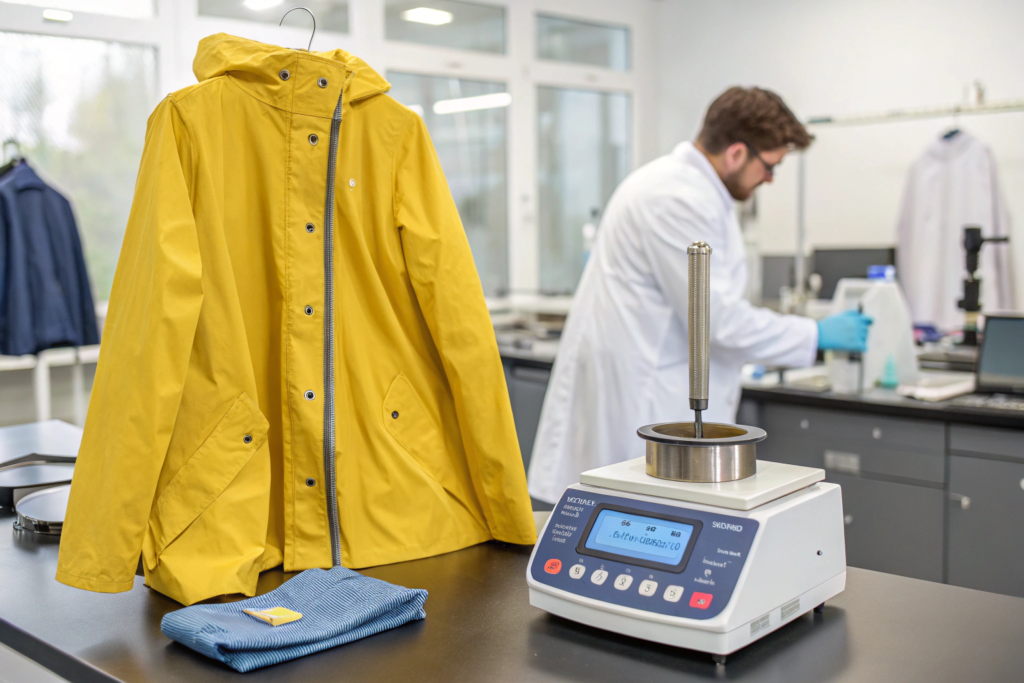
The Hydrostatic Head Test is the globally recognized standard for measuring a fabric's resistance to water penetration. It quantifies the pressure (measured in millimeters of water column, mm H₂O) that the fabric can withstand before water seeps through. The test is performed using a specialized machine that clamps the fabric sample under a column of water, increasing the pressure until the third drop penetrates the reverse side. Industry classifications are clear:
- Water-Resistant: Typically 1,000 - 5,000 mm H₂O. Suitable for light drizzle or short exposure.
- Waterproof: Requires a minimum of 5,000 mm H₂O, with high-performance garments often exceeding 10,000 or even 20,000 mm H₂O for severe conditions.
Simultaneously, Breathability (MVTR) Testing is conducted. A truly functional raincoat must not only keep water out but also allow perspiration vapor to escape. The MVTR test measures how many grams of water vapor can pass through one square meter of fabric in 24 hours (g/m²/24h). Higher numbers indicate better breathability. Tests like the ISO 15496 (Upright Cup Method) or the more advanced ISO 11092 (Sweating Hot Plate) provide this data. The balance between high hydrostatic head and high MVTR is the hallmark of a premium technical fabric.
What Are the Key International Standards for Fabric Testing?
Manufacturers and laboratories rely on established standards to ensure consistency and credibility. The primary standards for hydrostatic head testing are:
- ISO 811: Textiles — Determination of resistance to water penetration — Hydrostatic pressure test.
- AATCC 127: Water Resistance: Hydrostatic Pressure Test.
- JIS L 1092: Japanese standard with similar methodology.
For breathability, ISO 15496 and ASTM E96 are commonly referenced. Sourcing fabric with certified test reports from mills that adhere to these standards is the first step in building a verifiable raincoat.
How Does Fabric Construction Influence Water Resistance?
The performance of any fabric is determined by its construction and finish. Laminated membranes (e.g., Gore-Tex, eVent) are waterproof and breathable by design, creating a physical barrier to liquid water while allowing vapor molecules to pass. Coated fabrics have a layer of polyurethane or other polymer applied; they are often waterproof but can compromise breathability. The Durable Water Repellent (DWR) finish is a topical treatment applied to the outer fabric that causes water to bead up and roll off, preventing the face fabric from becoming saturated, which can compromise breathability. Testing must evaluate the base fabric's inherent waterproofness and the effectiveness and durability of the DWR finish.
How Do You Perform Simulated Rain and Shower Tests on the Finished Garment?
Laboratory fabric tests are necessary but not sufficient. A raincoat is a complex 3D object with sewn seams, zippers, pockets, and hoods—all potential points of failure. The next stage tests the fully constructed garment under controlled, simulated rainfall.
The Spray Rating Test (AATCC 22) is a fundamental, qualitative check. A pre-weighed sample of the finished fabric or a small section of the garment is secured at a 45-degree angle. A standardized nozzle sprays water onto it for 5 minutes. After spraying, the sample is tapped and its wetted appearance is compared to a reference scale (from 100, no sticking or wetting, down to 0, complete wetting). This test is fast and useful for initial screening but does not simulate prolonged, heavy rain.
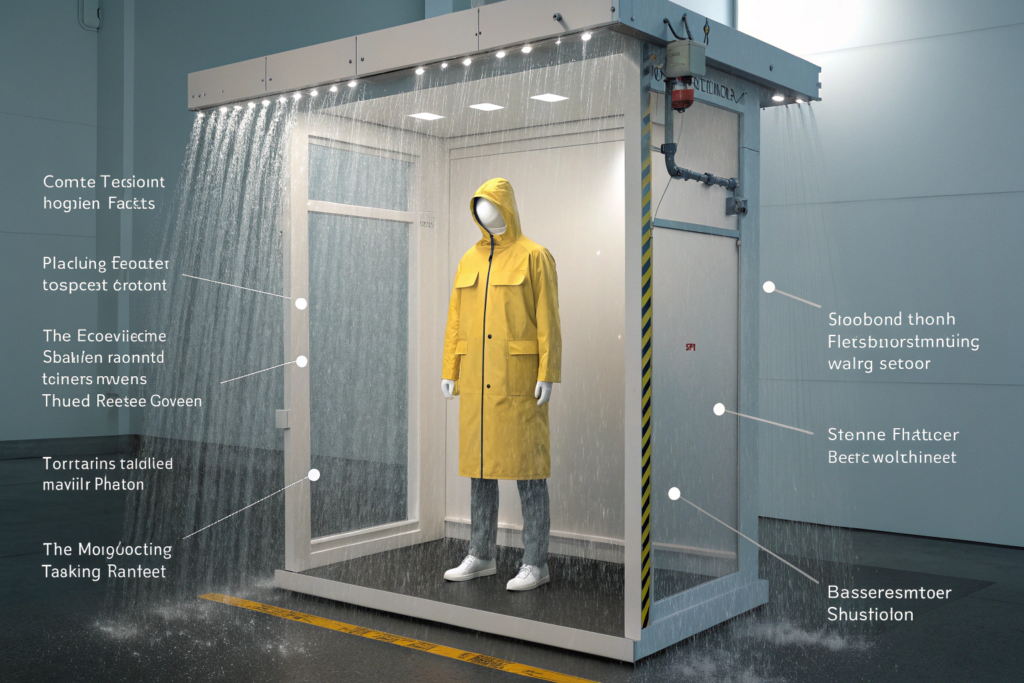
For a more rigorous full-garment test, a Rain Tower or Shower Test is used. The complete raincoat is placed on a mannequin or suspended, and it is subjected to a simulated rainstorm for a set duration (e.g., 10, 30, or 60 minutes) at a specific water pressure and droplet size. The interior is then inspected for any moisture penetration, with particular attention to taped or sealed seams, zipper flaps, and pocket welts. This test effectively validates the quality of the factory's sealing processes.
How Do You Test Seam Sealing and Construction Integrity?
Seams are the most critical vulnerability. The Hydrostatic Head test can and should be repeated on sewn seams to ensure the taping or welding process does not create weak points. Additionally, a Seam Leak Test can be performed by directing a focused jet of water along the length of a seam from a short distance and inspecting the reverse side for moisture. For waterproof zippers, a simple test involves pouring a small amount of water directly onto the closed zipper coil and checking the interior after a few minutes.
Why is a "Dynamic Water Penetration Test" Important for Activewear?
Static tests on flat fabric or hanging garments don't fully simulate the pressure exerted on fabric during movement (e.g., from a backpack strap, knee bending, or arm movement). Some advanced test methods simulate this dynamic pressure by rubbing the fabric surface under water or applying pressure cyclically. While more complex, these tests are crucial for validating high-performance rainwear intended for hiking, climbing, or other demanding activities, ensuring that seams and fabric don't fail under stress.
How Do You Execute Practical Field and Durability Tests?
The final tier of testing moves out of the lab and into real-world conditions. This phase assesses durability, comfort, and performance over time—factors that lab tests can't fully predict.
Controlled Field Testing involves having testers wear the raincoat during actual outdoor activities in rainy weather for extended periods. Testers log conditions, activity level, duration, and any instances of leakage or discomfort. They also provide feedback on mobility, hood performance, ventilation, and whether internal condensation becomes a problem—a key indicator of breathability performance in use.
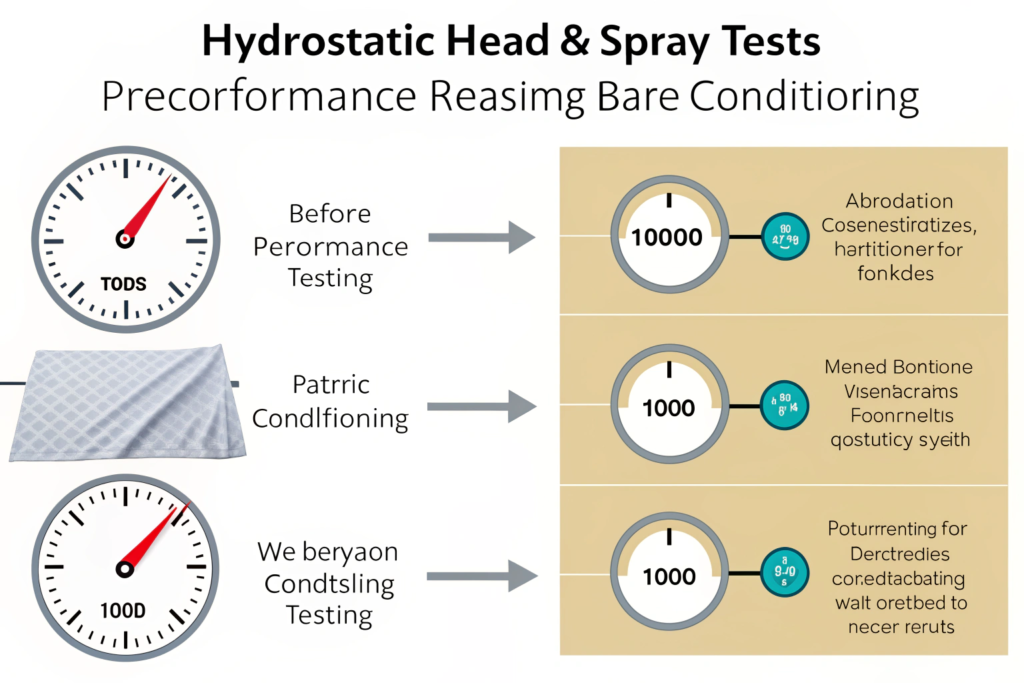
Crucially, the product must be tested after simulated wear and care. The durability of water-repellent (DWR) finishes and seam tapes is not infinite. Therefore, pre-conditioning the garment is mandatory before final lab tests. Standard protocols include:
- Abrasion: Using a Martindale or Wyzenbeek machine to rub the fabric a set number of cycles.
- Laundering/Dry Cleaning: Washing or dry-cleaning the garment 5-10 times per relevant care instructions (e.g., AATCC 135).
- Flexing: Using a flex tester to simulate the stress on fabric and seams from body movement.
After this pre-conditioning, the Hydrostatic Head and Spray Rating tests are repeated. A significant drop in performance (e.g., from 10,000 mm to 2,000 mm after abrasion and washing) reveals a lack of durability and must be addressed at the material or construction stage.
What Are the Industry Benchmarks for Consumer Labels?
Understanding common labeling helps translate test data into consumer claims:
- Water Resistant: Implies a DWR finish that causes water to bead up, but the fabric may wet through under sustained pressure. Often associated with Spray Ratings of 80-90.
- Waterproof: Legally implies the garment will keep the wearer dry under defined conditions. Should be backed by a hydrostatic head of at least 5,000mm and fully sealed seams. Brands often use proprietary standards (e.g., The North Face's DryVent, Helly Hansen's Helly Tech®) which specify their own rigorous test protocols.
- Breathable: Should be supported by an MVTR rating (e.g., "10,000 g/m²/24h").
How Do You Conduct a Simple "At-Home" Quality Check?
While not a substitute for lab tests, a basic check can be performed by holding the cuff of a sleeve under a running tap for 1-2 minutes while observing the inside. Checking that zippers have adequate storm flaps and that all seams are fully sealed (flat taping, no gaps) are quick visual inspections that can catch major flaws. However, these checks cannot verify the fabric's pressure rating or the durability of its properties.
How Should You Build an In-House QC Testing Regimen?
For a manufacturer, integrating these tests into a staged Quality Control protocol is essential for batch consistency and client confidence.
Establish a three-stage testing pipeline:
- Incoming Material Inspection: Require and verify mill test reports for HH and MVTR on all fabric rolls. Perform spot-check AATCC 22 Spray Tests.
- In-Process Checks: After seam sealing/taping, perform seam leak tests on samples from each production batch.
- Final Pre-Shipment Audit: For each production lot, conduct a finished garment shower test on a statistically significant sample size (following AQL sampling standards). Also, send random selected units to an accredited third-party lab for periodic audit testing against ISO or AATCC standards to validate your in-house results.

Why is Third-Party Certification a Strategic Advantage?
For high-value or technical rainwear, obtaining certification from an independent laboratory like ITS, SGS, or Bureau Veritas provides unparalleled credibility. They can test to specific international standards and issue a formal report. Furthermore, licensing a recognized performance label (like GORE-TEX®) involves passing the material supplier's own exhaustive battery of tests and adhering to their manufacturing guidelines, which is the ultimate testament to a product's performance and a powerful marketing tool.
How Do You Document and Communicate Test Results?
Maintain a Technical File for each raincoat style, containing all fabric test reports, in-house QC records, and any third-party certificates. This is crucial for liability protection and for providing evidence to buyers. For your sales and marketing teams, translate technical data into clear, compliant consumer language (e.g., "Tested to withstand a water column of 10,000mm, suitable for heavy rain and snow").
Conclusion
Testing the water resistance of a raincoat is a rigorous scientific and practical discipline that moves from the molecular behavior of fabric to the real-world experience of the end-user. A professional approach mandates a combination of standardized laboratory tests for fabric metrics, simulated rain tests for finished garment integrity, and field trials coupled with durability conditioning to assess long-term performance. This holistic methodology ensures that "waterproof" is a demonstrable fact, not a marketing hope.
By implementing this tiered testing strategy, manufacturers can guarantee product reliability, make accurate and defensible performance claims, build unshakable brand trust, and ultimately deliver rainwear that truly protects in any storm. It transforms quality control from a cost center into a core brand asset.
To develop high-performance, verifiably waterproof outerwear and accessories, partner with Shanghai Fumao. Contact our Business Director Elaine at elaine@fumaoclothing.com to leverage our expertise in technical material sourcing, precision garment construction, and rigorous in-house testing protocols.