You've secured a large order, but the quoted unit price is squeezing your margins thin. This is the critical juncture where volume should translate into value, but without the right strategy, it can instead lead to eroded profits. The challenge is to move beyond simple price haggling and unlock the structural cost savings that bulk manufacturing truly enables.
Achieving a better unit price for bulk accessory orders requires a strategic, multi-pronged approach that optimizes material sourcing, streamlines production efficiency, leverages long-term partnership value, and employs smart financial and logistical planning. It's about collaborating with your manufacturer to engineer cost out of the process, not just demanding a lower number.
This guide will outline the four key levers you can pull to secure a more favorable cost structure. We'll delve into material and design optimization, production and efficiency gains, the power of partnership and forecasting, and financial and logistical tactics. For brands looking to build a sustainable bulk sourcing strategy, partnering with a factory that offers comprehensive design services is essential for implementing many of these cost-saving measures from the very beginning.
How Can Material and Design Optimization Lower Costs?
The single largest component of your product's cost is materials. The second is the labor required to assemble it. Smart design and material choices directly target these two areas, creating significant, recurring savings that compound over a large order.
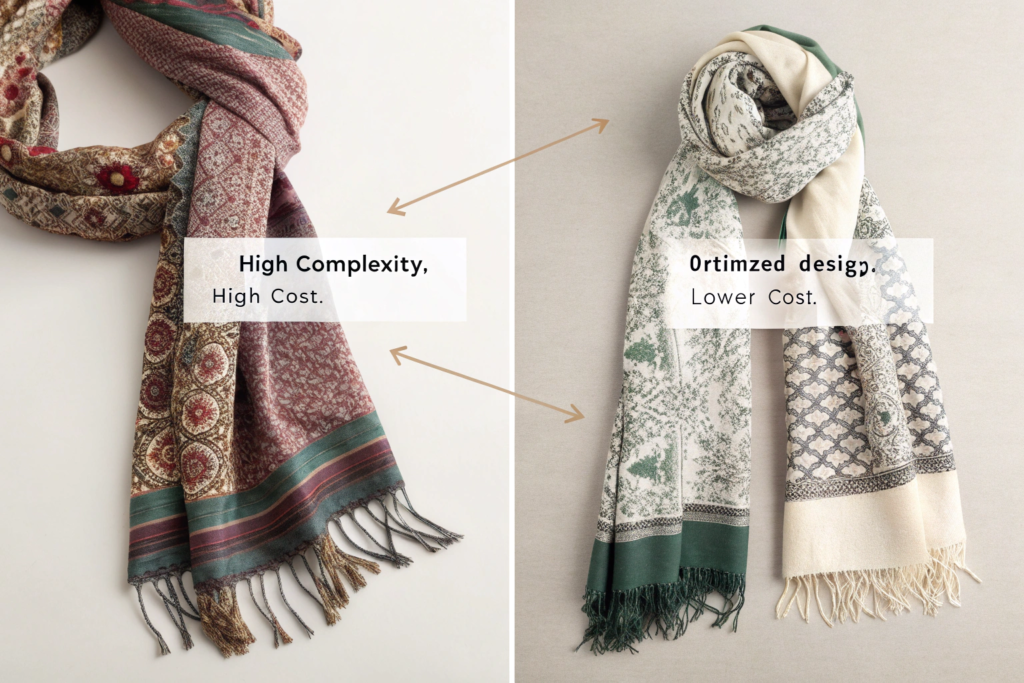
Cost optimization starts at the design phase by standardizing components across multiple products, value engineering the product (simplifying construction without compromising quality), and strategically sourcing materials in bulk or from more efficient suppliers. The goal is to design for manufacturability (DFM).
Let's break it down with an example. If you order five different beanie styles, each with a unique, custom-made pom-pom, you pay five setup costs and buy five small batches of different materials. By standardizing to one or two pom-pom types (size, material) used across all styles, you consolidate demand, buy those materials in larger volume, and secure a better price. Similarly, simplifying a bag's internal pocket structure from three complex pieces to two simpler ones reduces cutting and sewing time. At Shanghai Fumao, our design team actively consults with clients on value engineering—such as suggesting a slightly different fleece blend that maintains hand-feel but is 10% more cost-effective at high volumes, or recommending a stitch type that is equally strong but faster for our machines to execute.
What is "Value Engineering" in Accessory Design?
Value engineering is a systematic method to improve the "value" of a product by examining its function and modifying it to reduce cost without sacrificing performance. For accessories, this can mean:
- Reducing the number of components: Fewer parts to source, inventory, and assemble.
- Simplifying assembly: Replacing a hand-stitched detail with a clean machine-stitched alternative.
- Optimizing material usage: Adjusting pattern layouts (nesting) to get more pieces out of a yard of fabric or roll of leather, reducing waste.
- Substituting materials: Using a high-quality acrylic-polyester blend instead of 100% wool for a scarf line, offering similar warmth and drape at a lower cost.
Initiate a DFM (Design for Manufacturability) review with your factory before finalizing your tech pack. Their engineers can often spot cost-saving opportunities invisible to a designer.
How Does Bulk Material Sourcing Work?
When you place a large order, your factory also places large orders with their suppliers. You can leverage this in two ways:
- Consolidated Material Purchase: Agree with your factory to use the same base material (e.g., a specific 210D nylon or cotton canvas) across multiple styles or future orders. This allows the factory to commit to a larger volume with the mill, securing a better price that is passed on to you.
- Direct Material Sourcing (for advanced buyers): For extremely large orders, you might source key raw materials directly from a mill and supply them to the factory (a "CMT" or Cut-Make-Trim model). This requires expertise but can offer the highest level of cost control.
Always ask your factory: "If I can commit to using this same fabric/component for my next three orders, what kind of material cost reduction can we achieve?"
How Do Production Efficiencies Scale with Volume?
Manufacturing is governed by economies of scale. The fixed costs of setup are distributed over more units, and the variable costs per unit often decrease as the production system hits its optimal, uninterrupted rhythm. Your goal is to help the factory maximize its efficiency for your order.
Key production efficiencies include reduced machine setup and changeover time, optimized line balancing and labor specialization, lowered defect rates through process refinement, and better utilization of factory capacity. A smooth, large run is inherently more cost-effective per unit than multiple small, disjointed runs.
Consider the production line. Setting up a sewing line for a new product takes time: distributing patterns, adjusting machines, training workers on the specific steps. For an order of 500 units, this setup time might represent 20% of the total production time. For an order of 5,000 units, the same setup time might represent only 2%. This dramatic reduction in the percentage of time spent on non-productive setup is a primary driver of lower unit costs. Furthermore, as workers repeat the same task thousands of times, they become faster and more consistent, reducing labor minutes per piece and improving quality yield. We plan our production schedules at Shanghai Fumao to group similar client orders (e.g., all canvas totes) together to maximize these efficiencies, and we share a portion of these savings with clients who provide us with large, predictable volumes.

Why Does a Longer, Uninterrupted Run Lower the Price?
Continuity is key. An uninterrupted run allows the factory to:
- Maintain Momentum: Workers stay in rhythm, supervisors don't need to re-brief teams, and quality remains consistent.
- Optimize Material Flow: Raw materials are delivered in bulk and fed continuously to the line, avoiding stoppages.
- Minimize Machine Downtime: Machines are calibrated once and run for extended periods without needing changeovers.
When negotiating, ask about the factory's "optimal run length" for your product. Committing to an order size that matches this (or even allowing them to produce it all in one lot rather than split shipments) can be a powerful bargaining chip for a better price.
How Can You Help the Factory Reduce Defects and Rework?
Defects are a direct cost to both you and the factory. Proactive collaboration reduces them. Provide crystal-clear tech packs and approved sealed samples. Be available to answer production queries quickly. Consider funding a pre-production sample (PP sample) run of 50-100 units to catch any issues before the full order is cut. This minimizes the risk of a whole batch being made incorrectly. Additionally, agreeing on a realistic and fair AQL (Acceptance Quality Level) standard prevents contentious and costly disputes over minor issues. A partnership that focuses on preventing cost is more valuable than one that merely argues about cost.
How Does Partnership and Forecasting Secure the Best Terms?
Factories invest in reliable partners. Your relationship and business behavior are intangible assets that can translate into tangible pricing advantages. Demonstrating that you are a low-risk, high-potential client makes a factory more willing to invest in you through better pricing.
Building partnership leverage involves providing accurate, long-term forecasts, establishing a track record of on-time payments and clear communication, and exploring strategic agreements like annual volume commitments or exclusivity in certain product categories.
Shift from a transactional mindset to a strategic one. Present the factory with a 12-month rolling forecast, even if it's non-binding. This allows them to plan their capacity, secure raw materials at better rates in advance, and potentially reserve production slots for you during peak seasons. A history of paying deposits and balances promptly reduces their financial risk and administrative cost. Most importantly, discuss a pricing tier structure. For example: "Orders of 1,000-4,999 units: Price X. Orders of 5,000-9,999 units: Price Y. Orders of 10,000+ units: Price Z." This gives you a clear target to aim for and gives the factory incentive to help you grow. At Shanghai Fumao, we offer our most loyal partners tiered pricing and first priority on production scheduling because their success and planning make our operations more efficient and predictable.

What Should a Strategic Volume Commitment Look Like?
A formal or informal volume commitment is a powerful tool. It can be structured as:
- Annual Volume Discount: "If I purchase over 50,000 units total across all styles in the next 12 months, I receive a 5% rebate on the total."
- Style-Specific Commitment: "I commit to ordering at least 5,000 units of this specific bucket hat style per season for the next two years."
- Capacity Booking: A non-refundable deposit to book a dedicated production line for a set period during the busy season.
These commitments give the factory confidence to make investments (like purchasing specialized equipment) that can ultimately lower your costs.
Why is Payment Term Flexibility a Negotiation Tool?
Cash flow is critical for factories. Offering favorable payment terms can be exchanged for a better unit price. Standard terms might be 30% deposit, 70% before shipment. Consider:
- Offering a Higher Deposit (e.g., 50%): Improves the factory's cash flow to purchase materials.
- Paying via Letter of Credit (L/C) at Sight: Provides the factory with a guaranteed payment from a bank upon shipment, reducing risk.
- Exploring Supply Chain Finance: Using platforms that allow you to extend your payment terms while the factory gets paid early by a third-party financier.
Presenting yourself as a finance-savvy and reliable partner can open up discussions beyond just the per-piece cost.
What Financial and Logistical Tactics Improve Landed Cost?
The final delivered cost of your goods (the "landed cost") includes more than just the FOB (Free On Board) price. Optimizing shipping, duties, and order consolidation can significantly impact your total cost per unit, making a slightly higher FOB price from a more efficient factory ultimately cheaper.
Critical tactics include consolidating shipments to achieve better freight rates, optimizing packaging to reduce size and weight, leveraging trade agreements to reduce or eliminate duties, and strategic order timing to avoid peak season surcharges.
Think holistically. A 5% reduction in your ocean freight cost has the same bottom-line impact as a 5% reduction in your FOB price. Work with your factory and freight forwarder on:
- Packaging Optimization: Can the accessory boxes be made slightly smaller? Can polybags be thinner? Can items be shipped flat-packed (like caps) instead of pre-shaped? This reduces cubic volume (CBM), the basis of shipping cost.
- Shipment Consolidation: Combine multiple smaller orders into one full container load (FCL) instead of shipping via less than container load (LCL). FCL rates per CBM are dramatically lower and offer more control.
- Incoterms Strategy: If you have the expertise, taking control of the main freight by operating on FOB terms (where you choose and pay the freight forwarder) can sometimes yield better rates than the factory's standard CIF (Cost, Insurance, and Freight) quote.
We assist our clients in analyzing these elements, sometimes recommending slightly sturdier corrugated cartons that allow for higher stacking in the container, ultimately fitting more units in and lowering the per-unit shipping cost.

How Can You Minimize Tariffs and Duties?
For importers in markets like the USA or EU, duties are a major cost.
- Correct HS Code Classification: Work with your customs broker to ensure your hair accessories, scarves, etc., are classified under the most favorable Harmonized System (HS) code. An expert like a licensed customs broker is essential here.
- Leverage Trade Programs: If shipping from China to the USA, ensure your factory provides the correct documentation for applicable exclusions. For other regions, research if there are preferential trade agreements.
- First Sale for Export Rule: In some complex supply chains, it may be possible to base duties on the price paid to the manufacturer, not a higher price paid to a middleman. This requires specific legal structuring.
While this area is complex, even a small reduction in duty percentage on a large order value is a substantial saving.
Does Order Timing Affect Price?
Absolutely. Factories and logistics providers have peak seasons (typically Q3/Q4 for holiday goods). Placing your bulk order for Q1/Q2 delivery (the "low season") can provide leverage. The factory has more available capacity and may be more willing to negotiate favorable pricing to keep their lines running. Similarly, booking ocean freight space well in advance of the peak season (August-October) locks in better rates. Planning your production calendar counter-cyclically can be a smart financial strategy.
Conclusion
Securing a better unit price for bulk accessory orders is a sophisticated exercise in supply chain collaboration and strategic planning. It requires looking beyond the invoice line item to optimize design, empower production efficiency, build a valuable partnership, and manage the total landed cost. By engaging with your manufacturer as a strategic ally and sharing the goal of a lean, effective production process, you unlock the true economies of scale.
This comprehensive approach not only improves your margins on the current order but also establishes a foundation for sustainable, profitable growth for seasons to come.
Ready to optimize your next bulk accessory order for maximum value? Contact our Business Director, Elaine, at elaine@fumaoclothing.com. Let Shanghai Fumao partner with you to analyze your supply chain, implement cost-saving strategies, and deliver the quality and pricing that support your brand's success.