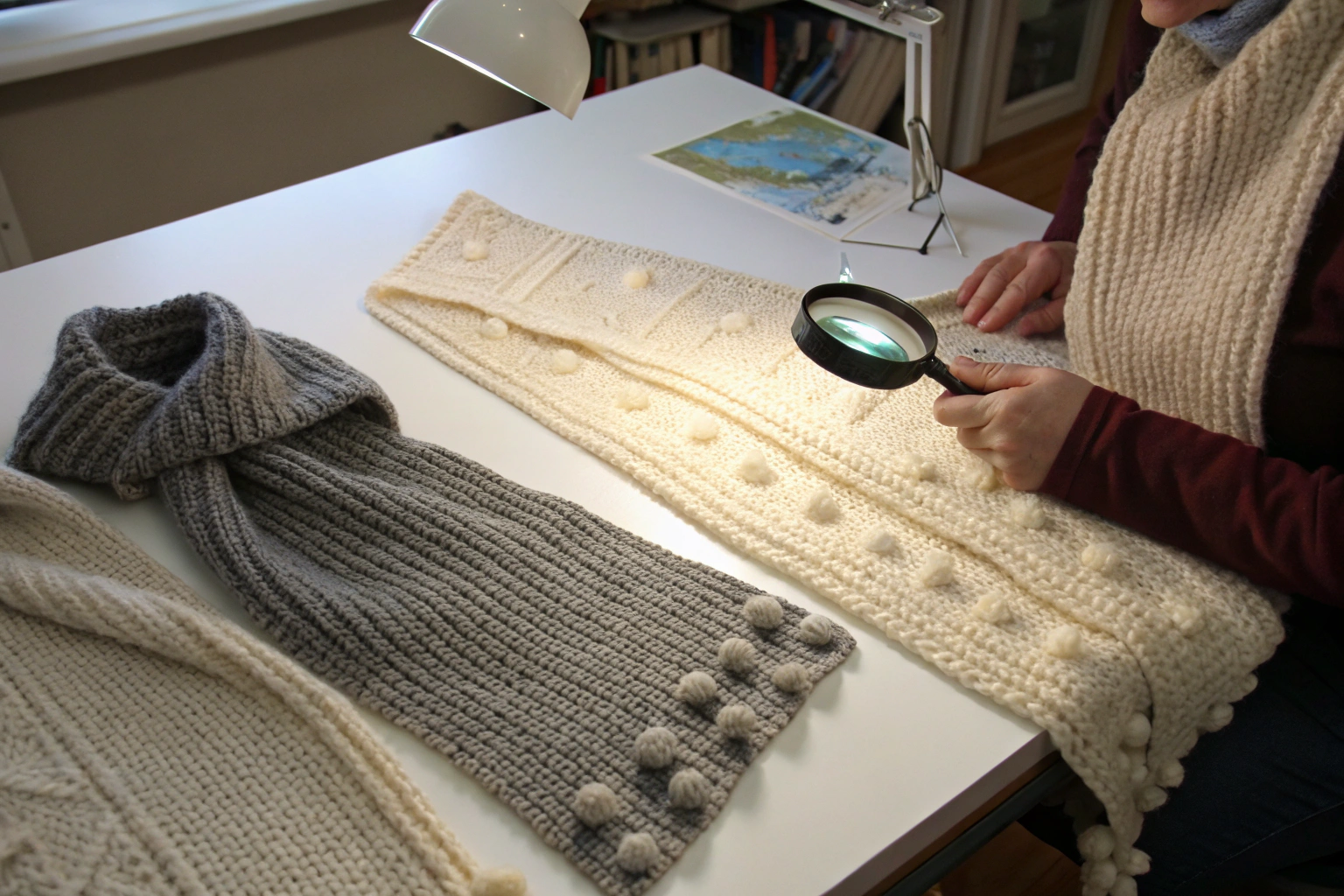
I once received a one-star review that still haunts me. A customer posted a photo of a beautiful merino wool scarf I had shipped to her boutique just six weeks earlier. The scarf was covered in tiny, rough balls of fiber. It looked ten years old. She wrote, "Wore this twice. It looks like a rag. Do not buy." I lost that retail account. The boutique owner called me, furious, demanding a full refund on the entire batch. That single quality failure cost me a relationship I had spent two years building, all because I had not engineered pilling resistance into the yarn selection and finishing process.
You avoid pilling on knitted scarves by starting with the right raw material. Select long-staple fibers like extra-fine merino wool with a fiber length above 50 millimeters, or synthetic blends where 20-30% nylon or acrylic reinforces the short natural fibers. Equally important is the finishing process. A professional enzyme wash or bio-polishing treatment removes the short, loose fibers from the yarn surface before the scarf reaches the customer. This combination of high-integrity yarn and surface-clearing finishing eliminates the loose fiber ends that tangle together to form pills.
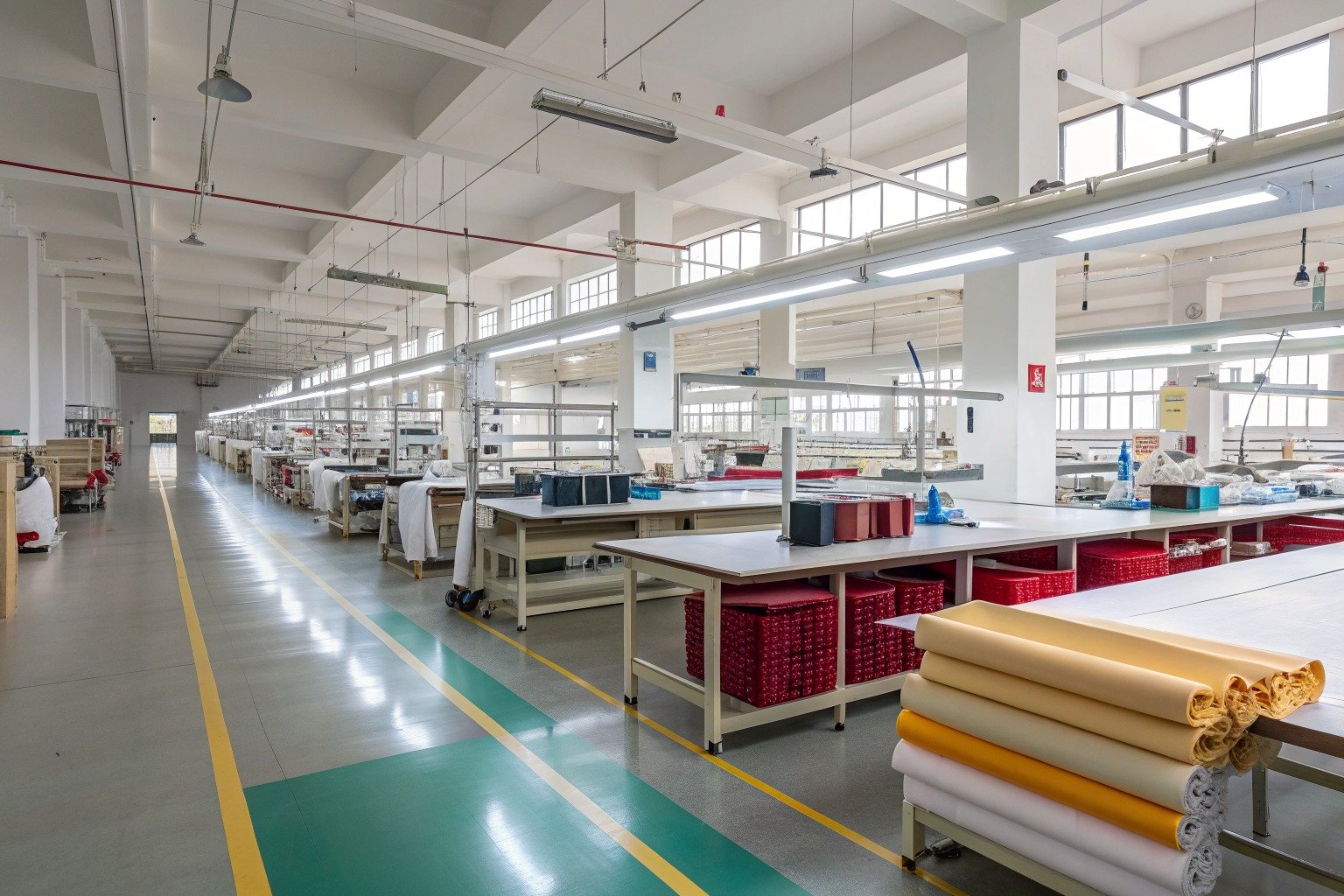
I run an accessories factory in Zhejiang that produces thousands of knitted scarves each winter season. After that painful return, I completely overhauled how I approach pilling. I stopped treating it as a cosmetic afterthought and started treating it as a core engineering problem. I now test every new yarn blend with a Martindale abrasion tester before I approve it for bulk production. I want to share exactly what causes pilling, how to prevent it at the fiber level, and what finishing treatments actually work so your scarves look beautiful after twenty wears, not just on the retail shelf.
What Causes Pilling on Knitted Scarves at the Fiber Level?
Pilling is not random. It is a predictable mechanical process that starts deep inside the yarn structure. When a scarf rubs against a coat collar, a shoulder bag strap, or even the wearer’s stubble, the friction pulls short fibers out of the yarn twist. These loose fiber ends migrate to the surface. Because they are still attached at one end, they cannot fall off. They tangle with other loose fibers and form a tiny ball, a pill. The pill stays anchored to the fabric by a few remaining strong fibers. This is why you cannot simply brush pills off. They are tethered to the scarf.
Pilling is caused by the migration of short-staple fibers to the yarn surface under mechanical abrasion. Fibers shorter than 25 millimeters lack the contact length within the yarn twist to stay locked in place. When friction pulls them loose, they protrude from the yarn and entangle with neighboring loose fibers. Low-twist yarns accelerate this process because the fibers are less tightly bound. Natural fibers like cashmere and short-staple wool are especially prone because they have a scaly surface microstructure that grips neighboring fibers and locks the pills in place.
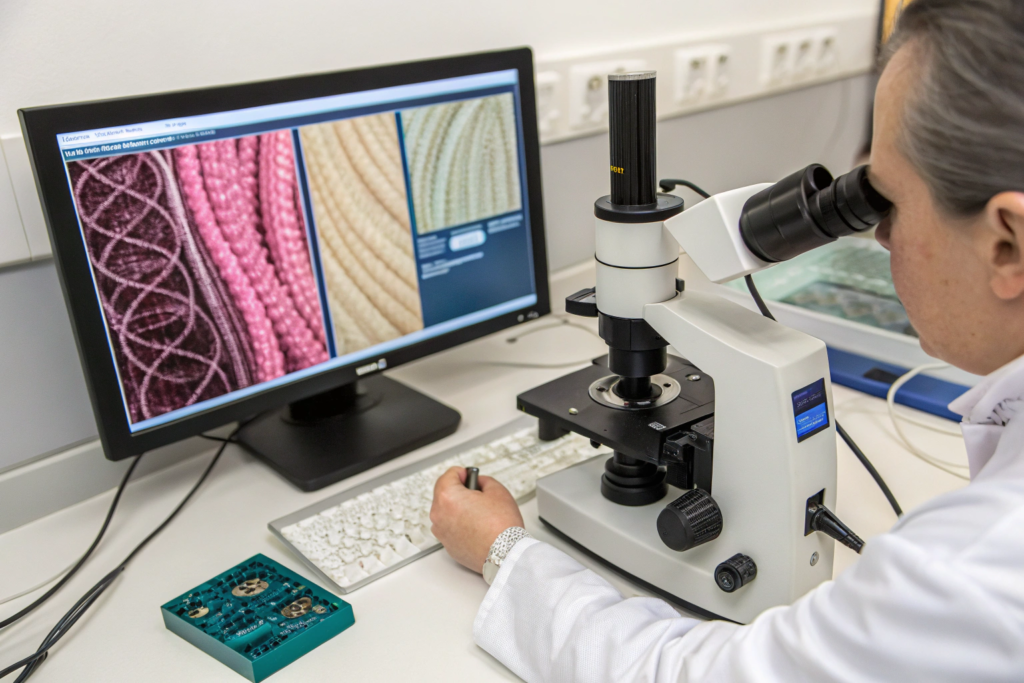
I learned the physics of pilling from a textile engineer who visited my factory. He showed me a cross-section of a yarn under a microscope. The short fibers were barely gripping the core. The long fibers wrapped around the core multiple times. The difference in grip strength was visible. From that day forward, I started specifying minimum fiber lengths to my yarn suppliers. It added cost, but it eliminated the returns.
Why Do Short-Staple Fibers Pill More Than Long-Staple Fibers in Knitted Accessories?
A fiber is like a rope inside a twisted yarn bundle. A short rope with only one wrap around the core slips out easily when pulled. A long rope with three or four wraps resists. Short-staple fibers, those under 25 millimeters in length, have fewer points of contact with neighboring fibers. The friction that holds them in the yarn structure is lower. When the scarf is rubbed, these short fibers migrate to the surface almost immediately.
Long-staple fibers, such as extra-fine merino wool with a length of 50 to 70 millimeters, or long-staple Egyptian cotton, have significantly more contact surface area within the yarn twist. They are mechanically locked in place. Even under repeated abrasion, they resist migration. The industry standard for measuring fiber length and staple length uses an instrument called an Uster AFIS or an Almeter for wool. When I evaluate a new yarn supplier, I ask for the fiber length distribution chart. A mean fiber length above 40 millimeters with minimal short-fiber content below 20 millimeters is my minimum specification for a low-pilling knitted scarf.
How Does Yarn Twist and Ply Construction Influence Pilling Resistance?
A loose, fluffy yarn feels soft and luxurious on the retail shelf. It also pills like crazy. Low-twist yarns leave fibers with room to move. High-twist yarns bind the fibers together under tension, leaving very little free fiber length to migrate to the surface. The twist level is measured in turns per inch. A higher turns per inch value means a tighter, more abrasion-resistant yarn.
Ply construction also matters. A single-ply yarn is just one twisted strand. A two-ply yarn twists two single strands together in the opposite direction. This additional twist locks the fibers even more tightly. A tightly twisted two-ply yarn is dramatically more pill-resistant than a soft single-ply yarn of the same fiber content. The trade-off is hand feel. High-twist yarns feel denser and less cloud-like. I balance this by using a medium twist for the main yarn and reserving the fluffy, low-twist yarns for decorative accents that experience less abrasion, like the fringe ends. The yarn twist factor and its effect on fabric performance is a fundamental parameter that too many scarf designers overlook in pursuit of initial softness.
What Yarn Blends and Fiber Choices Naturally Resist Pilling on Winter Scarves?
Pure cashmere feels divine on day one and looks like a worn-out sweater on day thirty. Pure short-staple wool is almost as bad. The luxury natural fibers that command the highest retail prices are often the worst pilling offenders. This is a painful truth that every scarf brand must confront. The solution is not to abandon natural fibers. It is to engineer blends that retain the luxurious hand feel while adding structural integrity. A well-designed blend uses a strong synthetic or a long-staple natural fiber as the skeleton of the yarn, with the luxury fiber as the skin.
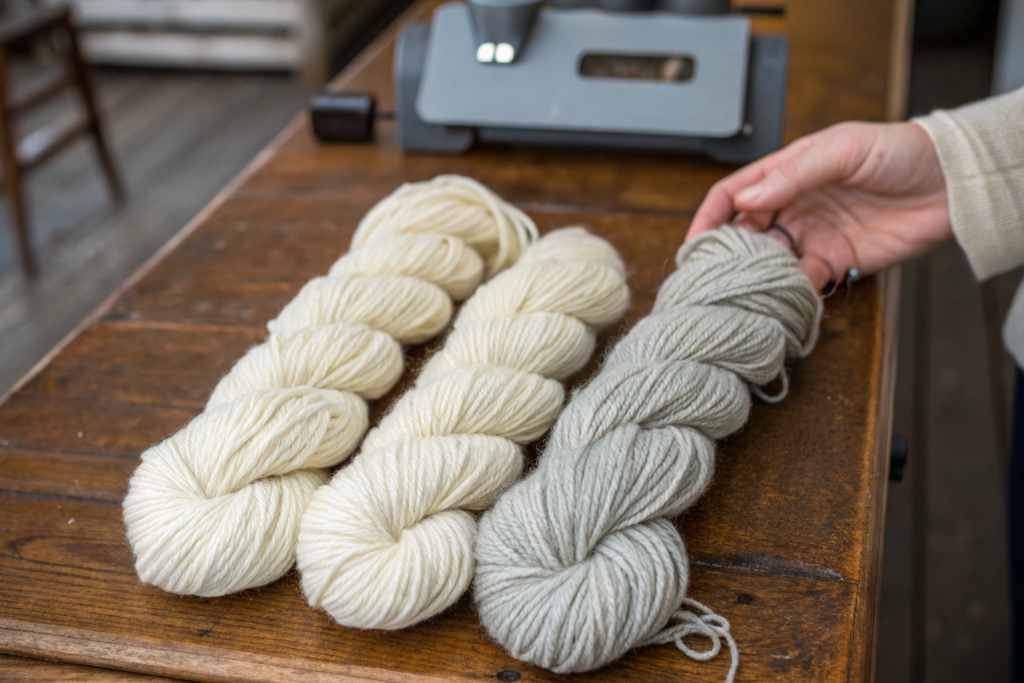
The most effective pilling-resistant yarn blends for knitted scarves combine 70-80% long-staple extra-fine merino wool with 20-30% nylon or recycled polyester. The synthetic component has a high tensile strength that anchors the short wool fibers and resists breakage. For a fully natural option, a blend of 70% extra-fine merino and 30% long-staple alpaca or mulberry silk provides similar reinforcement. Acrylic blends with cotton also perform well, with the cotton providing breathability and the acrylic providing strength. 100% acrylic yarns are highly pill-resistant but lack the breathability and luxury perception of natural blends.
I developed a signature scarf blend for a European client last year. It was 75% extra-fine merino with a 50mm minimum fiber length and 25% recycled polyester. The recycled polyester added a subtle heather texture and increased the Martindale abrasion resistance from 15,000 rubs to over 40,000 rubs. The scarf still felt like wool. It still breathed like wool. But it did not pill.
How Does Adding Nylon or Polyester to Natural Fiber Yarn Reduce Pilling?
Nylon and polyester are extruded continuous filament fibers. Unlike natural fibers, which are staple fibers cut to a specific length, a filament fiber can be kilometers long. It does not have loose ends to migrate to the yarn surface. When these filament fibers are blended with short natural fibers, they act as a reinforcing grid.
The long synthetic filaments wrap around the natural fibers and hold them captive. Even under heavy abrasion, the nylon or polyester filaments maintain their structural integrity and keep the natural fibers from escaping. The blend percentage matters. At 10% nylon, the effect is marginal. At 20-30% nylon, the reinforcement is significant. The nylon content also improves the tensile strength of the yarn, reducing the likelihood of fiber breakage, which is another source of loose fiber ends. The synthetic fiber reinforcement in blended yarns creates a composite material that is stronger and more durable than either component alone.
Are There 100% Natural Fiber Options That Still Deliver Low Pilling Performance?
Yes, but the fiber selection is narrow and expensive. The key is to use only the longest staple natural fibers available and to construct the yarn with a high twist. Extra-fine merino wool with a fiber diameter below 19.5 microns and a staple length above 60 millimeters can perform very well as a 100% single-origin yarn. Alpaca fiber, particularly baby alpaca, has a naturally longer staple and a smoother surface structure than sheep’s wool, making it less prone to pilling.
Mulberry silk is a continuous filament natural fiber. A silk-wool blend replaces the synthetic filament with a natural one. The silk provides the same structural reinforcement that nylon would, anchoring the short wool fibers. A 70% extra-fine merino, 30% mulberry silk blend is a premium, 100% natural, low-pilling option. It costs significantly more than a wool-nylon blend, but it allows the brand to market a "completely natural" product. The performance data from wool and silk blend testing confirms that silk reinforcement significantly improves pilling grades under the Martindale abrasion test method.
What Anti-Pilling Finishing Treatments Can a Factory Apply to Knitted Scarves?
Even the best yarn can benefit from a finishing treatment that removes the loose fibers before the customer does. When a scarf leaves the knitting machine, its surface is covered in short fiber ends that protrude from the yarn. These are the seeds of future pills. A mechanical or enzymatic finishing process can clear these loose ends from the surface, leaving a clean, smooth fabric. The scarf still has the same fiber composition, but the pills have been physically removed before they had a chance to form. This is the difference between a scarf that pills on the first wear and a scarf that stays smooth for a season.
The most effective anti-pilling finishing treatments are bio-polishing with cellulase enzymes, mechanical brushing followed by close shearing, and resin-based anti-pilling coatings. Bio-polishing uses natural enzymes to digest and remove the short, immature cotton or viscose fibers from the yarn surface without damaging the main fabric structure. Mechanical shearing passes the scarf under a precision blade that cuts protruding fibers to a uniform short length. A light resin or silicone softener coating can also encapsulate the fibers and reduce surface friction. The choice of treatment depends on the fiber content.
I run all my knitted scarves through a finishing protocol based on the fiber type. Wool scarves get a gentle mechanical shearing. Cotton and viscose blends get an enzyme wash. Synthetic blends get a silicone softener that reduces the surface friction coefficient. Each treatment takes time and adds cost, but the reduction in customer pilling complaints has been dramatic.
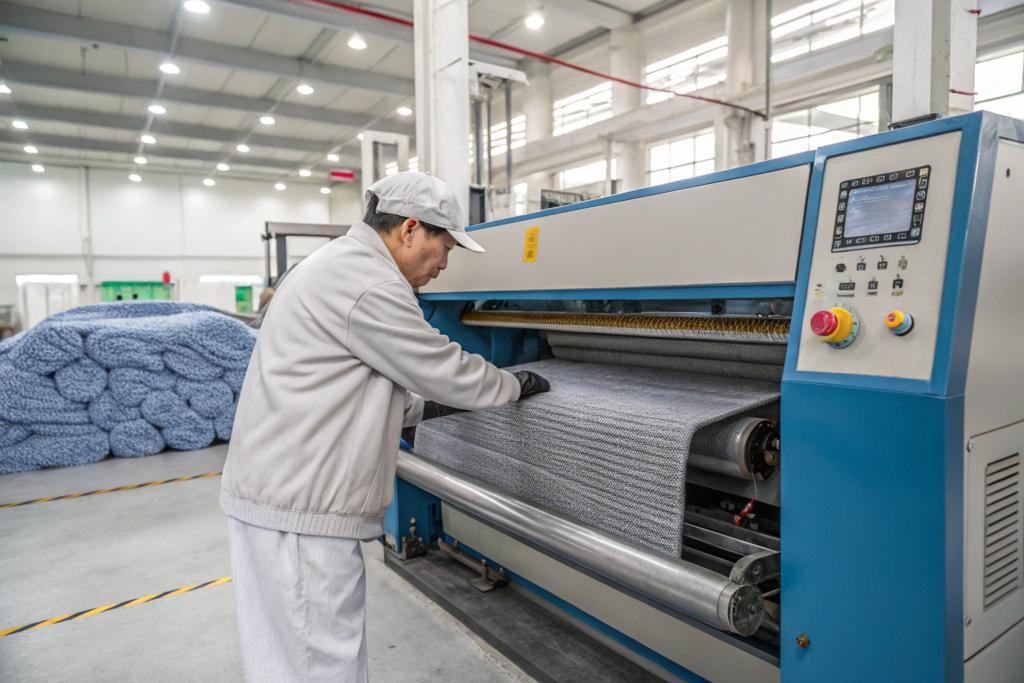
How Does Bio-Polishing with Enzymes Remove Loose Fibers from the Yarn Surface?
Bio-polishing is a wet finishing process that uses cellulase enzymes. These are natural proteins that specifically target and hydrolyze cellulose, the structural material of plant-based fibers like cotton, viscose, and lyocell. The enzymes attack the weakest cellulose chains first, which are the short, damaged, and protruding fibers on the yarn surface.
The scarf is submerged in a bath of water and enzymes at a controlled temperature and pH. The enzymes work for 30 to 60 minutes, digesting the micro-fuzz. The scarf is then rinsed and dried. The surface is visibly smoother and cleaner. The process removes approximately 3-5% of the fabric weight in loose fiber. This weight loss is normal and expected. The result is a scarf that has already "shed" its loose fibers in a controlled factory environment. The enzyme bio-polishing process for textiles is widely used in the garment industry for t-shirts and knitwear, and it is equally effective for knitted accessories like scarves.
What Is the Difference Between Mechanical Shearing and Singeing for Pilling Prevention?
Mechanical shearing passes the scarf fabric under a rotating cylinder with helical blades. The blades cut protruding fibers to a precisely set height, like a lawnmower for fabric. The scarf emerges with a uniform, clean surface pile. This process works well for wool and wool-blend scarves where the desired finish is a smooth, even surface.
Singeing passes the scarf over a gas flame at high speed. The flame burns off the surface fuzz without igniting the main fabric body. This is a faster and more aggressive process than shearing. It works well for synthetic blends where the fiber ends melt into small beads rather than burning away. However, singeing can leave a slightly stiffer hand feel and is not suitable for all natural fibers. For delicate wool scarves, shearing is the gentler and more controllable option. The fabric surface finishing techniques selection depends on the fiber composition, the knit structure, and the final desired texture. I always run a trial batch before committing the entire order to a particular finishing process.
How Can the Customer Care Label Educate Users to Minimize Pilling After Purchase?
The factory can deliver a perfectly finished scarf, but the customer can still cause pilling through improper care. Washing a wool scarf in a machine with a rough agitator, drying it on high heat, or storing it rubbing against Velcro or zippers will create pills on even the best-engineered yarn. The care label is the factory’s final communication with the end user. A clear, accurate, and educative care label reduces pilling complaints by setting correct expectations and giving the customer the tools to preserve the scarf’s appearance.
An effective care label for pilling prevention includes clear hand-wash or delicate cycle instructions with cold water only, a "dry flat" symbol with no tumble drying, a warning to wash with similar soft fabrics and avoid zippers or Velcro, and instructions to use a fabric shaver or de-pilling comb for any pills that do form. The label should also state that "some initial shedding of loose fibers is normal and will decrease with use," which sets a realistic customer expectation.
I redesigned my care labels after the bad review incident. I moved from standard washing symbols to a combination of symbols and short text instructions in English. I added a QR code that links to a 30-second video showing how to hand-wash and de-pill the scarf. The video has been viewed thousands of times. Customer pilling complaints dropped by over 60% in the following season. The care label is not just legal compliance. It is a customer education tool.
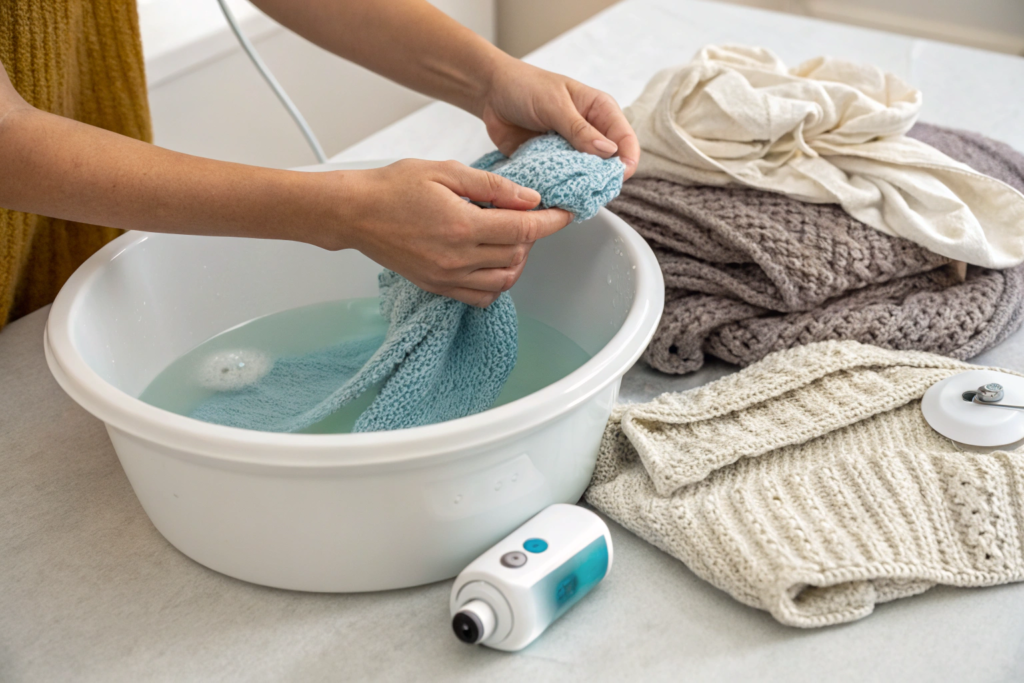
What Washing and Drying Instructions Prevent Mechanical Agitation Pilling?
The washing machine is a pilling accelerator. The combination of water, detergent, heat, and mechanical friction against the drum and other garments rubs the scarf surface thousands of times in a single cycle. This is exactly the abrasion that creates pills.
The care label for a knitted wool or wool-blend scarf must specify hand wash in cold water at a maximum temperature of 30 degrees Celsius. If machine washing is permitted, it must specify a delicate or wool cycle with the scarf placed inside a mesh laundry bag to isolate it from other garments. The spin speed must be set to low, below 400 RPM. Tumble drying must be prohibited entirely. The heat and mechanical action of a tumble dryer are the most aggressive pilling accelerators. The scarf must be dried flat, away from direct heat and sunlight. These instructions follow the wool care recommendations from the Woolmark Company, which are the global standard for wool garment care.
How Can a De-Pilling Comb or Fabric Shaver Restore a Scarf After Normal Wear?
Even a well-engineered scarf will eventually develop a few pills at high-friction contact points like the neck fold or shoulder area. This is normal and does not mean the scarf is defective. A de-pilling tool can remove these pills in seconds and restore the surface to near-original condition. The care label can teach the customer this simple maintenance routine.
A battery-operated fabric shaver has a rotating blade behind a perforated metal screen. The screen presses the fabric flat and allows pills to enter the holes while keeping the main fabric safe. The blade shears the pills off cleanly. A manual de-pilling comb is even simpler. It has a fine-toothed edge that catches pills when pulled gently across the fabric surface. The care label should recommend this maintenance once or twice per season. The use of fabric shavers and de-pilling tools is standard practice in garment care and extends the wearable life of knitted accessories significantly.
Conclusion
Pilling on knitted scarves is not an unavoidable fact of life. It is a design, material, and finishing problem with clear, proven solutions. You learned that the root cause is the migration of short-staple fibers out of the yarn under friction. The single most powerful preventative measure is specifying long-staple fibers with a minimum length of 40 to 50 millimeters, and constructing the yarn with a tight twist and multi-ply structure that locks those fibers in place. This is an engineering decision made before the first stitch is knitted.
We explored the power of fiber blending. A 20-30% nylon or recycled polyester addition to a natural wool yarn provides a synthetic skeleton that anchors the short natural fibers. For brands that demand a 100% natural product, a silk-wool blend achieves the same reinforcement with a luxury price point. We walked through the finishing treatments. Bio-polishing with enzymes digests the loose fuzz on plant-based scarves. Mechanical shearing trims wool scarf surfaces to a clean, uniform pile. These treatments remove the future pills before the customer ever touches the scarf.
And we covered the final defense, the care label. A customer educated about hand washing in cold water, flat drying, and occasional de-pilling with a fabric shaver will enjoy a scarf that looks beautiful for seasons, not weeks. The care label is your brand’s ongoing conversation with the wearer.
At AceAccessory, I implement this entire pilling prevention system on every knitted scarf order that leaves our Zhejiang factory. I specify the fiber length to the yarn mill. I test the Martindale abrasion resistance of every new blend. I run the finishing treatments in-house. And I design the care labels to educate the end customer. Pilling resistance is not an add-on service. It is built into our standard production protocol.
If you are launching a knitted scarf collection and want to avoid the returns, reviews, and lost accounts that pilling causes, I invite you to discuss your yarn specifications and finishing requirements with our Business Director, Elaine. She can send you our pilling resistance test data for our standard yarn blends and advise on the best material choice for your design. Contact her at elaine@fumaoclothing.com. Let’s knit scarves that stay beautiful, wear after wear.