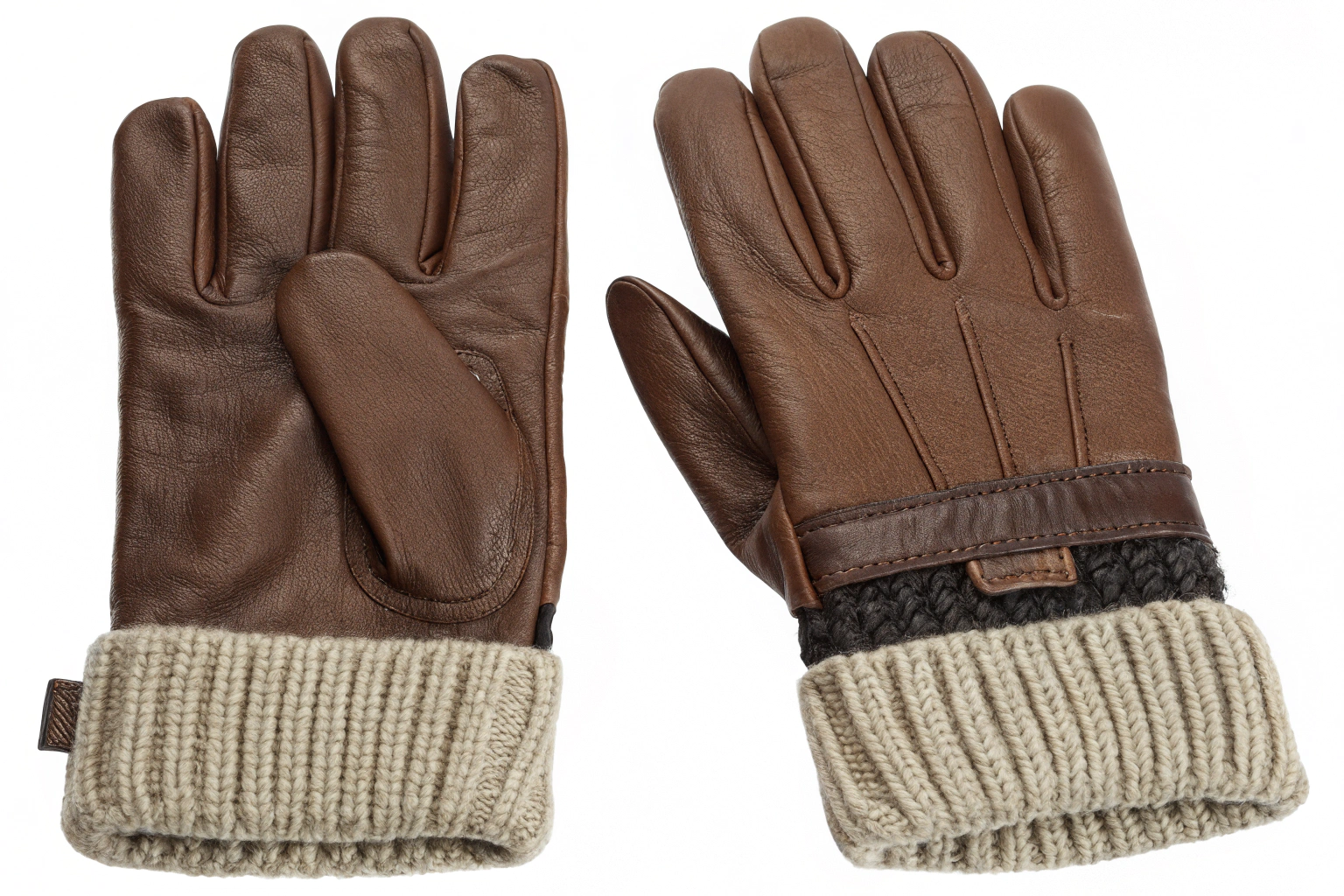
You're evaluating a sample of a knitted glove for your new winter collection. It looks fine at first glance—it has five fingers and it's the right color. But how can you be sure it's a high-quality product that will keep your customers' hands warm, last for more than one season, and justify its price? The secrets to a glove's quality are hidden in its knit, its seams, and its fit. A quick glance is not enough; you need to know how to look.
How can you spot quality issues? You must perform a four-point inspection, just like a professional QC inspector would. You need to: 1) analyze the density and consistency of the knit fabric itself, 2) meticulously examine the seams, especially at the fingertips and thumb, 3) test the fit and elasticity of the cuff, and 4) check for the quality of the finishing, including any embellishments or tech-friendly fingertips. At Shanghai Fumao Clothing, we train our inspectors to be ruthless in this four-point check, because we know that a single flaw can ruin the entire experience of wearing a glove.
Is it hard to spot these issues? Not if you know where to look. Let's turn you into a glove quality expert.
How Can You Analyze the Knit Fabric Itself?
What is the foundation of any knitted glove? It's the fabric. Before you even look at the shape, you must assess the quality of the knit itself. A low-quality glove will often use a thin, loose knit to save on yarn costs and production time.
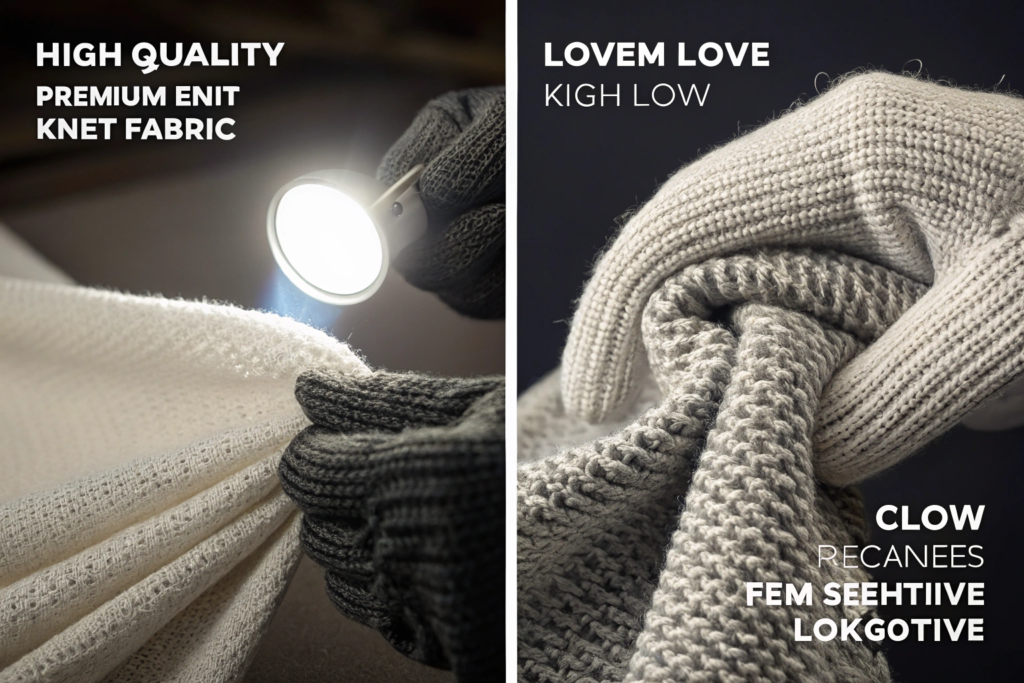
Hold the glove up to a light source. Can you see a lot of light passing through it? A dense, tight knit is a sign of quality. It means more yarn was used, which will result in a warmer, more durable glove. Now, stretch a section of the glove. A good quality knit will have excellent "recovery" and snap back to its original shape. A low-quality knit will feel loose and may stay stretched out, a phenomenon known as "growing." Also, look for consistency. Are there any visible lines, bands, or variations in the color? This can indicate inconsistent yarn tension during the knitting process, a hallmark of poor machine calibration.
What is "Pilling" and Why Should You Check for It?
Have you ever seen little fuzzy balls on the surface of a sweater? That's called "pilling." It happens when the short, loose fibers in a low-quality yarn rub together and get tangled. Vigorously rub a small, discreet area of the glove's fabric against itself for about 10 seconds. A high-quality yarn (like long-staple merino wool) will show very little or no pilling. A low-quality yarn will immediately start to look fuzzy and may form small pills. This is a quick and powerful test of the raw material's quality.
How Does Yarn Composition Affect Quality?
Should you look at the fiber content? Absolutely. A glove made from 100% acrylic will be cheap, but it won't be very breathable and may feel sweaty. A glove made with natural fibers like merino wool or cashmere will offer superior warmth, softness, and breathability. A blend that includes a small amount of nylon or spandex can be a good thing, as it adds durability and stretch, but a high percentage of cheap synthetics is often a red flag.
Why Are the Fingertips and Thumb Seams So Critical?
Where is a knitted glove most likely to fail? At the seams, especially at the fingertips. This is where the different parts of the glove are joined together, and it's a major indicator of the factory's skill level.
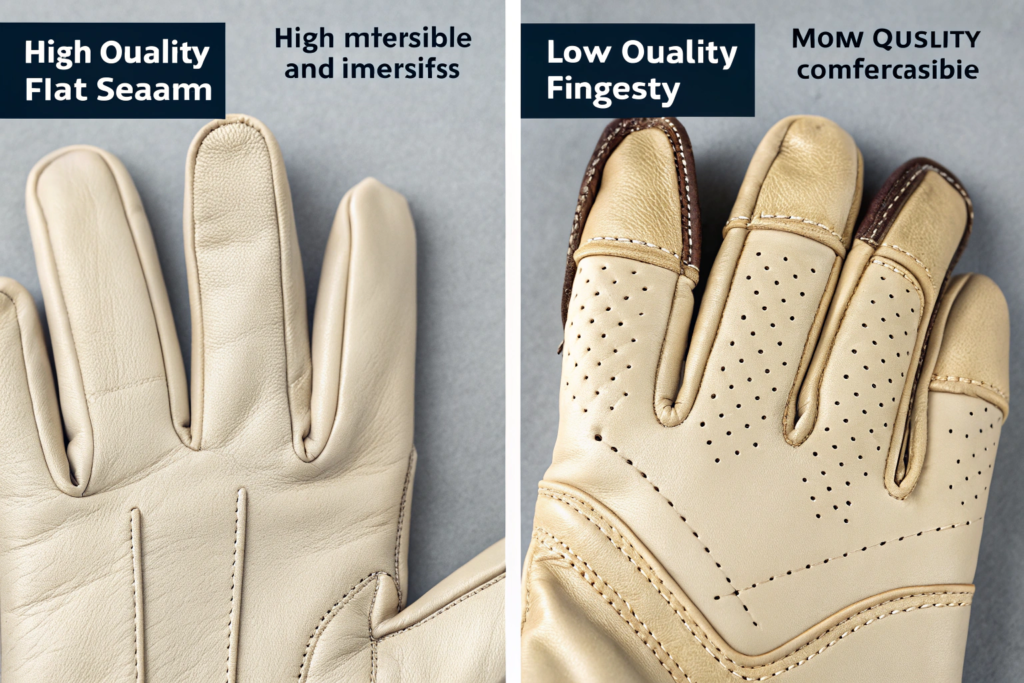
Turn the glove inside out. A high-quality glove will have very neat, flat, and minimal seams. The best gloves are often made on advanced, fully-fashioned knitting machines that can knit the fingers and thumb directly into the hand, resulting in very few, if any, bulky seams. This is called "integral knitting." A low-quality glove, on the other hand, will often have thick, bulky, and messy serged seams on the inside. These seams are not only uncomfortable, but they are also weak points that are prone to unraveling.
Now, look closely at the very tip of each finger. A well-made glove will have a smooth, rounded, and perfectly closed fingertip. A poorly made one will have a lumpy, square, or puckered tip where the seam was closed improperly. This is a tell-tale sign of sloppy craftsmanship.
What is the "Thumb Gusset" and Why Does it Matter?
What is the most complex part of a glove to construct? It's the thumb. The thumb needs to be able to move freely and in opposition to the fingers. A cheap glove will often have the thumb simply stitched onto the side of the hand as a separate tube. This is restrictive and uncomfortable. A high-quality glove will feature a "thumb gusset"—an extra, diamond-shaped piece of knitted fabric inserted at the base of the thumb. This gusset allows for a much greater and more natural range of motion. The presence of a well-integrated thumb gusset is a hallmark of a superior, thoughtfully designed glove.
How Can You Test Seam Strength?
Should you give the seams a gentle pull? Yes. Gently pull on the seams between the fingers. They should feel strong and secure, with no visible gaps or straining threads. If you can see the threads pulling apart under gentle pressure, you can be sure that seam will fail under the stress of daily wear.
How Can You Test the Fit and Elasticity of the Cuff?
What is the part of the glove that does the most work? It's the cuff. The cuff's job is to be stretchy enough to let your hand in easily, but also snug enough to stay in place and keep the cold air out. A poorly made cuff will either be too tight to be comfortable or so loose that it slides down constantly.
The cuff should be made in a rib knit structure (e.g., 1x1 or 2x2 rib), which has much more natural stretch and recovery than the plain knit of the glove's body. Stretch the cuff wide and then let it go. A high-quality cuff will snap back smartly to its original size. A low-quality cuff will feel limp and may stay partially stretched out. The length of the cuff is also a quality indicator. A longer cuff that can be tucked into a jacket sleeve offers better protection and is a sign of a more thoughtfully designed, premium glove.
What is the "Cast-Off Edge"?
What is the very last row of knitting on the cuff? This is called the "cast-off" or "bind-off" edge. This edge needs to have enough stretch to allow the cuff to open fully. A common defect in low-quality gloves is a cast-off edge that was made too tightly. You can test this easily: if the cuff fabric itself feels stretchy, but you feel a tight, un-stretchy "cord" right at the edge that prevents it from opening fully, the cast-off is defective. This will make the glove difficult to put on and take off.
How Should the Glove Fit Overall?
Is a good fit a sign of quality? Yes. Put the glove on. Do the fingers feel too long or too short? Is there a lot of extra, baggy material at the palm? High-quality gloves are knitted to an anatomical shape, providing a snug but comfortable fit. Low-quality gloves are often knitted as a simple, flat shape, resulting in a poor, baggy fit. This is especially important when sourcing from Chinese factories, as sizing must be clearly specified for your target market.
How Should You Check the Finishing and Embellishments?
What are the final details that separate a premium product from a cheap one? It's the finishing. This includes any logos, decorative elements, and special features like "tech-friendly" fingertips.
If the glove has an embroidered logo, is it neat and dense? If it has a leather or suede patch, is it stitched on securely with even stitches? Are there any loose threads anywhere on the glove? A high-quality factory will have a dedicated finishing department responsible for trimming all loose threads and performing a final visual inspection. Loose threads are a classic sign of a rushed, low-quality operation.
If the gloves are advertised as being "touchscreen compatible," you must test this feature thoroughly. Try to type a message on your phone. Does it work consistently on all the designated fingers? Is the conductive thread neatly integrated, or is it a sloppy, visible patch? Poorly executed tech tips that don't work are a common customer complaint and a major quality failure.

What About Paired and Sized Gloves?
How should a pair of gloves be presented? A professional factory will ensure that the two gloves in a pair are a perfect match in size, shape, and color. Hold the left and right gloves up against each other. Are they identical? It's a surprising but common defect in low-quality production for there to be slight size or color differences between the two hands. They should also be neatly tagged or joined together.
Why is a Final "Smell Test" Important?
Can a glove's smell indicate a problem? Yes. A high-quality knitted glove should smell neutral or have the faint, natural scent of its fiber (like wool). If the glove has a strong chemical, oily, or musty smell, it's a major red flag. This can indicate the use of low-quality dyes, harsh finishing chemicals, or improper storage in a damp warehouse, which can lead to mildew. This is a final, important sensory check.
Conclusion
So, how do you spot the quality issues in a knitted glove? Is it a matter of guesswork? No. It is a systematic, four-point inspection.
It's about analyzing the knit fabric for its density and resilience. It's about a forensic examination of the seams and fingertips, the most common points of failure. It's about testing the cuff for that perfect balance of stretch and security. And it's about scrutinizing the final finishing details that signal true craftsmanship.
By learning to see a glove not just as a shape, but as a collection of these critical details, you can protect your brand from quality issues, ensure your customers receive a product they will love, and build a reputation for excellence.
If you are looking for a manufacturing partner who obsesses over these details as much as you do, we are ready to show you the difference that a commitment to quality makes. Please contact our Business Director, Elaine, at her email: elaine@fumaoclothing.com.