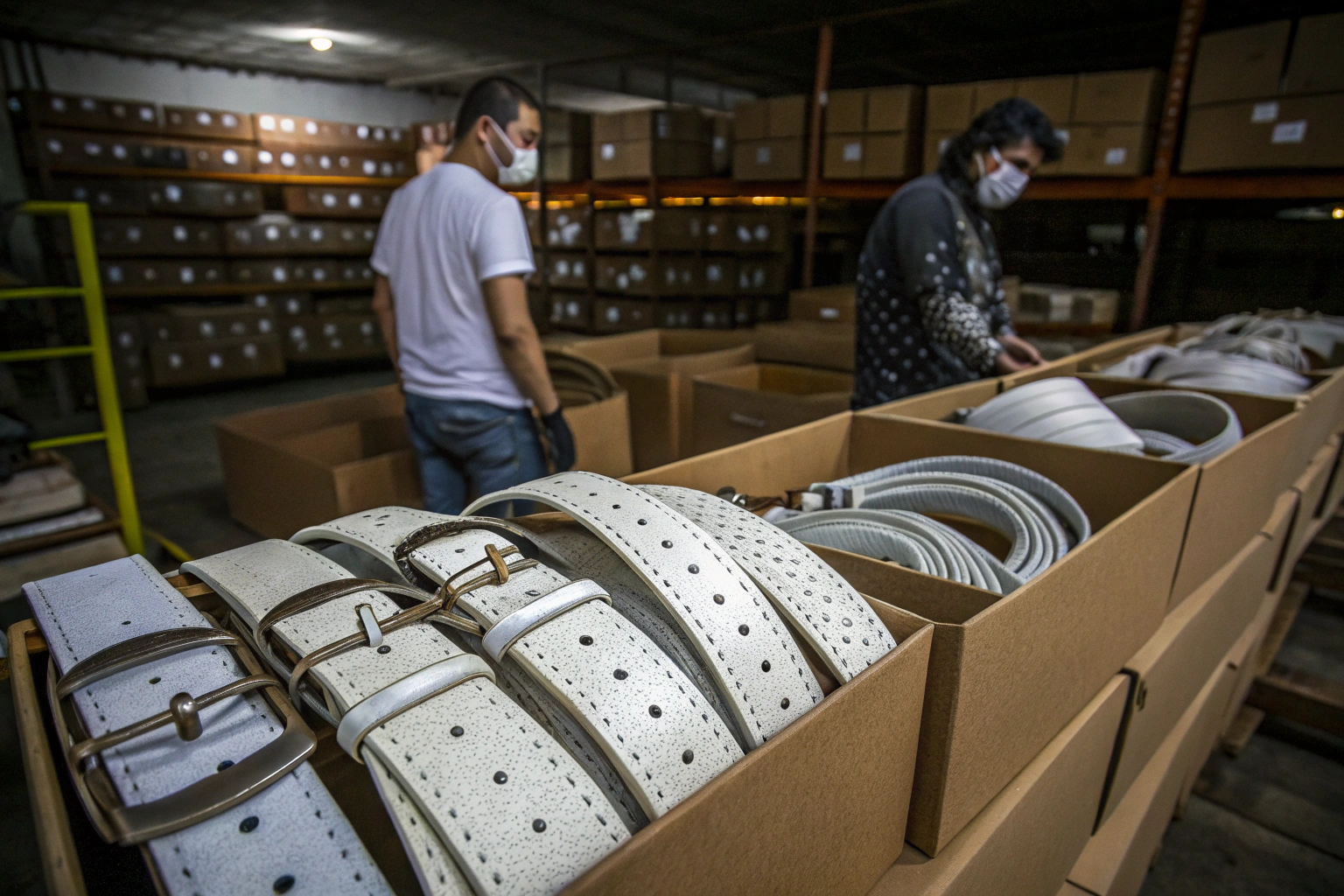
A buyer from a premium German leather goods brand called me three summers ago in a state of controlled panic. A shipment of 2,000 vegetable-tanned leather belts had just arrived at his Hamburg warehouse after a six-week journey from China. The container had traveled through the South China Sea, across the Indian Ocean, through the Suez Canal, and into the Mediterranean during July and August, some of the hottest, most humid months of the year. When his warehouse team opened the cartons, the smell hit them first. A musty, sour odor that made several workers step back. Then they saw the damage. A fine white-gray powder coated the surface of dozens of belts. Some belts had dark, speckled spots that had permanently stained the leather. The entire shipment was a loss. He had not insured against mildew, assuming it was a rare occurrence. It cost his brand nearly forty thousand euros and a season’s worth of inventory. That was when he called me, not to claim responsibility, his belts had not come from our factory, but to ask how we prevent this from ever happening to our clients.
To avoid mildew on leather belts during long sea freight to Europe, you must control the moisture exposure at every stage of the journey. This begins with ensuring the leather has a moisture content below 14 percent at the time of packing, measured with a calibrated leather moisture meter. The belts must be packed in breathable materials, never in sealed plastic bags that trap humidity, and the cartons must include desiccant packs that absorb ambient moisture. The shipping container must be inspected for leaks, condensation, and residual odors before loading. During transit, the container must be protected from the extreme temperature swings that cause container rain, the internal condensation that forms when warm, humid air cools against the container walls. Finally, the belts must never be stored in a container on a hot dock for extended periods before shipping, as this creates a greenhouse effect that incubates mold spores. The key is to treat mildew not as a single problem but as a chain of conditions, and to break the chain at every possible link.
Mildew on leather is a disaster that unfolds in slow motion. The belts leave our factory in perfect condition. They look beautiful, smell like quality leather, and are packed with care. Somewhere during the weeks at sea, invisible mold spores, which are present everywhere in the environment, find the right combination of moisture, warmth, and a food source, the leather itself. They germinate, grow, and destroy the product. At AceAccessory, we ship leather belts and other leather accessories to European brands every month, and we have developed a comprehensive anti-mildew protocol based on years of experience, consultation with leather chemists, and feedback from our logistics partners. Let me walk you through exactly how we prevent mildew and how you can ensure your leather belts arrive in Europe as pristine as they left our factory.
What Causes Mildew on Leather During Ocean Freight
Mildew is a living organism. It is a type of fungus that thrives in warm, humid environments and feeds on organic materials. Leather, being an organic material made from animal hide, is a perfect food source. The mold spores that cause mildew are everywhere, in the air, on surfaces, on the leather itself. They are harmless in their dormant state. They only become a problem when three conditions align. Moisture, warmth, and a food source. Remove any one of these three conditions, and mildew cannot grow. The challenge of ocean freight is that all three conditions are often present simultaneously, and the long transit time gives the mildew plenty of opportunity to establish itself.
Mildew on leather belts during ocean freight is caused by a combination of residual moisture in the leather, high humidity inside the shipping container, and temperature fluctuations that create condensation. The moisture content of the leather at the time of packing is the foundational risk factor. Vegetable-tanned leather, in particular, is hygroscopic, meaning it readily absorbs moisture from the air. If the leather’s moisture content is above 14 percent when packed, there is already enough water present to support mold growth. The relative humidity inside a shipping container on a tropical sea route can reach 90 percent or higher. This moisture saturates the air and is absorbed by the leather, the cardboard cartons, and the wooden pallets. The temperature inside a container sitting on a dock in a port like Singapore or Shanghai in summer can reach 60 degrees Celsius or more. When night falls, the container walls cool rapidly, but the air inside remains warm and moist. The moisture condenses on the cool metal walls and ceiling, forming droplets of water that can drip down onto the cargo below. This is called container rain, and it is one of the most destructive forces in ocean freight. The warm, humid, stagnant air inside a sealed container is the perfect incubator for mildew.
Understanding these causes is the first step to prevention. If you know where the moisture comes from, you can stop it at the source. If you know how temperature swings create condensation, you can insulate against them. Let me explain the two most critical factors in detail.
How Does Container Rain Create a Breeding Ground for Mold?
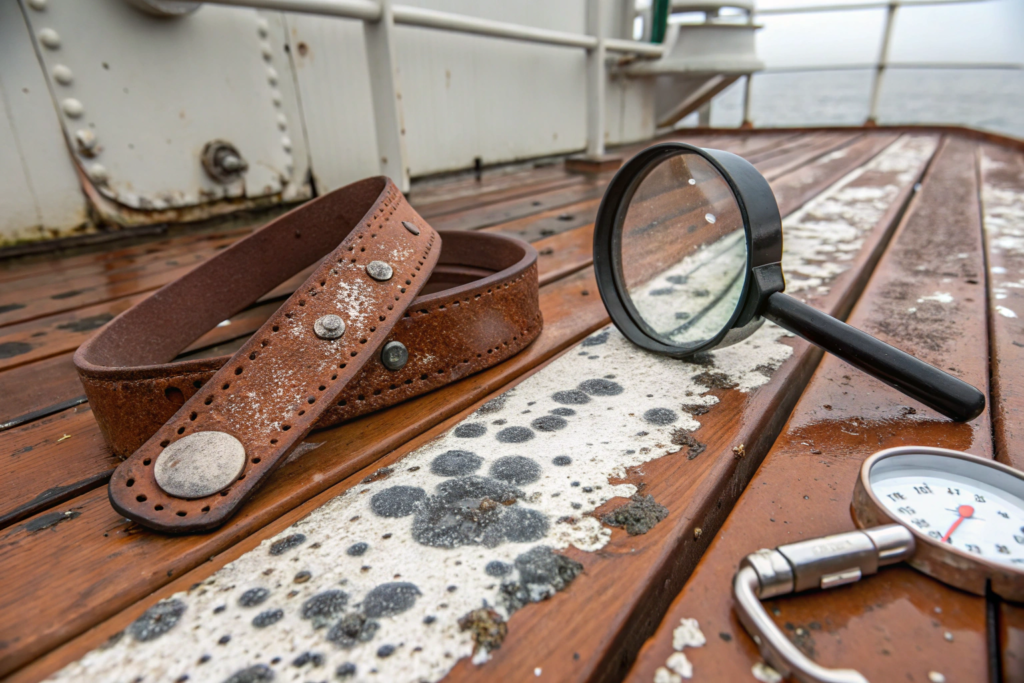
Container rain is a phenomenon that most people outside the logistics industry have never heard of, but it is responsible for a significant percentage of cargo damage in ocean freight. The mechanism is simple physics. Warm air can hold more moisture than cold air. When a container is loaded in a hot, humid port, the air trapped inside is warm and saturated with water vapor. As the ship travels across the ocean, the external temperature fluctuates. At night, or when the ship moves into cooler waters, the container walls and roof cool down. The air inside, in contact with the cool metal surface, also cools. As the air cools, its ability to hold moisture decreases. The water vapor reaches its dew point and condenses into liquid water on the coolest surfaces, typically the container ceiling and the upper walls. This condensation forms droplets. When enough droplets accumulate, they fall. This is container rain. The water drips down onto the top layer of cargo. If the cargo is a stack of cartons containing leather belts, the top cartons get wet. The water soaks into the cardboard, which wicks the moisture throughout the carton. The leather belts inside, already packed in a dark, warm environment, are now damp. The dormant mold spores on the leather spring to life. Within days, visible mildew colonies form. Container rain is most severe during voyages that cross multiple climate zones, like the route from China to Europe, where the container experiences tropical heat, temperate coolness, and everything in between. It is also severe in containers that sit on docks for extended periods before being loaded onto the ship. A container sitting on the dock in Shanghai in August is essentially a metal greenhouse. The internal temperature soars. Any moisture in the cargo, the pallets, or the air is driven out and becomes available for condensation when the temperature drops.
Why Does Leather Moisture Content Before Packing Matter?
The moisture content of the leather at the moment it is packed into the carton is the single most controllable risk factor in the entire anti-mildew chain. Leather is not a dry material. It contains water, both chemically bound within the collagen structure and physically held within the fiber network. The moisture content of properly conditioned leather should be between 10 and 14 percent by weight. Below 10 percent, the leather becomes brittle and prone to cracking. Above 14 percent, the leather enters a danger zone where mold spores can germinate. The moisture content is measured using a leather moisture meter, a handheld device with two pin probes that are pressed into the leather surface. The meter passes a small electrical current between the probes and measures the resistance, which correlates to moisture content. A measurement above 14 percent is a red flag. The leather should not be packed until it has been dried to a safe level. Vegetable-tanned leather is particularly susceptible to high moisture content because the tanning process itself uses water-based solutions, and the leather retains a natural affinity for moisture. If the leather is finished and packed too quickly after the final wet processing step, without adequate drying and conditioning time, it will carry excessive residual moisture into the carton. This trapped moisture is sealed in with the leather when the carton is closed. During the ocean voyage, the temperature inside the carton rises. The moisture is driven out of the leather and into the air inside the carton. If the carton is sealed in plastic or tightly wrapped, the moisture has nowhere to go. It saturates the air, condenses, and creates a micro-environment of extremely high humidity around the belts. Mildew follows inevitably. The solution is to measure the moisture content of every production batch before packing, using a calibrated meter, and to record the measurements in the QC report. If the moisture content is above 14 percent, the belts are moved to a drying room with controlled temperature and air circulation until the measurement drops into the safe zone.
What Pre-Shipping Treatments Prevent Leather Mildew
Prevention begins in the factory, long before the container is loaded. The treatments applied to the leather before packing are the first line of defense against mildew. These treatments fall into two categories. Controlling the leather’s inherent moisture content, and applying protective agents that inhibit mold growth. The most effective approach combines both. The leather must be dry enough that it does not provide the water needed for mold growth. And it should carry a mild, leather-safe anti-fungal agent that prevents any spores that are present from germinating, even if conditions become temporarily humid during transit.
Effective pre-shipping treatments to prevent mildew on leather belts include conditioning the leather to a moisture content between 10 and 12 percent, the sweet spot that prevents brittleness while denying mold the water it needs to grow. Applying a leather-safe anti-mildew agent, typically a formulation containing a mild fungistatic compound that is specifically designed for use on finished leather goods and does not discolor, stiffen, or create an oily residue on the leather surface. Using anti-mildew paper or anti-mildew chips inside each carton. These products are infused with volatile corrosion inhibitors or fungistatic compounds that slowly release a vapor that fills the enclosed space of the carton and prevents mold spore germination on the leather surface. Ensuring that the packing materials themselves are dry and mold-free. Cardboard cartons can carry mold spores and can absorb moisture during storage. Cartons should be stored in a dry, climate-controlled area before use, and should be inspected for any signs of dampness or pre-existing mold. Finally, performing a final moisture check immediately before the carton is sealed, using a moisture meter, and recording the reading on the QC checklist for that production batch.
These treatments work together as a system. The dry leather is the foundation. The anti-mildew agent is the active protector. The anti-mildew paper or chips provide ongoing protection during the voyage. The dry carton is the clean container. Together, they create an environment inside the carton that is hostile to mold. Let me explain the two most important treatments in detail.
What Anti-Mildew Agents Are Safe for Finished Leather Belts?
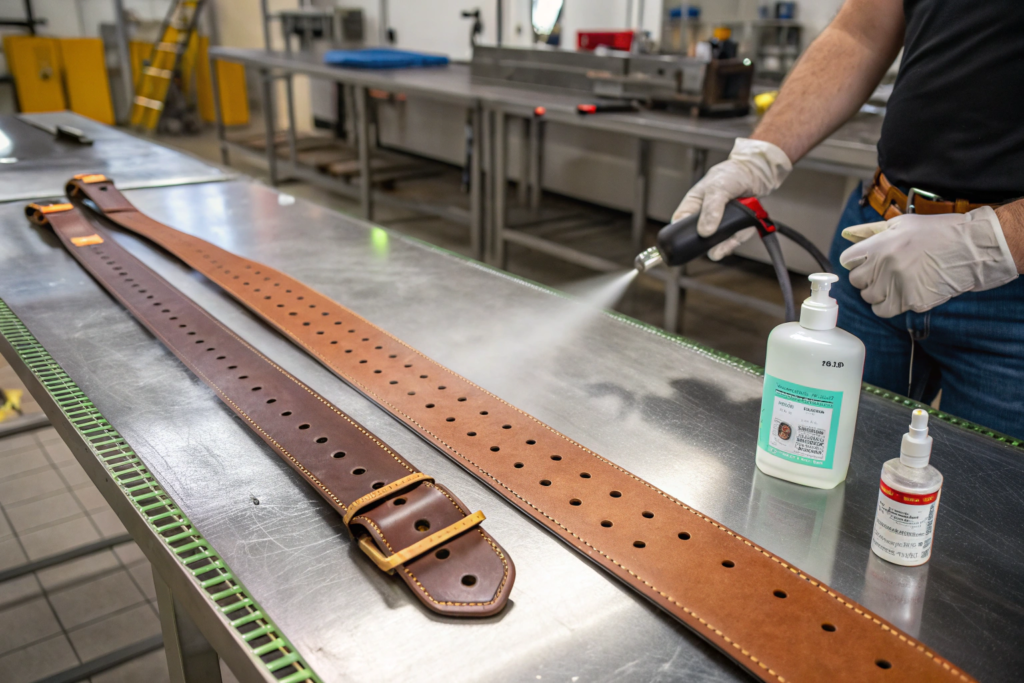
Not all anti-mildew chemicals are suitable for finished leather goods. Leather is porous, sensitive, and reactive. Harsh chemicals can discolor the leather, strip the finish, cause cracking, or leave an oily residue that attracts dirt. The anti-mildew agents we use on leather belts are specifically formulated for finished leather products. They are typically water-based solutions containing a quaternary ammonium compound or a phenolic derivative at a very low concentration, usually less than 1 percent active ingredient. These compounds are fungistatic, meaning they prevent mold spores from germinating rather than killing mature mold. They are applied as a fine mist or wiped on with a soft cloth as part of the final finishing process. The agent is absorbed into the leather surface, where it remains as a protective barrier. It is invisible, odorless once dry, and does not affect the leather’s color, sheen, or hand feel. The application must be even and light. Over-application can cause a slight surface residue or a change in the leather’s absorbency. We test every new batch of anti-mildew agent on a sample belt before using it in production. The test belt is treated, allowed to dry for 24 hours, and then inspected for any visual change, any odor, and any change in the leather’s flexibility. It is also subjected to an accelerated aging test, where it is placed in a humidity chamber at 35 degrees Celsius and 90 percent relative humidity for 72 hours. If the treated belt shows no mildew growth while an untreated control belt does, the agent is effective and safe. For clients who prefer to avoid chemical treatments entirely, we offer an alternative approach using microcrystalline wax. The wax is applied as a thin, even coating that seals the leather surface and creates a physical barrier against moisture absorption. The wax also gives the leather a subtle, desirable sheen and a slightly stiffer hand. This is a natural, mechanical protection rather than a chemical one.
How Do Desiccant Packs Work Inside Leather Goods Cartons?
Desiccant packs are the unsung heroes of moisture control. They are small packets filled with a material that actively absorbs water vapor from the surrounding air. The most common desiccant materials are silica gel, a porous form of silicon dioxide, and clay, a naturally occurring mineral with a high surface area. Both work by the same principle. The desiccant material has a strong affinity for water molecules. Water vapor in the air inside the carton is attracted to the desiccant surface and held there through physical adsorption. The desiccant pack effectively lowers the relative humidity inside the carton. For leather belts, we use silica gel desiccant packs because silica gel has a higher moisture absorption capacity than clay and can maintain a very low relative humidity, below 40 percent, which is well below the threshold at which mold can grow. The amount of desiccant needed depends on the volume of the carton, the expected humidity exposure, and the duration of the voyage. We calculate the required desiccant quantity using a standard formula based on the carton volume and the expected maximum humidity. A typical carton of leather belts will contain one 50-gram desiccant pack for a small carton of 0.05 cubic meters, or multiple packs for larger cartons. The desiccant packs are placed inside the carton, not just tossed on top. They are typically placed in a small breathable pouch or simply laid between the belts where they have maximum air exposure. The desiccant packs we use are dustless and are wrapped in a durable, non-woven fabric that does not shed fibers onto the leather. They are food-grade safe, though that is not a requirement for leather goods. An important detail that many people overlook is that the desiccant packs themselves must be dry when they are placed in the carton. Desiccant packs that have been sitting in a humid factory environment for days before use may already be saturated and useless. We store our desiccant inventory in a sealed, climate-controlled cabinet. Packs are removed only immediately before being placed into the carton. The carton is then sealed immediately to prevent the desiccant from absorbing ambient factory humidity.
What Packing Methods Protect Leather During Long Sea Voyages
The way leather belts are packed is as important as how they are treated. Even perfectly dry, anti-mildew treated belts can be ruined by poor packing that traps moisture, introduces mold spores, or fails to protect against physical damage that can create entry points for moisture. The packing system must balance two competing needs. The belts must be protected from physical damage, crushing, and abrasion. And they must be able to breathe. Sealing leather in an airtight, non-breathable package creates a micro-environment where any residual moisture is trapped and concentrated. The packing method must allow for gradual air exchange while still providing physical protection.
The optimal packing method for leather belts during long sea freight uses a layered, breathable system. Each belt is individually wrapped in uncoated, breathable kraft paper or acid-free tissue paper. This prevents the belts from rubbing against each other during transit vibrations, which can cause surface abrasion, and it provides a first layer of moisture absorption. The wrapped belts are placed in a corrugated cardboard carton that is sturdy enough to withstand stacking, with a recommended double-wall construction for heavy belts. The carton is not lined with plastic. Plastic lining traps moisture. Instead, the carton is lined with a sheet of anti-mildew paper or a breathable, fungistatic-treated paper. Desiccant packs are placed inside the carton, and the carton is sealed with paper-based packing tape, not plastic tape, to allow the carton to breathe slightly. The cartons are then stacked on wooden pallets that have been heat-treated to ISPM 15 standards to kill any pests or mold in the wood. The pallet is wrapped not in plastic stretch wrap, which traps moisture, but in a breathable pallet wrap or secured with fabric straps. The goal is to create a system that is physically protective but not hermetically sealed.
This packing protocol is based on the principle that moisture management is more effective than moisture sealing. A breathable package allows any moisture that does enter the carton to gradually escape, rather than being trapped and concentrated. Let me explore the two most critical packing decisions.
Should Leather Belts Be Wrapped in Plastic or Breathable Paper?
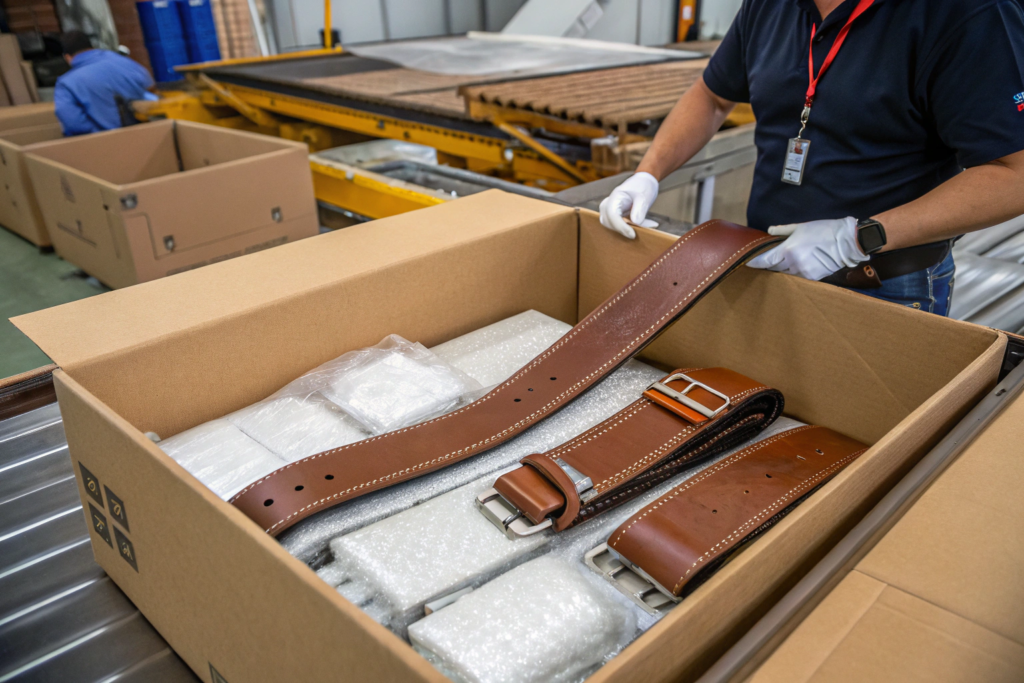
This is the most common mistake I see in leather goods packing, and the answer is definitive. Leather belts should never be wrapped in sealed plastic bags for ocean freight. The temptation to use plastic is understandable. Plastic is cheap, clear so the product is visible, and seems protective. But plastic is also impermeable to water vapor. If the leather belt has even a slightly elevated moisture content when it is sealed in a plastic bag, or if the ambient air trapped inside the bag is humid, the moisture has no escape route. During the ocean voyage, the temperature rises, the moisture is driven out, and it condenses on the inside of the plastic bag. The belt sits in a miniature sauna for weeks. Mildew is virtually guaranteed. Breathable paper, such as uncoated kraft paper or acid-free tissue paper, solves this problem. Paper is a natural material made of cellulose fibers. It is porous at a microscopic level. Water vapor can pass through paper. The paper absorbs some moisture from the belt, wicking it away from the leather surface, and then releases that moisture gradually into the air inside the carton, where the desiccant packs absorb it. Paper also provides excellent physical protection. It is soft and non-abrasive. It prevents the belts from rubbing against each other. If a belt buckle is present, the paper is wrapped around the buckle separately to prevent it from scratching the leather of adjacent belts. The paper we use is specifically chosen to be lignin-free and acid-free. Lignin, a component of wood pulp, can break down over time and release acidic compounds that can discolor leather. Acid-free paper is chemically stable and will not interact with the leather. Some clients prefer to use a lightweight, breathable cotton or non-woven fabric bag instead of paper for a more premium presentation. This is acceptable as long as the fabric is uncoated, breathable, and made from natural or pH-neutral synthetic fibers. The key principle is the same. The wrapping material must allow moisture vapor to pass through.
What Carton Sealing Methods Prevent Moisture Ingress?
The carton is the outer fortress. It must be strong enough to survive the stacking, shifting, and vibration of ocean freight. But it must also be sealed in a way that prevents liquid water from entering while allowing water vapor to escape. The carton flaps are the primary entry point for liquid water. If a container rain event occurs, water dripping from the container ceiling will land on the top of the carton. If the carton flaps have gaps or are poorly sealed, water can seep through the gaps and into the carton. The carton flaps should be fully closed, with no gaps. The center seam where the two outer flaps meet should be tight. We use a paper-based, water-activated reinforced packing tape to seal the center seam and the edge seams. Paper tape forms a strong bond with the cardboard that is difficult to break. Unlike plastic pressure-sensitive tape, which can peel off in hot, humid conditions, paper tape bonds more tightly as it absorbs moisture from the air. It also allows some vapor transmission. The tape is applied along the full length of every seam, not just a short strip in the center. For extra protection against liquid water from above, the top of the carton can be covered with a loose sheet of corrugated cardboard or a simple water-resistant but breathable topper before the carton flaps are closed. This sacrificial layer absorbs any small amount of water that enters through the flap gaps and prevents it from reaching the belts. The cartons are palletized, and the pallet is topped with a rigid pallet lid or a sheet of corrugated cardboard to deflect any dripping water. The pallet is wrapped with a breathable pallet net or secured with fabric straps. We do not use plastic stretch wrap to wrap the entire pallet. Plastic stretch wrap creates a sealed environment around the pallet that traps moisture. If the cartons or the pallet wood contain any residual moisture, the stretch wrap holds that moisture inside, creating a humid micro-environment. Breathable pallet wrapping, or no wrapping at all with a pallet lid for water protection, is the preferred method for leather goods.
What Container Loading Practices Reduce Mildew Risk
The shipping container is the macro-environment that contains the cartons for the entire voyage. Its condition, its loading, and its positioning on the ship all affect the micro-environment inside the cartons. A container with a small leak in the roof can flood the cargo during a rainstorm at the port. A container loaded with wet wooden pallets can humidify the entire interior. A container stowed on the deck in direct sunlight can experience extreme internal temperatures. Controlling these macro-level factors is the final and often overlooked link in the anti-mildew chain.
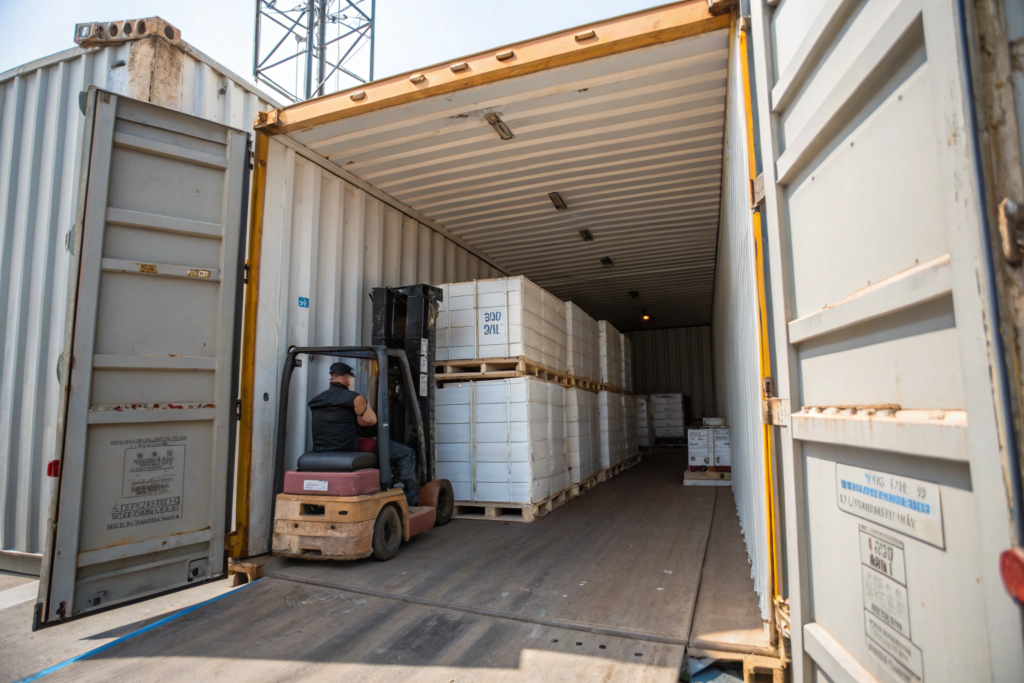
Container loading practices that reduce mildew risk on leather belts begin with a pre-loading container inspection. The container must be checked for structural integrity. The roof must have no holes, no rust perforations, and no gaps where light is visible. The doors must seal tightly, with intact rubber gaskets. The floor must be clean, dry, and free of any debris, oil, or chemical residues. The container should be sniffed for any musty or moldy odors. If the container smells, it should be rejected and replaced. The container should be loaded under cover whenever possible, not in the rain or high humidity. If loading must occur outdoors, it should be done quickly, and the doors should be closed immediately. Desiccant poles, also called container desiccants, should be mounted on the container walls. These are large, specially designed desiccant packs that absorb moisture from the container air during the voyage. A standard 40-foot container requires 8 to 12 desiccant poles, mounted on the corrugated wall ribs. The pallets should be loaded with air gaps between them and the container walls to allow air circulation. The cargo should not be loaded directly against the container walls, especially the side walls that experience the most temperature fluctuation and condensation. Finally, the container should be sealed immediately after loading and the seal number recorded.
The container is not just a box. It is a climate chamber that travels through multiple climate zones. Managing the internal climate of the container is the final and most challenging step. Let me explain the two most important container-level interventions.
How Should Containers Be Inspected Before Loading Leather Goods?
The pre-loading container inspection is a ten-minute process that can save thousands of dollars in cargo damage. The inspection begins on the outside. The inspector walks around the container, looking for any visible damage. Dents, punctures, rust spots, or areas where the metal is deformed. The roof is particularly important. The inspector should climb up or view the roof from an elevated position, checking for holes, rust, and standing water. The door gaskets are checked. The rubber seals around the doors must be intact, flexible, and free of cuts or gaps. A damaged gasket allows water to enter during rain or sea spray. The inspector then enters the container and closes the doors. In the darkness, any holes or gaps in the roof or walls will be visible as pinpoints of light. The light test is the most reliable way to find small perforations that are invisible in normal lighting. The inspector then checks the floor. The wooden floor should be dry to the touch. A moisture meter can be used for a quantitative check. The floor should have no stains, no oil spots, and no chemical residues. The inspector smells the interior. A musty, sour, or chemical odor indicates previous contamination. The container should smell neutral or faintly of wood. If the container fails any of these checks, it is rejected. We provide our container inspection checklist to the freight forwarder and require that it be completed and photographed for every shipment. The completed checklist is included in the shipping documentation.
What Role Do Container Desiccants Play on Long Voyages?
Container desiccants are the large-scale version of the desiccant packs inside the cartons. They are designed to absorb moisture from the air inside the entire container over the course of a multi-week ocean voyage. The most common type is the desiccant pole, a long fabric tube filled with calcium chloride or silica gel, with a hook or adhesive strip for mounting on the container wall ribs. Calcium chloride desiccants are particularly effective for ocean freight because calcium chloride can absorb up to 300 percent of its weight in moisture, and it continues to absorb even at very high humidity levels. The desiccant poles are mounted vertically on the container walls, typically two to three poles per 20-foot container and six to eight poles per 40-foot container. They are placed on the upper portion of the walls, near the ceiling, where the warm, moist air rises and where container rain condensation is most likely to form. As the container heats and cools during the voyage, the desiccant poles actively pull moisture from the air. The absorbed moisture is trapped in the desiccant material, usually turning into a gel so it does not leak. By the end of the voyage, the desiccant poles will be noticeably heavier and may feel sloshy with trapped water. This water was prevented from condensing on the container ceiling and dripping onto the cargo. The use of container desiccants is one of the most cost-effective insurance policies for moisture-sensitive cargo. A set of desiccant poles for a 40-foot container costs a modest amount compared to the value of the cargo. We include container desiccants as a standard part of our shipping protocol for all leather goods shipments to Europe. We also specify to the freight forwarder that the desiccants must be fresh, from a recently manufactured batch, and must be mounted correctly. Desiccant poles that have been sitting in a humid warehouse for months before use will have already absorbed significant moisture and will have reduced effectiveness. The manufacturing date is printed on each pole, and we require that the poles be within three months of their manufacture date.
Conclusion
Preventing mildew on leather belts during long sea freight to Europe is a battle fought on multiple fronts. The enemy is moisture, in all its forms. Residual moisture in the leather. Humidity in the air. Condensation on container walls. Dampness in packaging materials. Each source of moisture is a link in a chain that leads to mold growth, and the chain must be broken at every link. We have explored the science of container rain, the phenomenon that turns a metal shipping container into a condensation chamber. We have examined the critical importance of measuring leather moisture content before packing, with a calibrated meter, and ensuring it is below 14 percent. We have detailed the pre-shipping treatments, anti-mildew agents, desiccant packs, and anti-mildew paper, that create a hostile environment for mold spores inside the carton. We have discussed the packing methods, breathable paper over sealed plastic, paper tape over plastic tape, that allow moisture to escape rather than trapping it. And we have covered the container loading practices, pre-loading inspections, container desiccants, and proper stowage, that manage the macro-environment of the voyage itself.
At AceAccessory, we have integrated all of these practices into a standard operating procedure for every leather belt shipment to Europe. Our QC team measures leather moisture content at the finishing stage and again at the packing stage. Our packing team uses breathable paper, anti-mildew paper, and calibrated amounts of desiccant in every carton. Our logistics team specifies container desiccants, requires container inspection photographs, and works only with freight forwarders who understand the requirements of moisture-sensitive cargo. We have shipped thousands of leather belts to European brands in every season, through every ocean route, and we have a proven track record of mildew-free delivery. The protocols we have developed are available to every client, and we are transparent about our methods.
If you are sourcing leather belts, or any leather accessories, and you want a manufacturing partner who treats mildew prevention as an integral part of production quality, I invite you to contact us. Reach out to our Business Director, Elaine, at elaine@fumaoclothing.com. Tell her about your product, your destination, and any moisture-related issues you have experienced in the past. She can provide samples of our leather belts, share our detailed anti-mildew packing specifications, and provide a quotation for a production run that includes full moisture protection. Let us ensure your leather belts arrive in Europe as beautiful as the day they left our factory, with the rich smell of quality leather, not the sour odor of mildew.