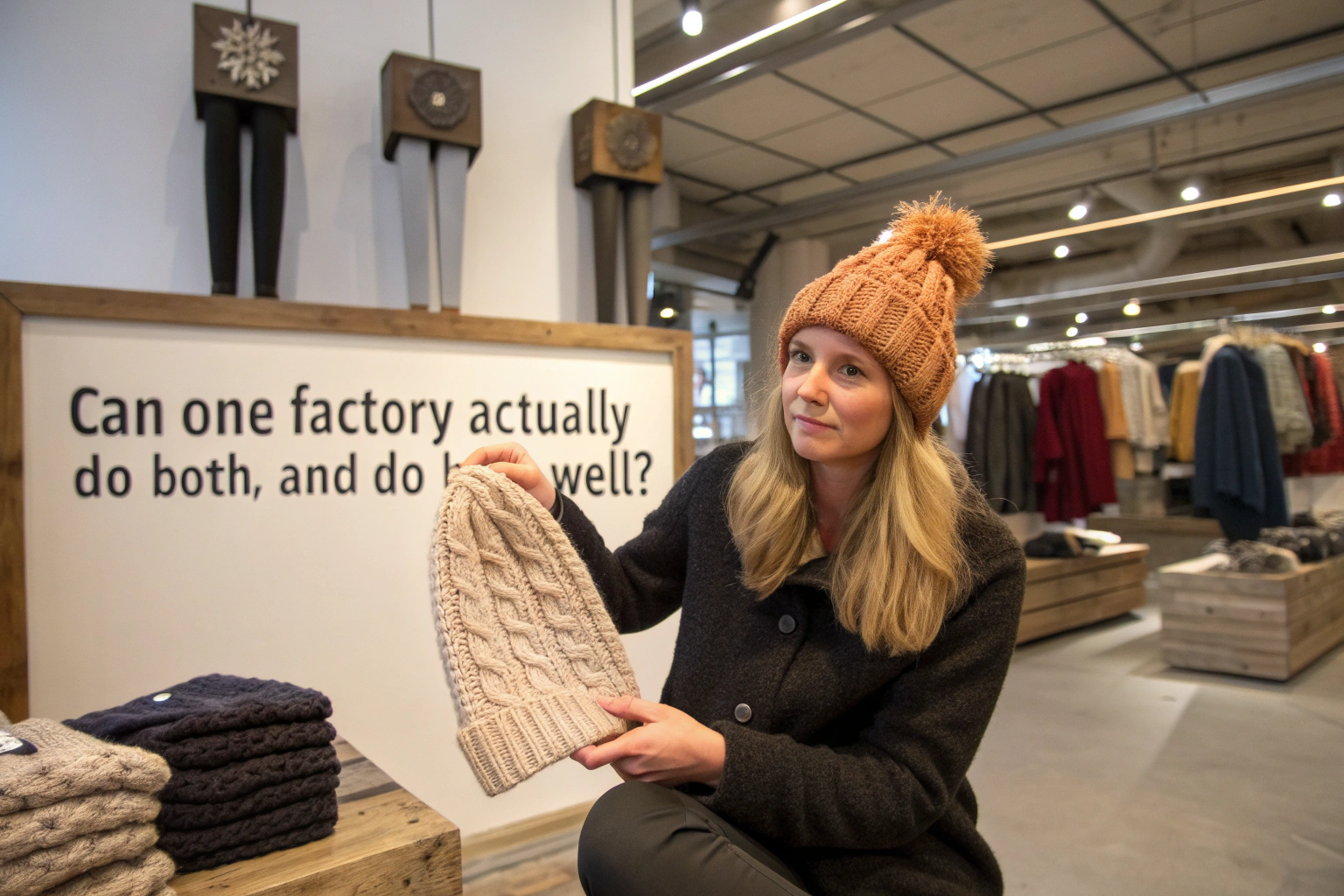
A buyer from a Scandinavian sustainable fashion brand sat in my showroom last winter, holding two beanie samples in her hands. In her left hand was a finely knitted merino wool beanie with a ribbed cuff, sleek, smooth, and technical. In her right hand was a chunky, hand-crocheted beanie with a beautiful textured stitch pattern, warm, rustic, and artisanal. She needed both styles for her winter collection. The knitted beanie was her volume seller, the product that paid the bills. The crochet beanie was her statement piece, the product that generated the Instagram buzz and the editorial features. She had been sourcing the two beanies from two different factories for three years. The logistics were a nightmare. Separate communications, separate minimum orders, separate shipping schedules, separate quality standards. She looked at me and asked the question that had been frustrating her for years. "Can one factory actually do both, and do both well?"
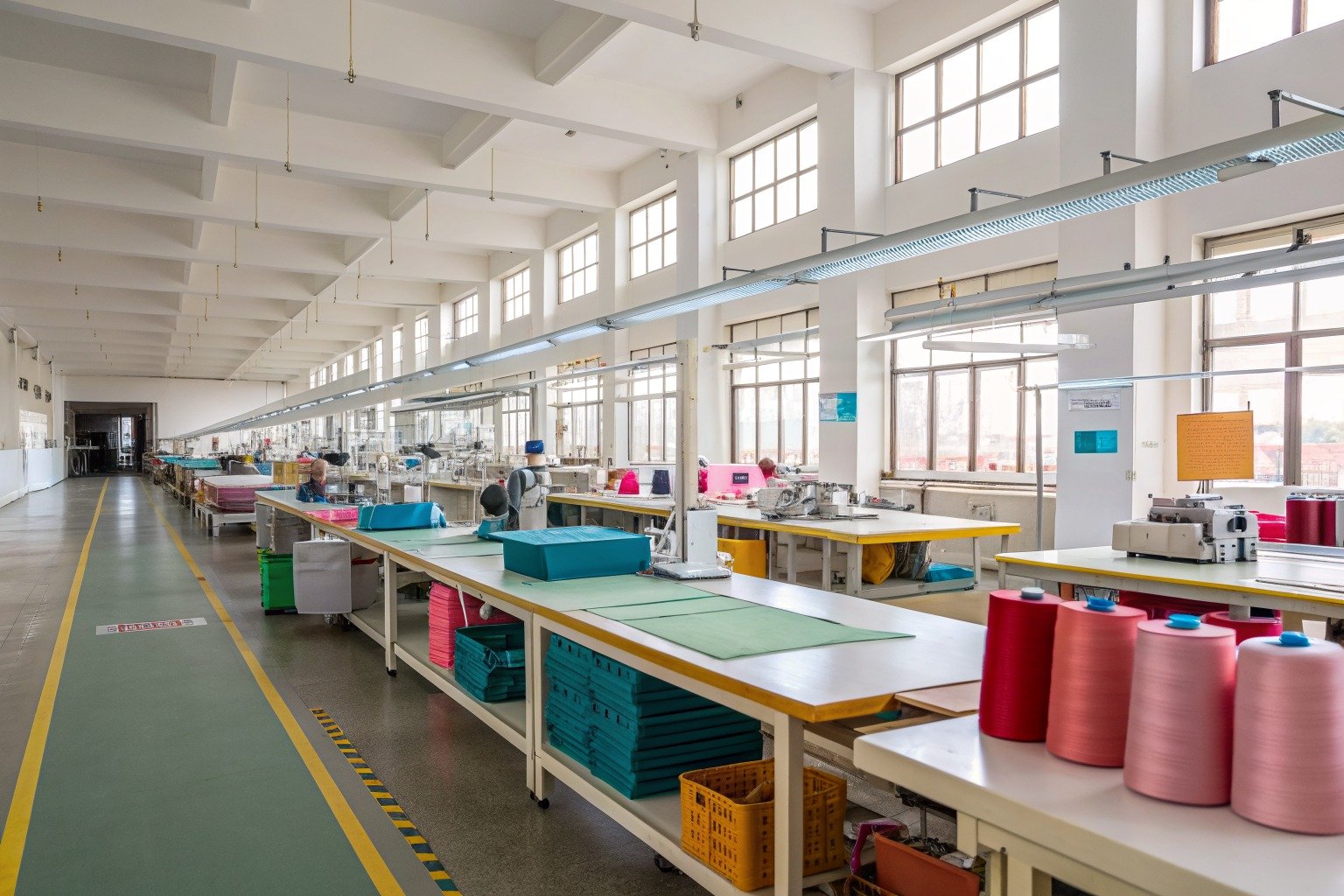
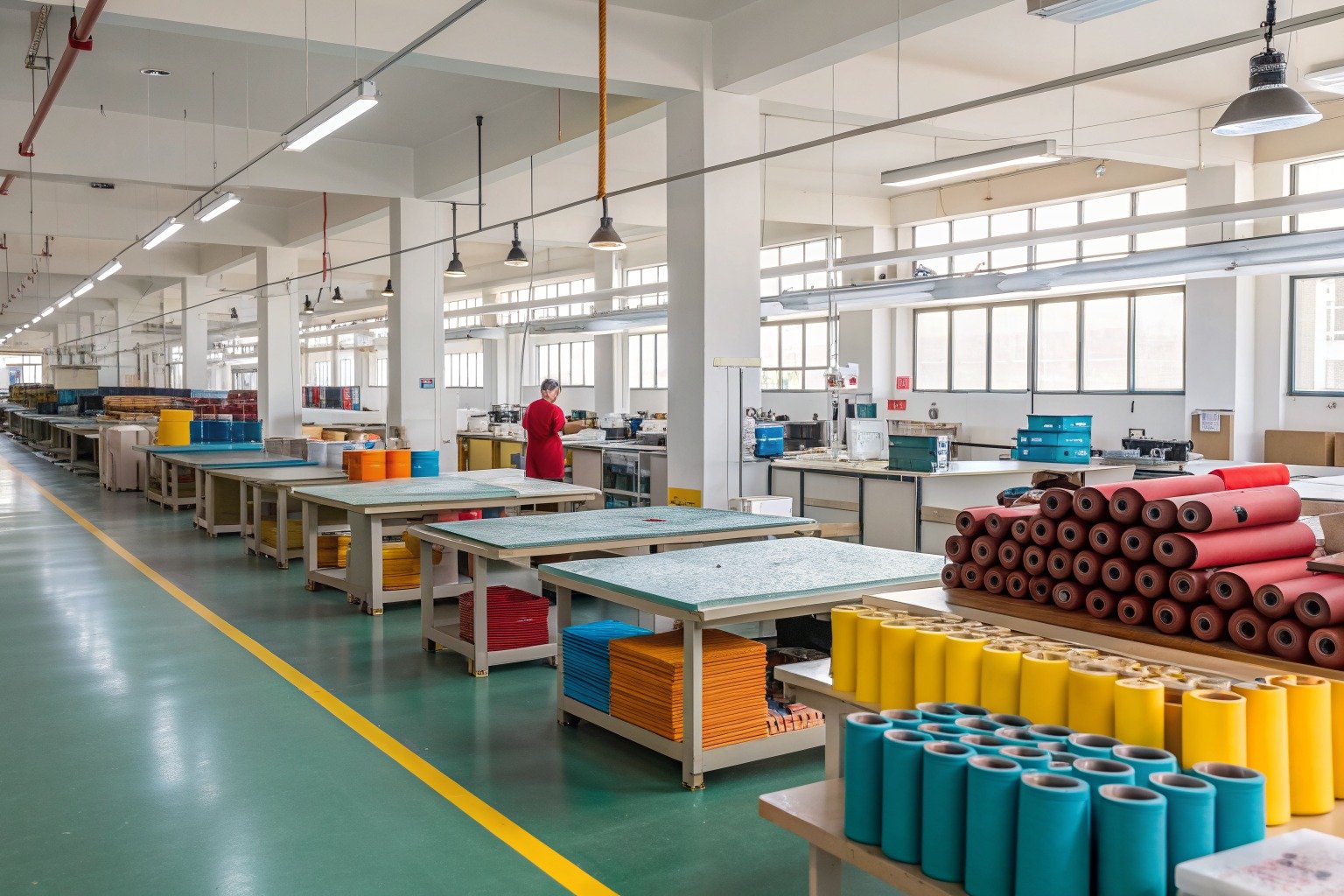
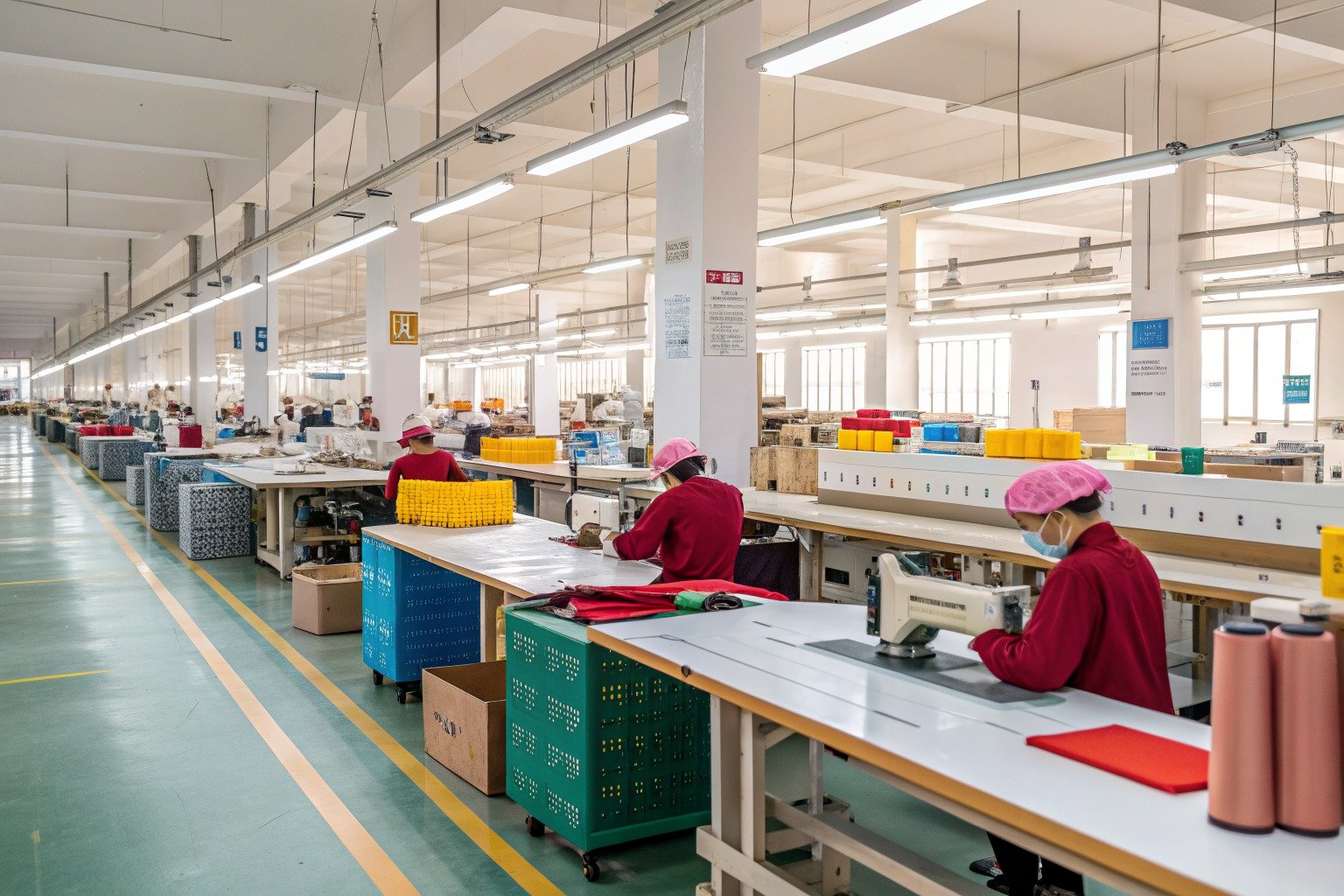
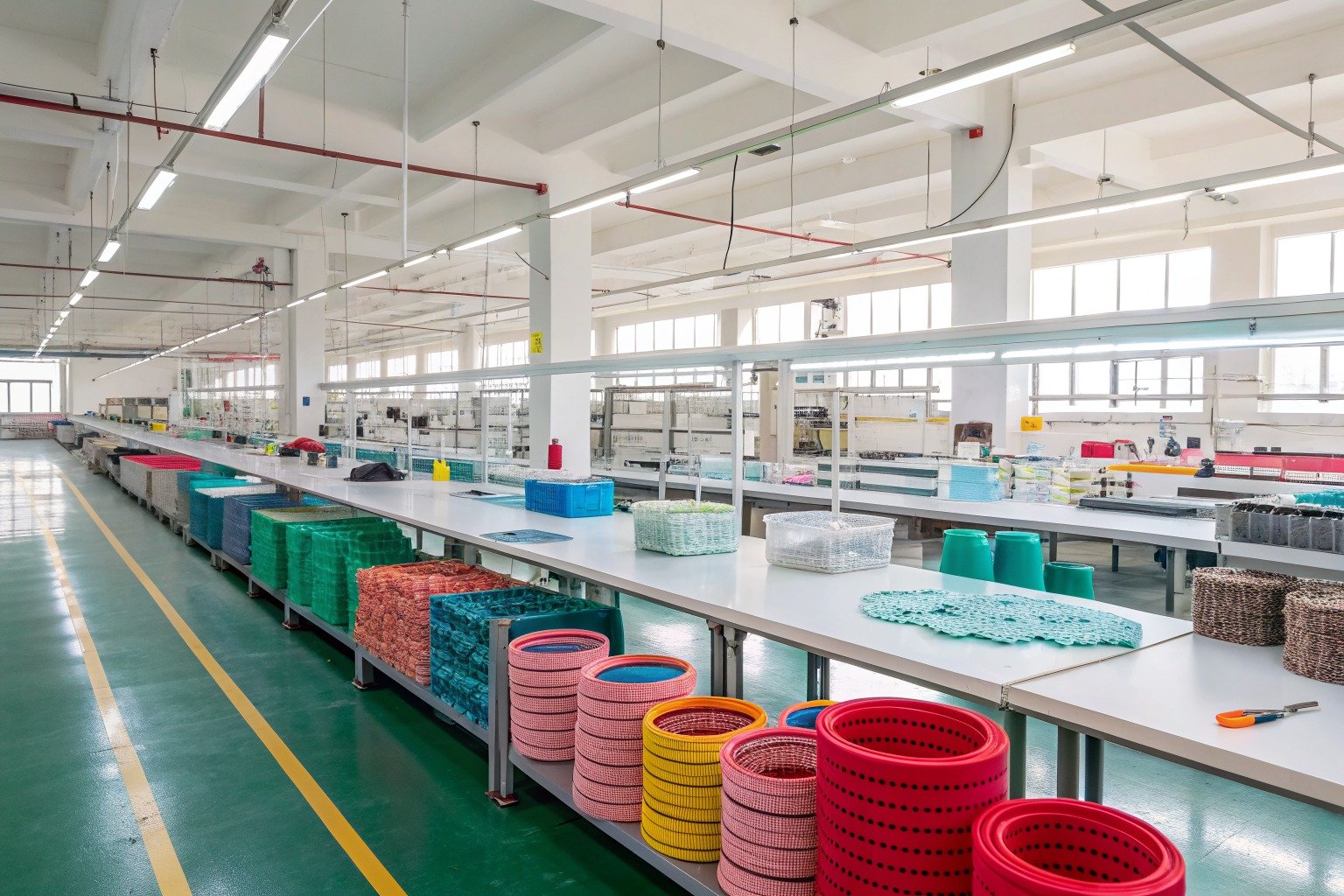
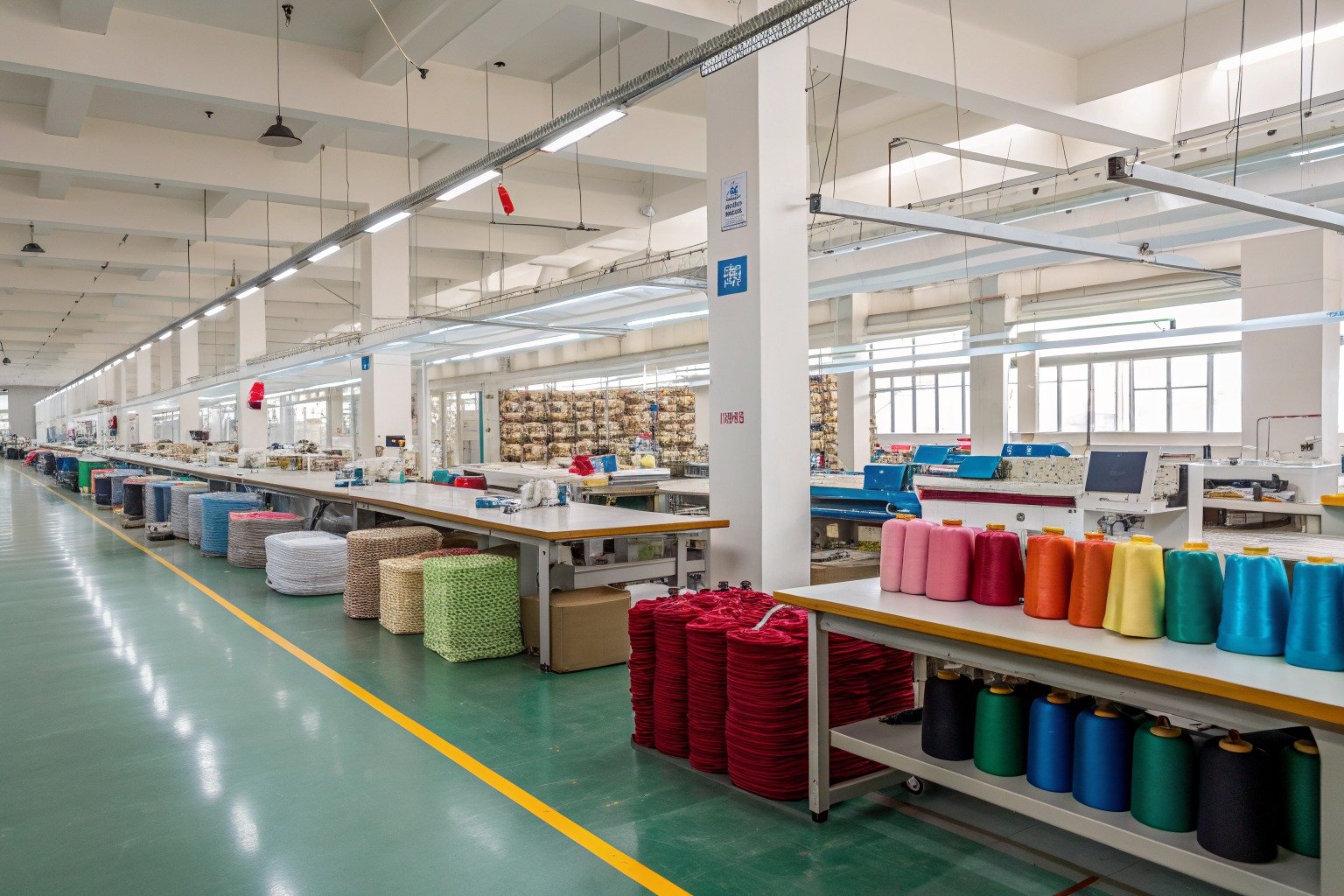
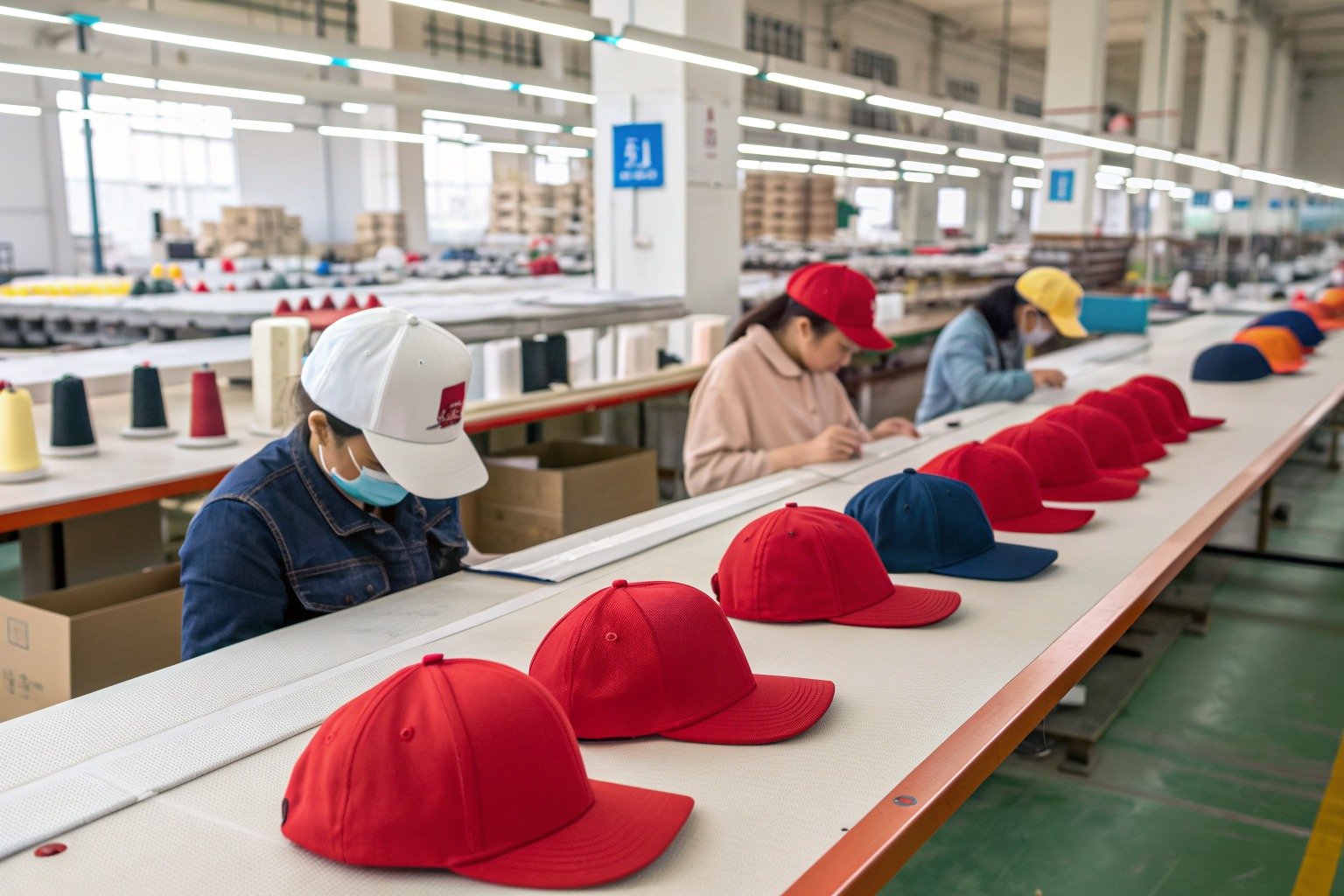
Yes, our factory produces both knitted and crochet beanies under one roof, with dedicated production lines, specialized machinery, and skilled artisans for each technique. The knitted beanie production uses industrial knitting machines, ranging from fine-gauge 12G and 14G machines for sleek, lightweight beanies to chunky 3G and 5G machines for thick, textured styles, with a production capacity of thousands of units per day. The crochet beanie production is a handcraft operation where skilled crochet artisans work individually on each piece, using crochet hooks and a variety of yarns to create the unique, hand-made stitch patterns that machines cannot replicate. This dual capability allows our brand clients to source their entire beanie collection from a single supplier, with consistent quality standards, coordinated color palettes, unified packaging, and a single point of contact for project management.
The ability to produce both knitted and crochet beanies in one factory is rarer than most buyers assume. Knitted beanie production is an industrial process. It requires significant capital investment in knitting machines, a skilled technical team to program and maintain them, and a production workflow optimized for efficiency and consistency. Crochet beanie production is a craft process. It requires a team of skilled hand artisans, each with years of experience, a different kind of quality control, and a production workflow that respects the slower, more deliberate pace of handwork. Most factories invest in one or the other. We invested in both because we listened to buyers like the one from Scandinavia who were tired of splitting their orders. Let me walk you through how we make both techniques work under one roof and what the advantages are for your brand.
What Is the Difference Between Knitted and Crochet Beanie Production
Knitted and crochet beanies may look similar to the untrained eye. They are both headwear. They both use yarn. They both keep heads warm. But the methods by which they are made are fundamentally different. Understanding these differences is essential for a buyer who wants to source both types of beanies and who needs to understand the cost, lead time, and design implications of each technique. The differences span the machinery, the labor, the materials, the design possibilities, and the production economics.
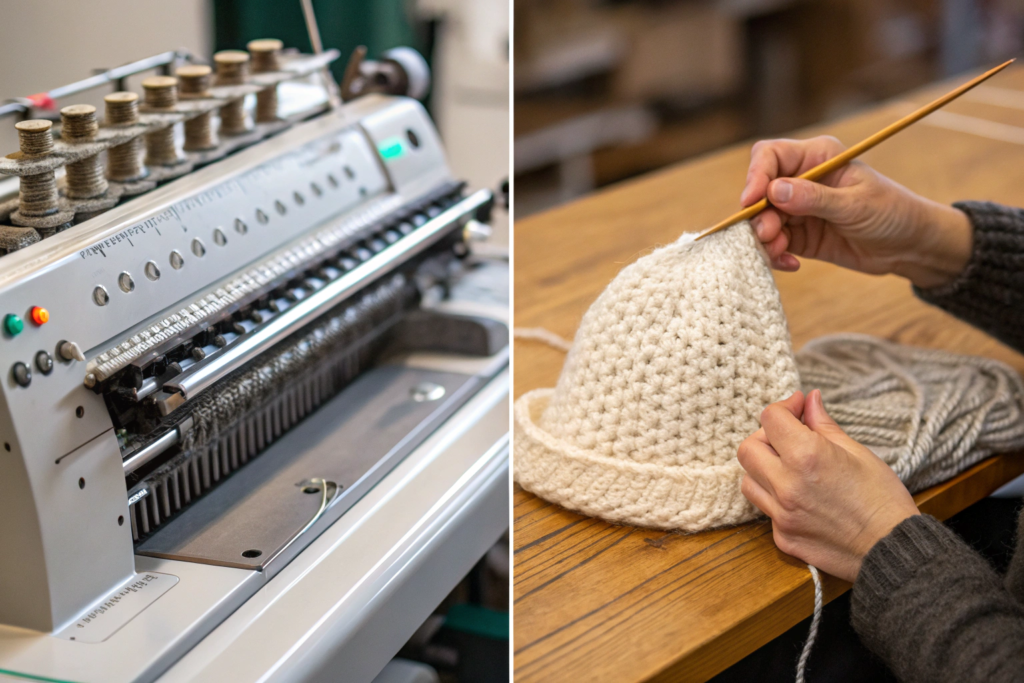
Knitted beanie production is an industrial process that uses computer-controlled knitting machines. These machines have a circular bed of needles, ranging from a few dozen for chunky gauge machines to over a hundred for fine gauge machines. The needles interlock loops of yarn in a continuous spiral to create a seamless tube of fabric. The machine can be programmed to create different stitch patterns, ribbing, jacquard designs, and crown shaping, all executed automatically. Crochet beanie production is a manual craft process. A skilled artisan uses a single crochet hook to interlock loops of yarn by hand. Each stitch is created individually. The artisan controls the tension, the stitch pattern, and the shape through their skill and experience. There is no machine. There is no automation. The production speed of knitting is measured in minutes per beanie. A basic knitted beanie can be produced on a machine in 5 to 10 minutes. The production speed of crochet is measured in hours per beanie. A simple crochet beanie might take 1 to 2 hours. A complex, intricately patterned crochet beanie can take 3 to 5 hours or more.
These fundamental differences drive the economics. A knitted beanie has a lower labor cost per unit because the machine does most of the work. A crochet beanie has a higher labor cost because every stitch is made by a human hand. A knitted beanie is highly consistent from unit to unit. A crochet beanie has subtle variations from piece to piece, which is part of its artisanal charm but requires a different approach to quality control. Let me explore each production method in more detail.
How Do Industrial Knitting Machines Create Seamless Beanie Bodies?
The industrial knitting machine is a marvel of textile engineering. For beanie production, we use circular knitting machines, also called circular weft knitting machines. The machine has a cylinder with a ring of latch needles arranged around its circumference. The number of needles determines the gauge of the machine. A 12-gauge machine has 12 needles per inch of cylinder circumference, producing a fine, smooth fabric similar to a T-shirt. A 3-gauge machine has 3 needles per inch, producing a chunky, open fabric. The yarn is fed into the machine from cones mounted on a creel. A series of cam systems controls the movement of the needles. As the cylinder rotates, the needles are raised and lowered in sequence, catching the yarn and forming loops that interlock with the loops from the previous row. The fabric is knitted continuously in a tube, emerging from the bottom of the machine. The machine can be programmed with a specific stitch pattern. A plain jersey stitch is the simplest, producing a smooth fabric. A rib stitch alternates knit and purl stitches to create vertical columns, which provides elasticity for the cuff. A jacquard pattern uses multiple yarn colors to create a design, with the machine selecting which needles knit which color according to a digital pattern file. The crown shaping, the decreases that close the top of the beanie, can be done on the machine itself, producing a fully finished beanie that only requires the final yarn tail to be closed and secured. This is called a fully fashioned knit beanie. Alternatively, the machine can produce a long tube of fabric that is then cut and sewn into individual beanies. Fully fashioned is the premium method because there is no cutting waste and no side seam. The knitting machine is operated by a technician who monitors the process, changes yarn cones when they run out, and performs quality checks on the fabric as it is produced. One technician can oversee multiple machines simultaneously.
Why Is Crochet Production Entirely Handmade and Artisanal?
Crochet cannot be replicated by a machine. This is a fundamental truth of textile manufacturing that surprises many people. Knitting machines exist because the knit stitch is a simple loop-through-loop structure that can be mechanized. The crochet stitch is structurally different. In crochet, each stitch is completed individually, and the hook must pass through the work in a way that a mechanical arm cannot replicate with the necessary dexterity and tension control. Every crochet machine ever invented has been a failure. The only way to produce a true crochet fabric is by hand. This makes crochet production inherently artisanal. Our crochet department is a studio, not a factory floor in the traditional sense. Skilled artisans sit at individual workstations with good lighting and ergonomic seating. Each artisan has their own set of crochet hooks in various sizes, from a fine 2-millimeter hook for delicate work to a chunky 10-millimeter hook for thick, oversized beanies. The artisan reads from a pattern, which may be a written pattern, a stitch diagram, or a reference sample. They select their yarn and begin hand-crocheting the beanie, stitch by stitch, round by round. The process is slow, deliberate, and meditative. The artisan controls every variable. The tension of the yarn, which determines the fabric density and the final size. The precision of the stitch placement. The tightness of the increases and decreases that shape the crown. A skilled crochet artisan develops a consistent tension through years of practice. Their beanies will be consistent in size and appearance, but each one will have an individuality that is the hallmark of handcraft. This individuality is a feature, not a defect. It is what makes a crochet beanie feel special, personal, and valuable. Quality control for crochet beanies is different from QC for knitted beanies. We do not expect machine-like uniformity. We expect consistency within an acceptable range of variation, and we inspect for stitch accuracy, tension consistency, and overall appearance. Each crochet beanie is inspected individually by a QC specialist who understands the craft.
What Are the Advantages of Sourcing Both From One Factory
Sourcing knitted and crochet beanies from a single factory offers advantages that go far beyond administrative convenience. The benefits touch every aspect of the product development and supply chain process, from design cohesion to quality consistency to logistics efficiency. When the same design team, the same color lab, the same QC team, and the same project manager oversee both product types, the result is a collection that feels unified and intentional, not a patchwork of pieces sourced from different suppliers with different standards.
Sourcing both knitted and crochet beanies from one factory provides six key advantages. Color coordination is the most immediately visible benefit. When both beanie types are produced in the same factory, they can be dyed in the same dye lot or matched to the exact same color standard, ensuring that the knitted oatmeal beanie and the crochet oatmeal beanie are the identical shade. When sourced from different factories, color matching becomes a game of sending swatches back and forth, with no guarantee of a perfect match. Quality consistency is the second advantage. A single QC team, applying the same standards and the same inspection protocols to both product types, ensures that quality expectations are uniformly met. Material coordination is the third advantage. Yarns can be bulk-purchased for the entire collection, reducing cost and ensuring consistent fiber content and quality across all products. Design cohesion is the fourth advantage. A single design team develops both product types, ensuring that the stitch patterns, the proportions, and the design details complement each other. Logistics simplification is the fifth advantage. One purchase order, one production schedule, one consolidated shipment, one set of customs documents, one delivery. The time and cost savings are significant. Communication efficiency is the sixth advantage. A single project manager serves as the point of contact for the entire beanie collection, eliminating the need to coordinate between two separate factories.
For brands that build their identity around coordinated collections, this unified approach is transformative. Let me explore the two most impactful advantages in more detail.
How Does Color Matching Work Across Different Beanie Types?
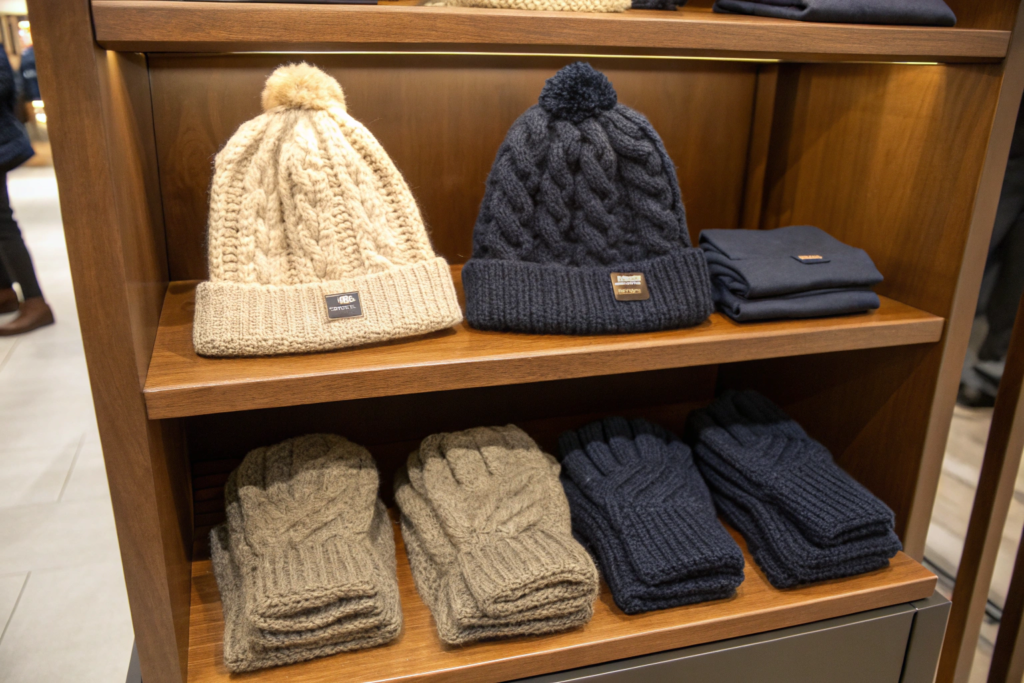
Color matching is the most persistent challenge in multi-factory sourcing. A brand wants its knitted beanie in "oatmeal" and its crochet beanie in "oatmeal" to be the exact same oatmeal. But if the knitted beanie is produced in Factory A and the crochet beanie in Factory B, the two factories are using different yarn suppliers, different dye houses, and different color matching processes. The oatmeal from Factory A has a slightly warm, yellow undertone. The oatmeal from Factory B has a slightly cool, gray undertone. Side by side on a retail shelf, the difference is jarring. The collection looks disjointed. The brand looks sloppy. When both beanie types are produced under one roof, the color matching process is unified. We source the yarn for the knitted beanies and the yarn for the crochet beanies from the same dye lot whenever possible. If the yarn types must be different, a plied yarn for knitting and a single-ply yarn for crochet, for example, we dye them together in the same dye bath to ensure the color chemistry is identical. If the fiber contents are different, a merino wool for the knitted beanie and a wool-acrylic blend for the crochet beanie, we match the colors using our spectrophotometer and our color lab. We create a color standard, a small skein of yarn in the exact approved color. Every yarn batch, whether for knitting or crochet, is measured against that standard under a D65 daylight lamp. The Delta E tolerance is 1.0 or less. This ensures that when the finished beanies are placed side by side, the colors are visually identical to the human eye. This level of color control is nearly impossible to achieve when working with two separate factories.
Can Combined Production Reduce Overall Lead Times?
Combined production can reduce the total project lead time, but the mechanism is not simply that one factory is faster than two. The lead time savings come from the elimination of coordination delays and the ability to parallel-process the two product types within a single production schedule. When working with two factories, the brand must finalize designs, approve samples, and manage production with two separate timelines. If one factory is delayed, the other factory’s product may be ready but cannot ship until the delayed product is complete. The brand is stuck waiting, paying for storage, or paying for two separate shipments. In a single factory, the project manager builds a unified production schedule. The knitted beanie production runs on the knitting machines. The crochet beanie production runs in the handcraft studio. These two workflows happen in parallel, in the same facility, under the same management. The project manager can see the status of both product types in real time and can adjust resources to keep the overall project on track. When both product types are complete, they are QC inspected together, packed together, and shipped together in a single consolidated shipment. The elimination of the consolidation delay, waiting for two separate shipments to arrive and be combined, can save a week or more. Additionally, the sample development process is faster. One design team develops both samples. One set of color approvals covers both product types. One shipping address receives one sample package containing both beanie types. The back-and-forth of sending separate samples from separate factories, with separate approvals and separate delays, is eliminated entirely.
What Yarn Types Work for Both Knitted and Crochet Beanies
The yarn is the foundation of any beanie, and the choice of yarn affects the look, the feel, the performance, the cost, and the production feasibility. Not all yarns work equally well for both knitting and crochet. Knitting machines require yarns with specific characteristics. The yarn must have a consistent thickness and a smooth surface to pass through the machine’s tensioners and needles without breaking or snagging. Crochet, being a hand process, is more forgiving of yarn irregularities. A slubby, textured, or uneven yarn that would jam a knitting machine can be beautifully worked by a skilled crochet artisan. Understanding which yarns work for which process, and which yarns can bridge both, is essential for creating a coordinated collection.
Several yarn types work well for both knitted and crochet beanies, allowing for a fully coordinated collection from a single material palette. Merino wool is the premium choice, offering exceptional softness, warmth, and breathability. It knits beautifully on fine to mid-gauge machines and crochets into a soft, drapey fabric with excellent stitch definition. Acrylic and acrylic-wool blends are the workhorse options, cost-effective, available in an unlimited color range, and suitable for both machine knitting and hand crochet. Cotton and cotton blends are the warm-weather options, breathable and soft, suitable for lightweight spring and summer beanies. Recycled polyester and eco-friendly blends made from post-consumer plastic bottles are the sustainable choice, increasingly popular with environmentally conscious brands. Alpaca and alpaca-wool blends offer a luxurious, fluffy texture that is stunning in both knitted and crochet forms, with a soft halo that adds visual depth. For chunky crochet styles, we often use a roving-style unspun wool or a thick-and-thin art yarn that would be impossible to machine knit but is a joy to crochet.
The key to a coordinated collection is to use the same fiber content and the same dye lot across both product types, even if the yarn construction is slightly different. A merino wool in a 2/28 worsted weight for knitting and a merino wool in a single-ply aran weight for crochet can be dyed together to achieve a perfect color match. Let me detail two of the most important yarn considerations.
What Wool Blends Offer the Best Stitch Definition for Crochet?
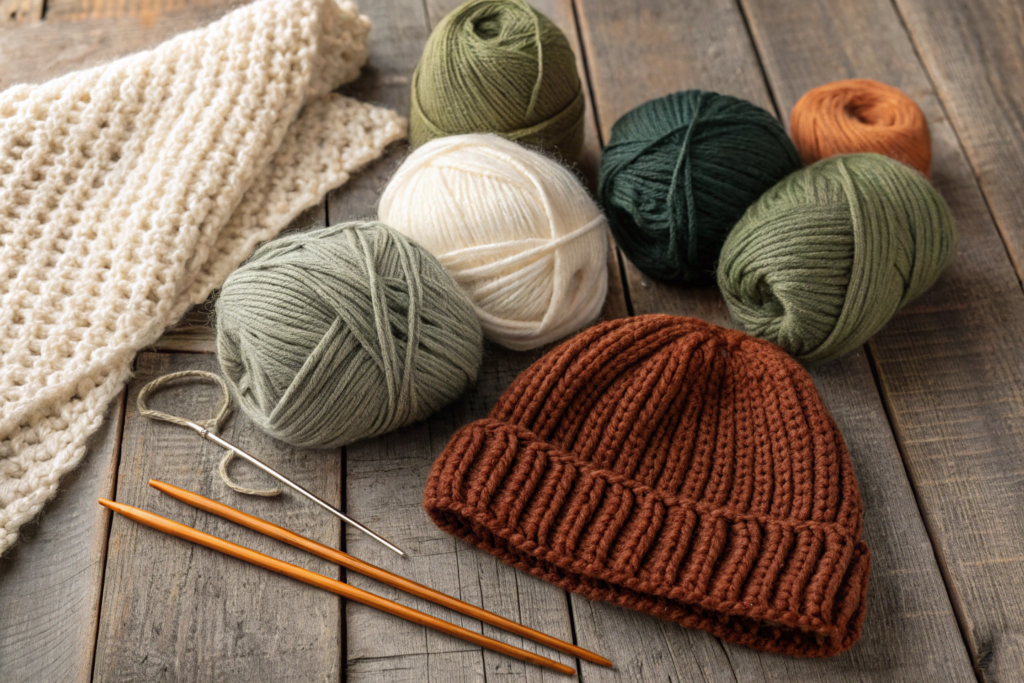
Stitch definition is the clarity with which the individual stitches and the stitch pattern are visible in the finished fabric. For a crochet beanie, stitch definition is critical. The beauty of crochet lies in the texture. A shell stitch, a bobble stitch, a cable stitch, these patterns are the reason a customer chooses a crochet beanie over a simpler knitted one. If the yarn is too fuzzy, too hairy, or too loosely spun, the stitch pattern becomes a blur. The detail is lost. The best yarns for crochet stitch definition are smooth, plied yarns with a tight twist. A plied yarn is made by twisting together multiple single strands. A 4-ply or 6-ply yarn has a round, smooth profile that catches the light and shows every stitch clearly. Merino wool is excellent for stitch definition because the fibers are fine and can be spun into a very smooth, even yarn. A superwash merino, which has been treated to prevent felting, is particularly good because the treatment also smooths the fiber surface. Cotton and cotton blends offer the crispest stitch definition of any fiber. Cotton has no fuzz or halo. Every stitch is razor-sharp. The trade-off is that cotton is less warm and less elastic than wool, so it is more suitable for decorative and warm-weather beanies. Acrylic can offer excellent stitch definition if it is a high-quality, tightly spun acrylic. Cheap acrylic yarns can be splitty, meaning the plies separate during crochet, causing the hook to catch and the stitch to look messy. We use premium acrylic yarns specifically designed for handcraft, which have a tight twist and a smooth finish. Alpaca and mohair blends, while beautiful and soft, have a fuzzy halo that obscures stitch definition. They are better suited for simple stitch patterns where the texture comes from the yarn itself rather than the stitch pattern.
How Does Yarn Weight Affect the Choice Between Knit and Crochet?
Yarn weight, the thickness of the yarn, is a critical variable that affects both the production method and the final product. Yarn weight is typically classified by terms like lace, fingering, sport, DK, worsted, aran, bulky, and super bulky. Fine yarns, lace to sport weight, are best suited for machine knitting on high-gauge machines. They produce a lightweight, sleek fabric that is ideal for fashion beanies and warm-weather headwear. Crocheting with fine yarns is possible but very time-consuming. A crochet beanie made from fingering-weight yarn requires thousands of tiny stitches and can take an artisan 8 to 10 hours to complete. The labor cost becomes prohibitive for most commercial applications. Medium-weight yarns, DK and worsted, are the sweet spot for both knitting and crochet. They knit well on mid-gauge machines, 7G to 12G, producing a classic beanie fabric. They crochet at a reasonable speed, 2 to 3 hours per beanie, and produce a fabric with excellent drape and stitch definition. The majority of our coordinated collections use DK or worsted-weight yarns for both knitted and crochet beanies. Chunky yarns, aran, bulky, and super bulky, are where crochet really shines. These thick yarns are difficult to machine knit. The needles on even a 3G chunky knitting machine can struggle with a super bulky roving yarn. The yarn may break, or the machine may not be able to form consistent stitches. Hand crochet handles these yarns beautifully. A skilled artisan can work with a roving as thick as a finger, creating a dramatically textured, ultra-cozy beanie in just an hour or two. The chunky crochet beanie is a statement piece. It is visually dominant, incredibly warm, and highly photogenic. For a coordinated collection, we often pair a DK-weight knitted beanie with a chunky-weight crochet beanie in the same fiber and color. The different yarn weights create a visual hierarchy within the collection while the shared color and fiber maintain the unity.
How Does Quality Control Differ for Knitted and Crochet Beanies
Quality control is the area where the dual nature of our beanie production is most apparent. A knitted beanie and a crochet beanie are both beanies, but they are fundamentally different products with different quality criteria, different failure modes, and different inspection methods. A single QC team inspects both product types, but the inspectors are trained to apply the appropriate standard to each. A knitted beanie is evaluated against criteria of machine precision. Dimensional consistency, stitch uniformity, seam strength. A crochet beanie is evaluated against criteria of artisanal consistency. Stitch accuracy, tension consistency, overall aesthetic quality. The QC process for each is tailored to the nature of the product.
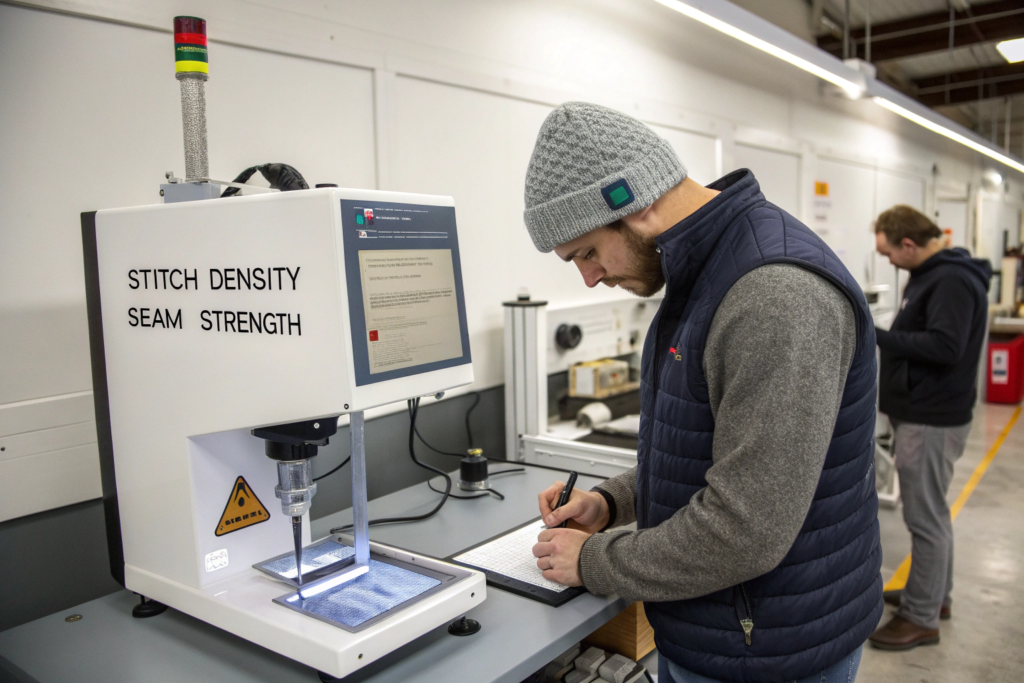
Quality control for knitted beanies focuses on machine-driven consistency metrics. The key checks are dimensional accuracy, where the beanie circumference, length, and cuff width are measured against the approved specification, with a tolerance of plus or minus 5 percent. Stitch density, the number of stitches per inch, is checked with a pick glass to ensure the machine settings have not drifted. Visual defects such as dropped stitches, holes, yarn contamination, and color stripes are checked under a lightbox. Seam strength at the crown closure is tested with a pull test to ensure the seam does not open. Quality control for crochet beanies focuses on handcraft consistency metrics. The key checks are stitch accuracy, where the stitch pattern is compared visually to the approved reference sample to ensure the correct stitch type and pattern repeat are used throughout. Tension consistency is evaluated by feel and by measuring the overall dimensions, which should fall within the tolerance range. Visual defects such as missed stitches, incorrect stitch counts, yarn knots, and loose ends are inspected. The overall aesthetic quality is assessed by an experienced craft QC specialist who can judge the evenness and the beauty of the handwork.
The pass-fail criteria are different. A knitted beanie with a 2-millimeter dimensional deviation might fail. A crochet beanie with the same 2-millimeter deviation might pass, because handcraft inherently involves slight variation. The QC team is trained to understand and apply these different standards appropriately. Let me explore the specific QC challenges of each production method.
How Do You Check for Consistent Tension in Hand-Crocheted Items?
Tension is the tightness with which the crochet artisan pulls each stitch. It is the most critical variable in hand-crochet quality and the most difficult to control. Tension that is too tight produces a stiff, small beanie that is uncomfortable to wear. Tension that is too loose produces a floppy, oversized beanie that lacks structure and shape. Tension that varies within a single beanie produces an uneven fabric with visible tight and loose areas. Checking for consistent tension is a skill that our crochet QC specialists develop over years of experience. The primary method is tactile. The inspector picks up the beanie and feels the fabric. A consistently tensioned fabric has a uniform hand feel across the entire surface. There are no stiff spots and no floppy spots. The inspector squeezes the fabric gently. A well-tensioned beanie has a pleasing resilience. It springs back when compressed. The secondary method is dimensional. The beanie is laid flat on a measurement table and the width and length are measured. These measurements are compared to the approved tolerance range for that style. A beanie that is too small indicates the artisan’s tension was too tight. A beanie that is too large indicates tension was too loose. If an individual artisan consistently produces beanies that are out of tolerance, they receive additional training and mentoring from a master crochet artisan. The tertiary method is visual comparison. The inspector holds the beanie next to the approved reference sample. They look at the size of the stitches, the openness of the fabric, and the overall proportion. A trained eye can spot a tension variation instantly. We also use a digital fabric density scale for spot checks. A small, calibrated weight is placed on a swatch of the crochet fabric, and the compression is measured. This provides an objective, numerical measurement of fabric density that correlates with tension. The crochet QC process is more labor-intensive than the knitted QC process because each piece is individually evaluated by a skilled inspector. This is reflected in the higher cost of crochet beanies, but it is essential to ensure that every handcrafted piece meets the brand’s quality standard.
What Machine Knitting Defects Require Extra Inspection?
Machine knitting is fast and consistent, but it is not immune to defects. A knitting machine is a complex mechanical system with hundreds of moving parts. A single malfunctioning needle can produce a defect that repeats throughout an entire production run. The most critical defect to catch is a dropped stitch, also called a run or a ladder. This occurs when a needle fails to catch the yarn, and the stitch unravels vertically down the fabric. A dropped stitch creates a visible line and a hole. On a seamless, fully fashioned beanie, a dropped stitch during the crown shaping can ruin the structural integrity of the entire piece. Dropped stitches are caught by visual inspection under a lightbox. The inspector stretches the fabric slightly, which opens up the stitches and makes a dropped stitch immediately visible. Yarn contamination is another machine-specific defect. A stray fiber of a different color, a piece of lint, or a fragment of a different yarn can get caught in the knitting machine and become embedded in the fabric. On a solid-color beanie, a contrasting fiber is highly visible and unacceptable. Inspectors scan the fabric surface under bright light to catch any contamination. Barre, a subtle horizontal stripe pattern, is a defect caused by variations in yarn tension, yarn thickness, or dye uptake between yarn packages. It is most visible on solid-color, plain-stitch beanies. Barre is difficult to catch in a single beanie but becomes obvious when multiple beanies are laid side by side. We inspect beanies in groups under consistent lighting to check for barre. Press-off is a catastrophic machine failure where the fabric comes off the needles entirely, resulting in a tangled mess of yarn. This is immediately obvious and the affected beanie is scrapped. The QC process for knitted beanies uses statistical sampling based on AQL standards. A random sample is drawn from each production batch and subjected to the full inspection protocol. If the sample failure rate exceeds the AQL threshold, the entire batch is quarantined and 100 percent inspection may be triggered.
Conclusion
The ability to produce both knitted and crochet beanies in a single factory is a strategic advantage that addresses a real pain point for brands and buyers. The brand gets a unified collection where the colors match perfectly, the quality is consistent, and the design language is cohesive. The buyer gets a single point of contact, a single production schedule, a single consolidated shipment, and a dramatically simplified sourcing process. We have explored the fundamental differences between the two production methods, machine knitting as an industrial process of speed and precision, hand crochet as an artisanal craft of skill and individuality. We have examined the advantages of unified sourcing, from dye-lot coordination that guarantees color harmony to parallel production scheduling that streamlines logistics. We have discussed the yarns that bridge both techniques and the yarns that are best suited to each. And we have detailed how quality control adapts to the very different nature of machine-made and hand-made products, applying technical precision to knitting and craft expertise to crochet.
At AceAccessory, our dual capability in knitted and crochet beanie production is not an afterthought. It is a core part of our business strategy. We invested in both the industrial knitting technology and the handcraft studio because we listened to the market. Brands want coordinated collections. Buyers want simplified supply chains. We have the machines, the artisans, the QC team, and the project management expertise to deliver both product types at the quality level each demands. Our clients appreciate being able to develop their entire winter headwear collection with one partner, from the sleek, technical merino knitted beanie to the chunky, textured, artisanal crochet statement piece.
If you are developing a beanie collection that includes both knitted and crochet styles, and you want the efficiency and cohesion of working with a single factory, I invite you to contact us. Reach out to our Business Director, Elaine, at elaine@fumaoclothing.com. Tell her about your collection vision, the styles you are planning, and the yarns and colors you are considering. She can arrange for samples of both our knitted and crochet work, in coordinated colors and materials, so you can see the quality and the consistency for yourself. Let us simplify your supply chain and elevate your collection.