Have you ever held a "full-grain leather" belt in your hand, admired its rich smell, and believed you had sourced a premium product, only to watch it peel like a sunburned skin after three months of wear? I have seen this betrayal happen to a good friend who runs a menswear brand. He had paid a premium price for what the factory certified as "full-grain Italian leather." The belts arrived. They looked perfect. They sold fast. Then the returns started. The surface was lifting. A thin, plastic-like layer was separating from a gray, fuzzy backing. It was not full-grain leather. It was split leather with a polyurethane coating. The factory had lied. The certification was fake. My friend lost his credibility and his repeat customers.
AceAccessory is a professional manufacturer and exporter of accessories. You verify that a factory’s belts are genuinely full-grain leather by demanding a third-party lab test report that identifies the specific leather layer structure, performing a physical burn and water absorption test on the samples, and auditing the factory’s raw hide inventory for the characteristic natural grain markings that cannot exist on corrected or bonded leather.
Full-grain leather is the most honest material. It wears its history on its surface. The scars, the insect bites, the neck wrinkles are all visible. It is the uncensored top layer of the hide. It is the strongest and the most beautiful. But it is also the most faked. As a factory owner in Zhejiang who buys hides from certified tanneries, I can teach you the forensic methods to tell the real from the fake. This knowledge is your financial protection.
What Does a Genuine Full-Grain Leather Edge Look Like?
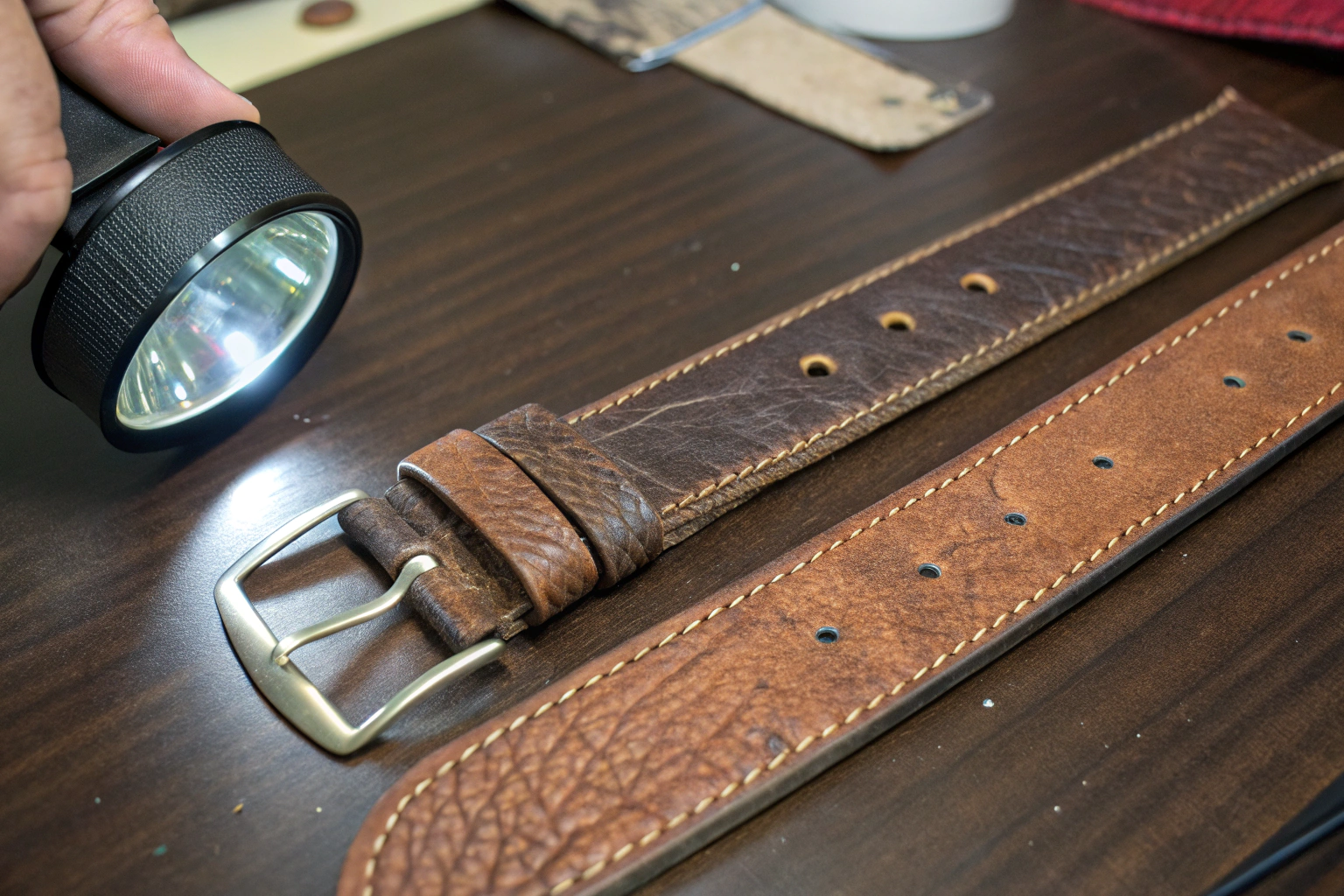
The edge of the belt is the window to its soul. A genuine full-grain leather belt has an edge that looks like solid, compressed wood. It is dense. It is uniform. When you cut it with a sharp blade, the cut surface is smooth and almost shiny from the tight fiber compression. There are no layers. There is no fuzzy, loose middle section.
A fake leather belt, or a "genuine leather" belt made from bonded leather, has a distinct layered edge. It looks like a plywood board. The top is a thin, shiny plastic layer. The middle is a loose, fibrous, gray-ish brown material. This is ground-up leather dust mixed with glue. This is the "bonded" layer. It is weak. It tears like paper. A corrected-grain leather belt, which is sanded top-grain with a painted on grain pattern, has a uniform, unnaturally perfect texture. But at the edge, under a magnifying glass, you can see the paint line. The color does not penetrate the fiber. It sits on top like a cake icing. A full-grain edge is stained through with dye. The color penetrates deep. The natural grain pores are visible, not just on the surface, but in the structure. The burnish test is a definitive check. A genuine full-grain edge burnishes to a smooth, glassy, dark brown finish when rubbed with a wooden slicker and gum tragacanth. A bonded or corrected leather edge remains rough and fuzzy. It will not burnish. It melts if you try to heat it.
Why Is the "Suede Side" Test a Quick Verification?
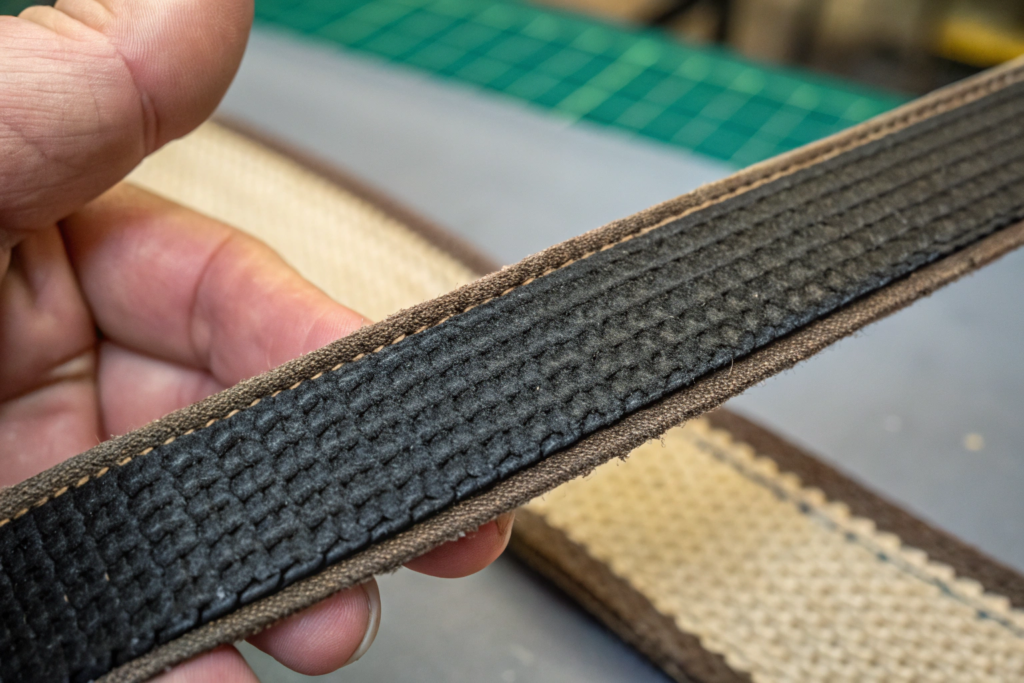
The underside of the belt is the flesh side. On a full-grain belt, it should feel like fine suede. It is soft, with a short, velvety nap.
On a split leather or bonded leather belt, the back is often a glued-on, synthetic backing. It feels like felt or paper. It peels off easily. Scratch the back with your fingernail. A genuine full-grain flesh side yields slightly and shows a fingerprint of disturbed fibers. A fake backing is hard and scratch-resistant, or it pills up like a cheap sweater. This is a five-second field test. It works at a trade show. It is a quick filter for obvious fakes.
What Does the "Fiber Pull" Reveal Under Magnification?
Use a 10x jeweler’s loupe. Look at the cut edge. Insert a fine needle into the fiber structure.
In full-grain leather, the needle enters a solid mass of interlocking collagen fibers. You cannot easily separate a specific layer. In bonded leather, the needle separates the glued dust. It crumbles. The particles fall out. In corrected grain, you can lift the painted top layer with the needle tip. It separates cleanly from the fuzzy substrate. This is the definitive mechanical test. It reveals the hidden construction. A genuine full-grain is one unified piece of nature. The fakes are man-made laminates.
What Is the Water Drop Test and How Does It Identify Full-Grain?
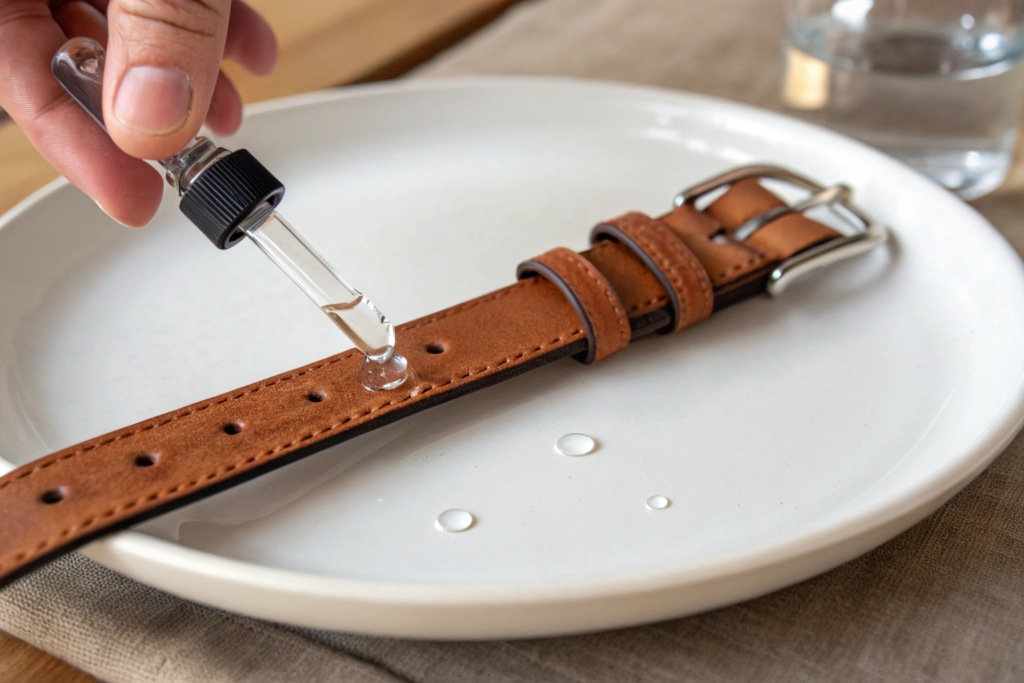
Full-grain leather is naked. It has no plastic shield. It breathes. It absorbs. The water drop test is the classic, definitive field test.
Place a single drop of clean water on the belt surface. Watch it. On a genuine full-grain leather, the water will behave like rain on dry earth. It will slowly darken the leather and sink in. The spot will remain dark for a few minutes until it evaporates. This absorption proves the grain pores are open. They are not sealed by paint or plastic. On a corrected-grain or PU-coated belt, the water beads up like mercury on a glass table. It sits there, perfectly round. It does not soak in. You can roll it around. This is the plastic barrier. On a bonded leather belt, the water might absorb into a scratch, but not the surface. It reveals the inconsistency. The water test is a truth serum for leather. It is a beautiful, simple demonstration. We encourage our clients to do it on their pre-production sample. It creates an immediate, tactile understanding of the material’s authenticity.
How Does the Absorption Speed Vary with Leather Type?
Full-grain cowhide absorbs slowly. It is dense. The drop takes 30 to 60 seconds to fully sink in. Full-grain calfskin absorbs faster. The pores are finer and more open.
If the water vanishes instantly, the leather might be overly porous, heavily sanded suede or a low-quality belly cut. If it never absorbs, it is coated. The speed of absorption is a secondary clue. It tells you about the density and the finish. A premium aniline-dyed full-grain will absorb moderately slowly, leaving a beautiful, temporary dark watermark. This is the "patina preview." It shows the customer what will happen over years of use. It is a selling feature, not a flaw.
What Does the "Burn Test" Smell Reveal?
Take a tiny snip from the buckle fold allowance. Hold it with tweezers. Apply a lighter flame to the edge. Smell the smoke.
Real leather smells like burning hair or burning meat. It is a protein. It smells organic, slightly acrid. It does not drip. It forms a black, carbonized ash that crumbles. Fake PU leather smells like burning plastic. It is a chemical, sweet, acrid smell. It melts. It drips. It forms a hard, plastic bead. This test is destructive and absolute. The smell is unmistakable. It is the ultimate forensic truth. Only do this on a hidden scrap, not the finished belt. But it confirms the polymer identity beyond any doubt. It distinguishes animal skin from petrochemical plastic.
How Do You Audit a Factory’s Raw Material Hide Inventory?
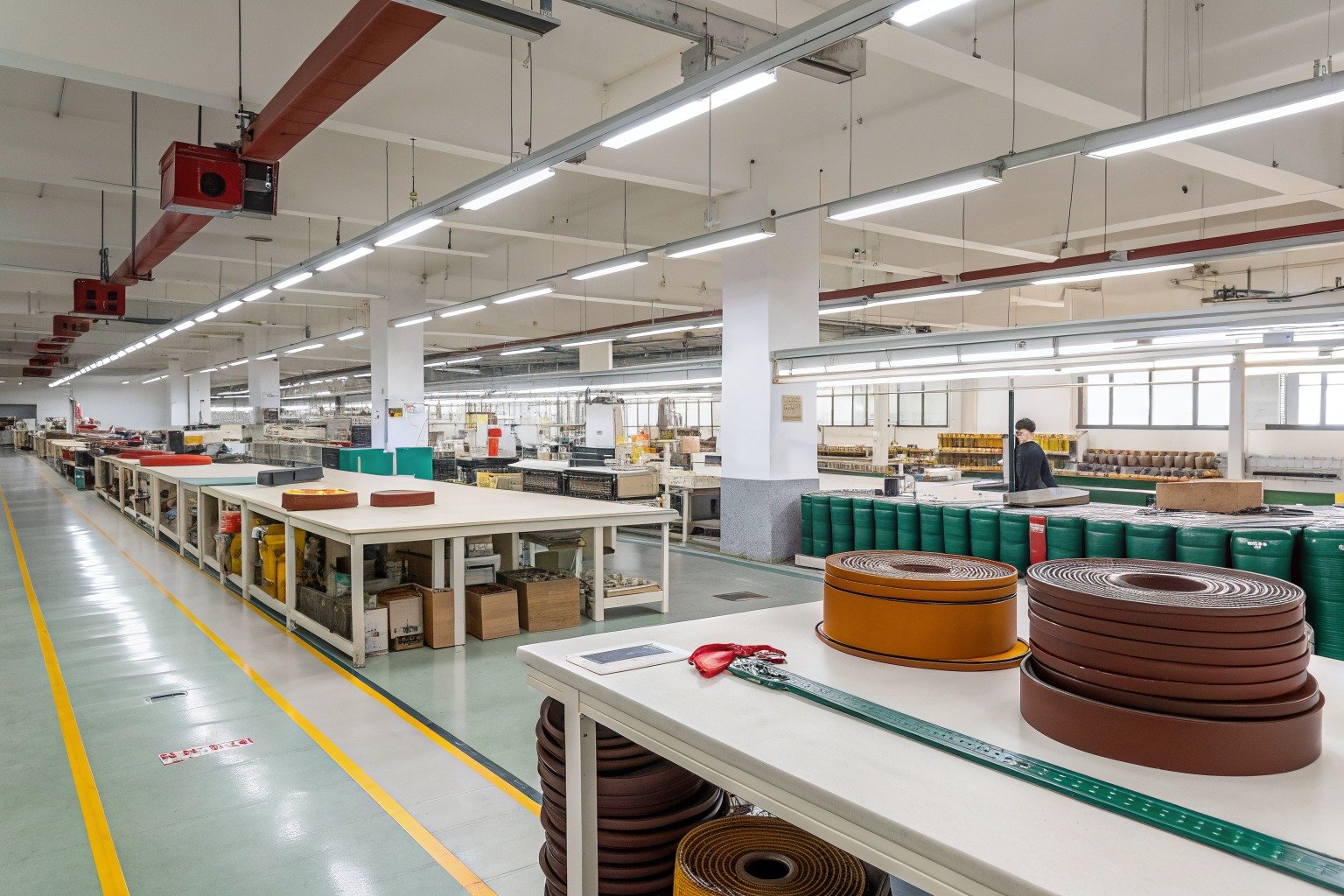
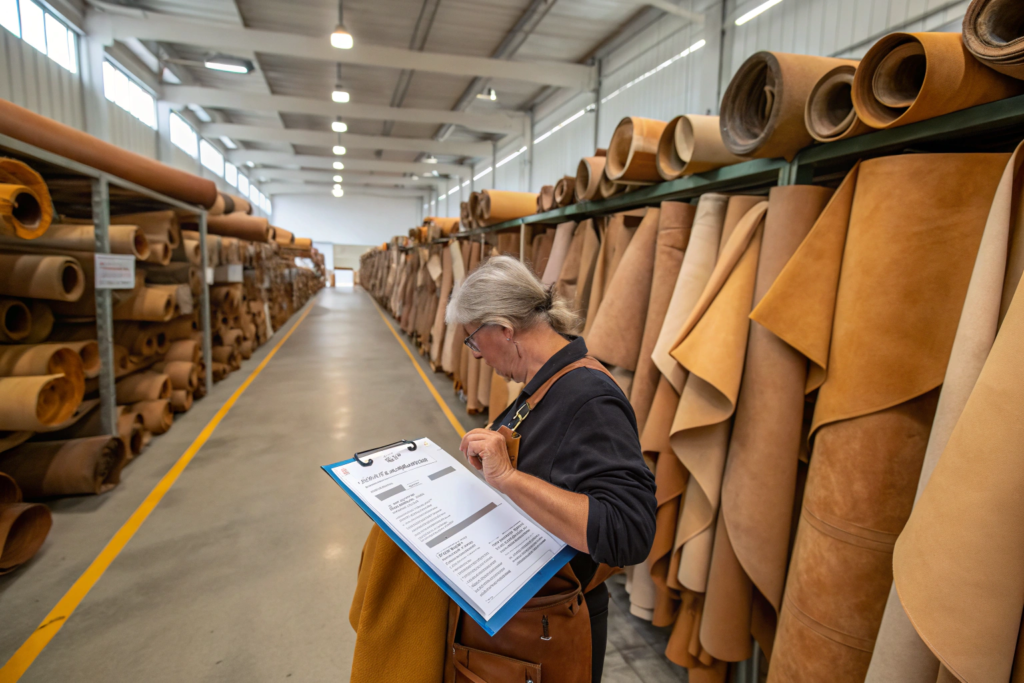
A factory’s physical inventory is a confession. You cannot hide the truth of your materials when a buyer stands in your warehouse. A video audit of the raw material store is the most powerful verification tool.
You ask the factory to walk you through their leather storage. You look at the hides. A genuine full-grain hide has visible, natural imperfections. The brand mark from the ranch. The barbed wire scar. The stretch marks around the belly. The visible, irregular grain pores that tighten at the spine and loosen at the belly. These are the fingerprints of a real animal. A factory that only produces "perfect" belts but has no imperfect hides in stock is a factory that uses corrected grain. They buy hides that have already been sanded and embossed. You also demand to see the tannery tags. Every professional hide has a tag from the tannery. It states the hide origin, the tanning method, the thickness, and the grade. A full-grain tag will say "Full Grain, Aniline Dyed" or "Full Grain, Semi-Aniline." A corrected grain tag will say "Corrected Grain, Embossed." A bonded leather roll has no tag, or a generic "Leather Board" label. The tag is the birth certificate. You photograph it. You trace it back to the tannery’s website. This is the document audit that proves the material’s pedigree.
What Are the Visible Natural Markings of Full-Grain?
Look for "fat wrinkles." These are parallel, wavy lines, especially on the neck area. They look like the rings of a tree. They are a sure sign the top surface has not been sanded off.
Look for healed scars. A smooth, shallow, closed scar is a defect of beauty. A full-grain belt proudly displays these. A corrected grain belt has a uniform, fake grain pattern. It repeats perfectly every few centimeters. Nature does not repeat perfectly. Look for the "hair follicle" pores. They are small, randomly spaced, and irregular in size. An embossed grain has perfectly uniform, machine-stamped pores. The difference is obvious under a magnifying glass. It is the difference between a real forest and an artificial Christmas tree.
Why Is the Tannery Certificate of Origin Critical?
The tannery name is the ultimate guarantee. A reputable Italian or German tannery has a public reputation. They do not sell bonded leather as full-grain.
We buy our full-grain hides from tanneries certified by the Leather Working Group. They have a Gold or Silver rating for environmental and chemical management. We provide the tannery’s certificate of origin with every belt order. It lists the hide’s traceability number. You can contact the tannery directly to verify the lot. A factory that refuses to name its tannery is hiding a cheap, uncertified source. The tannery is our partner in authenticity. We want you to know who they are.
What Third-Party Lab Tests Can Scientifically Confirm Leather Grade?
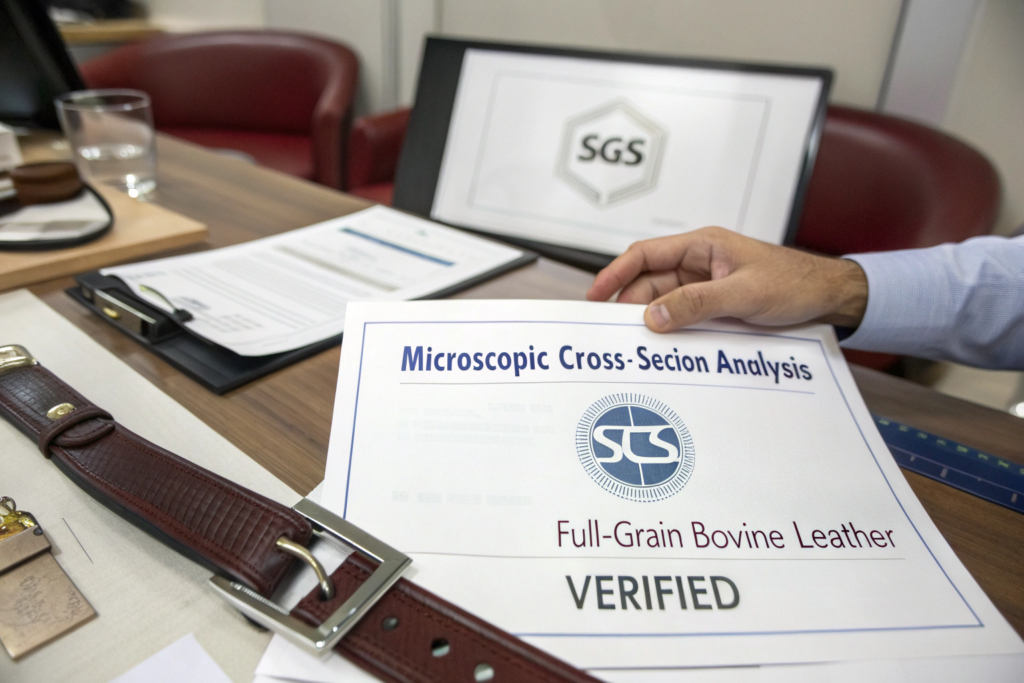
For absolute legal and retail certainty, nothing replaces a third-party lab test. This is the document you show a customs inspector or a skeptical wholesale buyer. The specific test is a "Microscopic Leather Identification" analysis.
The lab uses a stereo microscope and a scanning electron microscope. They prepare a cross-section slice of the belt, thinner than a human hair. The image reveals the exact structural layers. A full-grain leather will show a continuous, interwoven collagen fiber matrix with a distinct, intact grain layer at the top. There will be no separate coating layer thicker than 0.15 millimeters, which is the legal limit for a "non-coated" claim. A split leather will show a distinct separation plane. A bonded leather will show a composite of fiber fragments and adhesive binder. The lab report will state the leather type according to the ISO 17186 standard. This is the "naming" standard for leather. The report is indisputable. It is the scientific truth. We provide this report for any client who requires it. The cost is around 200 dollars and takes one week. It is the ultimate insurance policy against misrepresentation.
What Is the ISO 17186 Standard?
It is the international standard that defines how to correctly label leather. It specifies the terms "full-grain," "top-grain," "split leather," and "bonded leather."
The standard includes a microscopic method. It defines the acceptable thickness of a surface coating. If the coating is thicker than 0.15 mm and contains more than 50% of the total thickness of the surface layer, the material cannot legally be called "full-grain" or even "top-grain." It must be called "coated leather." This standard is the legal weapon. If a competitor falsely labels a belt, this standard is the basis for a false advertising lawsuit. We use it as our internal benchmark.
How Do You Test for Aniline vs. Pigmented Finish?
Aniline is the highest quality full-grain finish. It is a transparent dye that soaks into the leather. The natural grain is fully visible. Semi-aniline has a light protective clear coat. Pigmented has a paint layer.
The lab uses a solvent rub test. A cotton swab with a specific solvent is rubbed on the leather. If the color transfers to the swab, it is an aniline or semi-aniline finish. If no color transfers, it is pigmented. This test determines if the "full-grain" belt is truly natural or is a painted, corrected version. A painted full-grain is a contradiction. It hides the natural beauty it claims to preserve. We specify this test for our premium aniline belts.
Conclusion
Verifying genuine full-grain leather is a combination of sensory examination, destructive testing, inventory audit, and scientific lab work. Your own eyes can see the natural imperfections. Your own nose can smell the organic burn. A simple drop of water reveals the open, breathing pores. A factory’s tannery tags and hide inventory confirm the material’s origin. An ISO-standard lab test provides the legal, indisputable proof of the fiber structure.
A factory that deals in genuine full-grain leather is proud of these tests. We welcome them. We provide the tannery certificates. We encourage the water drop test on our samples. We send the microscopic cross-section reports. We want you to be absolutely certain of the material’s integrity because it is the foundation of our product’s value.
In our Zhejiang factory, the raw hide store is open for video audit. Our leather is sourced from LWG-certified tanneries. Our belts are cut from the top layer of the hide, with the scars and grain proudly visible.
If you are sourcing leather belts and want to be absolutely certain of the material grade, I invite you to contact our Business Director, Elaine. She can send you a sample belt, along with the corresponding tannery tag and a cross-section lab test report from our last batch. She can conduct a live video walk-through of our leather inventory. Send her an email at elaine@fumaoclothing.com. Let us build a belt that is as honest as the hide it comes from.