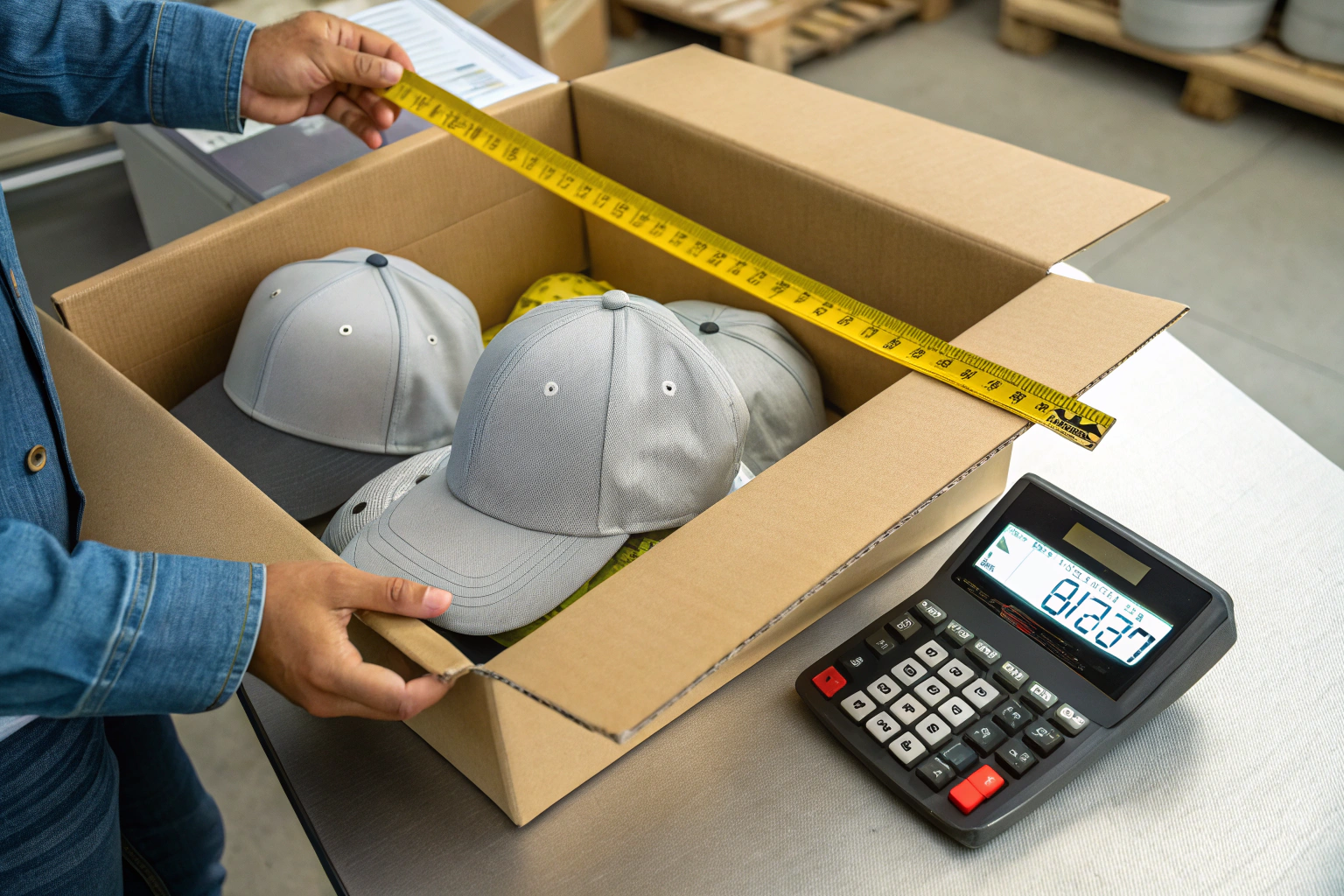
Have you ever shipped a carton of beautiful wide-brim hats, only to receive a freight bill that was triple the original quote? I watched a client turn pale when he opened that invoice. He had budgeted for 50 kilograms of cargo. The airline charged him for 150 kilograms. The hats were light as feathers. But they took up too much space. The problem was not the weight. It was the air. He had packed a giant box of nothing. The dimensional weight rule punished him for it. If you do not design your packaging for air freight, you are throwing your profit margin out the window of a cargo plane.
AceAccessory is a professional manufacturer and exporter of accessories. You avoid air freight dimensional weight overcharges for hats by reducing the carton volume, using vacuum compression for soft hats, nesting structured hats to minimize empty space, and selecting a shipping carton with the optimal dimensional divisor for your carrier.
Hats are volume killers. A baseball cap is a dome of air. A straw fedora is a hollow bowl. A floppy beach hat is a giant disc. The airlines calculate freight by comparing the actual weight with the space the box occupies. They charge you for whichever is bigger. As a factory owner in Zhejiang who ships thousands of hats by air every month, I have engineered a packaging system that slashes dimensional weight. Let me walk you through the math, the materials, and the methods. This will save you thousands of dollars on your next urgent shipment.
What Is Dimensional Weight and Why Does It Penalize Hats?
Dimensional weight is a billing technique. It is also called volumetric weight. The airline looks at your box. It measures the length, width, and height in centimeters. It multiplies those three numbers. Then it divides by a divisor, usually 6000 for international air freight. The result is the "dimensional weight" in kilograms.
Here is the painful reality. A carton of 24 baseball caps might actually weigh 8 kilograms. But the box might measure 60cm by 40cm by 40cm. The calculation is 60 x 40 x 40 = 96,000. Divide by 6,000. You get 16 kilograms volumetric weight. The airline charges you for 16 kilograms. You are paying for double the actual weight. Hats trap air. A structured cap has a stiff front panel that cannot be crushed. A straw hat has a rigid brim that creates a huge empty dome. The shape of a hat is the enemy of efficient packing. Our job is to design the air out of the hat.
How Do Airlines Calculate the Volumetric Divisor?
The standard divisor is 6,000 for air freight. This means one cubic meter of space equals 167 kilograms of chargeable weight. A lower divisor is worse for you.
Some express couriers use a divisor of 5,000. This is even more punitive. A box with a volume of 0.05 cubic meters weighs 10 kilograms actual. At a 6,000 divisor, the charge is for 8.3 kilograms. At a 5,000 divisor, the charge is for 10 kilograms. You need to know the specific divisor of your shipping contract. We always ask the buyer for their carrier’s divisor. We then optimize the box size to get as close to the actual weight as possible. We want the "chargeable weight" to equal the "gross weight." This is the efficiency target. You can learn more about these rules from air freight logistics experts.
Why Are Hat Cartons Often Over-Packed with Air?
Fear. Buyers worry the hat will crush. They ask for a large box with lots of paper filler. The filler adds weight and volume. It is a double penalty.
A structured wool fedora needs protection. But a cardboard spacer uses less volume than crumpled paper. We engineer the inner fitments precisely. A hat should sit in its box like a piston in a cylinder. No movement. Minimal air gap. We also educate our clients that a slightly flattened brim can be reshaped with a quick steam. The minor inconvenience of steaming is much cheaper than the constant overcharge of air freight. This packaging logic is central to export packaging optimization.
How Can You Vacuum Pack Soft Hats for Air Freight?
Soft hats are perfect for vacuum packing. Beanies, knit caps, fleece bucket hats, and soft cotton sun hats can all be compressed. Vacuum packing removes 75% of the volume.
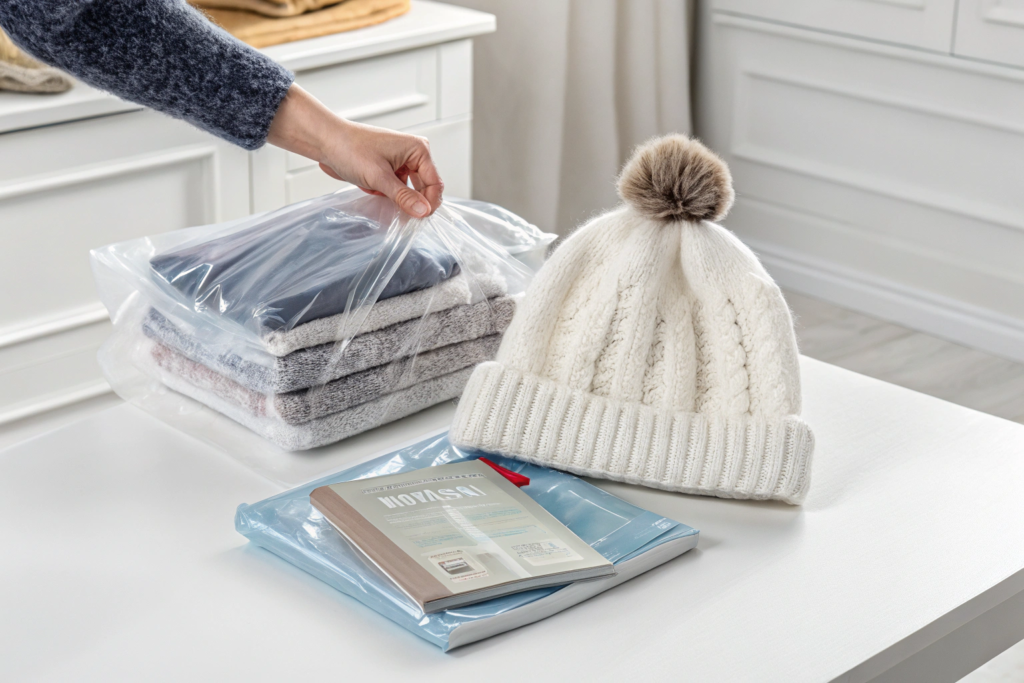
The process is simple. We fold the hat neatly. We slide it into a high-barrier vacuum bag. The machine extracts the air. The bag shrinks down to a solid, flat block. A carton that previously held 50 beanies can now hold 200. The dimensional weight drops proportionally. The key is the recovery. Polyester and acrylic yarns have a memory. They spring back to shape when you open the bag. Natural wool takes a bit of time. We recommend airing the wool hat for 24 hours before retail display. We do not vacuum-pack structured hats with buckram lining. The lining will crack. We only use this for soft, unstructured styles. This technique is a game-changer for e-commerce brands that ship globally by express courier.
Does Vacuum Packing Damage the Hat’s Shape?
It does not damage soft yarns. The fibers are resilient. A high-quality knit will recover fully. We test this by leaving a hat compressed for 30 days, simulating a long sea-air transit.
We open the bag and inspect the crown. We measure the circumference. It must match the original spec. We steam it lightly. The hat looks fresh. The only caution is with embellishments. If a beanie has a pom-pom, we do not vacuum-crush the pom. We place the pom outside the vacuum zone using a specialized bag with a dome pocket. This protects the fluff. Our quality control team tests every new style for vacuum compression tolerance.
What Are the Best Vacuum Bags for Export Shipments?
Kitchen vacuum bags are not strong enough. They puncture. We use a 7-layer co-extruded nylon and polyethylene bag. It is 100 microns thick. It has a one-way valve for the vacuum nozzle.
The bag seals hermetically. It blocks moisture and odors. It is transparent, so customs can see the product without opening the bag. This speeds up clearance. The bag itself is reusable. The end customer gets a premium storage solution. It adds value to the product. The cost is about 20 cents per bag. The saving on air freight is several dollars per hat. The return on investment is massive. It is one of the smartest strategies we recommend to online store owners.
How Should You Pack Structured Hats to Minimize Volume?
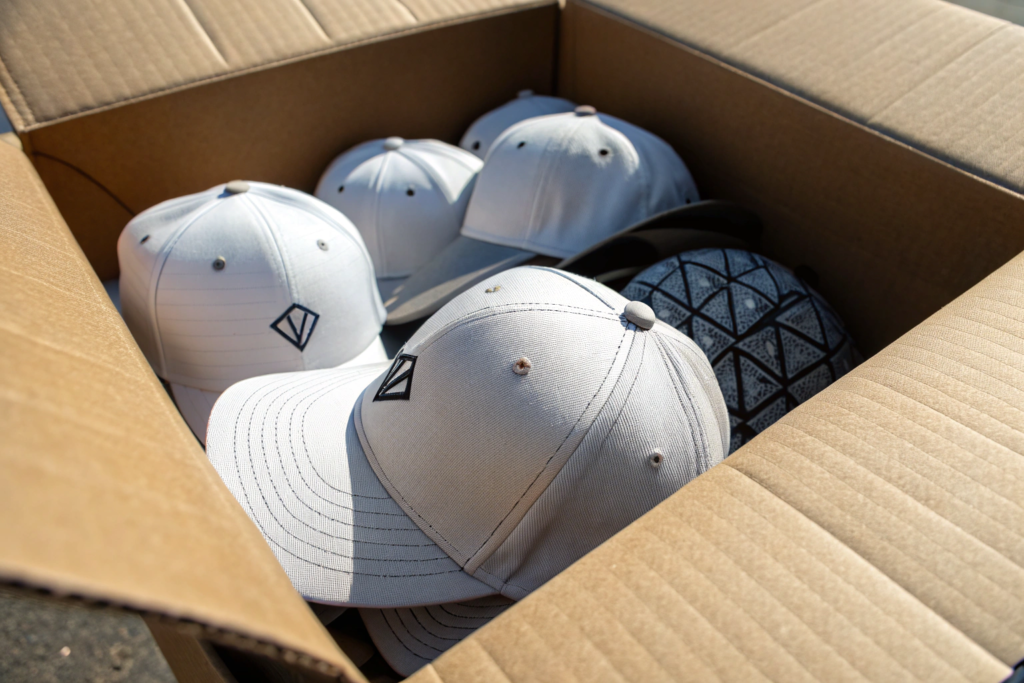
Structured hats cannot be crushed. The front panel has a plastic or buckram stiffener. We use a "nesting" technique. We stack the hats like traffic cones. The sweatband of one hat sits inside the crown of the next. We call this the "spoon stack."
For a standard order of 24 baseball caps, the traditional packing uses a large rectangular box with cardboard dividers. The volume is huge because each hat sits in its own cubicle. The nesting method eliminates the dividers. We lay the hats in a single flowing row. We zip-tie the brims together to lock the position. The carton height drops by 30%. The dimensional weight drops accordingly. For fedoras and stiff-brim hats, we use a "brim up, brim down" alternating method. The brims overlap like roof tiles. We place a foam ring between the brims to prevent chafing. This is precision packing. Our shipping department trains for weeks on these specific configurations. It is not random.
Why Should You Avoid Cardboard Dividers in Hat Boxes?
Dividers protect. But they eat space. A divider has a thickness of 3 millimeters. Multiply that by 10 dividers. You lose 3 centimeters of box length.
Dividers also add weight. Cardboard is heavy. They increase the actual weight without adding protection that a snug nest cannot. We print the care instructions on a thin paper sleeve that wraps the hat. This replaces the bulky product card. Every millimeter and every gram counts in the dimensional weight game. We use a 3-ply corrugated box instead of a heavy 5-ply. It is still crush-resistant, but lighter. This is called right-sizing the packaging.
What Is the Best Box Shape for Air Freight Hat Shipments?
Cubes are bad. A cube has equal dimensions. It maximizes volume relative to the product. We use a "flat and wide" box for brimmed hats.
A standard fedora box might be 45cm long, 45cm wide, and 20cm high. The volume is 40,500 cubic centimeters. If we pack the same hats in a box that is 60cm long, 30cm wide, and 15cm high, the volume is 27,000 cubic centimeters. That is a 33% volume reduction, but the hats fit perfectly. The dimensional weight drops by a third. The carrier’s fee drops by a third. This is the simple geometry of logistics. Our project managers calculate the optimal aspect ratio for every hat style. We test it in a drop test to ensure the flatter box still protects against corner impacts. The science of carton dimension optimization is a permanent part of our development process.
What Role Does the Hat Design Itself Play in Freight Cost?
The best way to avoid dimensional weight charges is to design the hat to collapse. A rigid hat is a shipping liability. A flexible hat is a shipping asset.
Our design team works on "travel-friendly" construction. We use a memory-wire brim. The brim has a thin, spring-steel wire sewn into the edge. You can twist the hat into a figure-eight. You slip it into a tiny pouch. The customer opens the pouch. The hat springs back open. No creases. No damage. The shipping volume is 10% of a standard hat. This product innovation solves the dimensional weight problem permanently. We also use snap-stud brims. A wide beach hat has a snap on the crown. You fold the brim up and snap it. It packs flat. These design features are selling points. They add value to the consumer and reduce the freight bill. It is intelligent design.
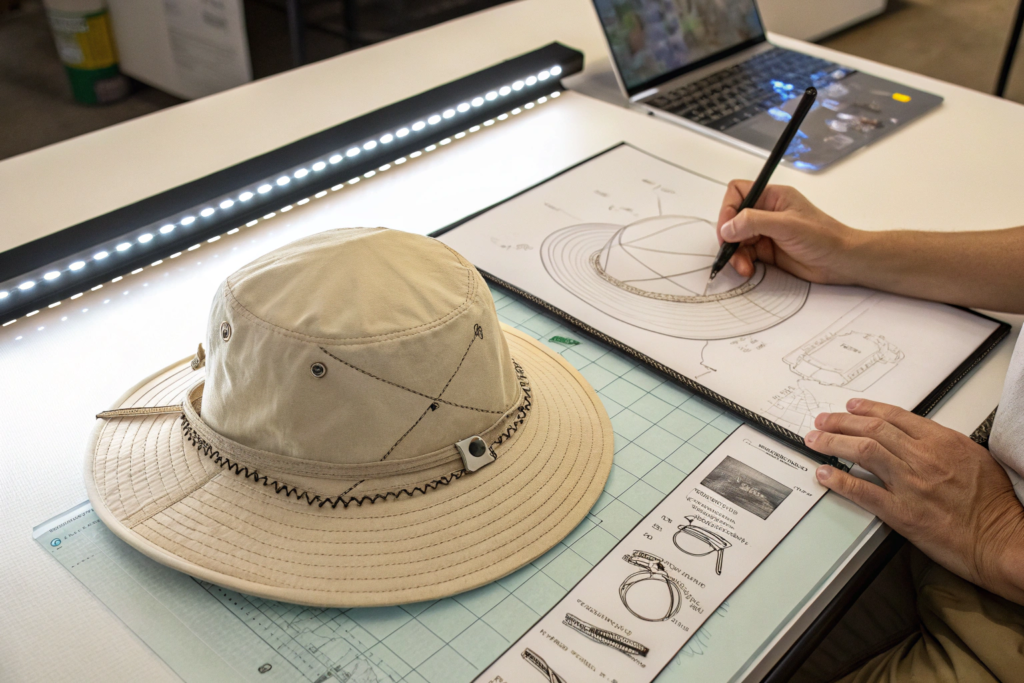
Can a Collapsible Hat Still Look Structured and Premium?
Yes, if the fabric has a "bounce-back" quality. We use a high-twist polyester taffeta. It looks like a stiff cotton but has the resilience of a spring.
The secret is the bias-cut binding. The edge of the brim is cut on the bias of the fabric. This allows it to stretch and recover without wrinkling. The memory wire is coated in plastic so it does not rust if the hat is packed wet. The result is a hat that can sit flat in a suitcase for a week and still look sharp on a dinner patio. It meets the quality standard of a premium resort brand while being a logistics dream. It is the perfect example of design for logistics.
How Do You Test a Foldable Hat’s Durability?
We use a repetitive compression machine. It folds the hat into a travel pouch and releases it 500 times. We then inspect the brim wire.
The wire must not kink. The fabric must not show permanent fold lines. We hang the hat and apply steam. It should return to 98% of its original shape profile. This is the factory standard. We call it the "packability test." It is a critical quality gate. A foldable hat that does not recover is just a crumpled mess. We guarantee ours recover. This assurance lets retailers sell a "packable" feature with confidence. It directly translates to lower shipping costs, which makes the retail price more competitive.
Conclusion
Air freight dimensional weight overcharges are a tax on bad packaging. Hats are inherently inefficient to ship because of their shape. But with smart engineering, that inefficiency disappears. Vacuum packing compresses soft beanies into dense tiles. Nesting techniques squeeze the air from between structured caps. Collapsible wire brims eliminate volume entirely. The right box shape aligns the dimensions with the carrier’s divisor.
In our Zhejiang factory, every hat design includes a logistics assessment. We do not just design for the look. We design for the journey. Our packing floor is trained in the specific configurations that minimize dimensional weight for FedEx, DHL, UPS, and commercial air freight. We send you the dimensional weight calculation with the sample. You know the shipping cost before you order.
If you are tired of losing money on air freight and want a factory that treats packaging as a profit center, I invite you to speak to our Business Director, Elaine. She can review your current hat designs and suggest the best packing method, or present our range of packable, travel-friendly styles. Send her an email at elaine@fumaoclothing.com. Let’s keep your freight bills light and your hats flying high.