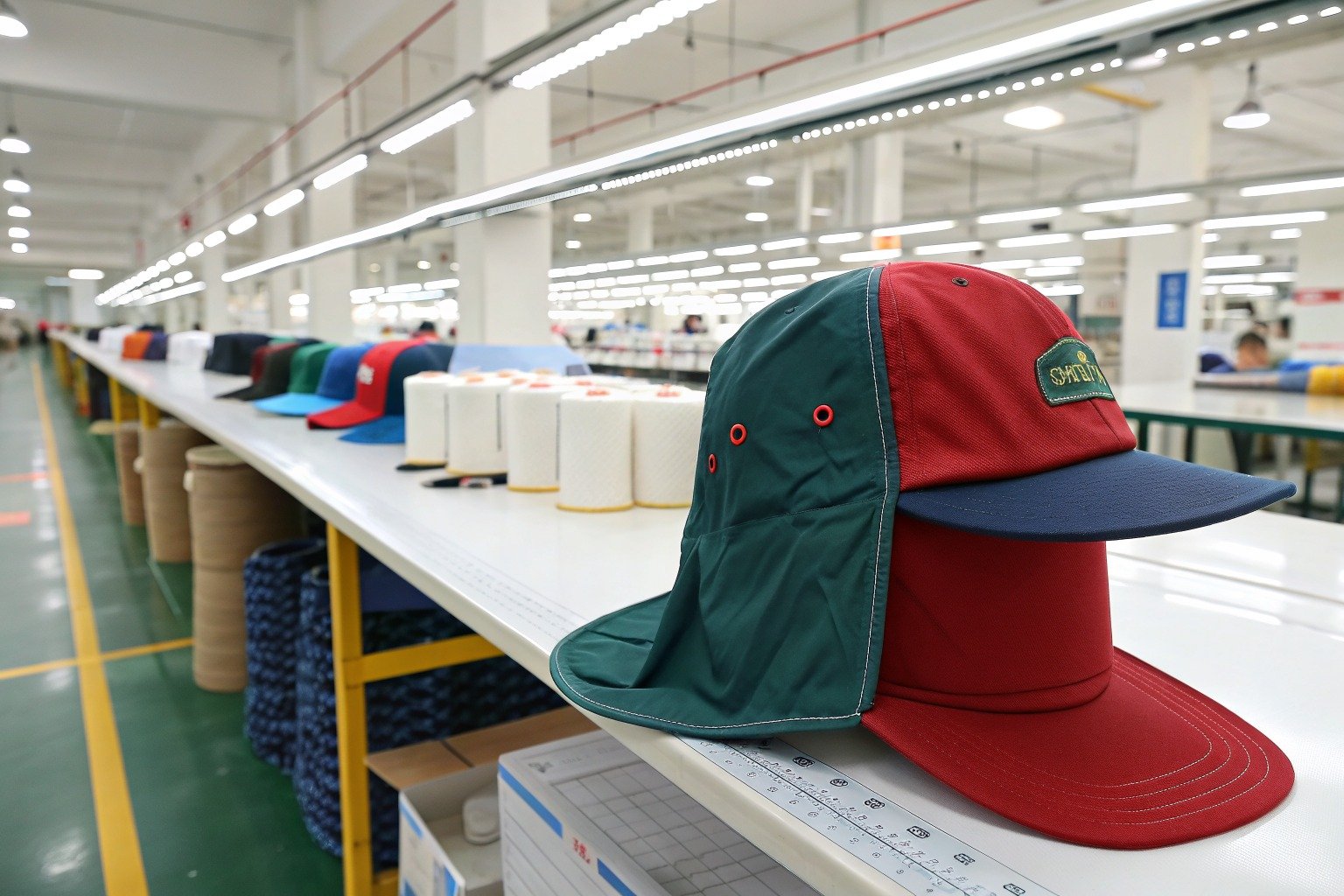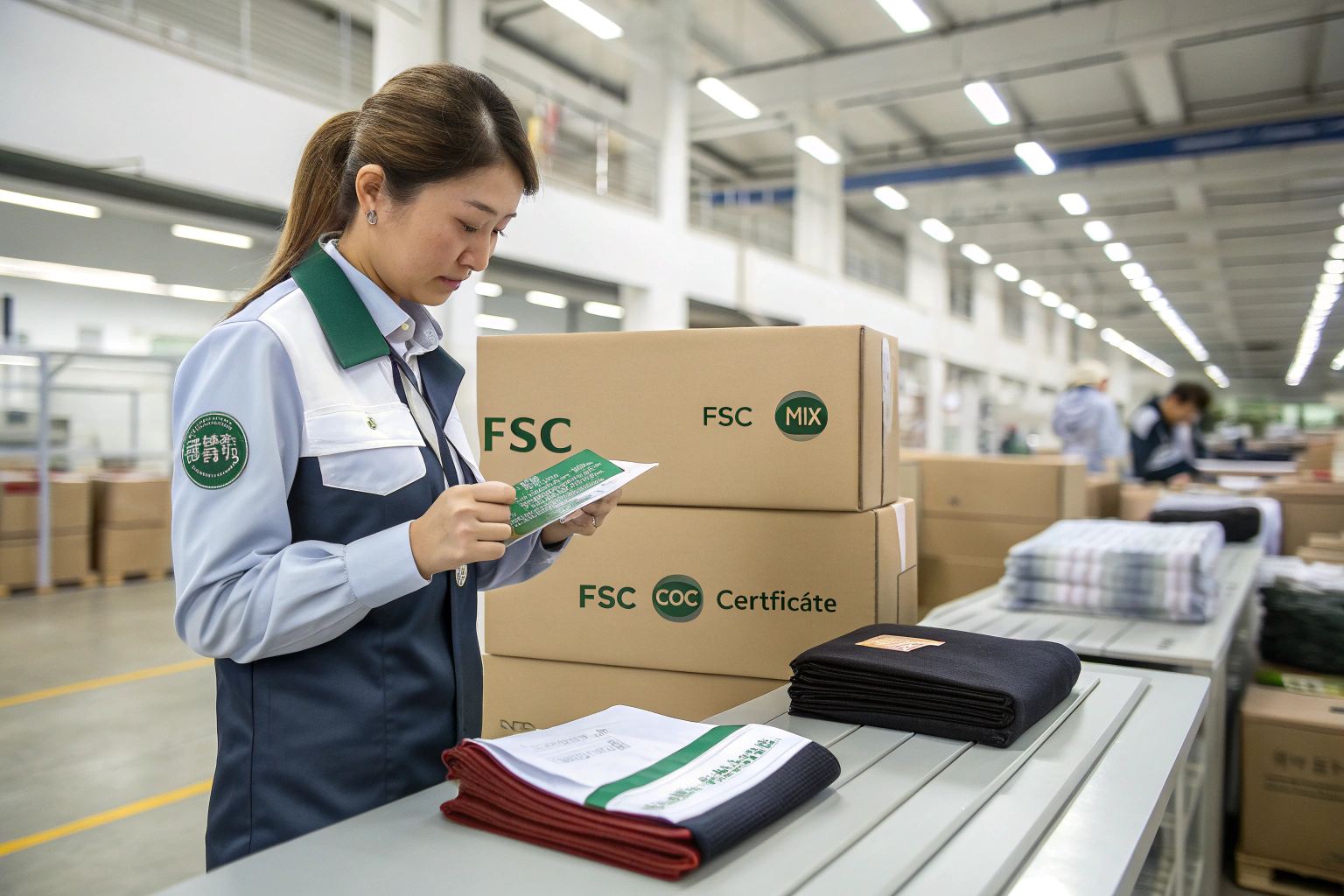
You ship a container of hair bands and scarves to a major European supermarket chain. Every product is OEKO-TEX certified, nickel-free, and AZO-free. The quality is perfect. The container arrives at the distribution center in Rotterdam, and the receiving inspector flags the shipment. The hair band hangtag card is printed on non-certified virgin paper. The scarf insert cardboard is unmarked. The entire shipment is quarantined, and the supermarket issues a non-compliance chargeback. You missed the packaging requirement. The product was compliant. The paper it sat on was not.
European supermarkets require FSC-certified packaging for accessories because the EU Timber Regulation and the upcoming EU Deforestation Regulation prohibit the sale of products associated with illegal logging or deforestation-linked supply chains. FSC chain-of-custody certification provides the legal documentation proving the paper, cardboard, and wood-fiber packaging components originate from responsibly managed forests, not from illegal clear-cutting operations in high-conservation-value forests.
This is not a voluntary sustainability preference. It is a legally enforced supply chain documentation requirement that carries the same weight as a product safety test. I want to explain exactly what FSC certification means at the packaging level, which specific packaging components trigger the requirement, how we maintain our FSC chain-of-custody certification in our Zhejiang facility, and what documentation the European supermarket’s compliance auditor expects to see before releasing the purchase order.
What FSC Labels Must Appear on a Hair Accessory Hangtag?
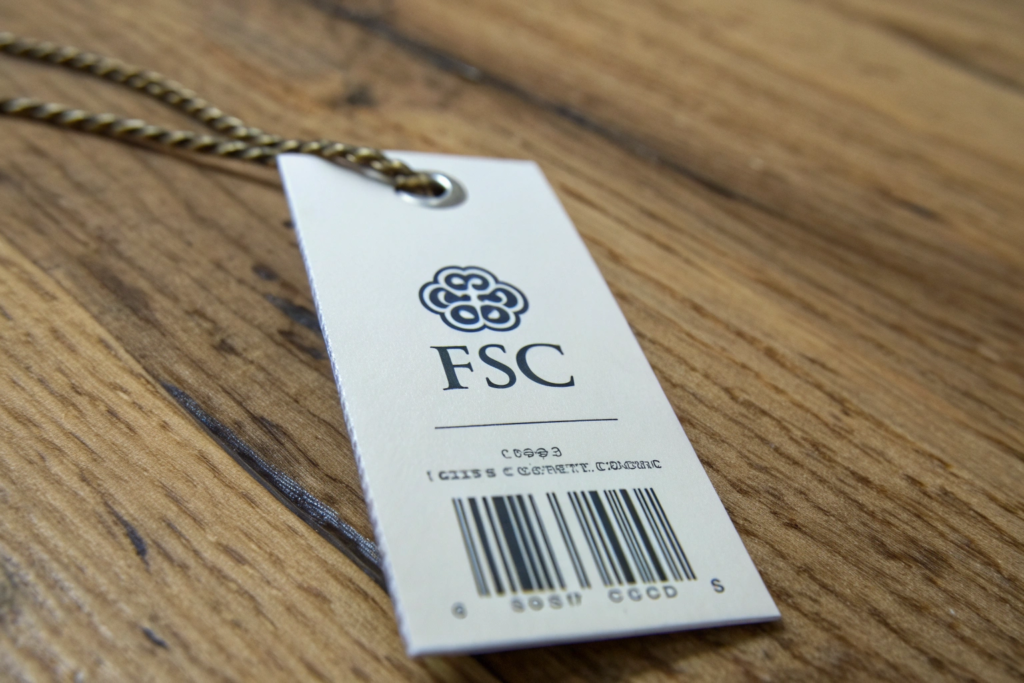
A hair band hangtag is a small piece of printed card, roughly 40 by 80 millimeters. It must fit the brand logo, the fiber content, the care instructions, the country of origin, the barcode, and now the FSC label. The FSC label is not optional and it is not a generic tree logo. It is a specific trademarked label with a specific chain-of-custody certificate number printed beneath the check-tree logo.
The FSC label on a hair accessory hangtag must state one of three designations: FSC 100% if the paper fiber comes entirely from FSC-certified forests, FSC Mix if the fiber is a blend of FSC-certified, recycled, and controlled wood sources, or FSC Recycled if the fiber is 100% post-consumer recycled material. Below the logo, the hangtag must display the chain-of-custody certificate number of the printing facility, not the accessory factory, so the paper trail can be audited.
We print our hangtags and insert cards through an FSC-certified printing partner in Ningbo. The printer’s FSC certificate number is embedded in the print file as a vector element, and it prints directly on every hangtag. The certificate number on the hangtag must match the printer’s active FSC certificate in the FSC database. We verify this quarterly.
Why does the certificate number belong to the printer, not the factory?
FSC chain-of-custody tracks the physical custody of the certified paper material from the forest to the paper mill, to the printer, to the accessory factory, and finally to the retail package. The entity that applies the FSC label to the finished paper product, in this case the printer, is the entity whose certificate number appears on the label. Our factory holds a separate FSC chain-of-custody certificate for handling the finished printed packaging and assembling it with the accessories, but our certificate number does not appear on the hangtag itself.
Can a small hangtag omit the FSC label due to space constraints?
No. The EU Timber Regulation and the retailer’s own supplier manual do not provide an exemption for small packaging. If the hangtag is too small to fit the full FSC label and certificate number at a legible font size, the FSC label can be printed on the back of the tag, or the tag can be slightly enlarged to accommodate it. The minimum font size for the certificate number is 5 points.
What Carton and Insert Materials Trigger an FSC Requirement?
The supermarket’s FSC policy typically applies to all paper and wood-fiber components that are in direct contact with the product or that are retained by the consumer after purchase. This definition captures more components than most suppliers realize.
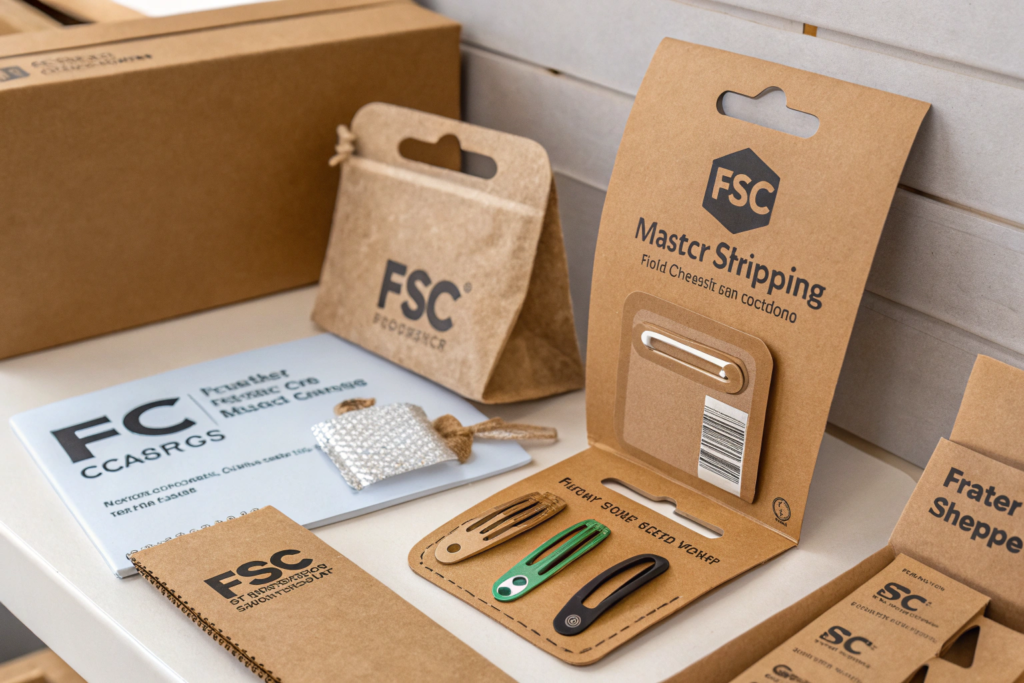
The packaging components that trigger an FSC requirement include the individual product hangtag card, the folded insert card that holds a pair of hair clips or a scarf, the blister card backing if made of paperboard, the tissue paper wrapping inside the product bag, and the retail shelf-ready display tray if it is made of cardboard and placed directly on the store shelf. The master shipping carton may be required to carry FSC certification at the retailer’s discretion.
We audit each new accessory SKU against a packaging material checklist before the first production run. The checklist identifies every paper or wood-fiber component, its function, its contact status with the product, and whether the retailer’s supplier manual requires FSC certification for that component.
Does the tissue paper inside a scarf polybag need an FSC label?
If the tissue paper is a branded tissue with the retailer’s logo, it is considered a retained packaging element that the consumer sees and keeps. It requires an FSC claim printed on the tissue or on a small adhesive label applied to the tissue. If the tissue is a plain, unbranded acid-free tissue used purely for protection during shipping, most retailers classify it as transit packaging and do not require an FSC label.
How is the shelf-ready display tray treated under the EU Deforestation Regulation?
A shelf-ready display tray made of corrugated cardboard, printed with the brand’s seasonal campaign graphics, and placed directly on the supermarket shelf is a retail packaging component subject to the FSC requirement. The FSC label is printed on the bottom panel of the tray. A plain brown shipping carton that stays in the back room and is never seen by the consumer is classified as transit packaging and is often exempt.
How Does an FSC Chain-of-Custody Audit Work for an Accessory Factory?
Holding an FSC chain-of-custody certificate is not a one-time purchase. It is an annual audit conducted by an accredited certification body, and the auditor physically traces a batch of certified packaging material from the receiving dock to the finished product shipment.
An FSC chain-of-custody audit for an accessory factory works by the auditor selecting a random batch of FSC-certified hangtags or insert cards from our inventory, requesting the supplier invoice showing the FSC claim, the delivery note, and the material transfer record that tracks that specific batch from receiving, through storage, through production assembly with the accessories, to the final shipment. The auditor verifies that the quantity of FSC-certified material purchased matches the quantity used and sold, preventing the introduction of non-certified material into a certified batch.
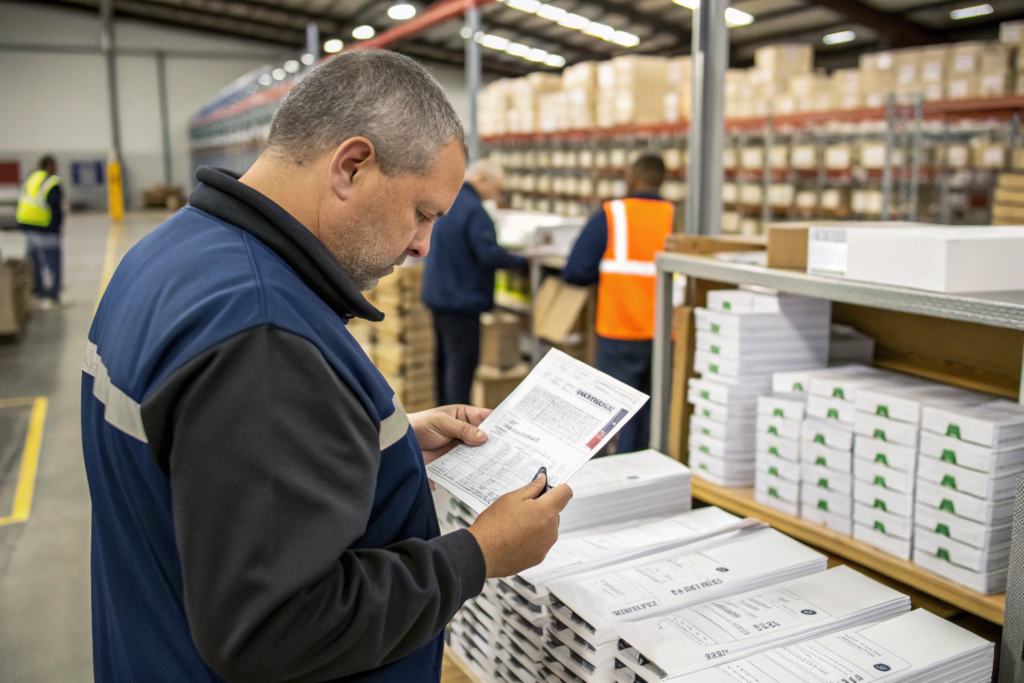
Our FSC certificate is audited annually by an auditor from SGS. The audit occupies one full day on-site. We maintain a dedicated FSC-certified material storage rack, clearly labeled, separated from non-certified paper goods. Every FSC-certified hangtag batch is assigned a unique lot number that links the printer’s invoice to the specific production order.
What documentation is required to pass the audit for a specific order?
For a specific supermarket order of 5,000 hair bands requiring FSC-certified hangtags, we must present four documents to the auditor: the printer’s FSC certificate, the printer’s invoice with the FSC claim and certificate number, our internal receiving record showing the quantity received and the storage location, and the production traveler showing the quantity of hangtags consumed during assembly. These four documents form an unbroken chain-of-custody.
What happens if non-certified paper accidentally enters the FSC batch?
If a worker mistakenly uses a non-certified hangtag on an FSC-required order, and this is discovered during final QC, the entire batch must be 100% inspected, every non-certified tag must be removed and replaced with a certified tag, and the non-conformance is recorded in our FSC non-compliance log. This log is reviewed by the auditor. Repeated non-conformances trigger a major non-conformity finding and potential certificate suspension.
What Penalties Does a European Supermarket Impose for Non-Compliant Packaging?
A supermarket supply agreement is a legally binding contract. The FSC packaging requirement is a specification clause in that contract. Breaching a specification clause triggers the same contractual penalties as shipping a product with incorrect dimensions or a missing safety label.
A European supermarket imposes a tiered penalty for non-compliant packaging: first offense, a warning letter and a requirement to submit a corrective action plan within 30 days. Second offense within 12 months, a chargeback of 3 to 5% of the invoice value of the non-compliant shipment, plus the cost of re-labelling or re-packaging at the retailer’s distribution center. Third offense, removal from the approved supplier list for a minimum of 12 months.
We have never reached a second offense with any client. Our packaging compliance checklist, our quarterly verification of our printer’s FSC certificate status, and our dedicated FSC-certified material storage rack prevent the error before the first accessory touches a hangtag.

Is the FSC compliance checked at the port of entry or at the distribution center?
The European customs authority does not routinely check for FSC labeling at the port, because FSC is a private certification standard, not a customs tariff regulation. The compliance check happens at the supermarket’s distribution center during the inbound quality inspection. The inspector scans a sample of hangtags and inserts and verifies the FSC label and certificate number are present and legible.
Can a shipment be re-labeled at the distribution center to avoid a chargeback?
The supermarket may permit re-labeling at the distribution center if the non-compliance is limited to a missing FSC label on an otherwise FSC-certified paper material. The supplier must provide the FSC claim documentation from the printer, pay a re-labeling fee of approximately 0.15 euro per unit, and accept a delivery delay. The re-labeling does not remove the first-offense warning from the supplier’s record.
Conclusion
FSC-certified packaging for accessories sold through European supermarkets is a mandatory supply chain documentation requirement rooted in the EU Timber Regulation and the upcoming Deforestation Regulation. The hair band hangtag, the scarf insert card, the tissue paper, and the display tray are all paper components that must carry a visible FSC label with the printer’s chain-of-custody certificate number. The factory must maintain a separate FSC chain-of-custody certification and pass an annual audit linking purchased certified material to shipped finished goods.
Our Zhejiang facility holds a current FSC chain-of-custody certificate. We source our hangtags and inserts exclusively from an audited FSC-certified printer, and we maintain the quarterly verification schedule, the certified material segregation, and the batch-level lot numbering that the SGS auditor reviews. Our packaging compliance checklist ensures every supermarket order leaves our dock with the correct FSC labels in place.
If you are preparing an accessory order for a European supermarket and need to confirm FSC packaging compliance or need guidance on which packaging components require the FSC label, contact our Business Director, Elaine. She will send you a copy of our FSC CoC certificate, a sample hangtag showing the correct FSC label placement, and the packaging compliance checklist we use for supermarket orders. Write to her at elaine@fumaoclothing.com. Let’s make sure your packaging passes the inbound inspection on the first scan.