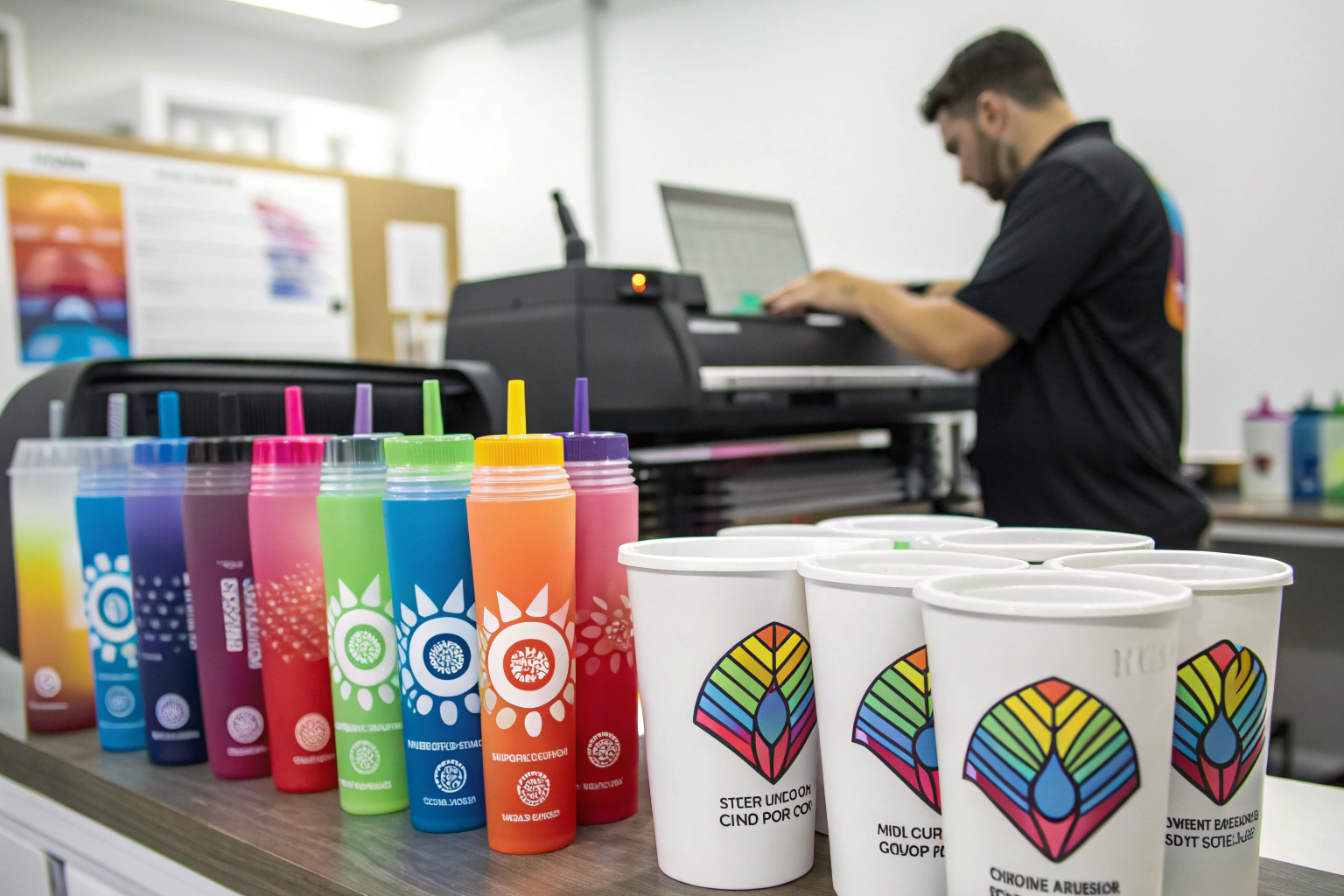
You have a beautiful, full-color logo. It has gradients, shadows, and photographic elements. It looks stunning on your website and on your screen. Now you want to put it on a cup for a promotional giveaway or a retail product. You email a factory in China and ask for a quote on custom printed cups. The factory replies with a list of acronyms you do not fully understand: sublimation, UV DTF, IML. The prices vary wildly. The sample photos look different. You are not just trying to print a logo. You are trying to choose a printing method that will make your brand look professional, not cheap, and will last through washes and daily use.
The most common and effective cup printing methods for full-color logos in 2026 are full-wrap dye sublimation for all-over photographic coverage on coated metal and polyester cups, UV DTF decal application for vibrant spot logos and gradients on any hard surface including glass and stainless steel, and In-Mold Labeling or IML for durable, high-volume production of plastic cups with complex graphics.
I manage AceAccessory in Zhejiang, and cups and drinkware are a significant part of our promotional and retail accessory business. The printing method you choose is the single most important factor in the final look, durability, and cost of your custom cup. Let me explain the three dominant methods for 2026 so you can specify your order with confidence.
Why Is Dye Sublimation the Gold Standard for Full-Wrap Photographic Prints?
If you have seen a stunning, full-color, edge-to-edge printed tumbler or water bottle, you have almost certainly seen dye sublimation. This printing method has become the dominant choice for premium promotional and retail drinkware, and for very good reasons. It produces a print quality that is unmatched in its vibrancy, detail, and durability.
Dye sublimation is a chemical process. Your full-color logo is printed onto a special transfer paper using sublimation inks. This paper is then wrapped tightly around the cup, which has a special polymer coating. The cup and paper are placed in a heat press. Under high heat and pressure, the solid ink on the paper turns directly into a gas. This gas penetrates the polymer coating of the cup and bonds with it at a molecular level. When the cup cools, the ink is permanently embedded in the coating. It is not a layer sitting on top of the surface. It is part of the surface.
Because the ink is embedded, it will not scratch, peel, or fade with normal use and washing. The print is seamless. The colors are vibrant and continuous-tone, meaning you can print photographs and complex gradients with perfect fidelity. This is the method we recommend for clients who want a premium, high-impact promotional product or a retail-ready drinkware item. This dye sublimation process for full color photographic printing on coated cups and tumblers is the premium choice for 2026.

What Types of Cups Are Compatible with Dye Sublimation?
Dye sublimation is not a universal method. It only works on surfaces that have been specially prepared with a polymer coating. The most common compatible cups are stainless steel tumblers and water bottles that have a sublimation coating, typically a white or clear powder coat finish. It also works exceptionally well on polyester fabric items, but for hard goods, the coating is essential.
It does not work on bare stainless steel, uncoated aluminum, or standard glass. The ink has nothing to bond to. It also does not work well on dark-colored surfaces because the sublimation inks are translucent and rely on a white base to appear vibrant. At AceAccessory, we clearly identify which of our cup styles are sublimation-ready. We source our coated stainless steel cups from suppliers who certify the quality and consistency of the sublimation coating. This compatible cup materials and coatings for dye sublimation printing is a critical specification.
What Are the Limitations of Dye Sublimation?
While the print quality is exceptional, sublimation does have limitations. The primary limitation is the material compatibility described above. The second limitation is the cost. The process requires specialized heat press equipment, sublimation paper, and inks. The production time per unit is longer than some other methods. This makes sublimation more expensive per unit than methods like pad printing or screen printing, especially for small quantities.
However, for full-color photographic logos, the other methods are simply not capable of achieving the same result. The value and perceived quality of a sublimated cup justify the higher cost for brands that prioritize a premium image. We are transparent with our clients about the cost-benefit analysis. This cost and material limitations of dye sublimation printing for cups helps clients make an informed decision.
Why Is UV DTF Decal Printing Exploding in Popularity for 2026?
If 2025 was the year the industry discovered UV DTF, 2026 is the year it becomes the standard for high-quality spot logos on a vast range of cup materials. UV DTF stands for Ultraviolet Direct-to-Film. It is a decal transfer process that combines the best of digital printing with incredible material versatility.
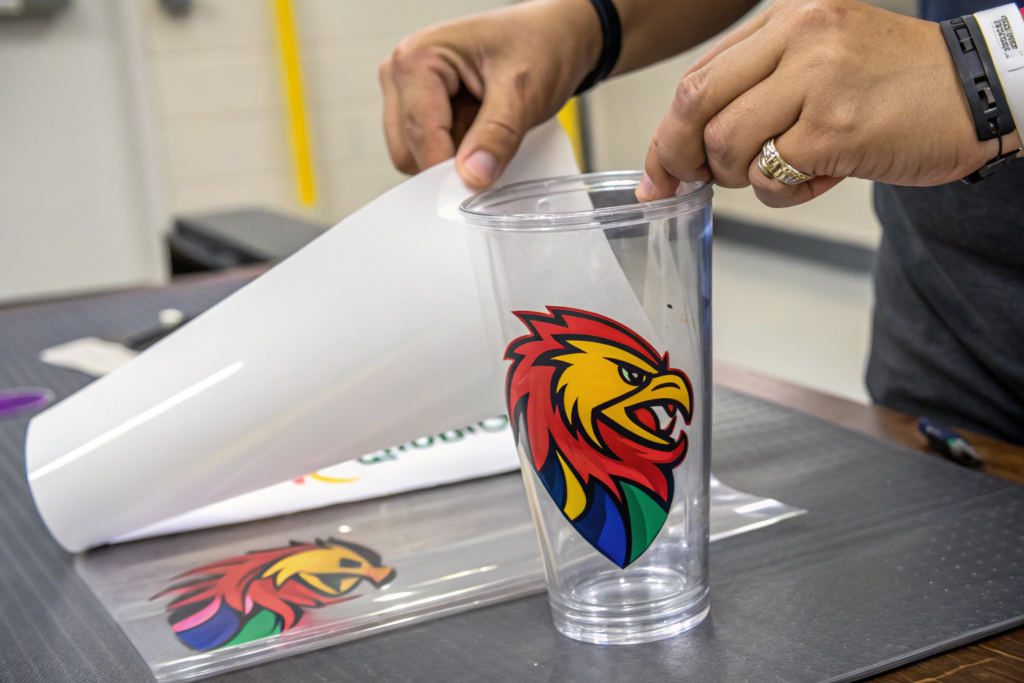
The process begins with a specialized printer that uses UV-curable inks to print your full-color logo onto a special dual-layer film. The printer lays down a white ink underbase first, then prints the CMYK colors on top, and finally prints a layer of adhesive. The result is a sheet of pre-made, ready-to-apply decals. To apply the decal to a cup, the transfer film is peeled away, the decal is positioned on the cup, and it is pressed firmly into place. The bond is instant and permanent.
The biggest advantage of UV DTF is its versatility. Because it is a decal, it can be applied to almost any hard surface: bare stainless steel, glass, ceramic, plastic, wood, and even powder-coated tumblers. It does not require a special coating like sublimation. The white ink underbase ensures that the colors are vibrant and opaque, even on dark or clear surfaces. It is perfect for spot logos on water bottles, wine glasses, coffee mugs, and even the bottom of a stainless steel tumbler as a complement to a sublimation wrap. This UV DTF decal printing process and advantages for spot logos on diverse cup materials is the most versatile method available.
How Does the Durability of UV DTF Compare to Sublimation?
UV DTF is highly durable, but in a different way than sublimation. A sublimation print is embedded in the coating. It is virtually indestructible as long as the coating remains intact. A UV DTF decal is a durable layer adhered to the surface. It is resistant to scratching, water, and normal handling.
However, it is a surface application. Under extreme abrasion, such as repeated scrubbing with a harsh scouring pad, a UV DTF decal can eventually be damaged. For normal use and hand washing, it is very durable. We recommend hand washing for all custom printed drinkware to maximize longevity, regardless of the printing method. For the vast majority of applications, UV DTF durability is excellent. This durability and care requirements for UV DTF decals on drinkware is comparable to high-quality screen printing.
What Are the Cost and Order Quantity Advantages of UV DTF?
UV DTF has a significant advantage in cost and flexibility for smaller order quantities. Because the decals are printed digitally on sheets, there are no screen setup fees or expensive mold costs. The setup cost is minimal. This makes UV DTF the ideal choice for orders of 100 to 1,000 units with a full-color logo.
You can even mix and match designs on the same order. You can order 100 cups with Logo A, 100 with Logo B, and 100 with Logo C for little to no additional setup cost. This flexibility is impossible with screen printing or In-Mold Labeling. It allows small brands, corporate gift programs, and event-specific merchandise to access high-quality full-color printing without committing to large minimum order quantities. This low setup cost and order quantity flexibility of UV DTF printing for promotional cups is driving its rapid adoption.
When Is In-Mold Labeling (IML) the Right Choice for Plastic Cups?
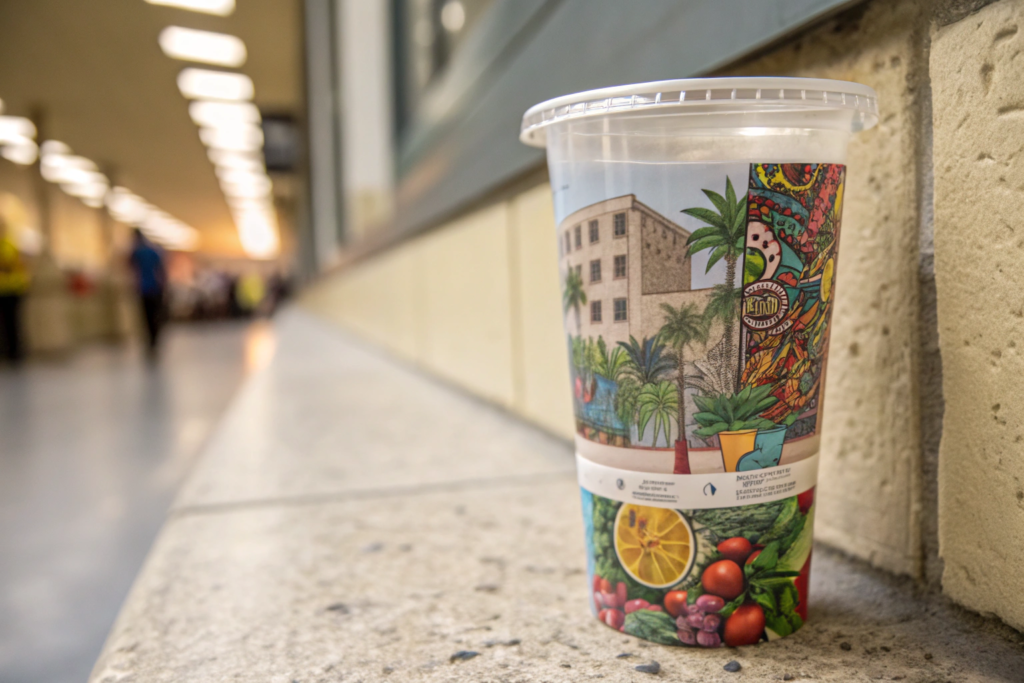
For high-volume production of plastic cups, such as stadium cups, reusable travel mugs, and promotional tumblers, In-Mold Labeling, or IML, is the gold standard for durability and premium appearance. It is a process where the decoration becomes an integral part of the cup itself.
The process begins with a pre-printed label. Your full-color logo is printed on a thin polypropylene film using high-quality gravure or digital printing. This label is precisely cut to shape. The label is then placed inside the cavity of an injection mold. Molten plastic is injected into the mold. The heat and pressure of the molten plastic fuse the label to the surface of the forming cup. When the cup is ejected from the mold, the label is not on the surface. It is the surface. It is chemically and mechanically bonded to the cup.
The result is a decoration that is completely permanent. It cannot be scratched off, peeled off, or faded by washing. It is resistant to moisture, oils, and everyday wear. The print quality is excellent. Because the label is printed before molding, it can achieve very high resolution and vibrant colors. This is the method used for the durable, high-quality plastic cups you see from major brands. This In Mold Labeling process for high volume durable plastic cup decoration is the industrial standard.
What Are the MOQ and Tooling Requirements for IML?
The primary barrier to entry for IML is the tooling cost and the minimum order quantity. An injection mold for a plastic cup is a precision tool that costs several thousand dollars to fabricate. The IML labels themselves require printing plates or cylinders, which also have setup costs.
Because of these fixed costs, IML is only economically viable for larger production runs. The typical MOQ for an IML cup is 5,000 to 10,000 units per design. Below this quantity, the amortized tooling cost makes the per-unit price very high. However, for a brand that orders 20,000 or 50,000 cups of the same design, IML offers an exceptional combination of durability, quality, and a competitive unit price at scale. We guide our clients through this cost-volume analysis. This minimum order quantity and tooling cost considerations for In Mold Labeling cups is a critical part of the decision-making process.
How Does the Print Quality and Durability of IML Compare?
IML print quality is excellent. Because the label is printed flat before being formed, it can achieve very high line screen resolution and precise color registration. The colors are protected by a layer of clear film or are embedded within the label structure. The durability is the highest of any printing method. An IML decoration will last as long as the plastic cup itself. It is the premium choice for a high-volume, long-lasting product. This durability and print quality comparison of IML versus other cup printing methods confirms its position as the top-tier option for plastic.
How Do You Choose Between Sublimation, UV DTF, and IML for Your Project?
Choosing the right printing method is a decision that balances four key factors: the cup material, the design complexity, the order quantity, and the budget. There is no single "best" method. There is only the best method for your specific project.
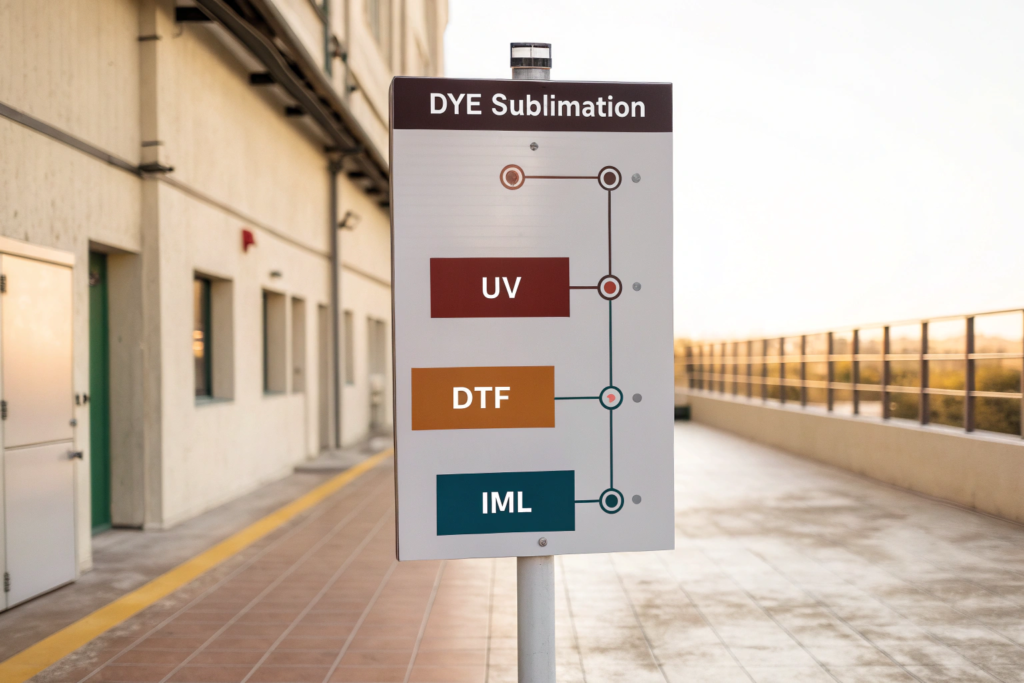
Here is a simple decision framework. If your cup is a coated stainless steel tumbler, your design is a full-wrap photograph or complex pattern, and your order quantity is 500 units or more, choose Dye Sublimation. If your cup is glass, bare stainless steel, or any uncoated hard surface, your design is a spot logo or a front-and-back print, and your order quantity is flexible from 100 to 5,000 units, choose UV DTF. If your cup is a plastic stadium cup or travel mug, your order quantity is over 5,000 units, and you require the absolute maximum durability, choose In-Mold Labeling.
At AceAccessory, we do not just quote a price. We consult with our clients to determine the optimal printing method based on their specific needs. We explain the trade-offs clearly. We provide samples of each method so you can see and feel the difference. This decision framework for selecting the optimal cup printing method sublimation UV DTF or IML ensures you invest your budget wisely.
Can You Combine Printing Methods on the Same Cup?
Yes, and this is a growing trend for premium products. You might use dye sublimation for a stunning, full-wrap landscape pattern on a tumbler, and then use UV DTF to apply a small, opaque brand logo on the bottom or on the opposite side. Or you might use UV DTF to apply a personalized name or monogram to a cup that already has an IML decoration. Combining methods allows you to leverage the strengths of each technology. Our production team can manage multi-process decoration. This combining multiple printing methods on a single drinkware item for unique effects creates a truly custom, high-value product.
What File Formats and Artwork Specifications Are Required?
The digital file you provide is the blueprint for the print. For all three methods, vector artwork is preferred for logos and text. Acceptable file formats are Adobe Illustrator .AI, .EPS, or high-resolution .PDF with fonts converted to outlines. This ensures sharp, clean edges. For photographic images in sublimation or UV DTF, a high-resolution raster file, 300 DPI at the actual print size, is required. We provide our clients with detailed artwork guidelines and a template for the specific cup dimensions. Our pre-press team reviews every file for potential issues before production begins. This required artwork specifications and file formats for custom cup printing prevents costly errors.
Conclusion
The world of custom cup printing for 2026 offers more high-quality, full-color options than ever before. Dye sublimation remains the champion for seamless, photographic all-over prints on coated metal drinkware. UV DTF decals have emerged as the versatile, low-minimum solution for vibrant spot logos on virtually any hard surface. And In-Mold Labeling continues to be the industrial workhorse for durable, high-volume plastic cups. Each method has its unique strengths, cost structure, and ideal application.
The key to a successful custom cup project is not just choosing a printing method, but choosing the right manufacturing partner who understands these technologies and can guide you to the best solution for your specific brand, budget, and quantity. At AceAccessory, we are that partner. We have invested in the equipment, the supplier relationships, and the technical expertise across all three of these key printing platforms.
If you are planning a custom cup or drinkware project for 2026 and want expert guidance on the best printing method for your full-color logo, I encourage you to contact our Business Director, Elaine. She can provide samples, discuss your specific requirements, and recommend the optimal solution. You can email Elaine at: elaine@fumaoclothing.com. Let us help you make your brand look its best on every cup.