I have been manufacturing accessories for over 15 years. In that time, I have seen many brands succeed. I have also seen many fail. One of the most common reasons for failure is supplier dependency. A brand that relies on a single supplier is vulnerable. I remember a client who sourced all her hair clips from one factory. The factory had a fire. Production stopped for six months. The client lost her entire season. She had no backup. She had no alternative. Her business never recovered. That experience taught me a hard lesson. Diversification is not optional. It is essential. Today, I want to share what I have learned about building a diversified accessory supplier portfolio.
Building a diversified accessory supplier portfolio involves sourcing from multiple suppliers across different regions, product categories, and capability tiers. A well-diversified portfolio includes primary suppliers for core products, secondary suppliers for volume flexibility, backup suppliers for risk mitigation, and niche suppliers for specialty items. You should also consider geographic diversification. Suppliers in different regions face different risks. A typhoon in Guangdong may not affect a supplier in Zhejiang. You should also diversify by capability. Some suppliers excel at high-volume production. Others excel at custom, low-volume work. By balancing these, you reduce risk, increase flexibility, and improve negotiating power. At Shanghai Fumao, we understand that our clients need diversification. We position ourselves as a reliable partner, but we also encourage clients to have a portfolio.
You might be thinking, "I have a good relationship with my current supplier. Why would I complicate things?" The answer is risk. A good relationship is valuable. But it does not protect you from a fire, a flood, or a sudden closure. Diversification is insurance. It is not about distrusting your current supplier. It is about protecting your business. Let me walk you through how to build a diversified portfolio.
Why Is Supplier Diversification Critical for Accessory Brands?
Supplier diversification is not a nice-to-have. It is a necessity. The accessory industry is vulnerable to disruptions. I have seen it firsthand. A supplier goes out of business. A factory is shut down for non-compliance. A shipping delay becomes a crisis. A single point of failure can destroy a brand.
Supplier diversification is critical because it mitigates risk, increases flexibility, and improves negotiating power. A single supplier creates a single point of failure. If that supplier has a problem, your business stops. Diversification spreads the risk. If one supplier has a delay, others can cover. Diversification also increases flexibility. You can allocate volume based on capacity, quality, or price. If one supplier is at capacity, you can use another. Diversification also improves negotiating power. When suppliers know you have alternatives, you get better pricing and service. For accessory brands, where margins are tight and trends move fast, diversification is essential.
I want to share a story about a client who learned this lesson. She had one supplier for her entire line of belts. The supplier was good. The relationship was strong. Then the supplier's owner retired. The new management was incompetent. Quality dropped. Deliveries were late. The client had no backup. She spent months finding a new supplier. She lost sales. She lost customers. Now, she has three belt suppliers. She has not had a disruption since.

What Are the Risks of Single-Supplier Dependency?
The risks are numerous. Operational risk: a fire, flood, or equipment failure can stop production. Financial risk: a supplier can go out of business unexpectedly. Quality risk: a supplier can have a quality decline with no alternative. Capacity risk: a supplier can be at capacity when you need to scale. Pricing risk: a supplier can raise prices with no competition. Geopolitical risk: tariffs or trade restrictions can affect a single region. Compliance risk: a supplier can fail an audit, and you have no alternative. All of these risks are real. I have seen each of them happen.
How Does Diversification Improve Negotiating Power?
When you have multiple suppliers, you are not captive. You can compare prices. You can negotiate better terms. If one supplier raises prices, you can shift volume to another. This competition benefits you. Suppliers know that you have options. They will work harder to keep your business. They will offer better service, better quality, and better pricing. I have seen clients save 10% to 20% simply by having alternatives. The negotiating power is real.
How Do You Structure a Diversified Supplier Portfolio?
Diversification is not random. It is strategic. You need to think about different roles. Some suppliers are your core. Some are your flexibility. Some are your insurance. I have developed a framework for structuring a portfolio.
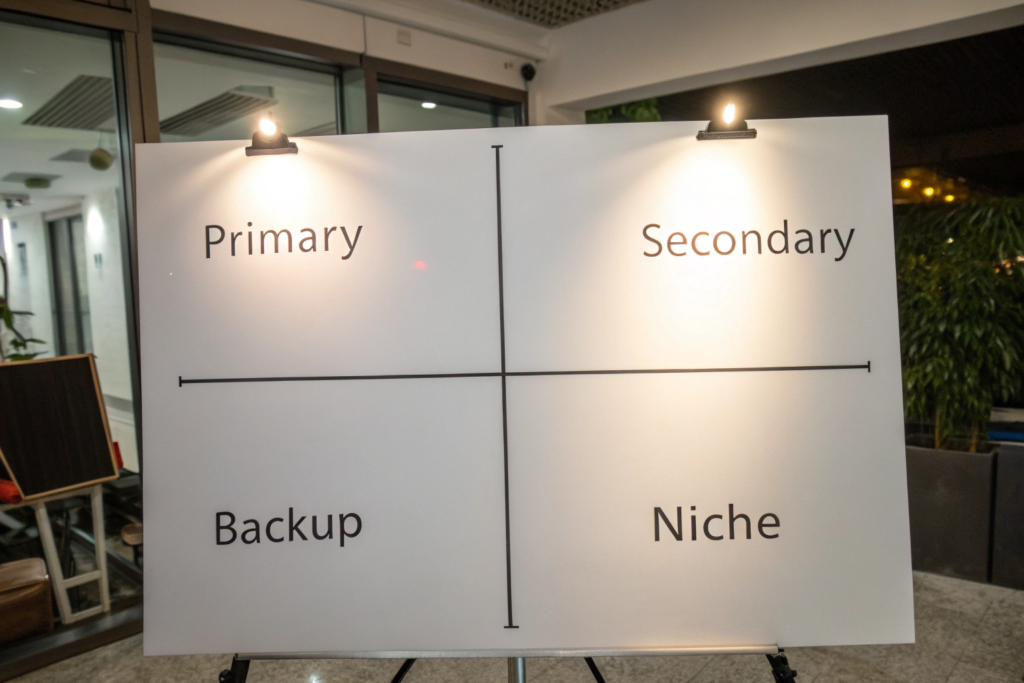
A diversified supplier portfolio should include four tiers: primary suppliers, secondary suppliers, backup suppliers, and niche suppliers. Primary suppliers are your core partners. They handle the majority of your volume. You have strong relationships with them. Secondary suppliers are for volume flexibility. When you need to scale up, they can take overflow. Backup suppliers are for risk mitigation. You may not use them regularly, but they are qualified and ready. Niche suppliers are for specialty items. They excel at specific materials, techniques, or styles that your primary suppliers do not offer. This four-tier structure balances efficiency with resilience.
I want to give a practical example. A client of ours has a primary supplier for their core hair clip line. They order 80% of their volume from us. They have a secondary supplier in another region for overflow. When they have a large promotion, they split the volume. They have a backup supplier they have qualified but not used. They test them annually. They have a niche supplier for handmade, artisanal clips. This structure gives them efficiency from the primary, flexibility from the secondary, security from the backup, and differentiation from the niche.
What Is the Role of Primary Suppliers?
Primary suppliers are your core partners. They handle the majority of your volume. You have strong relationships with them. They know your products. They understand your quality standards. They are invested in your success. With primary suppliers, you should negotiate favorable terms. You should share forecasts. You should build a partnership. The goal is efficiency and consistency. At AceAccessory, we serve as a primary supplier for many clients. We take that role seriously.
What Is the Role of Secondary and Backup Suppliers?
Secondary suppliers are for flexibility. When your primary supplier is at capacity, you use your secondary. When you have a spike in demand, they can handle it. Secondary suppliers should be qualified to your standards. You should order from them periodically to maintain the relationship. Backup suppliers are for risk mitigation. You may not use them regularly. But they are qualified. They are ready. If your primary supplier has a problem, you can activate your backup immediately. This prevents disruption. We encourage our clients to have secondary and backup suppliers. It protects us too. It ensures that if we have a problem, our clients are not stranded.
How Do You Diversify by Geography?
Geography matters. Different regions have different risks. A typhoon may hit Guangdong but miss Zhejiang. A trade policy may affect one region more than another. I have seen clients who sourced all their products from one city. When that city had a COVID lockdown, their supply chain stopped. Geographic diversification would have saved them.
Geographic diversification means sourcing from suppliers in different regions. In China, key accessory manufacturing regions include Guangdong (southern China), Zhejiang (eastern China), and Jiangsu (eastern China). Each region has different strengths. Guangdong is known for metal accessories and bags. Zhejiang is known for textiles, hair accessories, and hats. Jiangsu is known for high-end textiles and leather. By sourcing from multiple regions, you reduce the risk of regional disruptions. You also access different skill sets. A supplier in Zhejiang may be better at woven hats. A supplier in Guangdong may be better at metal buckles. Geographic diversification is a powerful risk mitigation tool.
I remember the COVID lockdowns in 2022. Factories in Guangdong were shut down. Our factory in Zhejiang was not. Clients who had suppliers only in Guangdong were stuck. Clients who had suppliers in multiple regions, including us, continued production. The geographic diversification saved them. It was a powerful lesson.

What Are the Key Manufacturing Regions in China?
China has several key accessory manufacturing regions. Guangdong province, centered on Guangzhou and Shenzhen, is known for metal accessories, bags, and electronics. It is a major hub for export. Zhejiang province, centered on Yiwu and Ningbo, is known for hair accessories, hats, scarves, and textiles. It is also a major export hub. Jiangsu province, centered on Suzhou and Nanjing, is known for high-end textiles, silk, and leather. Fujian province is known for shoes and apparel. Each region has different strengths. We are located in Zhejiang. We know the region well. We can help clients identify suppliers in other regions.
How Do You Manage Suppliers Across Different Regions?
Managing multiple suppliers across regions requires systems. You need clear specifications. You need quality control processes. You need communication protocols. You need to visit suppliers regularly. It is more work than managing a single supplier. But the benefits outweigh the costs. At AceAccessory, we help our clients manage their portfolio. We can produce in our factory. We can also introduce clients to trusted suppliers in other regions. This supplier network is part of our service.
How Do You Diversify by Product Category and Capability?
Not all suppliers are good at everything. Some specialize in metal. Some specialize in textiles. Some are great at high volume. Some excel at custom, low-volume work. Diversifying by capability ensures that you have the right supplier for each product.
Diversifying by product category and capability means matching suppliers to their strengths. A supplier that excels at metal hair clips may not be good at fabric headbands. A supplier that is great at high-volume production may not be good at custom, low-volume work. Your portfolio should include specialists. Have a supplier for metal accessories. Have a supplier for textiles. Have a supplier for leather. Have a supplier for high-volume production. Have a supplier for custom, low-volume work. This specialization ensures that each product is made by the best possible partner.
I want to share an example. A client needed both metal hair clips and fabric headbands. They initially used one supplier for both. The results were mediocre. The metal clips were good, but the headbands were poor. We advised them to split. They found a specialist for headbands. The quality improved. The costs were similar. The specialization made the difference.
How Do You Identify Supplier Strengths?
Identify supplier strengths by looking at their portfolio. What do they make most of? What are they known for? Ask them. A good supplier will be honest about their strengths. They will tell you if a product is outside their expertise. You can also ask for references. Look at their equipment. A supplier with metal stamping machines is good for metal. A supplier with embroidery machines is good for fabric. We are transparent about our strengths. We excel at hair accessories, headwear, belts, and scarves. We are honest about what we do best.
How Do You Balance High-Volume and Low-Volume Suppliers?
High-volume suppliers are efficient. They have automated lines. They have low unit costs. But they may have high minimum order quantities. Low-volume suppliers are flexible. They have lower MOQs. They can handle custom work. But their unit costs are higher. In a diversified portfolio, you use high-volume suppliers for your core, stable products. You use low-volume suppliers for test products, custom orders, and seasonal items. This balance optimizes cost and flexibility. We offer both high-volume and low-volume production. Our flexible MOQ program supports clients at all stages.
Conclusion
Building a diversified accessory supplier portfolio is essential for long-term success. It mitigates risk. It increases flexibility. It improves negotiating power. A single supplier is a single point of failure. Diversification spreads the risk.
A strong portfolio has four tiers: primary suppliers for core volume, secondary suppliers for flexibility, backup suppliers for risk mitigation, and niche suppliers for specialty items. It is diversified by geography, product category, and capability. Suppliers are qualified through a rigorous process. Relationships are maintained through regular orders, communication, and visits.
At Shanghai Fumao, we are proud to be a trusted partner in our clients' portfolios. We specialize in hair accessories, headwear, belts, scarves, and bags. We have the capacity and flexibility to serve as a primary or secondary supplier. We also have a network of trusted partners to support your diversification. Your business deserves a resilient supply chain. Let us help you build it.
Please contact our Business Director, Elaine, at elaine@fumaoclothing.com to discuss how we can fit into your diversified supplier portfolio. We can help you identify gaps and introduce you to trusted partners to build a resilient, flexible supply chain.