I still remember the call I got from a client five years ago. She was furious. Her latest shipment of scarves had arrived, and the colors did not match the previous batch. The red was too bright. The blue had a purple undertone. She had already sold the product to her retailers based on the first batch. Now she had a warehouse full of scarves that looked wrong next to each other on the shelf.
That was a hard lesson for both of us. And it is a problem I see over and over again in this industry. Color inconsistency is one of the most common and most frustrating issues in accessory production. It destroys brand identity. It confuses customers. And it creates huge headaches for importers.
I am the owner of AceAccessory. Our factory in Zhejiang produces thousands of scarves every month. And over the years, we have developed a system that ensures color consistency, batch after batch. Let me share with you exactly how we do it, and how you can build this reliability into your own supply chain.
Understanding Why Color Varies Between Production Runs?
I have learned that color variation is not a mystery. It is caused by specific, measurable factors. Once you understand these factors, you can control them. But if you ignore them, they will control you.
The first thing I tell every new client is this: color is chemistry. It is not just about picking a pretty shade from a Pantone book. It is about how dye interacts with fiber, how heat affects the process, and how different materials absorb color differently.
What Causes Color Differences in Natural vs. Synthetic Fibers?
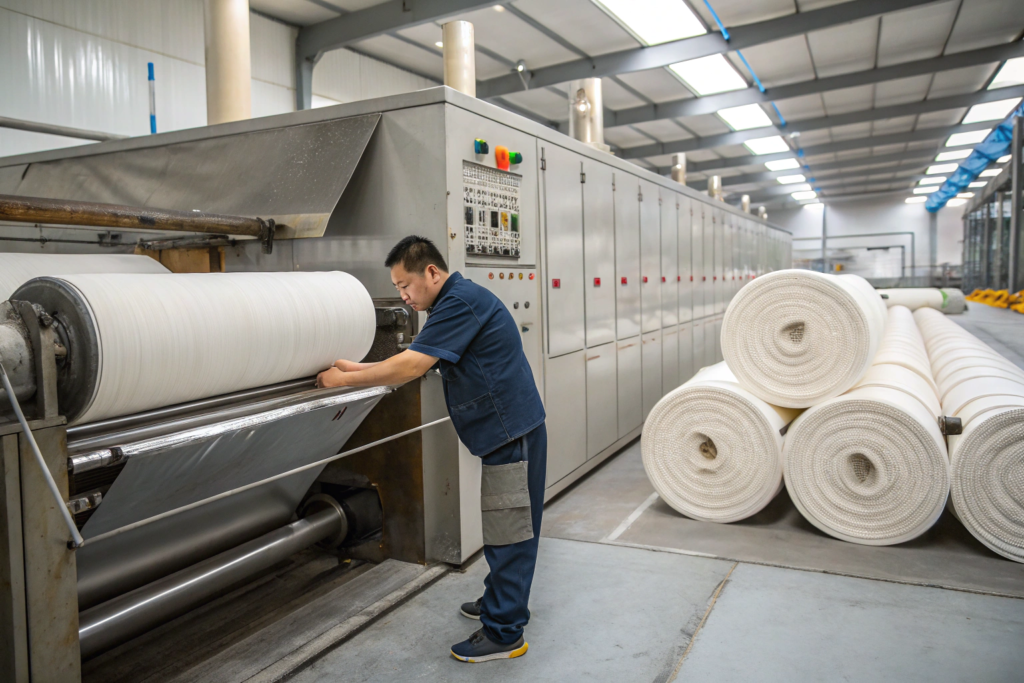
This is where many buyers get surprised. A scarf made from cotton will take dye differently than a scarf made from polyester. Even within the same fiber type, variations can happen.
Let me give you an example. We once produced a run of silk-blend scarves for a luxury client. The first batch was beautiful. The color was rich and even. For the second batch, we had to use silk from a different supplier because of a shortage. The fiber structure was slightly different. Even though we used the exact same dye formula, the color came out one shade lighter. We caught this before shipping. We showed the client. We explained the situation. We offered to re-dye the batch or source the original silk at a higher cost. The client appreciated the honesty. They chose to source the original silk, and we absorbed the extra cost to keep them happy.
The lesson here is simple: fiber type matters. Natural fibers like cotton and silk absorb dye differently than synthetic fibers like polyester and nylon. And even within the same fiber type, different suppliers or different lots can behave differently. We now test every batch of fabric before we start production. We run a small dye test. We compare it to the original standard. Only then do we proceed.
How Do Dye Lots and Batch Numbers Impact Color Matching?
This is a technical point, but it is critical. Dye is produced in batches. Each batch of dye has slight variations. A reputable dye supplier will provide a batch number and a dye specification sheet. If you do not track these numbers, you are flying blind.
Imagine this: your first batch of scarves uses dye lot A. Six months later, you order a second batch. The factory buys dye from the same supplier, but they get dye lot B. Even if the dye formula is the same, lot B might be slightly different. Maybe the pigment concentration is a fraction lower. Maybe the manufacturing process changed slightly.
We avoid this by buying enough dye for the entire production run. If a client plans to produce 10,000 scarves over three batches, we buy all the dye at once. We store it properly. We use it for each batch. This ensures that the dye chemistry is identical for every scarf we make.
We also keep detailed dye lot records for every order. If a client comes back a year later for a reorder, we can look up the exact dye lot we used. We can order the same dye from the same supplier. Or we can run a new dye test and adjust the formula to match the original.
This attention to detail is what separates a professional factory from a commodity supplier. It takes work. But it protects your brand identity.
The Role of Standardized Lighting and Visual Assessment
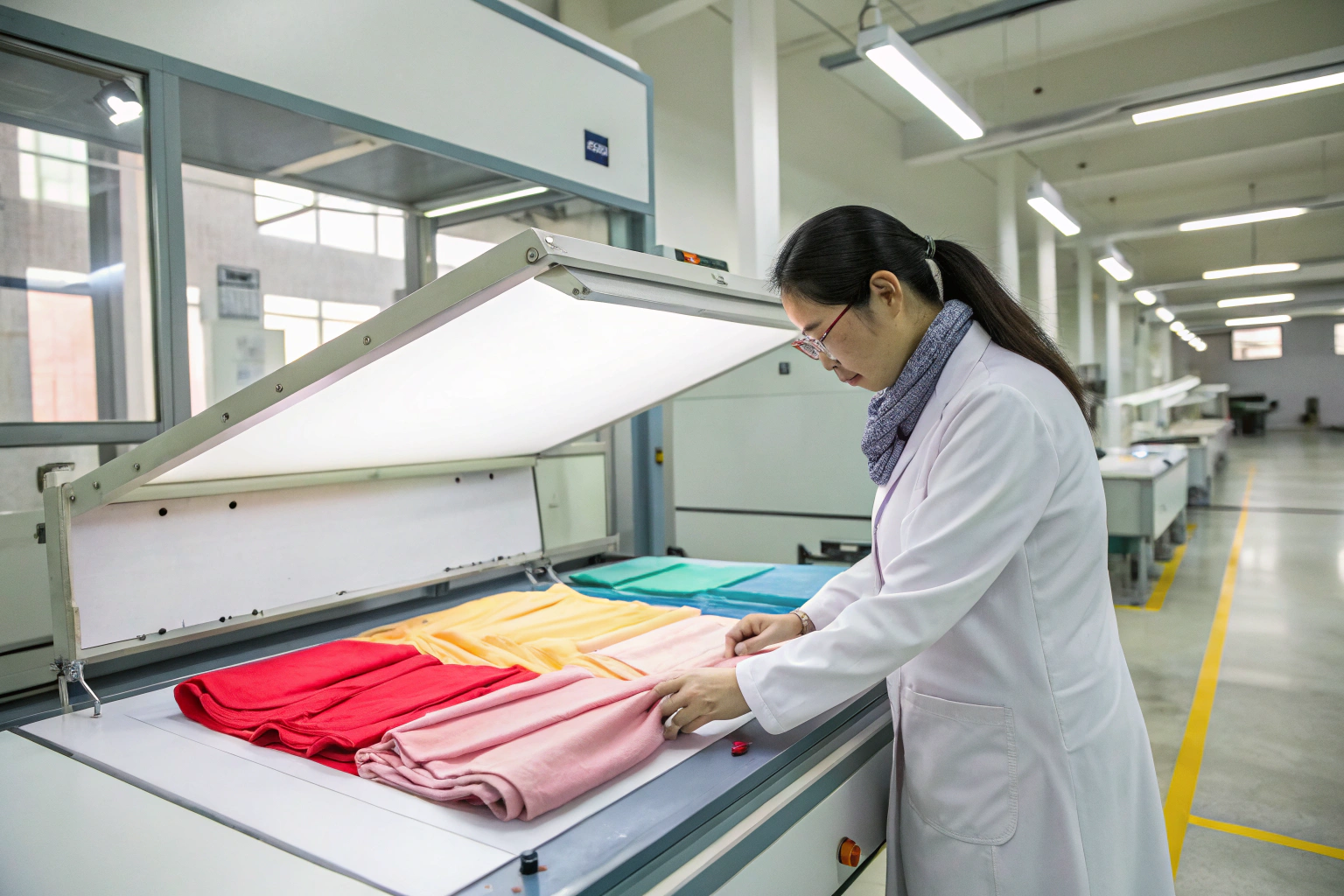
I have walked into many factories where the quality control team checks colors under regular fluorescent lights. Or worse, under natural light coming through a window. This is a disaster waiting to happen. Light changes everything. A scarf that looks perfect in your office lighting might look completely different under the fluorescent lights of a department store. And it will look different again under sunlight.
Why Is Light Booth Testing Essential for Color Approval?
This is one of the most important lessons I have learned in my career. You cannot trust your eyes under a single light source. You need to see how the color performs under different lighting conditions.
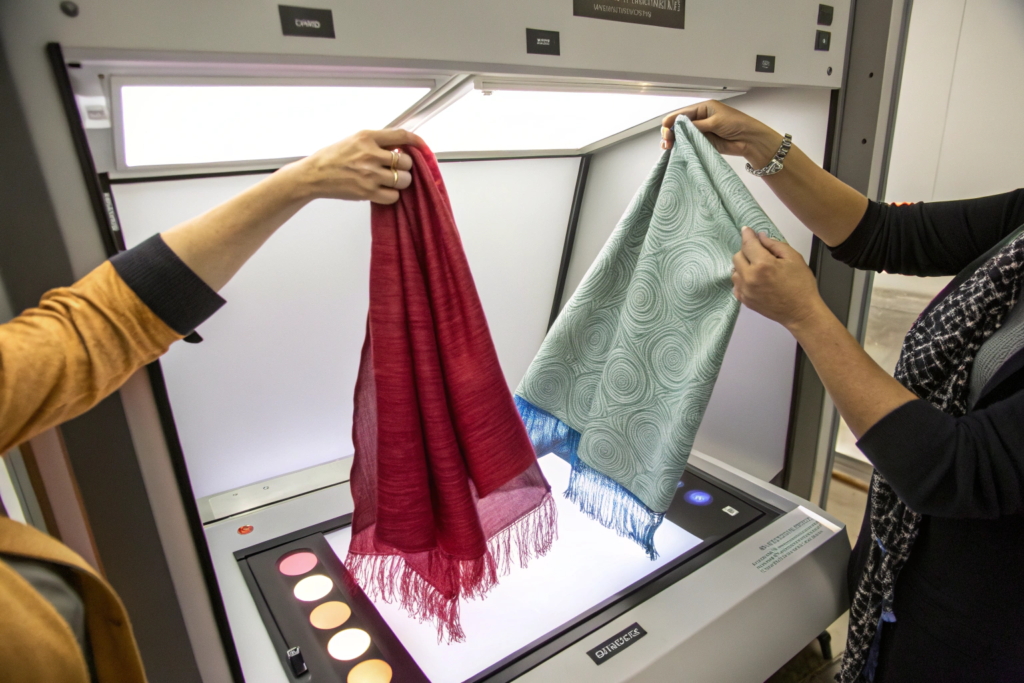
We use a standardized color assessment light booth for every color approval. This booth has multiple light settings. We check the scarf under daylight simulation. We check it under cool white fluorescent light, which mimics office and retail lighting. We check it under incandescent light, which mimics home lighting.
If the color looks consistent under all three lights, we approve it. If it shifts, we go back to the dye house and adjust the formula.
I remember a client who had a terrible experience with another supplier before coming to us. They approved a scarf color under the natural light in their office. The supplier approved it under the fluorescent lights in their factory. Both thought the color was correct.
When the scarves arrived, they looked perfect in the client’s office. But when their retail partner put them on the shelf under the store’s lighting, the scarves looked muddy and dull. The client had to discount the entire batch.
We use the light booth to prevent exactly this problem. We also provide our clients with light booth photos and reports for every color approval. They can see exactly how the color performs before we start mass production.
How to Set Up a Reliable In-House Color Checking Process?
You do not need to have a light booth in your own office. But you do need a reliable process. Here is what I recommend to all my clients.
First, always request a physical color standard. A Pantone number is a good starting point. But Pantone colors are printed on paper. Fabric absorbs dye differently than paper absorbs ink. So a Pantone number is a reference, not a guarantee.
We always create a physical fabric color standard for each project. We dye a small piece of the actual fabric to the target color. We cut it into swatches. We send one to the client for approval. We keep one in our own files.
Second, use the same light source for every color check. If you check colors in your office, use the same lamp every time. Better yet, invest in a small portable light booth. They are not expensive, and they save you from costly mistakes.
Third, always compare new batches to the original physical standard. Do not rely on memory. Do not rely on photos. Hold the new sample next to the original standard under consistent lighting. If they match, you are good. If they do not, reject the batch.
We follow this process for every single order. It adds a few minutes to the quality check. But it has eliminated color complaints from our clients for years.
Implementing a Systematic Dyeing and Production Protocol
Consistency does not happen by accident. It happens by design. In our factory, we have a written protocol for every dyeing and production process. We follow it exactly, every time. This is how we ensure that the 10,000th scarf looks the same as the first.
I learned this lesson from a mistake we made early in our business. We had a big order for solid-color scarves. The first batch was perfect. For the second batch, a different operator ran the dyeing machine. He used a slightly different temperature setting. The color came out half a shade darker. We caught it. We re-dyed the batch. But we lost time and money. That is when I realized we needed a system that did not depend on individual judgment.
What Are the Key Parameters to Control in Dyeing?
Dyeing is a science. There are specific variables that affect the final color. If you control these variables, you control the color. If you let them vary, your color will vary.
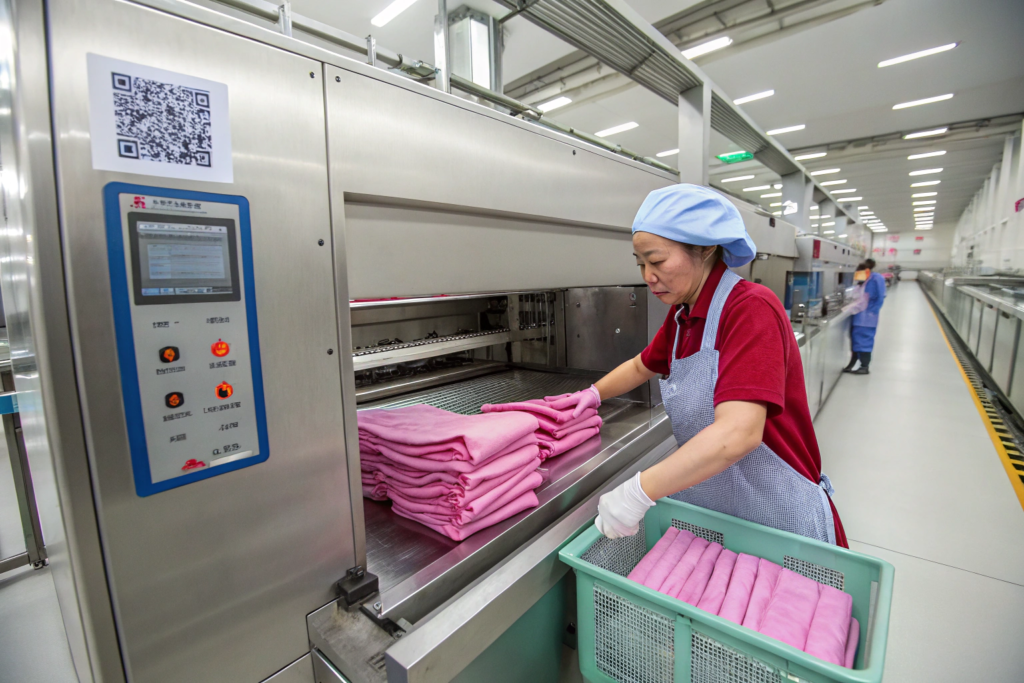
The first variable is temperature. Different dyes react at different temperatures. We set the temperature precisely. We monitor it throughout the dyeing cycle. We use digital temperature controls that log the data. If the temperature fluctuates outside the specified range, the machine alerts the operator.
The second variable is time. Dye needs time to bond with the fiber. We set a specific dyeing time for each color and each fabric type. We do not cut it short to save time. We do not extend it to make the color darker. We follow the protocol exactly.
The third variable is the dye-to-water ratio. Too much water, and the color comes out pale. Too little water, and the color comes out uneven. We measure carefully. We use the same ratio for every batch.
The fourth variable is the fabric preparation. Fabric needs to be clean and properly prepared before dyeing. Any residual chemicals or oils will affect how the dye absorbs. We have a pre-treatment process that we follow for every batch.
We document all these parameters for every order. We call this our dyeing protocol sheet. When we repeat an order, we pull the sheet. We set the machines exactly the same way. The result is color consistency.
How to Document and Repeat Successful Color Formulas?
This is where good record-keeping becomes invaluable. We have a database of every color we have ever produced. It includes the dye formula, the fabric type, the temperature, the time, and the dye lot numbers.
When a client reorders a scarf from a previous season, we do not start from scratch. We pull up the record. We check if we have any of the original dye lot left. If we do, we use it. If we do not, we order new dye that matches the original formula. Then we run a test to confirm the match.
We also keep physical color standards for every client. These are small fabric swatches attached to a card with all the production details. We keep one in our color library. The client keeps one for their reference.
I remember a client who came to us with a problem. They had a scarf that was selling well. They needed to reorder, but the original factory had gone out of business. They had no record of the dye formula. They only had a sample scarf.
We analyzed the sample. We reverse-engineered the dye formula. It took a few tests, but we matched it exactly. We then created a full protocol for that color. Now that client can reorder that scarf from us anytime, and the color will be consistent.
This is the power of documentation. It turns a one-time order into a repeatable production process.
Quality Control Checks at Every Stage, Not Just the End
I have visited many factories where the only quality check happens at the end. The scarves are folded, packed, and ready to ship. Then someone checks a few samples. If they look okay, the order goes out.
This is not quality control. This is quality hope. And hope is not a reliable strategy. In our factory, we check color at every single stage. We catch problems early, when they are easy to fix. We do not wait until the end, when fixing a problem means re-dyeing thousands of scarves or missing a shipping deadline.
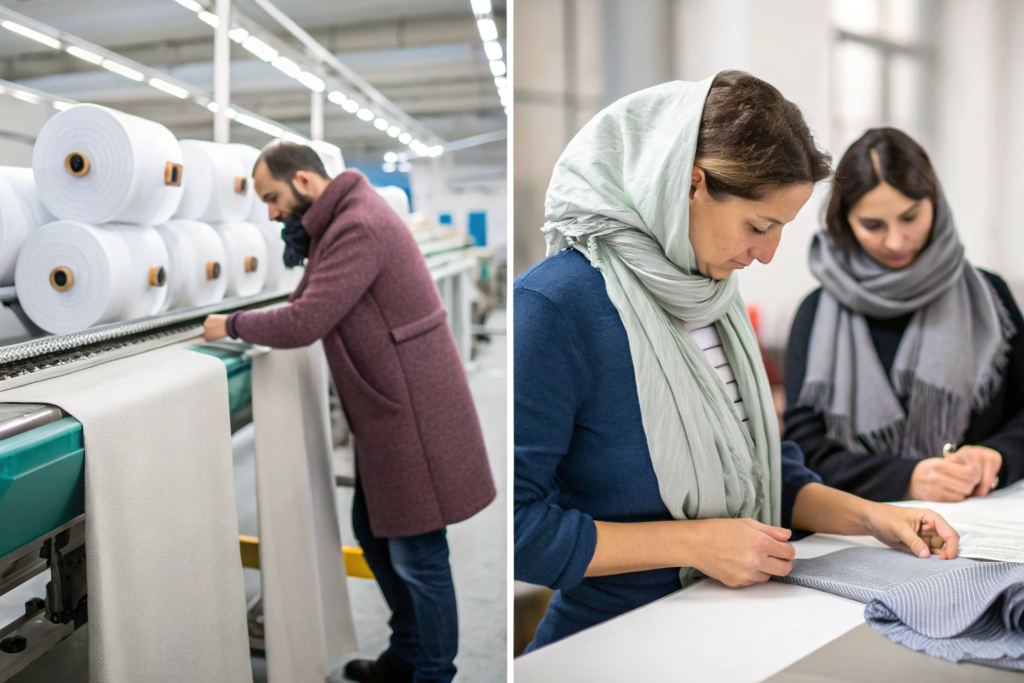
What Are the Critical Inspection Points in Scarf Production?
We have five critical inspection points for every scarf order. I want to share them with you so you can ask your own factory about their process.
The first inspection is on the raw fabric. Before we dye anything, we check the incoming fabric. We look for defects. We test for shrinkage. We verify that the fabric is clean and ready for dyeing. This is our raw material inspection point.
The second inspection is during the dyeing process. We do not just set the machine and walk away. We monitor the temperature and time. We take samples during the dyeing cycle. We check the color development. If something looks wrong, we stop and adjust.
The third inspection is after dyeing but before finishing. The fabric is still wet. We check the color under the light booth. We check for evenness. We measure the color with a spectrophotometer, which gives us a precise numerical reading. This is more accurate than the human eye.
The fourth inspection is during cutting and sewing. We check that the color is consistent across the entire scarf. We check that the stitching matches the fabric color. We check that there are no oil stains or marks from the sewing machines.
The fifth inspection is on the finished product. Every scarf is checked before it goes into the packing box. We do not sample-check. We do 100% inspection for color, workmanship, and size.
We call this our five-point quality control system. It adds time to production. But it adds reliability to our promise.
How to Use Spectrophotometers for Objective Color Measurement?
This is a tool that many smaller factories do not have. But it is a game-changer for color consistency. A spectrophotometer is a device that reads color numerically. It gives you a precise measurement, not just a visual opinion.
We use a spectrophotometer for every color we produce. We take a reading of the original color standard. We record the numbers. Then we take readings of each production batch. If the numbers match within an acceptable range, we approve. If they are outside the range, we reject.
This is especially important for clients who produce the same color across multiple product types. For example, a client might want a matching scarf, hat, and gloves all in the same red. The fabric might be different. The production processes are different. But the spectrophotometer gives us a common language.
We can dye the scarf to a specific number. We can dye the hat to that same number. Even if the materials are different, the color will match when the products are displayed together.
We provide spectrophotometer reports to our clients with every order. They can see the exact color measurements. They can verify the match themselves. This transparency builds trust.
Conclusion
Color consistency is not magic. It is not luck. It is the result of a disciplined system that controls every variable that affects color.
I have built AceAccessory on this principle. We test our materials before we start. We control the dyeing process with precise parameters. We use standardized lighting to assess color accurately. We inspect at every stage, not just at the end. And we document everything so we can repeat successful results. This system has saved my clients from the nightmare of mismatched batches. It has protected their brand identity. And it has built long-term partnerships based on reliability.
If you are sourcing scarves or any colored accessory, I encourage you to ask your factory about their color control process. Ask them how they handle dye lots. Ask them if they use a light booth. Ask them how they document their formulas. If they look confused, that is a red flag. If they can explain their process clearly, you have found a partner who takes quality seriously.
At AceAccessory, we are proud of our color consistency. Our clients know that when they reorder, they will get the same color they approved the first time. No surprises. No mismatches. Just reliable, consistent quality.
If you are ready to work with a factory that treats color consistency as a science, not an afterthought, I invite you to reach out. Our Business Director, Elaine, will personally walk you through our process and answer any questions you have. Her email is: elaine@fumaoclothing.com.