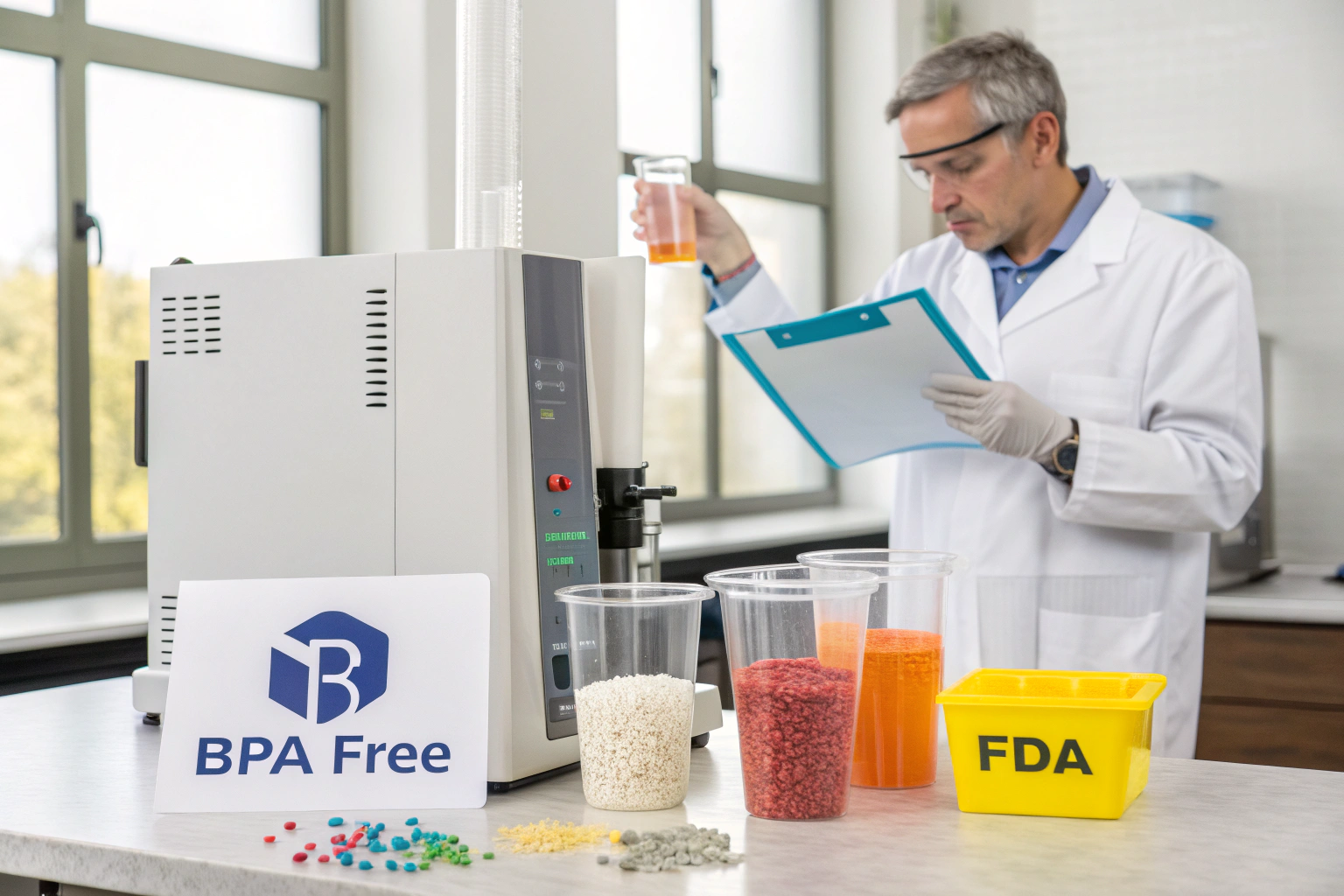
For importers and brands sourcing drinkware, the claim "BPA Free" is more than a marketing tagline—it’s a fundamental requirement for consumer safety and trust. If you worry about hidden chemicals in your products, potential health risks for end-users, or regulatory compliance in your markets, these concerns are valid and must be addressed at the source. The risk lies not in the final product but in the raw materials and manufacturing processes.
The most reliable way to ensure your cups are BPA-Free is to implement a multi-layered verification system that includes sourcing certified raw materials, conducting rigorous supplier audits, and performing regular, independent laboratory testing on both materials and finished products. This proactive, documented approach transforms a simple claim into a verifiable, defensible standard of safety.
This guide will detail the four pillars of building an ironclad BPA-Free assurance program. We will explore how to decipher material certifications, conduct effective factory audits, implement a routine testing protocol, and understand the crucial role of transparent documentation and clear labeling. For a broader view on establishing robust quality control systems for all your accessories, consider the strategies discussed in our guide on consistent quality control.
What Raw Material Certifications Guarantee BPA-Free Products?
The journey to a BPA-Free cup begins long before production—it starts with the resin pellets. Relying solely on a supplier’s verbal assurance is a significant risk. The foundation of safety is built on verifiable, third-party certifications for the raw materials used in manufacturing your drinkware.
Authentic BPA-Free status is guaranteed by material certifications from reputable international bodies and compliance statements from raw material suppliers. Key certifications to look for include the FDA (U.S. Food and Drug Administration) compliance for food contact substances, the LFGB (German Food and Commodities Act) for European markets, and specific BPA-Free declarations backed by test reports from the resin producer. These documents are your first line of defense.
Understanding these certifications requires a deeper look. Not all plastics are created equal. For tumblers, travel mugs, and plastic cups, the most common BPA-Free materials are Polypropylene (PP), Tritan™, or certain grades of ABS and SAN. Each material has its own properties and certification process. A professional manufacturer doesn’t just buy generic "plastic"; they source pre-certified resins from trusted suppliers and maintain the chain of custody documentation. At Shanghai Fumao, our procurement team insists on obtaining and filing the Material Safety Data Sheet (MSDS) and the supplier’s Certificate of Analysis (CoA) for every batch of polymer used in our drinkware production.

How to Verify FDA Compliance for Food-Contact Plastics?
FDA compliance in the U.S. is not a certification but a regulatory status. For food-contact plastics, you must ensure the specific resin grade and its additives are listed in the FDA’s regulations (Title 21 of the Code of Federal Regulations). The raw material supplier should provide a FDA Compliance Letter or Statement of Assurance. This letter attests that the material complies with the relevant FDA regulations for its intended use (e.g., hot or cold liquids). It is crucial to verify that the letter is specific to the exact material grade and colorant batch you are using. As your manufacturing partner, we provide these supplier documents for your review, ensuring transparency from the very beginning of the supply chain. You can learn more about these requirements directly from the U.S. Food and Drug Administration website.
What Is the Role of LFGB and Other International Standards?
For products entering the European Union, LFGB is a crucial standard. It is generally more stringent than FDA in some migration tests (the process of substances leaching from the material into food). Passing LFGB testing is strong evidence of a material’s safety. Other important standards include EU Regulation 10/2011 for plastic food-contact materials. When sourcing for global markets, your manufacturer should understand these regional requirements. We often guide our clients on the appropriate material selection based on their target market—for instance, recommending a specific PP copolymer that has passed both FDA and LFGB migration tests for a line of sports bottles. Reputable testing houses like SGS can perform these standardized migration tests and issue formal reports.
How to Audit Your Cup Manufacturer for BPA Compliance?
A certificate for raw materials is only as good as the factory’s ability to protect the integrity of those materials throughout production. An audit ensures that BPA-Free resins are not contaminated with non-compliant materials during storage, handling, or manufacturing. This step verifies the factory’s systems and discipline.
A comprehensive BPA compliance audit should examine the factory’s material segregation protocols, production line sanitation procedures (to prevent cross-contamination), and inventory management systems. It should also review their internal quality control records for incoming materials and finished goods testing. The goal is to confirm that their practices support their BPA-Free claims.
A deep-dive audit goes beyond checking paperwork. It involves a physical walkthrough of the production facility. Key areas to inspect include the raw material warehouse (are BPA-Free resins stored separately from industrial-grade plastics?), the feeding area of the injection molding machines (are hoppers and feeders cleaned between material runs?), and the finished goods area. Ask to see their Standard Operating Procedures (SOPs) for preventing cross-contamination. For example, a factory producing both BPA-Free children’s cups and non-food-contact accessory components must have rigorous separation processes. Our factory maintains dedicated production lines and storage zones for food-grade materials, a system we are proud to demonstrate to clients during audits.
What Key Questions Should You Ask During the Audit?
Prepare a checklist. Essential questions include: "Can you show me the FDA compliance letters for the resin used in my cup model?" "What is your procedure for cleaning machines when switching from a non-food-grade material to a food-grade one?" "How do you track material batches from receipt to production lot?" "Do you conduct any in-house migration or spot tests?" "What happens to scrap and rejected parts from the BPA-Free production line?" (They should be destroyed or recycled separately to prevent re-entering the food-grade material stream). The factory’s answers and their ability to provide immediate evidence will reveal their level of control. Organizations like the British Retail Consortium (BRC) have standards for consumer product manufacturing that include excellent frameworks for such audits.
What Physical Evidence of Compliance Should You Look For?
Physical evidence is irrefutable. Look for clear labeling on all material bags and containers in the warehouse—they should state the material type (e.g., PP) and "Food Grade" or "BPA-Free." Observe the production floor: are there color-coded bins for different material types? Are tools and containers used for food-grade production kept separate? Request to see the quality control records for the last few production runs of similar items. These records should include references to the raw material batch numbers used. Finally, ask to see samples of the finished product retention samples they keep, which are crucial for traceability in case of any future inquiry.
Why Is Independent Laboratory Testing Non-Negotiable?
Even with certified materials and a clean factory, independent lab testing is the final, unbiased seal of approval. It is the objective proof that your finished product, as it will reach the consumer, meets the required safety standards. This step validates your entire supply chain process and provides legal and regulatory protection.
Independent laboratory testing is non-negotiable because it provides scientific, third-party verification that BPA (and other harmful substances) is not present in your finished cups above the legally allowed limits. It tests for migration—the potential for chemicals to leach into food or drink under real-world conditions—which raw material certificates alone do not fully cover.
To implement an effective testing protocol, you must understand its frequency and scope. Testing should not be a one-time event. It should be conducted on a regular basis (e.g., annually or per major production lot) and whenever you change your material supplier or product design. The test should be performed by an accredited laboratory, such as one certified to ISO/IEC 17025. The standard test for BPA migration is typically conducted using food simulants (like acetic acid for acidic foods) under controlled time and temperature conditions, as outlined in standards like EN 14372 or FDA methods.

How Often Should You Test Your Cup Products?
The testing frequency depends on your risk tolerance and order volume. A robust minimum standard is to test every new product design before mass production and then at least once annually for each ongoing product line. Additionally, you should test any time there is a change in the source of your raw materials. For high-volume orders, testing per production batch or quarterly provides even greater assurance. The cost of testing is insignificant compared to the reputational damage and potential liability of a product recall. We build this testing schedule into our project timelines with clients, often coordinating the shipment of samples directly to an accredited lab of their choice, such as Intertek or Eurofins, to maintain an impeccable chain of custody.
What Specific Tests Verify BPA-Free Status?
Two primary types of tests are critical:
- Migration Test: This simulates whether BPA migrates from the plastic into food or drink. It uses food simulants (e.g., water, acetic acid, ethanol) and measures any migrated BPA. Passing this test is required for certifications like LFGB.
- Material Composition Analysis: This test, like GC-MS (Gas Chromatography-Mass Spectrometry), verifies that BPA is not present as a base component in the plastic material itself. It confirms the "BPA-Free" claim at the material level.
You should request test reports that clearly state the standard used (e.g., EU 10/2011), the testing method, the specific product tested (including color), and the result, which should be "Not Detected" or below the specific migration limit (SML). These reports are your ultimate shield in the marketplace.
How to Use Documentation and Labeling as Proof?
In the event of a customer inquiry or a regulatory check, your confidence comes from your documents, not your promises. Proper documentation creates an auditable trail from the resin plant to the store shelf. Furthermore, accurate labeling on the final product and its packaging is a legal requirement in many markets and a direct communication of safety to your end consumer.
Effective proof combines a technical file containing all compliance documents with clear, legally appropriate labeling on the product and packaging. The technical file is for you and regulators; the labeling is for your customers. Both are essential components of responsible product stewardship and brand protection.
Building this system requires organization and consistency. Your technical dossier for each cup SKU should include: 1) Raw material certificates (FDA/LFGB letters), 2) Factory audit reports, 3) Independent lab test reports, 4) A product specification sheet, and 5) A Declaration of Conformity (DoC). For labeling, research the specific symbols required in your target country, such as the "Glass and Fork" food-safe symbol or specific "BPA-Free" text requirements. The placement (on the product itself, the packaging, or both) is also regulated. As a full-service manufacturer, Shanghai Fumao compiles this dossier for our clients and provides expert guidance on labeling norms for North America, Europe, and other regions.

What Should Be Included in Your Product’s Technical Dossier?
Think of the technical dossier as the birth certificate and medical record for your product. It must include:
- Material Certificates: From the resin supplier.
- Supplier Audit Summaries: Your own or third-party audit reports of the factory.
- Lab Test Reports: The full, original reports from the independent laboratory.
- Product Specifications: Detailed drawings, material descriptions, and colors.
- Declaration of Conformity (DoC): A signed document where the manufacturer (or importer, depending on regulations) declares that the product meets all applicable safety standards. This is a legal requirement in markets like the EU.
We maintain organized digital files for each client project, making it easy to access and share this critical information, ensuring you are always prepared for due diligence.
What Are the BPA-Free Labeling Requirements in the USA and EU?
Labeling rules vary:
- USA: The FDA does not mandate a specific "BPA-Free" label, but any such claim must be truthful and not misleading. Many brands voluntarily label products as "BPA-Free." The "food-safe" symbol is also voluntary but widely used. California’s Proposition 65 may require a warning label if BPA is present above a very low threshold, so proving its absence is crucial.
- EU: Regulation (EU) No 10/2011 requires specific labeling for food-contact plastics, including the "glass and fork" symbol and information on permitted use (e.g., "for hot liquids"). The term "BPA-Free" can be used if verified. The responsible company’s address and batch identification are also required.
Mislabeling can lead to customs rejection, fines, and forced recalls. We help our clients navigate this complex landscape to ensure their cups, tumblers, and water bottles are correctly labeled for a smooth market entry. The European Commission’s website provides the full text of the relevant regulations.
Conclusion
Ensuring your cups are genuinely BPA-Free is a systematic process that cannot rely on trust alone. It demands a verifiable chain of evidence, from certified raw materials and audited production practices to independent laboratory validation and impeccable documentation. By implementing these four pillars—material certification, factory auditing, independent testing, and documented proof—you transform a potential liability into a compelling brand asset built on safety and transparency.
This rigorous approach not only safeguards your customers but also protects your brand from the severe financial and reputational risks of non-compliance. In today’s market, proof of safety is as important as the product itself.
If you are looking for a manufacturing partner who understands that "BPA-Free" is a promise backed by science and systems, let’s discuss your next drinkware project. Contact our Business Director, Elaine, at elaine@fumaoclothing.com to see how Shanghai Fumao can deliver safe, high-quality, and fully compliant cups for your brand.