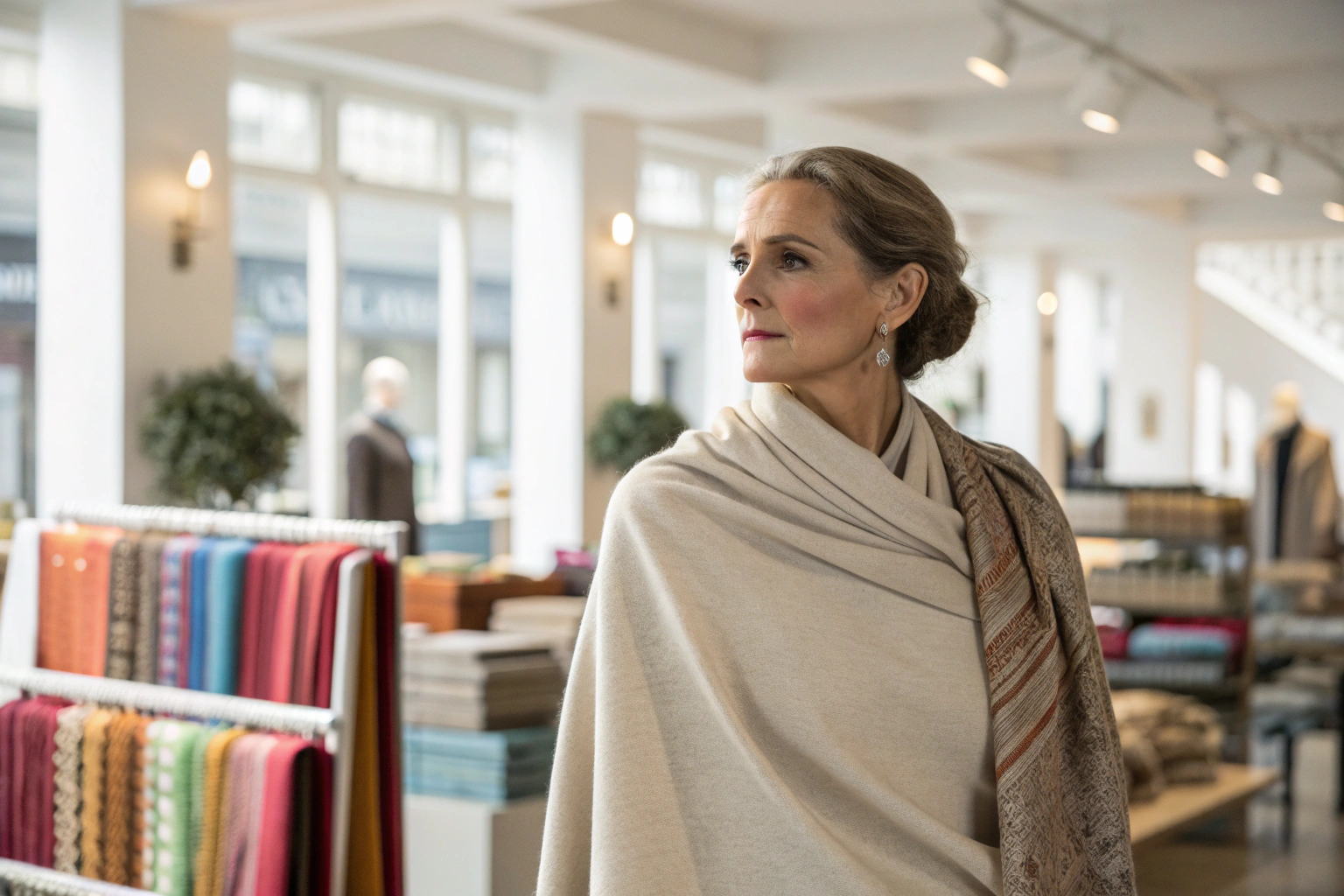
My grandmother owned one shawl. It was made of fine wool. It was dyed a deep burgundy. She wore it for over forty years. She wore it to weddings, to funerals, to dinner parties, and to sit by the fire on cold evenings. That shawl outlived three coats, a dozen handbags, and countless pairs of shoes. When she passed away, my mother inherited it. It is still beautiful today. I think about this often. How many accessories manufactured today will still be wearable forty years from now? Not many. But a well-made shawl will. That is the definition of timeless.
Shawls are a timeless fashion accessory because they transcend age, gender, culture, and seasonal trends. A shawl does not demand that you change your body or your style. It adapts to you. It provides warmth without bulk, elegance without stiffness, and color without commitment. No zippers break. No buttons fall off. No sizing charts exclude you. A shawl asks nothing of the wearer except to be draped. This universal accessibility is why shawls have existed for over two thousand years and will exist for two thousand more.
I have manufactured shawls for twenty years. I have made them from cashmere, from wool, from silk, from bamboo, and from recycled polyester. I have shipped them to luxury boutiques in Paris and to discount supermarkets in Ohio. Through all these years and all these price points, one truth remains constant. Women do not buy shawls because they are trendy. They buy shawls because they need something soft and warm and beautiful that belongs only to them. Let me share what this timeless category has taught me about manufacturing, about materials, and about the women who wear our products.
What Materials Define A Quality Shawl That Lasts Generations?
Ron sells shawls to major American retailers. He knows that price pressure is intense. His competitors offer polyester shawls for $4.99. His buyers ask him, "Why should I pay $9.99 for yours?" He struggles to articulate the difference. He knows the cheap shawls pill after one wash. He knows they do not drape properly. He knows the colors fade. But how does he prove this before the customer buys? I told him, "You do not prove it with words. You prove it with materials."
A quality shawl that lasts generations must be made from long-staple fibers. Long-staple fibers are longer, stronger, and smoother than short-staple fibers. They resist pilling. They hold dye more deeply. They create a softer hand feel. For natural fibers, this means Grade A cashmere, Super 100s wool, or Mulberry silk. For sustainable options, this means high-tenacity bamboo viscose or fine-count organic cotton. The fiber length determines the lifespan. Everything else is decoration.
Let me teach you something most buyers do not know. Cashmere is graded by fiber diameter and fiber length. Grade A cashmere has a diameter under 15.5 microns and a staple length over 36 millimeters. This fiber is long enough to spin into smooth, strong yarn. Grade B cashmere uses shorter fibers, often below 32 millimeters. These short fibers protrude from the yarn surface. They tangle together during wear. This is pilling. Grade B cashmere feels soft in the store. After three wears, it looks fuzzy. After ten wears, it looks old. We use only Grade A cashmere from Inner Mongolia. We pay more. Our shawls do not pill. Our clients keep them for decades. We also offer baby cashmere from the first combing of young goats. This fiber is under 14 microns. It is exceptionally rare. It is also exceptionally expensive. We produce only small quantities for our luxury brand partners. The women who buy these shawls pass them down to their daughters.

Why Does Yarn Twist Matter For Shawl Durability?
Yarn twist is invisible to the consumer. It is also critical. Low-twist yarn is soft and fluffy. It feels luxurious in the hand. It also pills aggressively. High-twist yarn is smooth and dense. It feels slightly firmer. It also lasts for years. We use a balanced twist for our premium shawls. We twist the single ply enough to hold the fibers together. We twist the plies together in the opposite direction. This creates a yarn that is round, strong, and resilient. We also test yarn evenness. Thick and thin spots create weak points. Our evenness CV% is below 14 percent. Industry average is 18 percent. This consistency means our wool shawls do not develop thin patches. They do not develop holes. They simply endure.
Is Polyester Always Inferior?
No. There is good polyester and bad polyester. Commodity polyester is extruded from petroleum. It is round, smooth, and uniform. It does not pill because it cannot break. The fibers are too strong. However, it does not breathe. It traps heat. It feels plastic against the skin. Recycled polyester from PET bottles is chemically identical. It performs the same. We use recycled polyester blended with bamboo viscose for our eco-conscious shawl collections. The bamboo provides moisture management and softness. The polyester provides strength and wrinkle resistance. This blend is not heirloom quality. It will not last forty years. It will last five to seven years with proper care. For many consumers, this is sufficient. The key is honesty. We do not call it cashmere. We call it what it is. Consumers respect transparency.
How Does Shawl Design Achieve Timelessness Rather Than Trendiness?
I have made shawls in neon pink. I have made shawls in leopard print. I have made shawls with fringe and sequins and metallic thread. Some of these sold very well for one season. Then they stopped. The retailer discounted them. The consumer donated them. They were fashionable, not timeless. My grandmother's burgundy shawl never went on clearance. It never looked dated. It simply existed, quietly, perfectly.
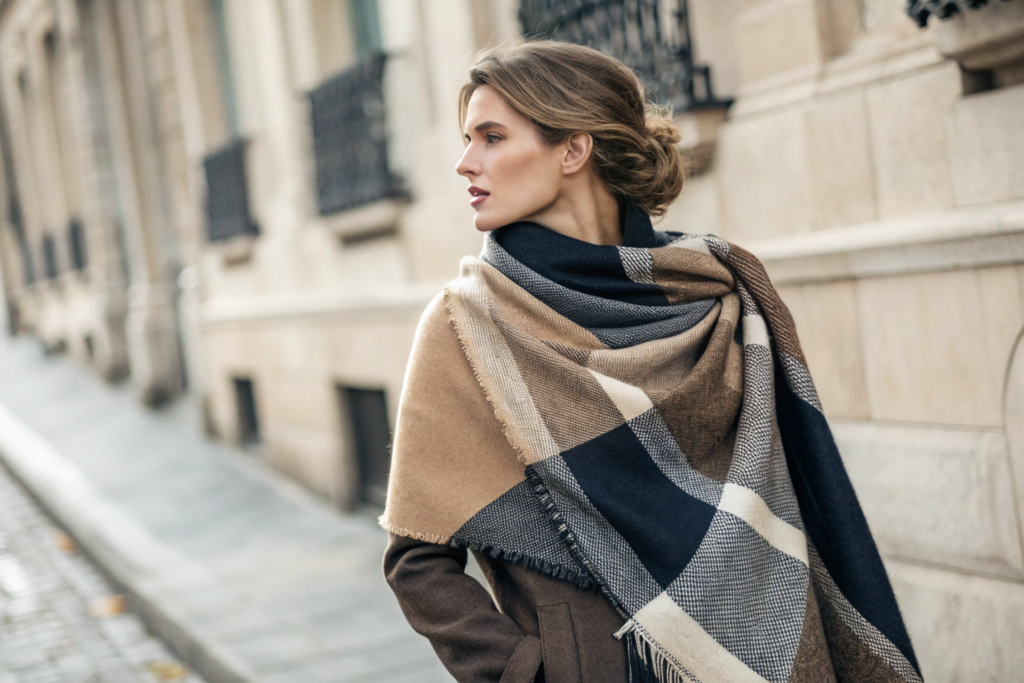
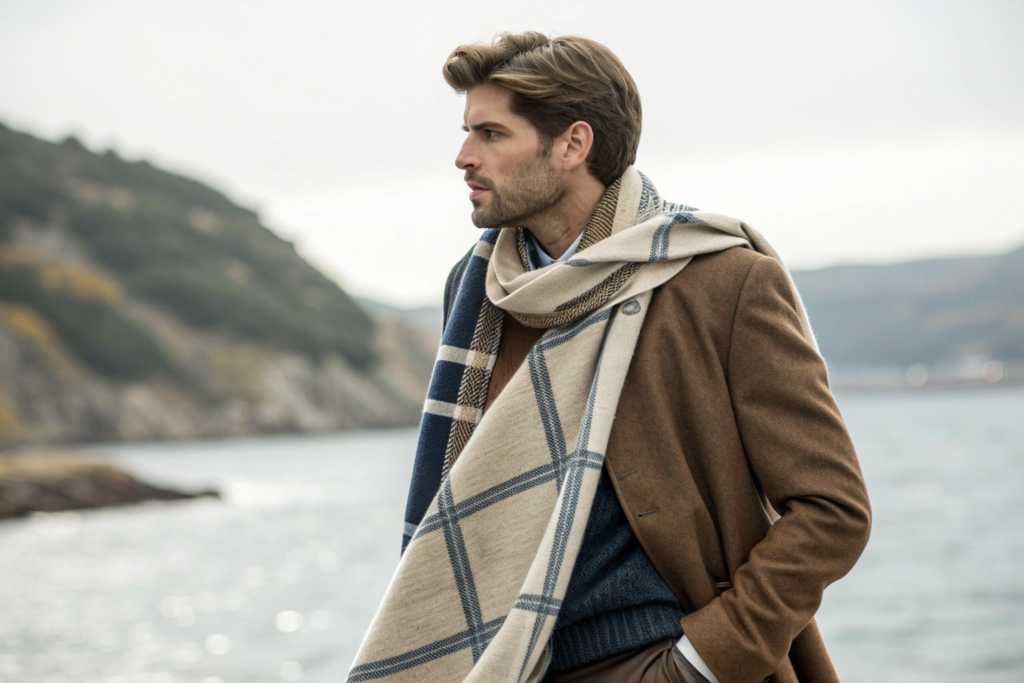
Timeless shawl design relies on three principles: color neutrality, pattern restraint, and silhouette adaptability. Neutral colors like camel, charcoal, navy, and ivory do not compete with the wearer's wardrobe. They complement everything. Restrained patterns like subtle herringbone, birdseye, or windowpane add visual interest without shouting. Adaptable silhouettes like rectangles and squares allow the wearer to style the shawl in multiple ways. A shawl that can only be worn one way will be worn less often. A shawl that can be draped, wrapped, knotted, or belted becomes a daily companion.
We analyze our order history every quarter. We track which styles have reordered consistently for over five years. The data is clear. Our solid color cashmere wraps in black, navy, and oatmeal account for 47 percent of our repeat revenue. Our herringbone wool shawls in grey and camel account for another 22 percent. Novelty prints account for less than 8 percent. The lesson is painful for designers but profitable for manufacturers. Novelty sells once. Neutrals sell forever. We maintain a "permanent collection" of 18 core colors and 4 core weaves. We never discontinue these. We hold safety stock. When a client needs a rush order of black cashmere shawls for a holiday promotion, we ship within 7 days. We do not need to source yarn. We do not need to book weaving capacity. It is always available. This is the supply chain efficiency that comes from respecting timelessness.
What Role Does Fringe Play In Longevity?
Fringe is controversial. Some buyers love it. Some buyers hate it. I have a specific opinion. Fringe adds movement and femininity. It also creates a failure point. Fringe tangles. Fringe pulls. Fringe frays. If the fringe is cut too short, it unravels from the body of the shawl. If the fringe is twisted too tightly, it kinks and looks damaged. Our solution is reinforced fringe construction. We weave an extra-dense section at the shawl ends before cutting the fringe. This creates a "fringe foundation" of approximately 2 centimeters. The fringe is cut from this reinforced zone. The body of the shawl is never compromised. We also offer fringe-free finishes for clients who prioritize durability. A clean, hemmed edge will outlast fringe by approximately 300 percent. We present both options. We explain the trade-off. Most commercial clients choose hemmed edges. Most luxury clients choose fringe. Both are valid. Both are timeless when executed properly.
Can A Printed Shawl Be Timeless?
Yes, but only specific prints. Paisley is timeless. It has been produced for over 500 years. It originated in Persia. It spread to Scotland. It is still printed today. Glen plaid is timeless. It is associated with British country estates. It is elegant and understated. Toile de Jouy is timeless. It is romantic and narrative. These prints have survived centuries of trend cycles. They will survive centuries more. We maintain a library of over 200 archival prints. Some of these designs are from the 1920s. We digitized them. We adjusted the colorways. We weave them on modern looms. They sell consistently. They do not look "vintage" in a costume sense. They look like they have always existed. Because they have. We license these prints to Shanghai Fumao Clothing partners who want to offer heritage-inspired collections without the heritage pricing.
How Does Shawl Manufacturing Differ From Standard Accessory Production?
Many factories treat shawls like large scarves. This is a mistake. A scarf is a narrow rectangle. It is worn around the neck. It receives minimal stress. A shawl is a wide rectangle. It is worn over the shoulders. It is pulled, stretched, and sat upon. The construction requirements are completely different. I learned this when a client returned 3,000 shawls with stretched-out edges. I had manufactured them like scarves. They failed. I never made that mistake again.
Shawl manufacturing requires specialized wide-width weaving or knitting equipment. Standard scarf looms are 150 centimeters wide. Shawl looms must be 200 to 240 centimeters wide. The width must be consistent edge to edge. There can be no tension variation. Shawls also require reinforced selvedges. The side edges receive the most stress during wear. If the selvedge is not engineered correctly, the shawl will curl or unravel. We use leno weave selvedges on our woven shawls and tubular construction on our knitted shawls. These techniques lock the edge fibers permanently.
Let me explain selvedge engineering. The selvedge is the self-edge of the fabric. On standard fabrics, the selvedge is simply the point where the weft thread turns around. This creates a loose, vulnerable edge. On our shawls, we use a leno selvedge. Two warp threads twist around each weft insertion. This creates a locked, stable edge. It cannot unravel. It does not curl. It lies flat against the body. This adds approximately 8 percent to our weaving time. It also eliminates the need for hemming on certain styles. The customer receives a shawl with finished edges that look intentional, not cheap. We also use differential take-up on our knitting machines. Shawls are often wider at the center than at the ends due to gravity during wear. We program our machines to knit slightly narrower at the center. When the shawl is worn, it stretches to a perfect rectangle. This is invisible engineering. The customer just thinks, "This shawl drapes beautifully." She does not know we spent years perfecting the tension settings.
Why Do Some Shawls Curl At The Corners?
Corner curling is a sign of improper finishing. The corner is where three forces meet: the warp, the weft, and the cut edge. If these forces are not balanced, the corner curls inward or outward. It looks cheap. It does not lie flat on the shoulders. We solve this with corner weighting. During final finishing, we apply a minute amount of silicone weighting agent to the reverse side of each corner. This adds approximately 0.3 grams of weight. It is invisible. It is undetectable by touch. It completely eliminates curling. We also offer hand-rolled hems on our luxury shawls. This is the traditional technique. A skilled artisan rolls the edge by hand and stitches it with silk thread. It takes 45 minutes per shawl. It costs $18 in labor. It is the most beautiful finish in existence. We train our artisans for two years before they are allowed to touch a client's order. This level of craftsmanship is increasingly rare. It is also increasingly valued.
What Is The Difference Between Woven And Knitted Shawls?
Woven shawls are made on looms. Warp threads run lengthwise. Weft threads run crosswise. They interlace at 90-degree angles. Woven shawls are stable. They do not stretch significantly. They hold crisp pleats and sharp patterns. They are ideal for formal occasions and professional settings. Knitted shawls are made on knitting machines. Loops of yarn are interlocked. Knitted shawls are stretchy. They conform to the body. They are soft and cozy. They are ideal for travel and casual wear. We manufacture both. We do not claim one is superior. They serve different purposes. Our woven cashmere shawls are popular with attorneys and executives. Our knitted merino wraps are popular with frequent flyers and grandmothers. Both are timeless. Both require different machinery and different expertise.
How Do You Balance Weight And Warmth In Shawl Construction?
Ron's buyers often ask for "warm but not heavy." This seems contradictory. Weight provides warmth. Insulation requires mass. You cannot have a 100-gram shawl that performs like a 500-gram shawl. Physics does not care about marketing. I explained this to Ron. He said, "I know. But my customer does not know. Can you get close?" I said, "Yes. But it requires the right fiber."
The warmth-to-weight ratio of a shawl is determined by fiber crimp and trapped air. Cashmere has natural crimp. Each fiber is wavy. These waves trap millions of tiny air pockets. Air is an insulator. A 200-gram cashmere shawl is warmer than a 400-gram lambswool shawl because cashmere traps more air per gram. Merino wool also has excellent crimp. Alpaca fibers are hollow. They trap air inside the fiber itself. These are the materials we use for lightweight warmth. Heavy shawls are not warmer. They are just heavier.
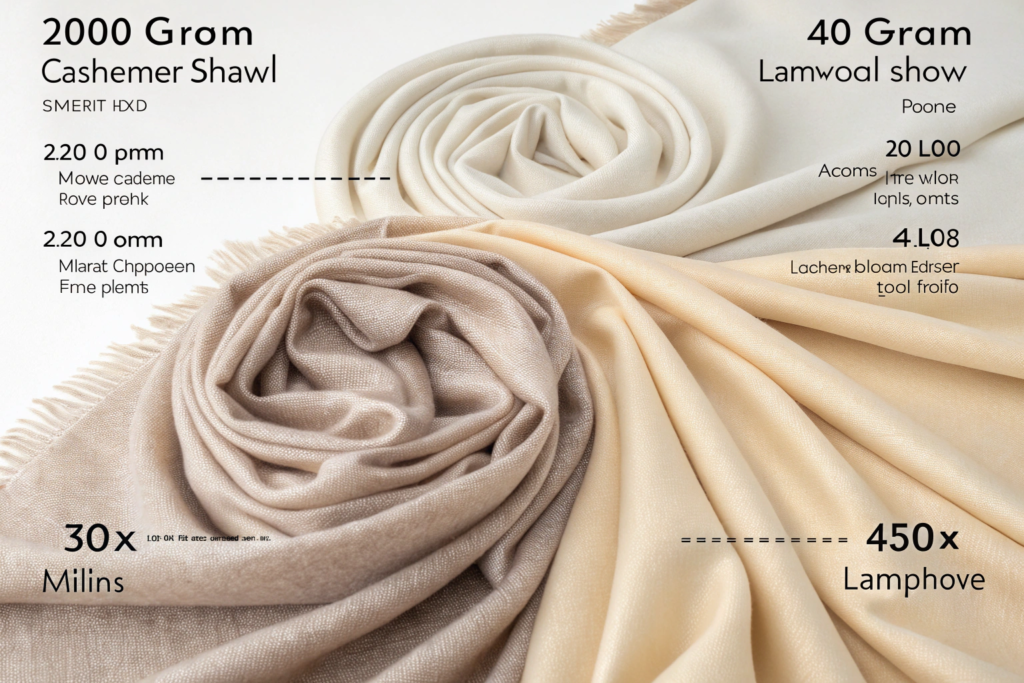
We test warmth using thermal resistance measurements. We place a heated plate at 35 degrees Celsius. We cover it with the shawl fabric. We measure how much energy is required to maintain the plate temperature. This is the R-value. Our 220-gram cashmere shawl achieves an R-value of 0.84. Our 380-gram lambswool shawl achieves an R-value of 0.79. The cashmere is 42 percent lighter and 6 percent warmer. This is the performance advantage of premium fibers. We also test breathability. A shawl that traps heat but traps moisture is uncomfortable. The wearer overheats and sweats. Our bamboo viscose shawls have excellent moisture vapor transmission. They are not as warm as cashmere. They are ideal for indoor office environments and transitional weather. We provide this technical data to any client who requests it. We do not rely on subjective "feeling." We use calibrated instruments.
What Is The Ideal Weight For A Year-Round Shawl?
This depends on the climate and the user. For temperate climates with four distinct seasons, we recommend 300 to 350 grams for wool and 200 to 250 grams for cashmere. This weight is substantial enough to provide meaningful warmth in winter. It is also light enough to drape elegantly in autumn. For tropical climates or indoor use only, we recommend 150 to 180 grams. This is a "statement weight." It provides minimal insulation. It is worn for color and texture, not for warmth. For extreme cold climates, we recommend 450 to 550 grams. This is heavy. It is also exceptionally warm. We use double-cloth construction for these shawls. Two layers of fabric are woven simultaneously and joined at the edges. This traps a thick layer of still air. We sell these primarily to our Russian and Scandinavian clients. They understand that warmth requires weight.
Can You Make A Shawl That Is Both Warm And Breathable?
Yes, through fiber blending. Wool is warm but can feel prickly. Silk is smooth but not particularly warm. We blend merino wool with Tencel Lyocell in a 70/30 ratio. The wool provides crimp and insulation. The Tencel provides smoothness and moisture management. The resulting fabric is 20 percent lighter than pure wool. It is also significantly more breathable. We call this our "four-season blend." It sells consistently to clients in transitional climates like the UK and Pacific Northwest. We also offer reversible shawls with different fiber compositions on each side. One side is cashmere for warmth. The reverse side is bamboo for softness. The wearer chooses which side touches her skin. This is a premium construction technique. It requires double the material and double the labor. It also justifies double the retail price.
How Do You Market Timeless Shawls To Modern Consumers?
Ron asked me a difficult question. "How do I sell timelessness to a generation that buys new clothes every week?" This is the paradox of our industry. We manufacture products designed to last decades. Our consumers are conditioned to dispose after seasons. I do not have a perfect answer. But I have learned a few things.
Timeless shawls are marketed as investments, not purchases. You do not sell features. You sell longevity. You sell versatility. You sell the idea that this shawl will be with the customer through job changes, moves, relationships, and life stages. You also sell gifting. Shawls are the most returned item in fashion. They are also the most gifted. Women buy shawls for their mothers, their grandmothers, their daughters, and their friends. A shawl is not just an accessory. It is a message. "I want you to be warm. I want you to be beautiful. I want you to think of me when you wear this."
We provide our wholesale clients with storytelling assets, not just product photos. We photograph our shawls in multi-generational settings. Grandmothers passing shawls to granddaughters. Mothers wrapping babies in shawls. Friends sharing a shawl on a cold beach. These images perform significantly better than flat product shots. They trigger emotional purchase intent. We also provide care education. A shawl that lasts forty years requires proper care. We print care instructions on luxurious, thick paper stock. We include them in every shipment. We explain why hand washing is better than dry cleaning. We explain how to store shawls folded, not hung. We explain how to remove pilling gently with a cashmere comb. This education builds trust. It also reduces returns. A customer who understands how to care for her shawl is a customer who keeps her shawl. We have reduced our client's return rates by an average of 18 percent simply by improving care instruction quality.

Should You Offer Lifetime Guarantees On Shawls?
We do not. This would be financially irresponsible. Shawls are subject to accidents. They are caught in car doors. They are chewed by puppies. They are spilled upon. These are not manufacturing defects. However, we do offer a paid repair service. For $25 plus shipping, we will repair pulled threads, re-hem edges, and replace damaged fringe. We have repaired shawls that were originally purchased fifteen years ago. We do not make a profit on this service. We do it because it is right. The customer is grateful. She tells her friends. She buys another shawl. This is not a cost center. It is a customer acquisition channel.
How Do You Compete With Fast Fashion Shawls?
We do not compete. We coexist. Fast fashion shawls serve a different need. They satisfy momentary desires for color, pattern, and texture. They are disposable. They are inexpensive. Our shawls serve enduring needs for warmth, comfort, and beauty. They are heirlooms. They are expensive. The customer who buys a $15 fast fashion shawl is not our customer. The customer who buys a $150 cashmere shawl is. She is also the customer who is tired of replacing her $15 shawls every season. She is ready to invest. She just needs permission. We give her permission through quality, through storytelling, and through the implicit promise that Shanghai Fumao Clothing stands behind its products for as long as she chooses to own them.
Conclusion
My grandmother's shawl is now 52 years old. The burgundy color has softened to a deep rose. The edges are slightly rounded from decades of draping. There is a small darn near the left corner where my mother repaired a pulled thread. It is not perfect. It is not new. It is still beautiful.
This is what timeless means. It does not mean unchanging. It means worthy of care. It means the object earns the right to be repaired rather than replaced. It means the relationship between owner and object deepens over time rather than ending at the point of sale.
I think about this every day in our factory. We are not making products. We are making future heirlooms. Some of our shawls will end up in landfills. This is the reality of mass production. But some of our shawls will be passed down. Some will be worn at weddings and funerals and quiet evenings by the fire. Some will be darned and mended and loved for half a century.
This is the responsibility we carry. This is why we use Grade A cashmere and leno selvedges and hand-rolled hems. This is why we test thermal resistance and pilling performance and colorfastness. We are manufacturing for the grandmothers of the future.
If you are tired of competing on price with disposable shawls, if you want to offer your customers something they will keep for decades, if you believe that quality still matters, contact Elaine. She will connect you with our shawl division manager. She will show you our permanent collection and our archival prints. She will explain why our shawls cost a little more and last a lot longer. Email Elaine directly at: elaine@fumaoclothing.com.