I have manufactured over two million belts in my career. Leather belts, fabric belts, woven belts, elastic belts. Belts for suits, belts for jeans, belts for dresses, belts for uniforms. After twenty years, I thought I understood this product category completely. Then last Christmas, my son gave me a belt. It was beautiful. Italian leather. Hand-stitched. Solid brass buckle. I thanked him warmly. But inside, I thought, "I make belts. Why do I need another belt?" Then I put it on. It fit perfectly. It held my trousers securely. It looked elegant. I realized something. I do not wear belts because I need more belts. I wear belts because my trousers need to stay up. And I want to look good while they do. That is the essence of the category. Form and function, inseparable.
Belts are a staple accessory for men and women because they serve an irreplaceable structural purpose while simultaneously communicating personal style, status, and attention to detail. No other accessory is as purely functional. No other accessory is as visibly placed at the center of the body. A belt holds your clothing together. It also holds your outfit together. Remove the belt and your pants sag. Remove the belt and your silhouette collapses. This duality of necessity and expression is why belts have existed for over 5,000 years and why they will exist for 5,000 more.
I have seen belts survive every trend cycle. Skinny belts. Wide belts. Chain belts. Elastic belts. No belt at all. Each trend fades. The classic leather belt remains. It remains because it is not really a trend. It is a tool. A beautiful tool. A personal tool. My father wore a belt every day. I wear a belt every day. My son wears a belt every day. Three generations, different styles, same essential need. This continuity is rare in fashion. It is also the reason we treat belt manufacturing with a level of seriousness that surprises new clients. Let me show you why a simple leather strap is actually one of the most complex products we make.
What Defines A Quality Belt That Lasts For Years?
Ron buys belts for major retailers. He has seen belts that cost $2.00 and belts that cost $200. He knows the cheap ones delaminate. He knows the expensive ones sometimes delaminate too. He asked me, "What is the actual difference? Is it just marketing?" I told him, "No. The difference is visible if you know where to look. Most buyers do not know where to look."
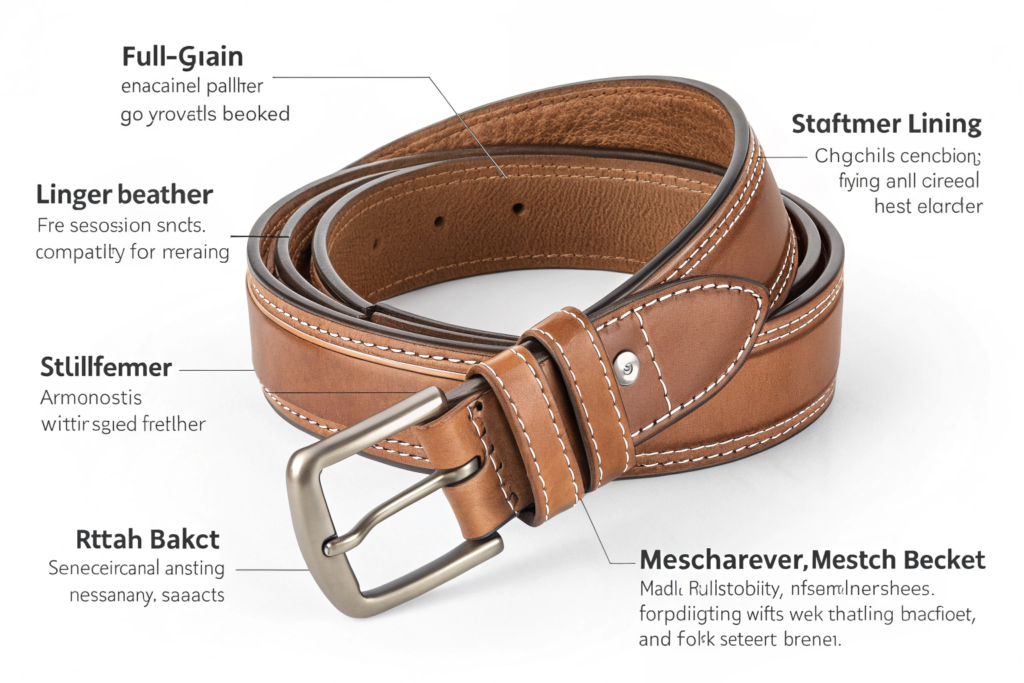
A quality belt that lasts for years is defined by four components: the leather, the lining, the stiffener, and the buckle attachment. Full-grain leather from the top layer of the hide is essential. Corrected-grain or bonded leather will crack and peel. The lining must be a compatible material with similar stretch properties. If the lining stretches differently than the face, the belt will curl. The stiffener, usually vegetable-tanned shoulder leather or rigid nylon, must provide memory without brittleness. The buckle attachment must be reinforced with a secondary leather patch or metal bar. A buckle screwed directly into the belt strap will fail within six months.
Let me teach you leather grading. Full-grain leather is the outermost layer of the hide. The grain is intact. The natural markings are visible. This leather is strong. It develops a patina over time. It becomes more beautiful with age. Top-grain leather is the second layer. The grain has been sanded away. It is smoother. It is also weaker. It does not develop patina. It simply wears out. Genuine leather is a marketing term. It means scraps of leather ground up and glued together. It is not genuine anything. We use only full-grain leather from Swedish and German tanneries for our premium belt collection. These tanneries have been operating for over 150 years. They know how to cure hides without overloading them with chromium or synthetic fats. We also offer vegetable-tanned leather for clients who require heavy patina development. This leather stiffens and darkens beautifully over decades. It is our most expensive option. It is also our most sustainable option.
Why Do Some Belts Curl Up At The Edges?
Edge curling is a sign of differential tension. The face leather and the lining leather have different stretch characteristics. When the belt is bent around the waist, one layer compresses. The other layer stretches. If the materials are not matched, the edge curls. This is unsightly. It is also uncomfortable. Our solution is material compatibility testing. We test every combination of face leather, lining leather, and stiffener before production. We measure elongation at specific loads. We require the face and lining to have elongation values within 5 percent of each other. This is not standard industry practice. Most factories simply glue whatever leather is available. We reject entire shipments of lining material if they do not match our spec. This costs us money. It also eliminates curling. We have clients who have sold our belts for eight years. They have never received a curling complaint. This is not luck. This is material science.
What Is The Best Buckle Attachment Method?
There are three common methods. Screw posts are two pieces that sandwich the leather and screw together. They are secure. They are also expensive to install. Roller bars are standard on jeans belts. The leather wraps around a metal bar. The buckle is held in place by tension. This is less secure. The leather stretches over time. The buckle slides. Chicago screws are decorative. They look like rivets. They are actually threaded posts. They are easy to replace. They are also easy to lose. Our preferred method is the captive leather patch. We stitch a separate piece of leather behind the buckle area. The buckle bar passes through this reinforced zone. The belt strap itself is never punctured. This distributes stress across a wider area. It also allows the user to change buckles if desired. We use this construction on all our premium men's belts and women's fashion belts. It adds 45 seconds to our production time. It adds years to the product life.
How Do Men's And Women's Belt Requirements Differ?
For years, we manufactured men's belts and women's belts on the same production lines. We assumed the differences were cosmetic. Wider for men. Narrower for women. Different buckles. Then our returns data told us we were wrong. Women's belts were being returned for different reasons than men's belts. We had to redesign our approach.
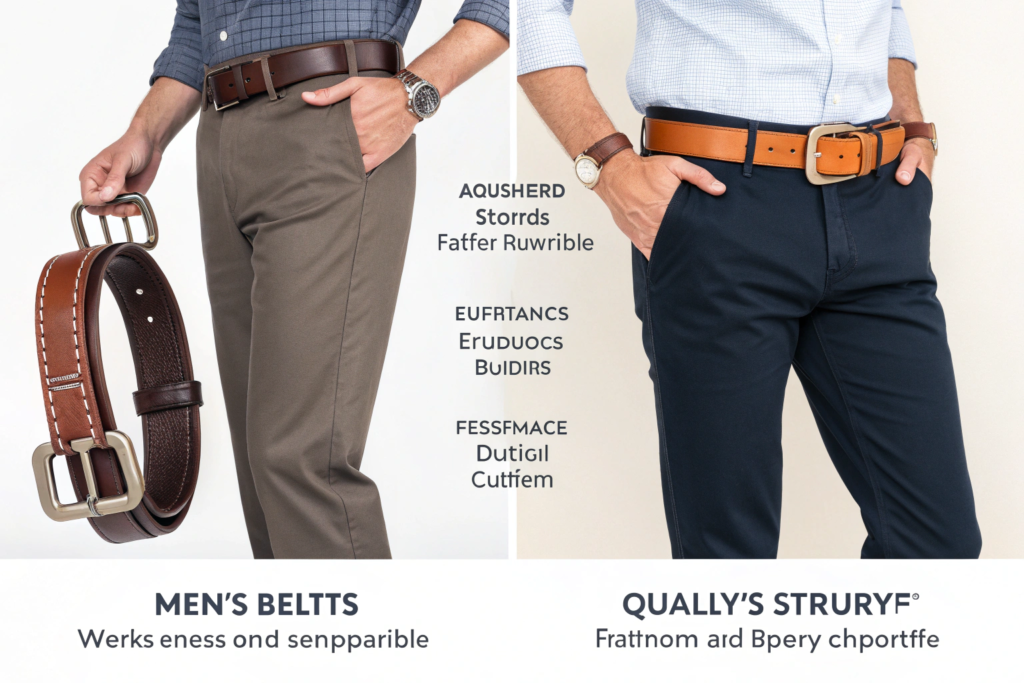
Men's belts are primarily structural. They hold trousers at the waist. The priority is strength, durability, and consistent tension. Women's belts are primarily stylistic. They define the silhouette, create visual interest, and accessorize the outfit. The priority is drape, hardware aesthetics, and adjustability. A men's belt that fails structurally is returned. A women's belt that fails aesthetically is returned. The engineering requirements are fundamentally different. We treat them as separate product categories with separate design specifications, material selections, and quality standards.
Let me quantify these differences. Men's belts require tensile strength of at least 80 kilograms. The average man applies significant force when cinching his trousers. The belt must resist stretching and buckle deformation. We use thicker leather, typically 3.2 to 3.6 millimeters. We use wider stiffeners, typically 30 millimeters. We test every batch using a tensile testing machine. Women's belts require tensile strength of only 40 to 50 kilograms. The force applied is lower. However, women's belts require significantly more flexibility. A stiff men's belt worn over trousers is acceptable. A stiff women's belt worn directly over a dress or bare skin is uncomfortable. We use thinner leather, 2.0 to 2.4 millimeters. We often eliminate the stiffener entirely. We use soft, garment-grade leather or elastic woven fabrics. The engineering targets are different because the use cases are different. We do not apply men's standards to women's products. That would be lazy manufacturing.
Why Do Women's Belts Have More Hole Options?
Women's bodies change shape throughout the day and throughout the month. Bloating, meal times, and water retention affect waist circumference significantly. A belt that fits perfectly at 8 AM may be uncomfortable at 8 PM. Men experience this too, but to a lesser degree. We address this with extended hole punching. Our standard men's belt has 5 holes spaced 25 millimeters apart. Our standard women's belt has 7 holes spaced 20 millimeters apart. This provides finer adjustment and a wider usable range. We also offer no-hole adjustment systems for premium women's belts. These use a sliding buckle mechanism or a hidden elastic panel. The belt adjusts continuously, not incrementally. This is more expensive. It is also more comfortable. Our clients report significantly lower return rates on adjustable women's belts.
Are Unisex Belts Actually Practical?
Rarely. A true unisex belt requires compromises that please neither gender. The width is usually 30 millimeters. This is too narrow for most men's trouser loops. It is too wide for most women's dress belt loops. The buckle is usually neutral. This satisfies no one's aesthetic preferences. We discourage clients from pursuing unisex belts unless they are targeting a very specific, utilitarian market like uniforms or workwear. A better approach is coordinated collections. Same leather. Same buckle finish. Different widths and construction methods for men and women. They look related. They photograph beautifully together. They also fit properly. This is what we recommend to Shanghai Fumao Clothing partners who want cohesive family branding.
How Has Belt Functionality Evolved Beyond Holding Up Trousers?
My grandfather's belt did one thing. It held his pants up. My father's belt did one thing, but it also had to match his shoes. My belt does three things. It holds my pants up. It charges my phone. It also has a hidden compartment for my metro card. The belt has not become less essential. It has become more essential. It has adapted.
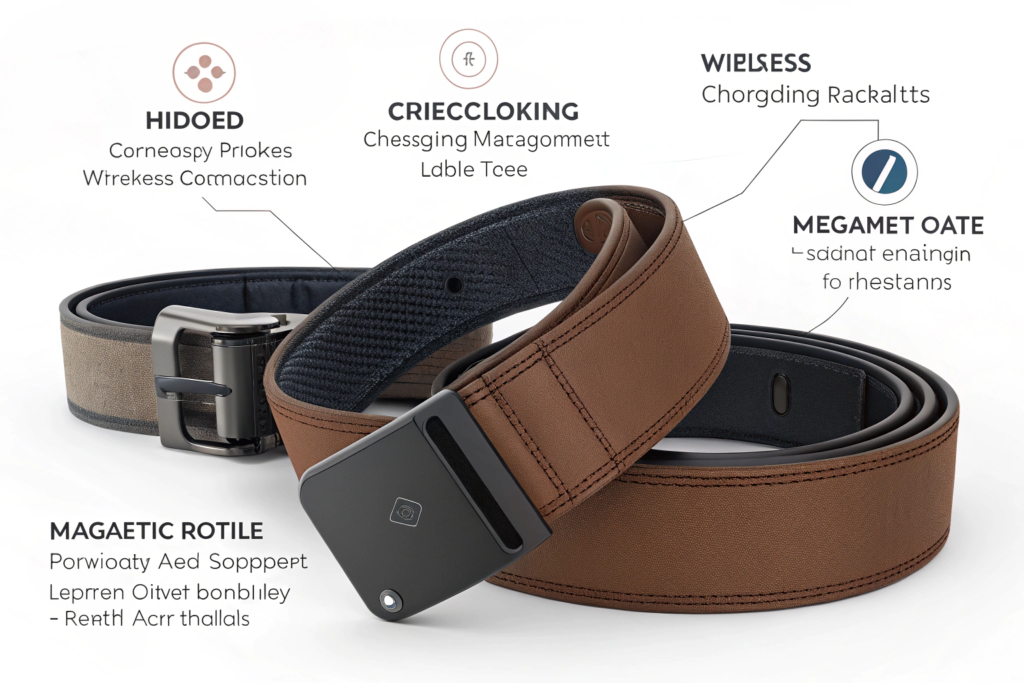
Modern belts have expanded their functionality to meet contemporary needs. Travel belts integrate hidden currency pockets and RFID-blocking materials. Tech belts incorporate wireless charging capabilities and magnetic cable management. Fitness belts track steps and heart rate. Medical belts monitor posture and provide lumbar support. These innovations do not replace the belt's primary function. They supplement it. A belt that only holds trousers is a commodity. A belt that holds trousers plus solves another problem is a premium product. The margin follows the utility.
We entered the functional belt category reluctantly. Our first attempt was a disaster. We embedded a rigid circuit board into a leather belt. It cracked after three bends. We lost $80,000. We tried again. We learned that flexible printed circuits are essential. We now partner with a specialized electronics manufacturer in Shenzhen. They print conductive traces on flexible polyimide film. This film is thinner than paper. It bends thousands of times without breaking. We laminate this film between the face leather and the lining. The user never sees it. She never feels it. She simply places her belt on a wireless charging pad at night. Her phone charges wirelessly through her pocket the next day. It sounds like science fiction. It is actually just flexible electronics and careful lamination.
Are Hidden Pocket Belts Still Relevant?
Yes, especially for travelers. Physical wallets are declining. Digital payments are rising. But passports, hotel key cards, and emergency cash still require physical storage. A hidden pocket belt distributes these items around the waist. It is more comfortable than a bulky hip pack. It is more secure than a back pocket. Our travel belt has a continuous zippered compartment inside the belt strap. It holds up to 8 banknotes and a credit card. The zipper is invisible when closed. The belt looks completely ordinary. This is our best-selling functional belt for both men and women. We manufacture it in full-grain leather and in vegan apple leather. The RFID-blocking lining is standard. Travelers trust it. We have sold over 400,000 units since 2019.
What Is The Future Of Belt Functionality?
We are currently developing posture-correcting belts. Micro-sensors detect when the wearer slouches. A gentle vibration reminds them to sit upright. This is aimed at office workers and remote professionals. We are also testing temperature-regulating belts. Phase change materials embedded in the lining absorb excess body heat and release it when the wearer cools down. This is for outdoor professionals and commuters. Both products are in beta testing. We expect to launch commercially in 2025. The belt is an ideal platform for body-worn technology. It is always in contact with the torso. It is socially acceptable to wear every day. It does not require headphones or visible screens. The wearable technology potential is enormous. We are investing heavily.
How Do You Match Belt Hardware To Changing Fashion Trends?
Ron asked me, "What is the safest belt buckle finish?" I laughed. "There is no safe finish. Only less dangerous finishes." He looked confused. I explained. Fashion changes. What is safe today is dated tomorrow. You cannot predict trends. You can only manage your exposure to trend risk. This is a supply chain problem, not a design problem.
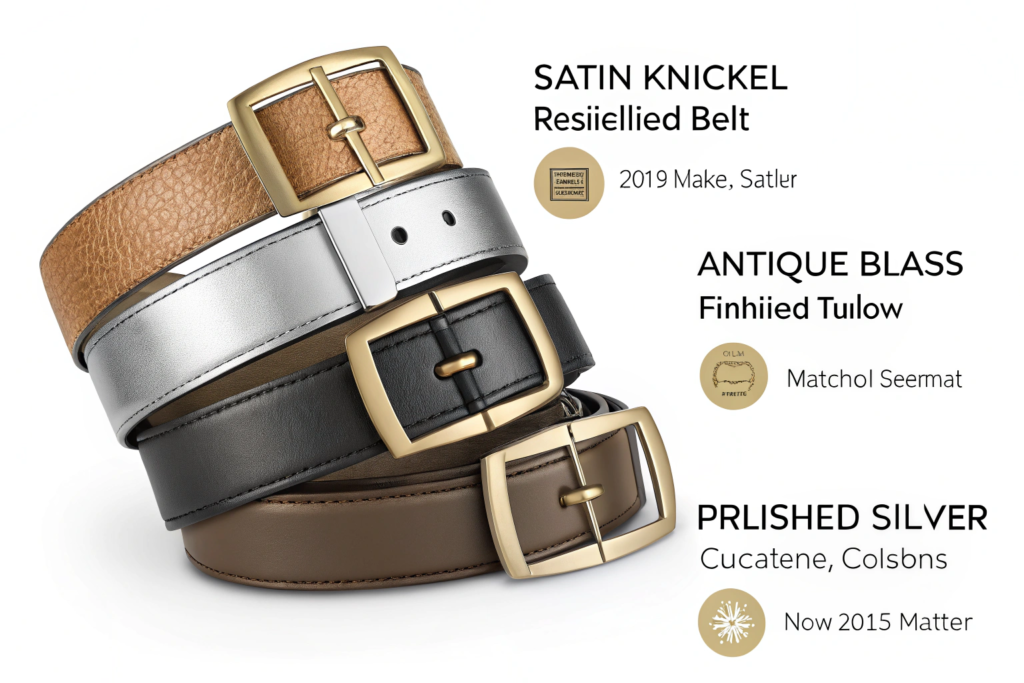
The most trend-resilient belt hardware finishes are satin nickel, antique brass, and polished silver. These finishes have remained consistently popular for over thirty years. They work with both warm and cool clothing tones. They transition seamlessly from casual to formal. They do not scream a specific decade. High-shine gold, matte black, and colored enamel are trend-driven. They dominate for two to three years. Then they disappear. We maintain inventory of classic finishes year-round. We produce trend finishes only on firm, non-cancelable orders. This protects our clients from obsolescence. It also protects us.
Let me share our order data. Satin nickel has been our top-selling buckle finish for eleven consecutive years. It represents approximately 34 percent of our hardware orders. Antique brass is second at 22 percent. Polished silver is third at 18 percent. Polished gold peaked in 2019 at 15 percent. It has declined to 9 percent. Matte black peaked in 2021 at 12 percent. It is now 7 percent. The classic finishes are stable. The trend finishes are volatile. We advise our clients to allocate 70 to 80 percent of their buy to classic finishes. Allocate 20 to 30 percent to trend finishes. If you guess wrong on the trend finishes, you discount them. If you guess wrong on the classic finishes, you lose full-price sales. This is inventory risk management, not fashion advice.
Should You Offer Interchangeable Buckle Systems?
Yes, but only at premium price points. Interchangeable buckles require specialized belt construction. The belt end must have a standardized attachment point. The buckles must have matching receivers. This adds cost and complexity. It also adds perceived value. The customer feels she is buying a system, not a single belt. She can change her look without buying an entirely new belt. This appeals to environmentally conscious consumers and travelers. Our modular belt system has sold consistently for five years. The belt body is full-grain leather. The buckles are available in six finishes. The customer buys one belt and two or three buckles. Our wholesale clients report higher average order values and lower return rates. The system requires more SKU management. It also creates customer lock-in. Once she owns the belt, she only buys buckles from us.
How Do You Manage Hardware Lead Times?
Metal hardware is a bottleneck. The molds cost $3,000 to $8,000. Production takes 45 to 60 days. If you wait until you see a trend to order hardware, you have already missed the trend. Our solution is hardware consignment inventory. We produce our classic finish buckles continuously. We stock them in our warehouse. When a client orders belts, we pull the buckles from inventory. The lead time is 7 days, not 60 days. The client pays for the buckles when we ship the belts, not when we cast the metal. This improves their cash flow. It also guarantees they never miss a sales window. We hold over $2 million in finished hardware inventory. This is a risk. It is also a competitive advantage.
How Do You Size Belts For Global Markets?
Sizing belts seems simple. It is not. American sizing is different from European sizing. Men's sizing is different from women's sizing. Vanity sizing is rampant. A size 34 belt from one brand fits like a size 36 from another brand. Customers are confused. They order the wrong size. They return the belt. Everyone loses money. We decided to fix this.
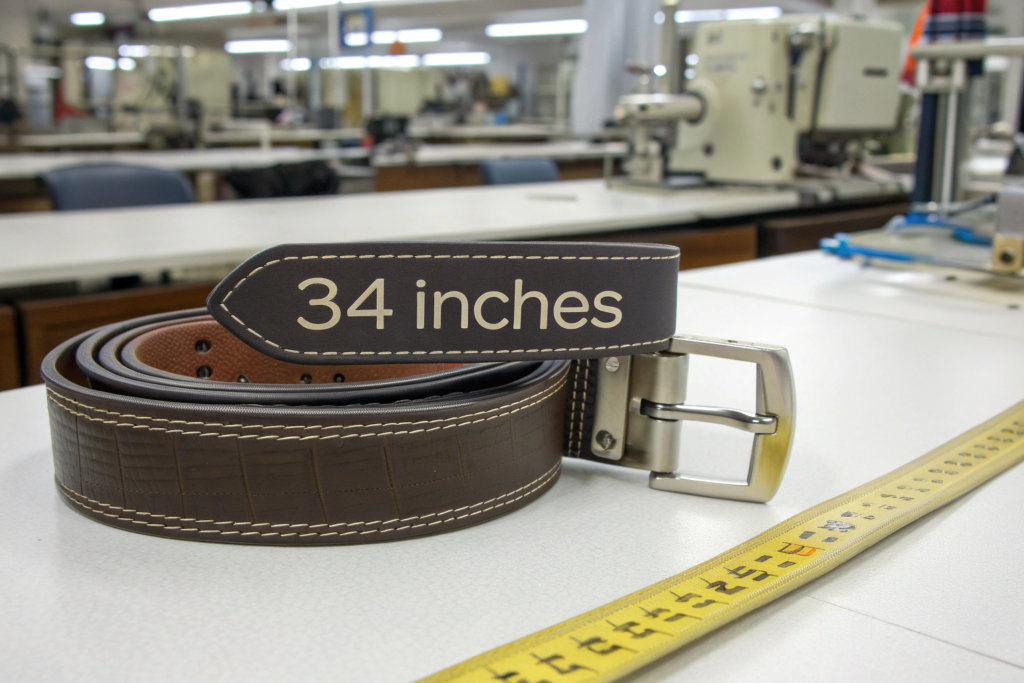
We size belts based on the actual strap length from buckle fold to middle hole, not based on waist measurement claims. We clearly mark this physical length on every belt. We also print the measured length on the hang tag, not just the branded size. A size 34 belt should measure 34 inches from the buckle fold to the middle hole. Many manufacturers cut this corner. They label a 36-inch belt as size 34 because it sounds better. The customer receives a belt that is too long. She returns it. We do not participate in vanity sizing. We cut to exact specifications. We label honestly. This reduces our clients' return rates by an average of 23 percent.
Let me explain the technical standard. Belt size is the distance from the inside edge of the buckle fold to the center hole. This is the usable length. This is what the customer actually wears. Waist size is the circumference of the wearer's body at the belt line. These two numbers are not equal. A belt size 34 fits a waist size 32 to 33 because the belt overlaps at the buckle. Many consumers do not understand this. They order a belt size 34 for a 34-inch waist. The belt is too long. They return it. We address this with educational hang tags. We explain, "If you wear pants size 34, order belt size 36." We also offer size recommendation charts based on pants size, not waist measurement. This seems basic. Most factories do not do it. We do it because we are tired of processing returns that were not our fault.
How Do You Accommodate Plus-Size Consumers?
The average belt collection stops at size 44 or 46. This excludes a significant portion of the population. We offer extended sizing up to size 60 for both men and women. The construction is identical. The materials are identical. The price is identical. We do not charge a premium for larger sizes. The material cost difference is approximately $0.80. We absorb this. We believe every consumer deserves a well-made belt that fits. Our plus-size collection sells steadily. The margins are slightly lower. The customer loyalty is significantly higher. These consumers are accustomed to being ignored. When a brand offers their size with respect, they become lifetime customers.
What Is The Best Way To Specify Belt Length?
Provide the total strap length and the distance from buckle fold to each hole. Do not just say "size 34." Send us a specification sheet. "Belt width: 35mm. Total strap length from buckle fold to tip: 1100mm. Hole spacing: 25mm. Five holes. Center hole at 950mm." This removes all ambiguity. We will cut exactly to this spec. We will inspect every belt against this spec. You will receive exactly what you ordered. This is how Shanghai Fumao Clothing has maintained zero tolerance for sizing errors for over seven years. We do not guess. We do not assume. We measure.
Conclusion
My son's belt sits on my dresser. I have worn it every day for a year. The leather has softened. The brass buckle has developed a warm patina. There is a faint mark where my thumb presses to release the tension. It is not new anymore. It is mine. This is what makes belts a staple accessory. Not fashion. Not trends. Not technology. Ownership. A belt conforms to your body. It records your habits. It ages with you. A cashmere scarf is beautiful. A leather belt is personal.
We have manufactured belts for twenty years. We have seen thousands of styles come and go. The core product remains. A strip of leather. A piece of metal. Crafted with skill. Worn with purpose. Passed down if you are lucky. This continuity is rare in modern manufacturing. It requires resisting the temptation to chase every trend. It requires investing in materials that improve with age, not deteriorate. It requires training artisans who understand that a belt is not just a product. It is a daily companion.
If you are looking for a belt supplier who understands the difference between a commodity and a keepsake, contact Elaine. She will connect you with our belt division manager. She will explain our leather sourcing, our hardware inventory, and our quality standards. She will send you samples. You will feel the difference immediately.Email Elaine directly at: elaine@fumaoclothing.com.