
A European home decor and accessories distributor called me two years ago with a payment problem that had been slowly strangling his cash flow. He was sourcing from three different factories in China, each shipping from a different port. One factory shipped from Ningbo, another from Shanghai, and a third from Shenzhen. Each factory demanded a 30 percent deposit upfront and the 70 percent balance before the goods were released from the factory. He was paying for goods in Shenzhen while his Ningbo shipment was still on the water, and his Shanghai shipment had not even left the port. At any given moment, he had over a hundred thousand euros in limbo. He was financing his factories’ working capital with his own cash. When one shipment was delayed by two weeks due to a vessel schedule change, his cash flow seized up entirely. He could not pay the balance on his next shipment, which delayed that shipment further, creating a cascading crisis. He asked me, "What is the right way to structure payment when goods are coming from multiple ports?"
The best payment term for a factory that ships from multiple ports is a structured payment schedule tied to verifiable shipping milestones rather than a single balance payment triggered by a single port departure. The optimal structure is a 30 percent deposit to initiate production, a 40 percent payment against a copy of the bill of lading for each individual shipment, and the final 30 percent paid 30 days after the arrival of each shipment at the destination port. This structure aligns the payment outflows with the shipping schedule, ensuring that the buyer pays for goods as they actually move rather than all at once. The key principle is that payment is triggered by documented proof that the goods have been loaded onto a vessel and are in transit, which is the bill of lading, and the final payment is deferred until the goods have arrived and can be inspected. For factories shipping from multiple ports, this structure should be applied separately to each shipment, so that each consignment has its own independent payment schedule tied to its own bill of lading date and its own arrival date.
The challenge of multi-port shipping is that the shipments are staggered. A factory with production facilities near different ports, or a sourcing agent consolidating goods from multiple factories, may ship part of an order from Ningbo in week one, another part from Shanghai in week three, and the remainder from Shenzhen in week five. If the payment term is a single balance payment triggered by the first shipment, the buyer pays for goods that have not yet been produced. If the payment term requires all goods to be shipped before any payment is made, the factory finances the entire production and waits months for payment. Neither extreme is sustainable. The solution is a payment structure that mirrors the physical flow of goods, payment follows shipment, shipment by shipment. At AceAccessory, we ship from multiple Chinese ports depending on the product type, the factory location, and the destination. We have developed payment structures that are fair to both parties and that keep the supply chain moving smoothly. Let me walk you through exactly how to structure payments for multi-port shipments.
What Payment Structures Work for Multi-Port Factory Shipments
The payment structure for multi-port shipments must address two competing needs. The factory needs cash flow to purchase materials and pay workers. The buyer needs assurance that they are paying for goods that actually exist, that have been shipped, and that will arrive as promised. The traditional single-payment structure, 30 percent deposit, 70 percent against copy documents, does not work well when the documents arrive in pieces, weeks apart. A better structure separates the order into individual shipments, each with its own payment milestones. This requires more administrative work, but the financial clarity and risk reduction are worth the effort.
The most effective payment structures for multi-port factory shipments are the per-shipment bill of lading payment structure, the letter of credit with partial shipments clause, and the open account with post-arrival payment. The per-shipment bill of lading structure is the most balanced. The buyer pays a single deposit, 30 percent of the total order value, to initiate the entire production run. As each individual shipment is loaded and a bill of lading is issued, the buyer pays 60 percent of that shipment’s value against a copy of the bill of lading. The final 10 percent of each shipment is held as a retention and paid 30 days after arrival, providing a quality and conformity guarantee. The letter of credit with partial shipments clause is the most secure for both parties. The buyer opens an irrevocable letter of credit that explicitly allows partial shipments. As each shipment is made, the factory presents the documents for that shipment to the bank and receives payment for that portion. The letter of credit governs the entire order, but payment is released in installments matching the shipping schedule. The open account with post-arrival payment is for established relationships with high trust. The buyer pays a deposit, and the balance is paid 30, 60, or 90 days after the arrival of each shipment. This gives the buyer maximum cash flow benefit but requires the factory to finance the production and transit time.
The choice of structure depends on the relationship between the buyer and the factory, the financial strength of each party, and the complexity of the shipments. A new relationship calls for a letter of credit. A mature relationship with a trusted factory can move to open account. Most of our client relationships operate on the per-shipment bill of lading structure, which we find provides a fair balance of risk and cash flow. Let me explain the two most practical structures in more detail.
How Does a Per-Shipment Bill of Lading Payment Work?
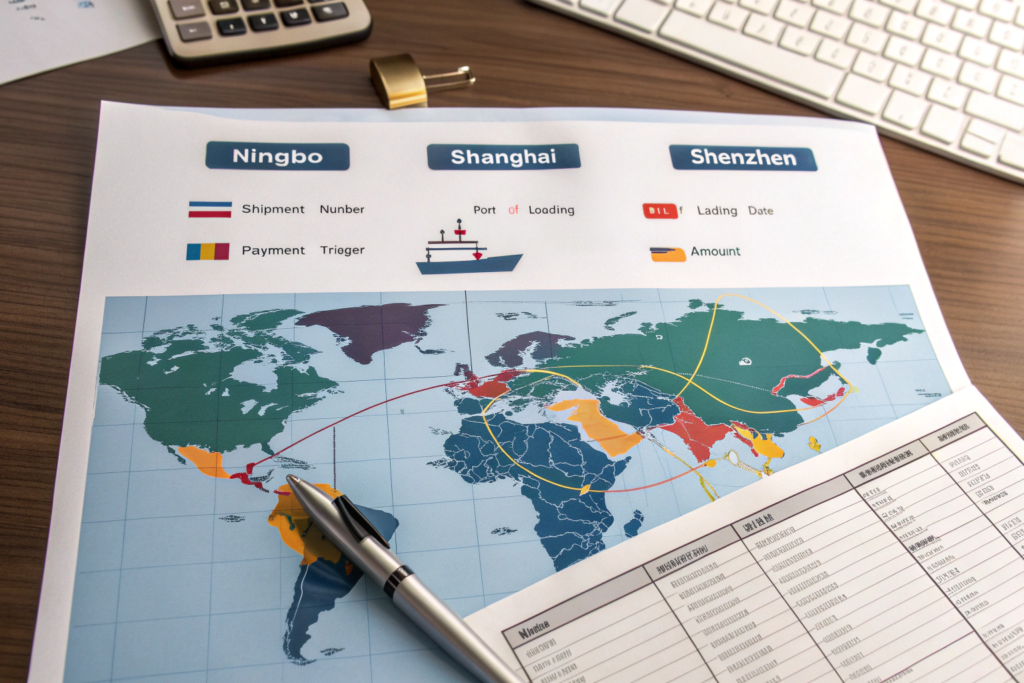
The per-shipment bill of lading payment structure is the workhorse of multi-port trade finance. It is simple, transparent, and directly ties payment to the physical movement of goods. The structure works as follows. The purchase order is divided into individual shipments, each with its own commercial invoice and packing list. The shipments are identified by a shipment number or a purchase order line item. The payment schedule is defined in the purchase order. Deposit, 30 percent of the total order value, paid within 7 days of order confirmation. This deposit covers the raw material costs for the entire order and is not allocated to a specific shipment. Per-shipment balance, 70 percent of each shipment’s individual value, paid within 5 business days of the buyer’s receipt of the copy bill of lading for that shipment. The copy bill of lading is sent by email or uploaded to a shared portal. It must be a clean on-board bill of lading, meaning the goods have been loaded onto the vessel, the bill is free of any clauses indicating damage or discrepancy, and it matches the shipment details. The buyer verifies the bill of lading details, shipment number, container number, seal number, port of loading, vessel name, estimated date of departure, and pays the balance for that shipment only. The factory ships the goods and releases the original documents, or telex releases the container, upon receipt of payment. The next shipment follows the same process independently. This structure has several advantages. The buyer’s cash outflows are staggered to match the shipping schedule. The buyer pays for goods as they ship, not all upfront. The factory receives payment for each shipment shortly after it departs, maintaining their working capital. The risk of a single shipment problem delaying the entire order is eliminated. If one shipment is delayed, the other shipments proceed on their own schedule, with their own payments. The administrative process is manageable. Each shipment generates its own set of documents, and payment is processed against those documents.
Can a Letter of Credit Handle Shipments from Multiple Ports?
Yes, a letter of credit is the most secure payment instrument for multi-port shipments, but it must be structured correctly to accommodate the staggered departures. A standard letter of credit assumes a single shipment. The credit specifies a single latest shipment date, a single port of loading, and a single amount. If the factory presents documents for a partial shipment, the bank may reject them because the credit did not explicitly authorize partial shipments. The solution is to include a partial shipments clause in the letter of credit. The clause states, "Partial shipments are allowed." This simple addition authorizes the factory to make multiple shipments under the same letter of credit, each presentation of documents triggering a payment for that portion. The letter of credit should also specify the ports of loading. If the shipments will depart from Ningbo, Shanghai, and Shenzhen, the credit should state "Port of Loading: Any Chinese Port" or list the specific ports. The credit should state the latest shipment date. This should be set to accommodate the last scheduled shipment. The expiry date of the credit should be set to allow time for the last shipment’s documents to be presented to the bank, typically 15 to 21 days after the latest shipment date. The credit should state the amount. This is the total value of all shipments. As each partial shipment is presented and paid, the available balance of the credit is reduced. The credit should specify the documents required. For each presentation, the factory must provide the commercial invoice for that shipment, the packing list, the full set of clean on-board ocean bills of lading, and any other documents specified in the credit, such as a certificate of origin or a packing declaration. The bank examines each presentation independently. If the documents comply, the bank pays the amount of that shipment. If the documents are discrepant, the bank notifies the buyer, and the buyer can waive the discrepancies or refuse the documents. The letter of credit with partial shipments provides strong protection for both parties. The factory is assured of payment from a bank upon presentation of compliant documents. The buyer is assured that payment will only be made for goods that have been shipped and documented. The cost of a letter of credit is a bank fee, typically a fraction of a percent of the credit amount, and it is a worthwhile investment for large orders or new supplier relationships.
How to Coordinate Payments Across Different Shipping Schedules
Coordinating payments across multiple shipments requires a system. Without a system, payments become reactive, late, and a source of friction with the factory. The system needs to track each shipment from production through to arrival, link each payment to a specific shipment milestone, and provide visibility to both the buyer and the factory. The system does not need to be sophisticated software. A shared spreadsheet can work for smaller operations. The key is that the information is accurate, current, and accessible to both parties.
Coordinating payments across different shipping schedules requires a shared shipment tracking document that is updated in real time as each shipment progresses. The tracking document should include, for each shipment, a unique shipment identifier, the port of loading, the estimated production completion date, the actual production completion date, the QC inspection date and result, the vessel booking date, the vessel cutoff date, the actual delivery to port date, the vessel name and voyage number, the estimated date of departure, the bill of lading date and number, the date the copy bill of lading was sent to the buyer, the payment due date, which is 5 business days from the bill of lading date or from the date of receipt of the copy, the payment amount, the date payment was made, the payment reference, the estimated date of arrival, and the actual date of arrival. This document serves as the single source of truth for all payment-related information. It eliminates confusion about which shipment has been paid, which is due for payment, and which is still in production. The document should be reviewed weekly by the buyer and the factory project manager to ensure alignment.
The tracking document is the operational tool. The strategic tool is the payment calendar. The buyer should forecast their payment obligations based on the estimated shipment dates and ensure that sufficient funds are available. A cash flow crunch caused by a forgotten payment obligation can delay a shipment and strain the factory relationship. Let me explain the two most important coordination mechanisms.

How Should Payment Milestones Be Tied to Shipping Documents?
Payment milestones should be tied to specific, verifiable, and independently issued shipping documents. The bill of lading is the gold standard trigger document. It is issued by the shipping line or the freight forwarder, not by the factory. It is an independent verification that the goods have been received, loaded onto a named vessel, and are in transit. The date on the bill of lading is the on-board date, the date the goods were physically loaded. This date is the trigger for the per-shipment balance payment. The payment due date should be defined in the purchase order as a specific number of days from the bill of lading date, typically 5 to 7 business days, or from the date the copy bill of lading is received by the buyer. The latter is more buyer-friendly because the buyer may not receive the copy for a day or two after the on-board date. The purchase order should state, "70 percent balance payment due within 5 business days of buyer’s receipt of the copy bill of lading." The buyer should acknowledge receipt of the copy bill of lading by email, stating the date of receipt, which starts the payment clock. For the final retention payment, the trigger document should be the arrival notice or the proof of delivery. The purchase order should state, "10 percent retention payment due 30 days after the arrival of the goods at the destination port, as evidenced by the arrival notice issued by the shipping line, provided no material quality or conformity defects have been notified by the buyer to the factory within that period." This ties the final payment to the successful arrival and acceptance of the goods. Other documents that can serve as payment triggers include the packing list, which verifies the quantities shipped, the commercial invoice, which verifies the values, and the certificate of origin, if required for customs purposes. The key principle is that each payment milestone is linked to a document that is issued by a third party and that provides objective evidence of progress.
What Happens When One Shipment Is Delayed but Others Are Ready?
This is the exact scenario that makes the per-shipment payment structure so valuable. In a single-payment structure, a delay in one shipment delays payment for all shipments. The factory may have two containers ready to ship but holds them because they need the payment for the full order. The buyer’s goods sit at the port, accruing storage fees, while the factory waits for the delayed shipment. This is a no-win situation. In the per-shipment payment structure, each shipment is independent. The two containers that are ready are shipped. The bills of lading are issued. The buyer pays for those two shipments. The factory receives payment for the goods that have been shipped. The delayed shipment proceeds on its own schedule. When it is ready, it is shipped, and payment follows. There is no cross-contamination between shipments. The purchase order should explicitly state that each shipment is a separate contractual obligation with its own payment schedule, and that delay or non-performance of one shipment does not relieve either party of their obligations with respect to the other shipments. This is a severability clause applied to shipments. The clause should read, "Each shipment under this purchase order constitutes a separate and independent contractual obligation. The buyer’s obligation to pay for a shipment is triggered by the shipping documents for that shipment and is not contingent upon the shipment of any other goods under this purchase order. Delay or non-shipment of any part of this order does not relieve the buyer of the obligation to pay for goods that have been shipped." This clause protects the factory, ensuring they are paid for what they ship. Conversely, the buyer’s obligation to pay for a delayed shipment is not triggered until that shipment actually occurs, protecting the buyer’s cash flow. The practical handling of a delayed shipment involves communication. The factory should notify the buyer immediately when a delay is anticipated. The revised shipment date should be added to the tracking document. The buyer adjusts their payment forecast. The delayed shipment is simply rescheduled, and the payment for it is deferred until the new bill of lading date.
What Are the Risks of Multi-Port Payment Structures
Multi-port payment structures solve many problems, but they also introduce new risks that must be managed. The risks fall into three categories. Documentary risks, where the bill of lading or other trigger documents contain errors or discrepancies that delay payment. Logistics risks, where port congestion, vessel delays, or container shortages disrupt the shipping schedule and the payment schedule. Financial risks, where currency fluctuations between the payment dates change the effective cost for one of the parties. Each risk can be mitigated through careful contract drafting, proactive communication, and the use of appropriate financial instruments.
The primary risks of multi-port payment structures are documentary risk, schedule disruption risk, and foreign exchange risk. Documentary risk is the risk that the bill of lading or other trigger document contains a discrepancy that prevents the buyer from accepting it or the bank from honoring it under a letter of credit. Common discrepancies include a misspelled consignee name, an incorrect port of discharge, a container number that does not match the packing list, or a bill of lading that is not marked "clean on board." Mitigation requires the factory to double-check all shipping documents against the purchase order before issuing them to the buyer, and for the buyer to review documents promptly upon receipt and notify the factory of any discrepancies within 24 hours. Schedule disruption risk is the risk that a shipment is delayed due to port congestion, vessel blank sailing, bad weather, or a container shortage, which defers the payment trigger and disrupts the buyer’s inventory planning. Mitigation requires the factory to book vessel space early, to have contingency plans for alternative vessels or ports, and to communicate delays immediately. Foreign exchange risk is the risk that the exchange rate between the contract currency and the buyer’s or factory’s local currency moves unfavorably between the order date and the payment date. Mitigation can include using a forward exchange contract to lock in the rate, agreeing to share the currency risk, or denominating the contract in a stable currency.
These risks are inherent in international trade. They are not unique to multi-port shipments, but the staggered nature of the payments means that the exposure period is extended. A single payment structure concentrates the exposure at one point in time. A multi-payment structure spreads it over weeks or months. Let me explore the two most impactful risks.

How Do You Handle Documentary Discrepancies on Bills of Lading?
A documentary discrepancy on a bill of lading is a ticking clock. The goods are on the water. The original documents are in transit or held by the bank. The bill of lading contains an error. The buyer needs the error corrected to clear customs or to satisfy the payment conditions. Every day of delay in resolving the discrepancy adds to the port storage fees and the demurrage charges at the destination. The resolution process depends on where the error occurred and when it is discovered. If the discrepancy is discovered before the original documents are released, the factory can request the shipping line to amend the bill of lading. This involves submitting a letter of indemnity to the shipping line, accepting liability for any consequences of the amendment, and paying an amendment fee, typically 50 to 100 dollars. The amendment is made, and a corrected bill of lading is issued. This process takes 24 to 48 hours. If the discrepancy is discovered after the original documents have been released and are in the banking channel, the amendment is more complex. The original bill of lading must be surrendered to the shipping line before a corrected one can be issued. This can delay the process by a week or more. If the discrepancy is minor, a misspelling of the buyer’s name that is still recognizable, a slightly incorrect weight that does not affect the customs value, the buyer may choose to accept the documents with the discrepancy and waive the error. Under a letter of credit, the buyer must formally waive the discrepancy with the bank. The best defense against documentary discrepancies is prevention. The factory should send a draft bill of lading to the buyer for approval before the original is issued. The draft is a non-negotiable copy of the bill of lading instructions. The buyer reviews the draft, confirms all details are correct, and approves it. Only then does the shipping line issue the final bill of lading. This simple step eliminates the vast majority of documentary discrepancies. We follow this procedure for every shipment.
What If a Shipment Is Delayed Due to Port Congestion?
Port congestion is the logistical reality of modern global trade. Major ports around the world experience congestion due to surges in cargo volume, labor shortages, weather events, and infrastructure limitations. A container scheduled to depart on a specific vessel may miss the cutoff because the port is gridlocked. The vessel sails without the container. The container is rolled to the next available vessel, which may be a week or more later. The bill of lading is delayed. The payment trigger is delayed. The buyer’s inventory arrival is delayed. The financial impact on the buyer can be significant, especially for seasonal goods. The purchase order should address this scenario. A well-drafted force majeure clause will typically cover port congestion as an event beyond the factory’s reasonable control. The clause should state, "The factory shall not be liable for delay in shipment caused by port congestion, vessel blank sailing, or other circumstances beyond the factory’s reasonable control, provided the factory notifies the buyer in writing within 48 hours of becoming aware of such circumstances and provides evidence of the event." The factory is relieved of liability for the delay, but the factory is still obligated to ship the goods as soon as reasonably possible. The payment is deferred until the new bill of lading date. The buyer may have recourse against their cargo insurance for the financial loss caused by the delay, depending on the policy terms. A marine cargo insurance policy with delay coverage, also called business interruption or delay in transit coverage, can compensate the buyer for lost sales or markdown costs resulting from a delayed shipment. This coverage is an add-on to standard cargo insurance and is worth considering for high-value, seasonal goods. The buyer and factory should also discuss mitigation measures. Can the goods be trucked to a less congested port, such as moving from Shanghai to Ningbo? Can the goods be split and shipped on multiple smaller vessels instead of one large vessel? The cost of these mitigation measures can be shared between the buyer and factory as a commercial agreement.
Conclusion
The best payment term for a factory that ships from multiple ports is a structure that mirrors the physical flow of goods. Payment follows shipment, shipment by shipment, with each consignment having its own independent payment milestones tied to its own bill of lading and its own arrival. We have explored the most effective payment structures, the per-shipment bill of lading payment, the letter of credit with partial shipments, and the open account with post-arrival terms, each suited to different levels of trust and relationship maturity. We have discussed the coordination mechanisms, the shared tracking document and the payment calendar, that prevent confusion and ensure timely payments across staggered schedules. We have examined the risks, documentary discrepancies, port congestion, and currency fluctuations, and the mitigation strategies, draft bill of lading approval, force majeure clauses, and forward exchange contracts, that manage those risks.
The core insight is that multi-port shipping is not a problem to be avoided. It is a logistical reality that, properly managed, can offer advantages in speed, cost, and flexibility. The payment structure should enable the logistics strategy, not constrain it. A well-designed payment structure gives the buyer control over their cash flow, gives the factory the working capital they need, and allows the goods to flow smoothly from multiple Chinese ports to their global destinations.
At AceAccessory, we ship from multiple ports as a routine part of our operations. Our accessories are produced in different factories across Zhejiang and surrounding provinces, and we route shipments through the most efficient port for each product and destination. We are experienced in the payment structures that support this multi-port model. We work with our clients to establish a payment schedule that is fair, transparent, and documented in the purchase order. We use shared tracking documents, draft bill of lading approval, and proactive communication to ensure that every shipment and every payment proceeds on schedule.
If you are sourcing from multiple factories or from a factory that ships from multiple ports, and you want to structure your payments for optimal cash flow and risk management, I invite you to discuss your situation with us. Contact our Business Director, Elaine, at elaine@fumaoclothing.com. Tell her about your sourcing model, your payment concerns, and the structure you are looking for. She can share our standard multi-port payment terms and work with you to customize a schedule that fits your business. Let us help you turn the complexity of multi-port shipping into a smooth, predictable, and well-financed supply chain.