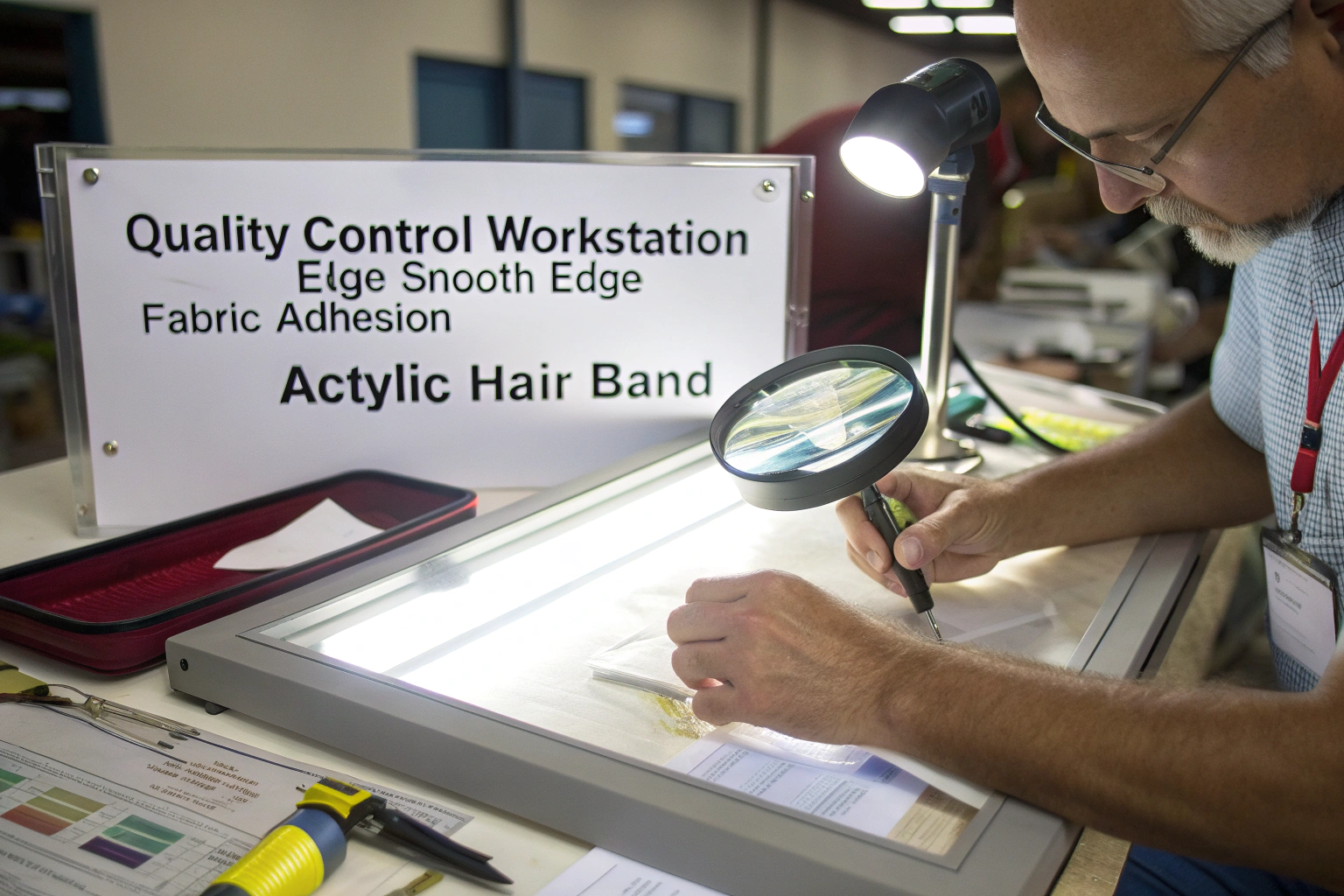
You open a carton from your latest shipment of 3,000 acrylic knotted headbands. The colors are beautiful. You pick one up. You give it a gentle flex. It snaps clean in half in your hands. Your stomach drops. You grab another. The fabric covering is already peeling away from the acrylic core at the edge. A third has a visible, sharp burr on the inner edge that would snag and tear a customer’s hair. You realize that the beautiful colors are masking a host of structural and safety failures. You are not just looking at a few defective units. You are looking at a systemic failure of quality control in the factory that made them. You didn’t just buy headbands. You bought a lesson in the specific, critical ways acrylic headbands can fail.
The top 5 non-negotiable quality checks for acrylic hair bands are: 1) A manual flex and tensile test to check for brittleness and cracking; 2) A fabric adhesion peel test to ensure the covering is permanently bonded; 3) A 100% tactile and visual inspection for sharp edges, burrs, and rough seams; 4) A dimensional accuracy check using a go/no-go fixture for consistent fit; and 5) A colorfastness and crocking test to prevent dye transfer onto skin or clothing.
I manage AceAccessory in Zhejiang, and we manufacture thousands of acrylic headbands every month. Acrylic is a beautiful material, but it has specific failure modes that a generic QC checklist will miss. You need a quality system that is specifically designed for the unique challenges of this product. Let me walk you through the five essential tests that we perform on every single batch, and that you should demand from your supplier.
The Manual Flex and Tensile Test: Why Is This the First Line of Defense?
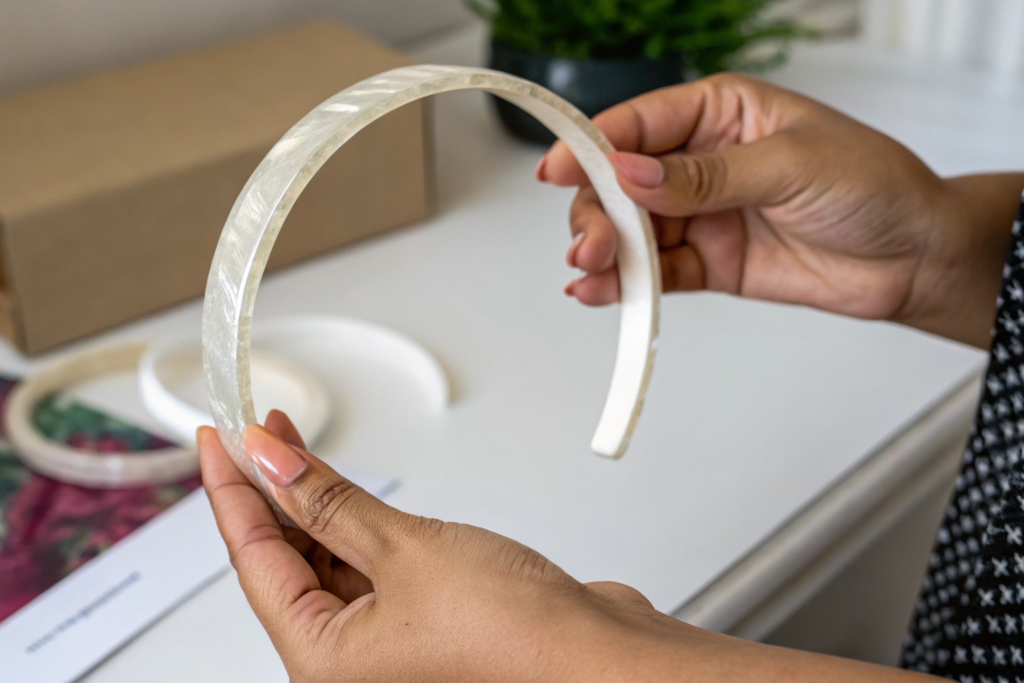
This is the single most important and revealing test for an acrylic headband. It can be performed in seconds and will immediately expose the most common and catastrophic defect: brittleness. Acrylic is a rigid plastic. It is not meant to be bent double, but it must have a degree of controlled flexibility to withstand the normal stresses of being put on and taken off a head. Cheap, poorly processed, or improperly cured acrylic becomes brittle. It looks fine on the shelf. It feels hard and solid. But the first time it is flexed, it develops stress fractures, visible as white marks called "crazing," or it snaps completely. A quality acrylic band should be able to be flexed inward by a moderate amount, simulating the stretch of fitting over an adult head, without any cracking or permanent stress whitening. At AceAccessory, our QC team performs this simple manual flex test on a random sample from every production batch. It is a fast, zero-cost, and brutally effective quality gate. This simple manual flex test to detect brittleness and stress fractures in acrylic is non-negotiable.
How Much Flex Is "Acceptable" for a Standard Acrylic Band?
You need a quantifiable standard, not just a subjective "bend it a bit." Based on our production data, a standard adult acrylic hair band should be able to be flexed inward so that the two ends are approximately 12 to 15 centimeters apart without any signs of cracking or permanent stress whitening. This simulates the normal range of motion. The band should also return to its original shape and resting width. A band that permanently deforms after a gentle flex will become loose and fall off the head. This quantifiable flex range for passing the acrylic hair band durability test provides an objective pass/fail standard.
What Does "Crazing" Look Like and Why Is It a Red Flag?
Crazing is the term for the network of fine, white, hairline cracks that appear on the surface of stressed acrylic. It is the unmistakable visual signature of a material that is about to fail. Even if the band does not snap immediately, the presence of crazing means the internal structure of the plastic is compromised. It will snap with very little additional stress. It is also a cosmetic defect that makes the product look old and damaged. Any band that shows crazing during the flex test is an automatic failure. This identifying crazing as a sign of imminent acrylic failure is a key QC skill.
The Fabric Adhesion Peel Test: How Do You Know the Covering Won’t Lift?
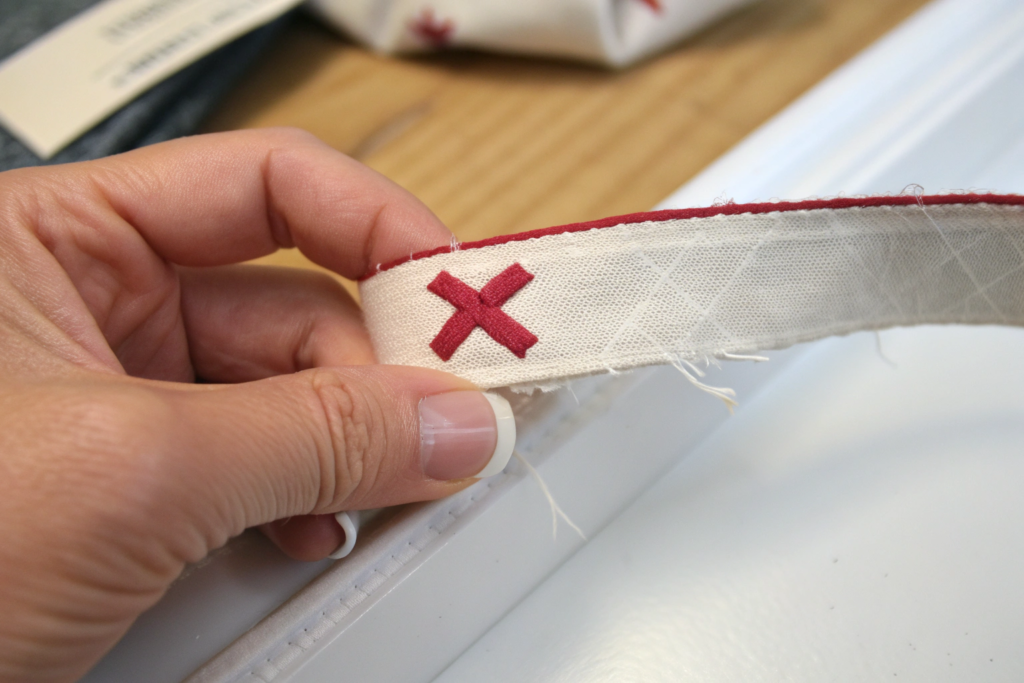
Many popular acrylic headbands are covered with a decorative fabric: velvet, satin, or a printed polyester. The bond between this fabric and the smooth, non-porous acrylic is a critical point of failure. A cheaply made headband will use an inadequate glue or will skip the essential step of preparing the acrylic surface. The result is delamination. The fabric begins to lift and peel at the edges, especially at the ends of the band where it is handled most. Once it starts, it cannot be stopped. The headband looks cheap and damaged. The adhesion peel test is simple. The QC inspector attempts to lift the edge of the fabric at the end of the band with a fingernail. On a quality headband, the fabric edge should be completely sealed and should not lift at all. If it lifts easily, the entire batch is suspect. At AceAccessory, we use a two-part process: the acrylic core is lightly abraded to create a mechanical bond, and a specialized, flexible industrial adhesive is used. This simple peel test to verify proper fabric adhesion on acrylic headbands prevents a major field failure.
What Causes the Fabric to Peel Away from the Acrylic?
The root cause is almost always a combination of two factors: a failure to properly prepare the acrylic surface and the use of the wrong adhesive. Acrylic is naturally smooth and has low surface energy. Glue does not stick to it well. The surface must be mechanically abraded or chemically treated to give the adhesive "tooth" to grip onto. Cheap factories skip this step. They also use cheap, rigid, general-purpose glues that become brittle and crack. A flexible, industrial-grade adhesive specifically designed for bonding plastics and textiles is required. This root causes of fabric delamination on acrylic accessories explains why cheap manufacturing fails.
How Do You Ensure a Clean, Seamless Fabric Finish?
Beyond the bond strength, the aesthetic of the fabric application is a key quality point. The fabric should be applied smoothly, without wrinkles, bubbles, or puckering. The edges should be cleanly trimmed, with no fraying or loose threads. The seam where the fabric ends meet should be tight and, ideally, hidden on the inside of the band. This requires skilled handwork and careful attention to detail during assembly. This quality standards for smooth and seamless fabric application on headbands defines a premium look.
The 100% Sharp Edge and Burr Inspection: Why Is This a Safety Imperative?
An acrylic hair band is worn against the sensitive skin of the scalp and behind the ears. Any sharp edge, rough seam, or small plastic burr can scratch the skin, snag hair, and cause pain. This is not a cosmetic defect. It is a safety and comfort hazard. Acrylic parts come out of an injection mold with a parting line, a thin ridge of excess plastic where the two halves of the mold met. This parting line, and any other rough edges from cutting or drilling, must be completely removed. The edges must be polished smooth. This is not a task that can be sampled. It requires 100% inspection. At AceAccessory, every single acrylic band is handled by a finishing operator who runs their thumb along the entire inner and outer edge, feeling for any sharpness or roughness. It is a tactile inspection. Bands that fail are sent back for re-finishing. This 100% tactile and visual inspection for sharp edges and burrs on plastic accessories is a non-negotiable safety protocol.
How Are Seams and Joints Inspected for Smoothness?
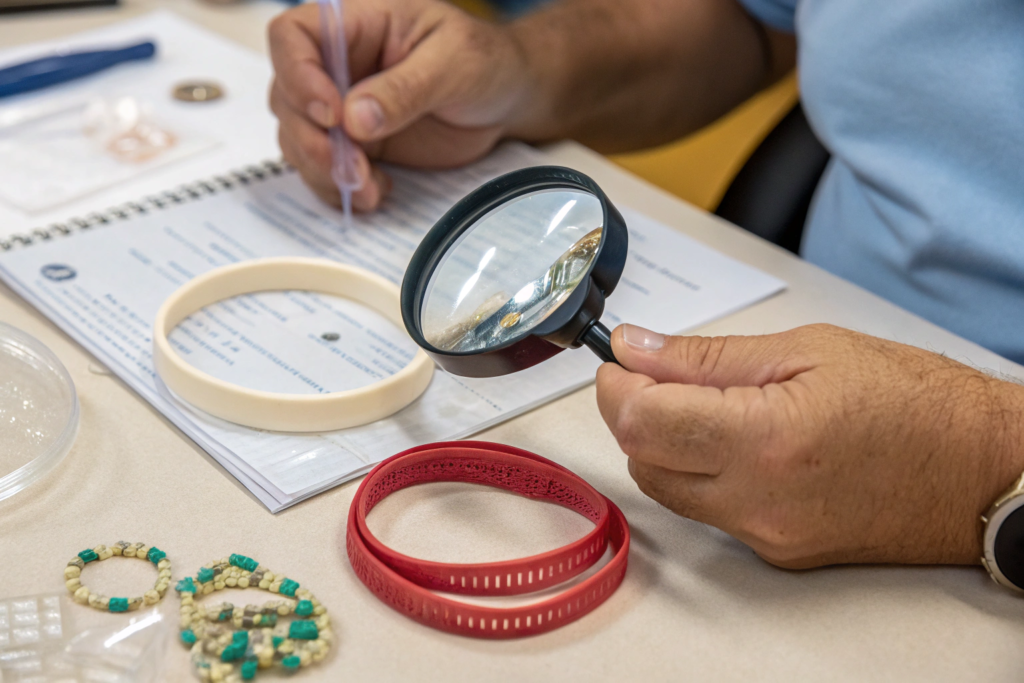
Many acrylic headbands are not a single piece. They may have a decorative knot, a bow, or a separate fabric element attached. The joint where these pieces meet is a potential snagging point. Any gap, rough edge, or bead of hard adhesive can catch and pull hair. The inspector pays special attention to these joints, running a fingernail across them to ensure they are perfectly smooth. Any catch is a failure. This seam and joint smoothness inspection for assembled hair accessories is a critical comfort factor.
What Is the Standard for Acceptable Surface Defects?
Acrylic is often transparent or translucent, making any internal bubbles, flow lines, or surface scratches highly visible. A cosmetic standard must be defined. We use a standard viewing distance of arm’s length under normal retail lighting. Defects that are not visible under this condition are considered acceptable. Defects that are immediately apparent, like a large bubble or a deep scratch, are rejected. We provide limit samples to our clients to align on this cosmetic standard. This cosmetic inspection standard for surface defects on clear acrylic accessories sets clear expectations.
The Dimensional Accuracy Check: How Do You Ensure a Consistent Fit?
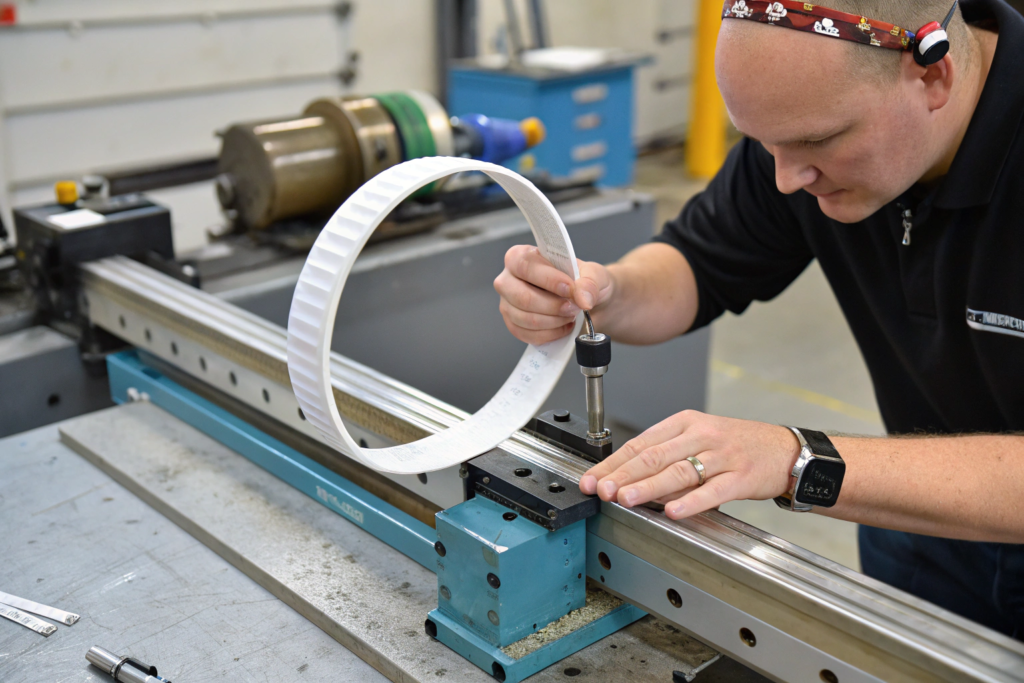
An acrylic hair band that is too narrow will painfully pinch the wearer’s head. A band that is too wide will slide forward and fall off. Consistency across a production run is essential for customer satisfaction. The dimensions of an acrylic band are determined by the injection mold. However, variations can occur if the acrylic is removed from the mold too hot and warps, or if the mold temperature fluctuates, affecting shrinkage. To ensure consistency, we use a simple but effective tool: a go/no-go fixture. This is a precisely machined gauge. The finished headband is placed in the fixture. If it fits within the acceptable tolerance range, it passes. If it is too narrow or too wide, it fails. This is a fast, objective, and repeatable check that is performed on a sample from every molding machine shift. This using go no-go fixtures for dimensional inspection of injection molded accessories ensures a consistent fit.
What Are the Standard Dimensions for an Adult Acrylic Band?
You should specify the target dimensions. A typical adult acrylic hair band has an inner width at its widest point of 12.5 to 13.5 centimeters. The overall length along the curve from tip to tip is 34 to 36 centimeters. The thickness is typically 3 to 5 millimeters. Providing these target dimensions with a reasonable tolerance, such as plus or minus 3mm in width, gives the factory a clear, measurable goal. This standard size chart for adult acrylic hair bands provides a baseline for development.
How Does Tooth Design Affect Grip and Comfort?
Many acrylic bands have small teeth on the inner surface to grip the hair. The design of these teeth is a critical comfort factor. Teeth that are too sharp will scratch the scalp. Teeth that are too blunt will not grip. The ideal tooth has a slightly rounded tip and an even spacing. The mold design and the QC inspection must pay close attention to this detail. This tooth design and comfort testing for non-slip hair bands is a detail that matters.
The Colorfastness and Crocking Test: Will the Color Transfer?
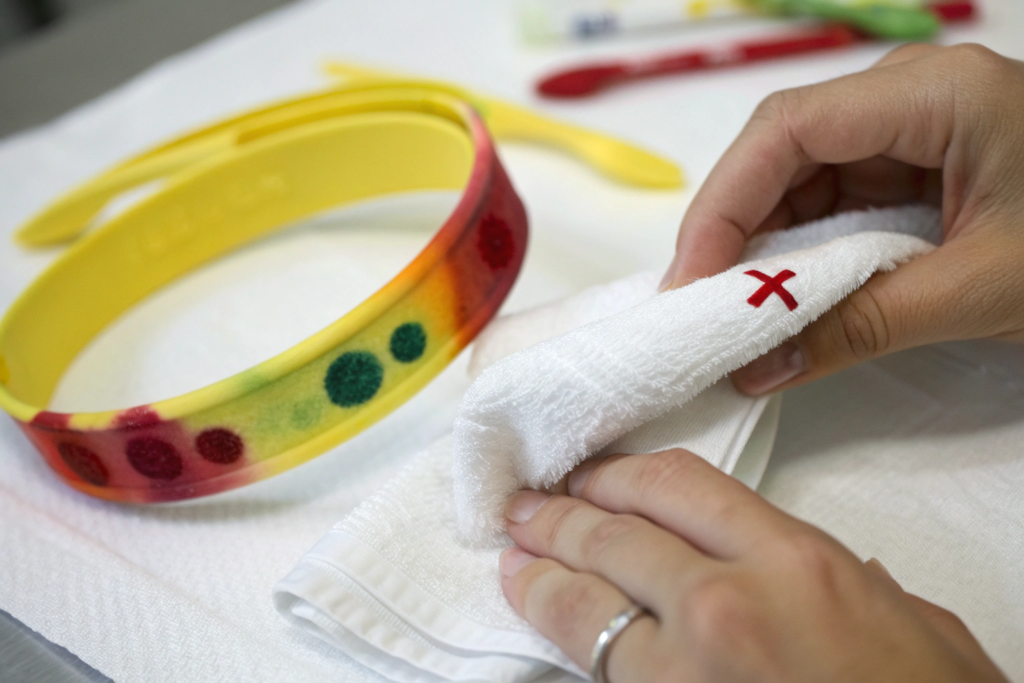
Acrylic headbands are often dyed in vibrant, saturated colors. If that color is not properly fixed into the material, it can transfer, or "crock," onto the customer’s blonde hair, their fingertips, or a light-colored blouse. This is a serious defect that leads to immediate returns and brand damage. We perform a crocking test on every colored acrylic batch. A standardized white cotton cloth is rubbed against the surface of the band under firm pressure for a set number of cycles. The cloth is then examined for any color transfer. Any visible transfer above a very faint trace is a failure. We also perform a wet crocking test using a cloth dampened with water or synthetic perspiration, as moisture can accelerate dye transfer. This dry and wet crocking tests for colorfastness on dyed acrylic accessories is a critical safety and quality check.
How Do You Test for Colorfastness on Fabric-Covered Bands?
Fabric-covered bands present a double risk. Both the fabric and the underlying acrylic could potentially transfer color. The same crocking test is applied to the fabric surface. Additionally, for bands that might be worn in humid conditions, we test for colorfastness to perspiration. The fabric is tested according to AATCC standards. This AATCC colorfastness testing for textile components of headbands ensures a durable, safe product.
What Is the Risk of Chemical Odor from Acrylic?
A strong, pungent chemical odor is a sign of low-grade acrylic with residual solvents or unpolymerized monomers. It is unpleasant and can be a sign of material instability. Our QC includes a simple odor test. A batch of bands is sealed in a bag for a period and then evaluated for odor. Any strong, objectionable smell is a reason for rejection. This odor testing for volatile organic compounds in acrylic accessories is a basic sensory check.
Conclusion
The quality of an acrylic hair band is not a matter of luck. It is the direct result of a disciplined, systematic quality control process that targets the specific, known failure modes of this product. The five tests described here, the flex test for brittleness, the peel test for adhesion, the edge inspection for safety, the dimensional check for fit, and the crocking test for colorfastness, are not optional. They are the essential pillars of a quality assurance program for acrylic headbands. A factory that consistently performs these checks is a factory that understands the product and cares about its performance. A factory that does not is simply rolling the dice with your brand’s reputation.
At AceAccessory, these five checks are embedded in our standard operating procedures. They are performed on every single batch, and the results are documented. We do this because we know that the true cost of a defective headband is not the unit price. It is the lost customer trust and the damaged brand reputation.
If you are sourcing acrylic hair bands and want a manufacturing partner who treats quality control as a core competency, I encourage you to contact our Business Director, Elaine. She can walk you through our full QC checklist and share sample inspection reports. You can email Elaine at: elaine@fumaoclothing.com. Let us build quality into every band.