I remember a conversation with a designer who was launching her first scarf collection. She was torn. She loved the look of a smooth, printed silk scarf, but she also adored the cozy, textured feel of a chunky knit. "I don't know which one to start with," she told me. "They're both scarves, but they feel completely different. How do I decide?" Her question gets to the very heart of scarf sourcing. Woven and knitted scarves are two fundamentally different products, each with its own unique set of advantages and challenges.
The pros and cons of sourcing woven versus knitted scarves come down to their fundamental structure, production process, and resulting properties. Woven scarves are made by interlacing two sets of yarns (warp and weft) at right angles. This creates a stable, durable, and less stretchy fabric with a crisp finish, ideal for printing and structured designs. Knitted scarves are made by interlooping a single yarn (or set of yarns). This creates a fabric that is inherently stretchy, soft, and drapes fluidly, perfect for cozy, textured, and form-fitting styles. At Shanghai Fumao Clothing, we specialize in both, and we help our clients understand these trade-offs to choose the perfect construction for their vision.
That designer was wise to hesitate. Choosing between woven and knitted is not a matter of better or worse; it is a matter of different. It's about understanding the inherent nature of each fabric type and matching it to the desired aesthetic, function, and production requirements. Let me walk you through the four key areas where woven and knitted scarves differ, so you can make an informed decision for your next collection.
How Do Structure and Drape Differ Between Woven and Knitted Scarves?
The most fundamental difference between a woven and a knitted scarf is how they are constructed. This difference in structure dictates everything else: how the scarf feels, how it hangs, how it moves, and how it can be designed. Understanding this is the first step in making your choice. It's the difference between a crisp, architectural statement and a soft, cozy embrace.
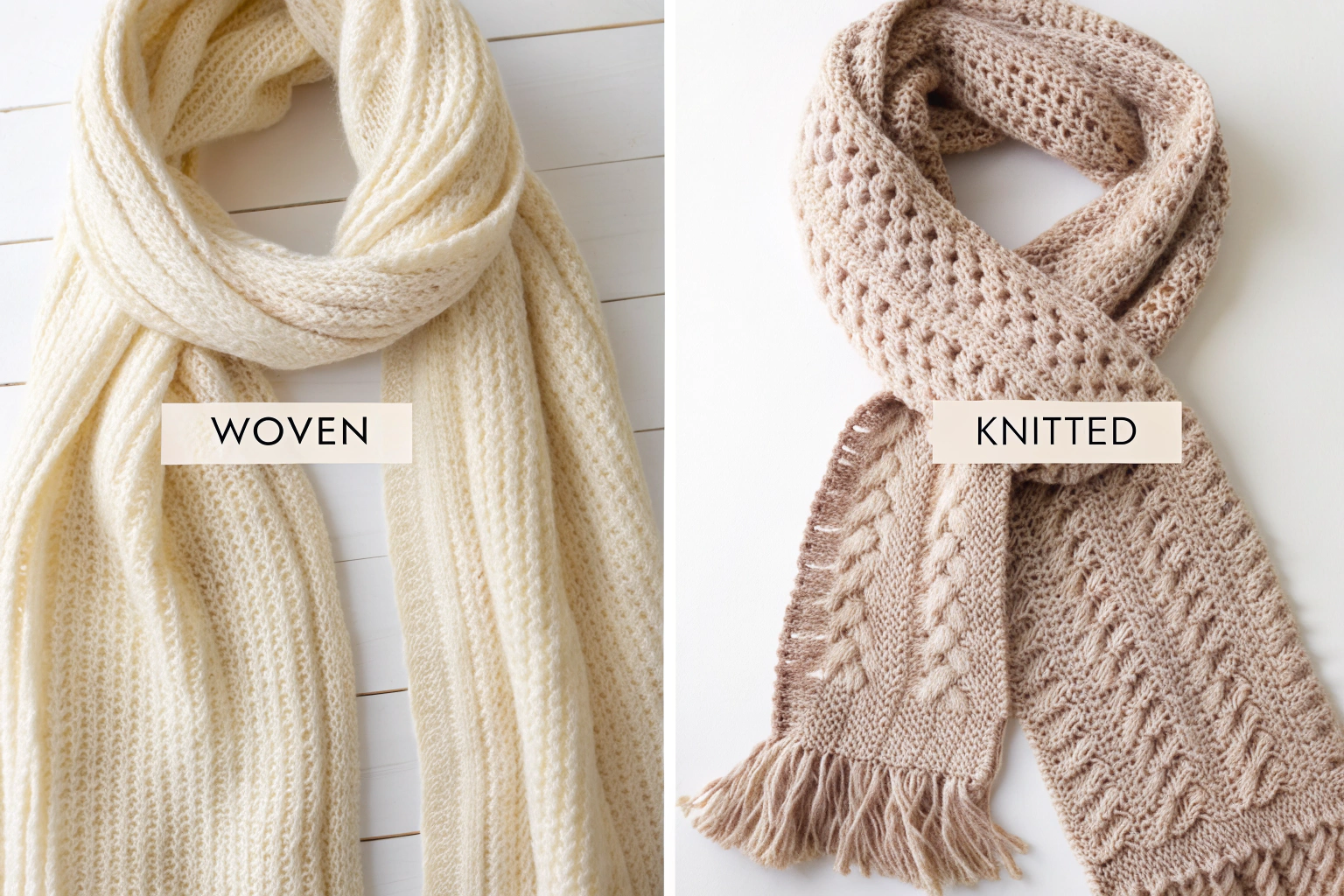
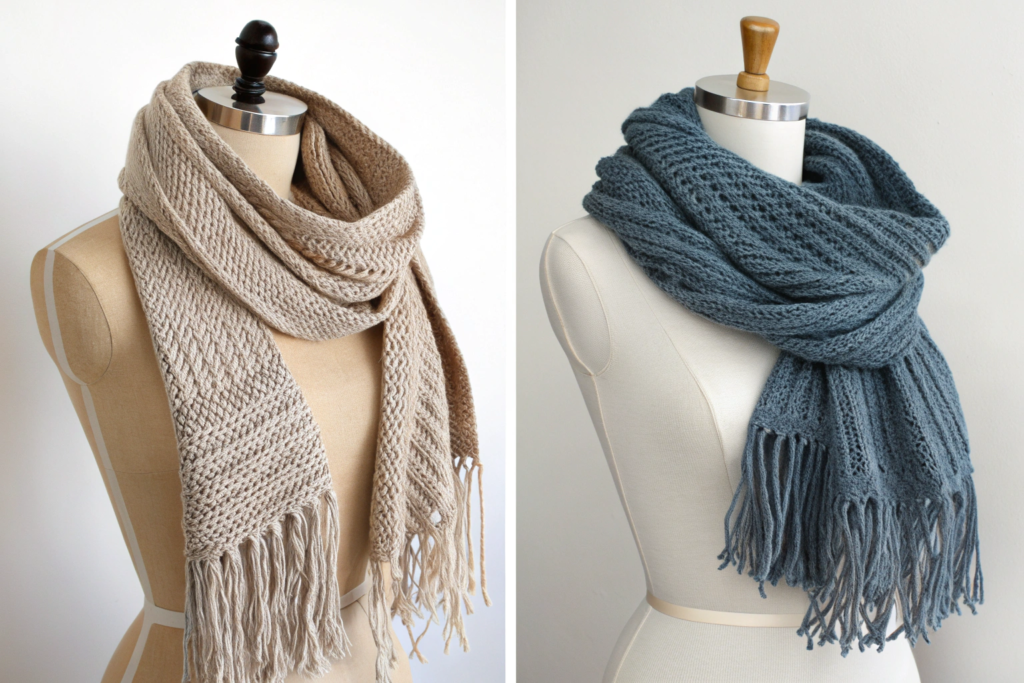
Woven fabrics are created on a loom, with one set of yarns (the warp) running lengthwise and another set (the weft) running crosswise, interlacing over and under. This creates a stable, firm structure with very little stretch (except on the bias). Woven scarves have a crisp, defined drape. They hold their shape well and are ideal for sharp pleats, structured folds, and clean edges. They are the canvas for detailed prints. Knitted fabrics are created on knitting machines, with needles forming a continuous series of interlocking loops. This looped structure gives knitted scarves their inherent stretch and flexibility. They have a soft, fluid drape, conforming to the body and falling in gentle folds. They are perfect for cozy, textured designs like cables and ribbing.
Let's visualize this. Think of a woven fabric like a piece of paper. It has a stable, two-dimensional structure. You can print on it, fold it, and it will hold a crease. A knitted fabric is more like a fine mesh or a net. It is three-dimensional, flexible, and can be stretched and shaped. This structural difference has profound implications. A woven scarf, especially one made from silk or fine cotton, can be printed with intricate, detailed patterns that remain crisp and clear. A knitted scarf, especially a chunky one, is defined by its texture—cables, ribs, and the soft, tactile quality of the yarn itself. It's about the feel as much as the look. This is a fundamental concept in textile science and fabric analysis. At Shanghai Fumao Clothing, our design team considers these structural properties from the very first sketch, ensuring the chosen construction perfectly complements the design vision.
Can a woven scarf have any stretch?
Woven fabrics have minimal stretch along their length or width. However, they do have "bias stretch." If you cut a woven scarf on the bias (at a 45-degree angle to the warp and weft), it will have a significant amount of stretch and a beautiful, fluid drape. This is how bias-cut silk scarves and dresses achieve their signature cling and flow. It's a more expensive and wasteful cutting method, but it creates a unique property.
Is a knitted scarf always stretchy?
Yes, all knitted fabrics have some degree of inherent stretch due to their looped construction. However, the amount of stretch varies greatly depending on the knit structure and the fiber used. A tight, fine-gauge knit will have less stretch than a loose, chunky cable knit. Rib knits are specifically designed for maximum stretch and recovery.
What Are the Differences in Production Time and Cost?
The structural differences between woven and knitted fabrics are mirrored in their production processes. These processes have a direct impact on lead times, costs, and minimum order quantities. For a brand sourcing scarves, understanding these production realities is essential for planning and budgeting. What is the most cost-effective choice for a large, simple order? What is the best choice for a small, design-driven collection?
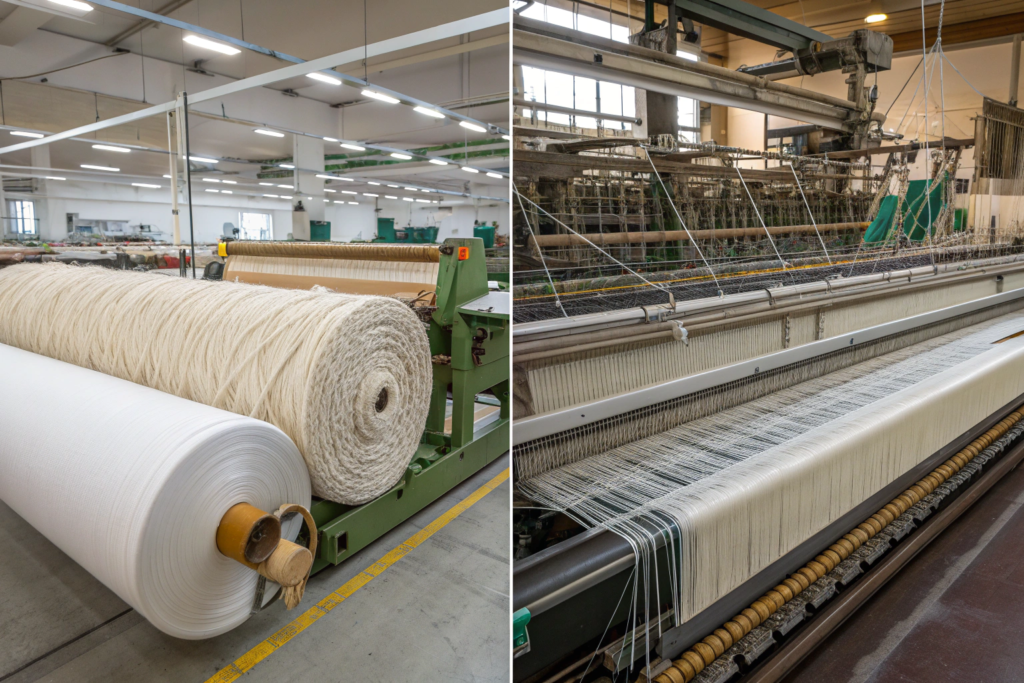
Woven scarf production is generally a two-stage process. First, the fabric is woven on a loom, which can be a relatively slow process. Then, the woven fabric must be cut and finished into individual scarves, often with hemmed or hand-rolled edges. This process is best suited for larger quantities to be cost-effective, as the setup time for the loom is significant. Knitted scarf production can be much faster, especially for simple styles. Many knitted scarves are made on specialized knitting machines that produce the scarf in its final shape, a process called "fully fashioned" knitting. This eliminates the cutting and seaming steps, reducing labor and waste. For small to medium runs, knitting can be very efficient. However, for very large runs of a simple, solid-colored scarf, weaving can become more cost-effective due to the speed of modern weaving looms.
Let's look at the cost implications in more detail. For a woven scarf, the major cost drivers are the yarn, the weaving, and the finishing (especially hems). A simple, solid-colored woven scarf in a common width can be very economical in large quantities. A complex jacquard weave with multiple colors is much more expensive and requires higher minimums. For a knitted scarf, the major cost drivers are the yarn, the knitting time, and any finishing (like adding fringe). A simple, stockinette stitch scarf in a bulky yarn can be knitted very quickly and is very cost-effective. A complex cable knit or a scarf with colorwork requires more time and skill, increasing the cost. The "fully fashioned" process, where the scarf is knitted to shape, is a significant advantage for knitted scarves, as it eliminates fabric waste and reduces labor. This is a key consideration in apparel manufacturing and cost analysis. At Shanghai Fumao Clothing, we have both weaving and knitting capabilities, allowing us to advise our clients on the most cost-effective production method for their specific design and order quantity.
Which type of scarf has lower minimum order quantities (MOQs)?
Generally, knitted scarves, especially simple styles made on flatbed knitting machines, can have lower MOQs than woven scarves. This is because the setup for a knitting machine can be quicker and less expensive than setting up a loom. For a fully-fashioned knitted scarf, the MOQ might be a few hundred pieces. For a simple woven scarf, you might need to order a full roll of fabric, which could translate to a higher MOQ.
Is hand-rolling a hem only possible on woven scarves?
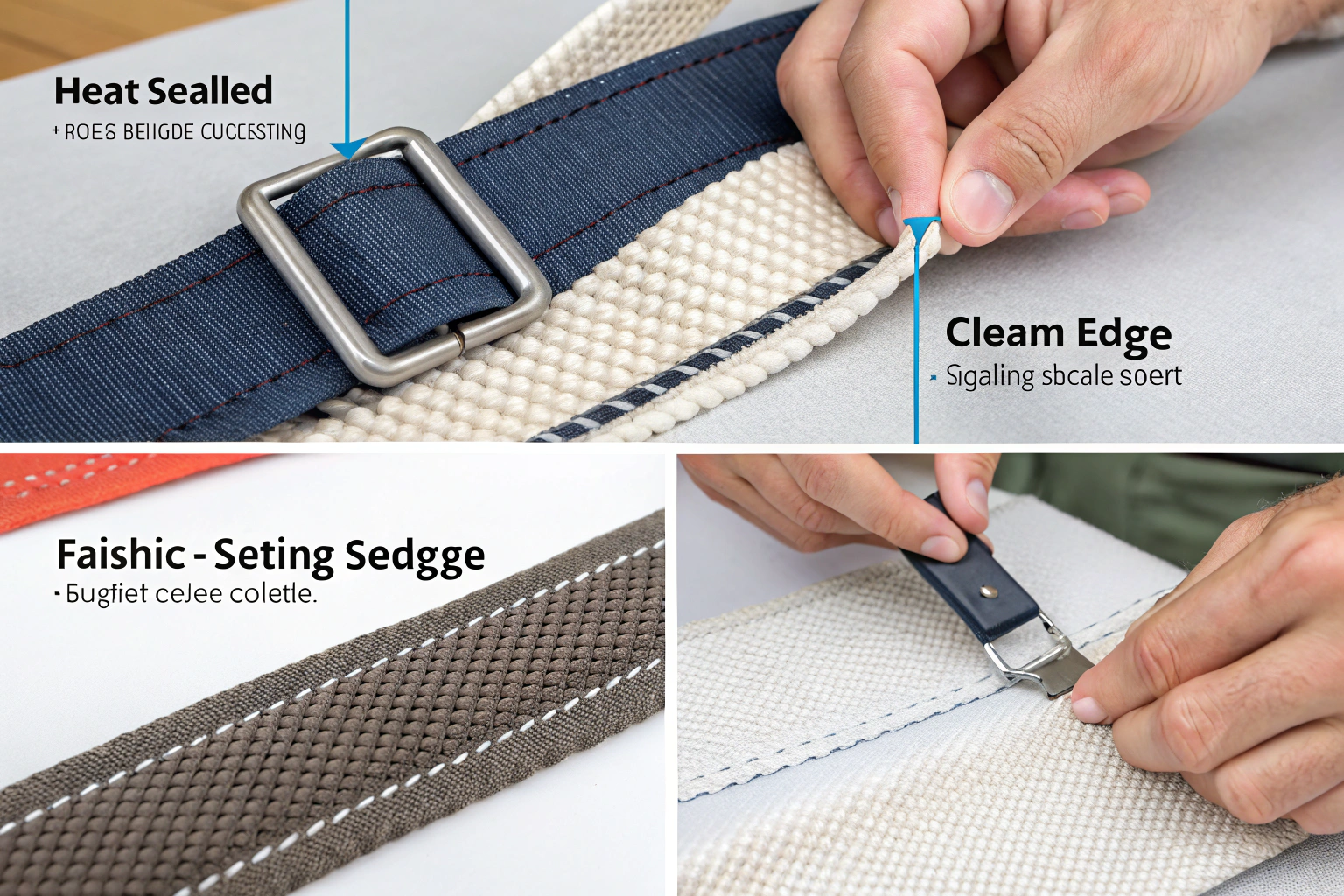
While hand-rolled hems are most commonly associated with luxurious woven scarves (especially silk), they can also be done on knitted scarves. However, it is less common. Knitted scarves are often finished with a simple fringe, a tassel, or a ribbed edge that doesn't require a separate hem. A hand-rolled hem on a knit scarf would be a very high-end, labor-intensive detail.
How Do Design Possibilities Differ: Prints vs. Textures?
The choice between woven and knitted is often a choice between two different forms of artistic expression. Woven scarves are a canvas for color and print. Knitted scarves are a canvas for texture and form. Understanding where each construction excels creatively is key to aligning your design vision with the right production method. You can't easily print a chunky knit, and you can't easily create a cable pattern on a flat weave.
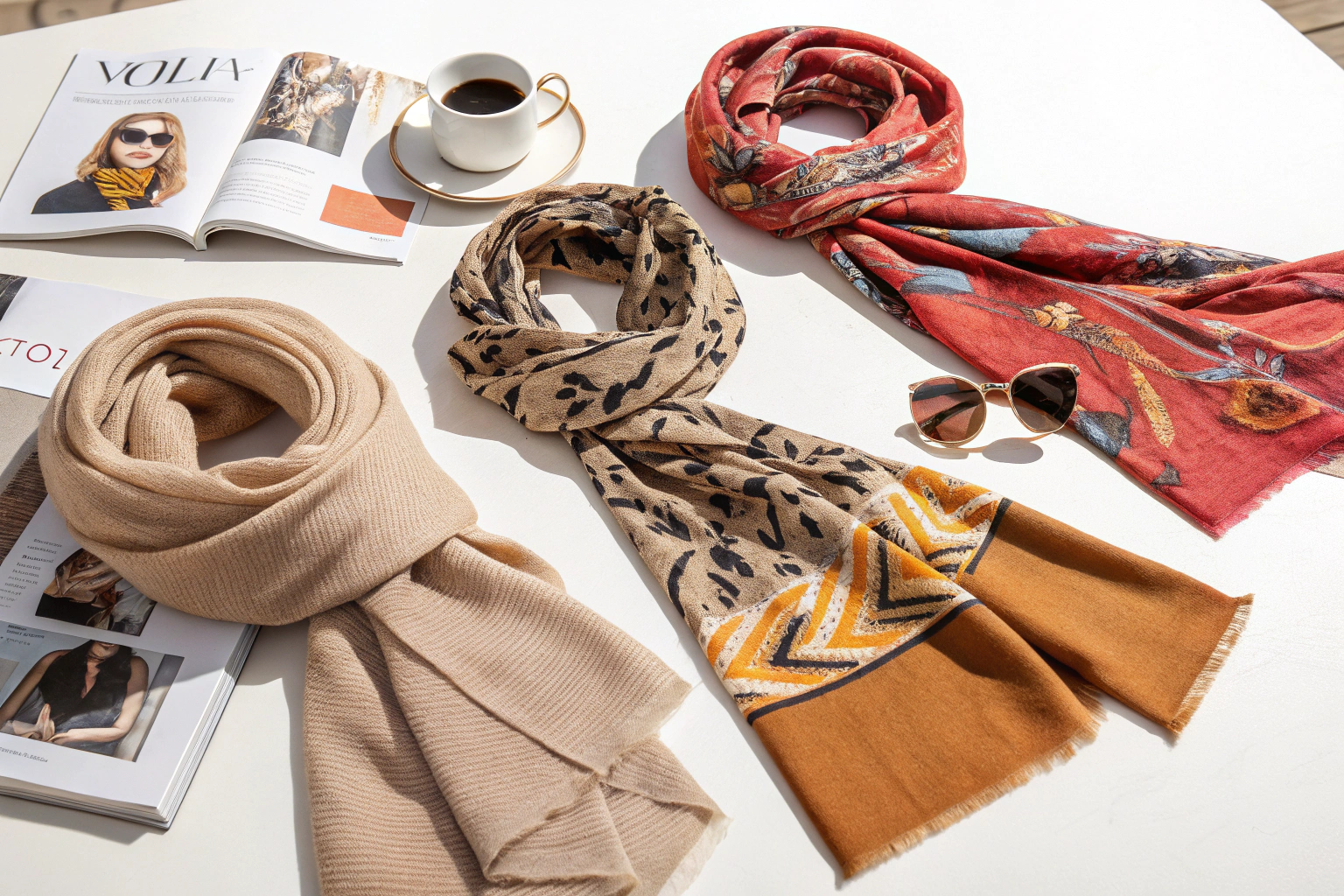
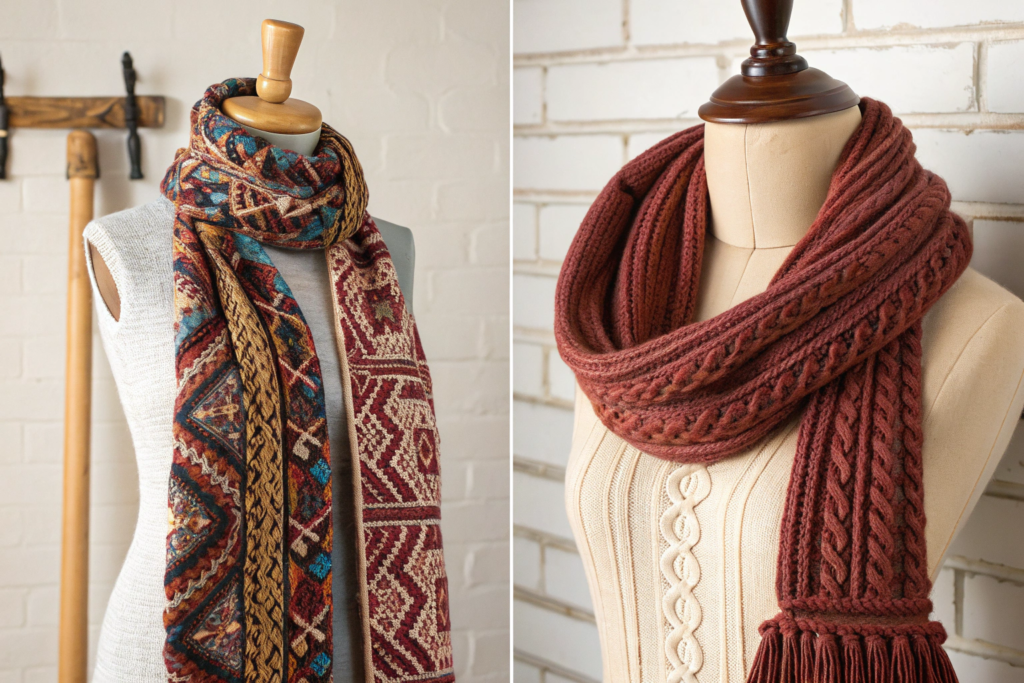
Woven scarves are the superior choice for printed designs. The stable, smooth surface of a woven fabric is the perfect canvas for intricate patterns, detailed motifs, and vibrant color palettes. Techniques like screen printing and digital printing are used to create everything from bold geometrics to delicate watercolor florals. Woven scarves are also ideal for jacquard weaves, where the pattern is created by the weaving process itself, resulting in a reversible, textured design. Knitted scarves are defined by their texture. The looped structure allows for an infinite variety of three-dimensional effects. Cables, ribs, bobbles, lace patterns, and fair isle colorwork are all created during the knitting process. The beauty of a knitted scarf often lies in the interplay of light and shadow on its textured surface. They are also the perfect vehicle for showcasing luxurious, tactile yarns like cashmere, alpaca, and merino wool.
The design implications are profound. If your collection is driven by a specific, complex print—say, a collaboration with an artist or a pattern inspired by a historical textile—a woven scarf is your only real option. The printing process requires a smooth, stable surface. If your collection is driven by the desire for a super-soft, cozy feel and a rich, tactile texture—like a chunky cable knit in a soft wool blend—a knitted scarf is the natural choice. You can also combine these concepts. For example, you could have a fine-gauge, smooth-knitted scarf that is then printed, though the print will not be as crisp as on a woven. Or you could have a woven scarf with a textured weave, like a slubbed silk or a basketweave. The key is to play to the strengths of each construction. This is the heart of textile design and development. At Shanghai Fumao Clothing, our design team is expert in both disciplines, helping clients choose the right canvas for their creative vision.
Can you print on a knitted scarf?
Yes, you can print on a knitted scarf, especially on fine-gauge, smooth knits. However, the print will not be as sharp and detailed as on a woven fabric. The looped structure of the knit can distort the print slightly. Printing on a chunky, textured knit is very difficult and the result will be blurry and unclear. For the best print quality, a woven fabric is always the first choice.
Can you create a cable pattern on a woven scarf?
No, not in the same way. Cables are created by manipulating loops in knitting. A woven fabric's structure is fundamentally different. You can, however, create textured woven fabrics through the use of different weave structures, like a basketweave, a herringbone, or a dobby weave. These create a textured surface, but it is a different aesthetic from a knitted cable.
What About Durability, Care, and End-Use?
Finally, the choice between woven and knitted affects the scarf's performance in the real world. How durable is it? How should it be cared for? What is its primary function? These are questions that matter to your customer and will affect their satisfaction with the product. A delicate silk scarf is a different product from a rugged wool knit, and they will be worn and cared for in very different ways.
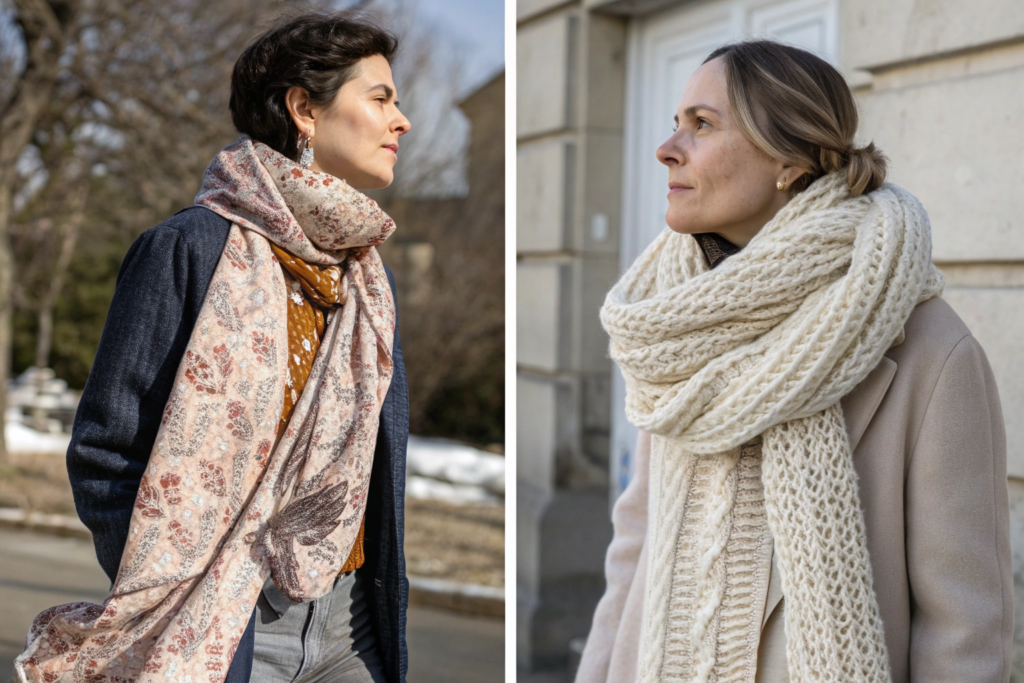
Woven scarves, especially those made from natural fibers like silk, cotton, or linen, can be delicate. They are often dry-clean only or require gentle hand-washing. They are prone to snagging if caught on jewelry or rough surfaces. Their primary function is often fashion and adornment. They add a pop of color, a print, or an elegant finish to an outfit. Knitted scarves are generally more durable and forgiving. They are often machine-washable (depending on the fiber) and can withstand more wear and tear. Their primary function is often warmth and comfort, though they are certainly also fashion items. A chunky wool or cashmere knit is designed to be worn in cold weather, providing both insulation and style. A fine-gauge knit can bridge the gap, offering both warmth and a more refined look.
The end-use also dictates the choice of fiber. A woven scarf intended for summer wear might be made from lightweight linen or cotton. A woven scarf for a special occasion might be made from luxurious silk charmeuse. A knitted scarf for extreme cold might be made from a thick, warm wool blend or a luxurious cashmere. A knitted scarf for transitional weather might be made from a lighter-weight cotton or a modal blend. The construction and the fiber work together to define the scarf's character. A customer buying a delicate silk woven scarf knows they are buying a special occasion piece that requires care. A customer buying a chunky wool knit knows they are buying a workhorse for cold winter days. Understanding this helps you position and market your product correctly. This is a key aspect of product development and market positioning. At Shanghai Fumao Clothing, we help our clients select the right fiber and construction for their target market and end-use, ensuring the final product meets customer expectations for both style and function.
Which type of scarf is easier to care for?
Generally, knitted scarves made from easy-care fibers like acrylic, cotton, or superwash wool are easier to care for (often machine washable) than delicate woven scarves, especially those made from silk or other fine natural fibers. However, a delicate, fine-gauge knitted scarf in cashmere may also require special care. The care instructions depend on the fiber, not just the construction.
Which type of scarf is warmer?
For the same fiber and weight, a knitted scarf is generally warmer than a woven one. The looped structure of a knit traps more air, creating a better insulating layer. This is why sweaters and winter scarves are almost always knitted. A woven scarf, even in a thick wool, will be less effective at trapping body heat.
Conclusion
The choice between a woven and a knitted scarf is a fundamental one that impacts every aspect of the product, from its initial design and production cost to its final feel, appearance, and end-use. Woven scarves offer a crisp, stable canvas for intricate prints and structured elegance. Knitted scarves offer softness, stretch, and the endless possibility of texture, along with superior warmth. Neither is "better." They are simply different tools for different creative and functional purposes.
At Shanghai Fumao Clothing, we have mastered both arts. Our weaving capabilities allow us to produce beautiful, printed and jacquard scarves in a range of fibers. Our knitting capabilities allow us to create everything from fine-gauge, luxurious knits to chunky, cozy cables. We can help you navigate the pros and cons of each, ensuring you choose the perfect construction for your vision, your budget, and your customer.
Are you ready to create a scarf collection that is perfectly suited to your brand? Let's talk about whether woven or knitted is the right path for you. Contact our Business Director, Elaine, at elaine@fumaoclothing.com to start the conversation.