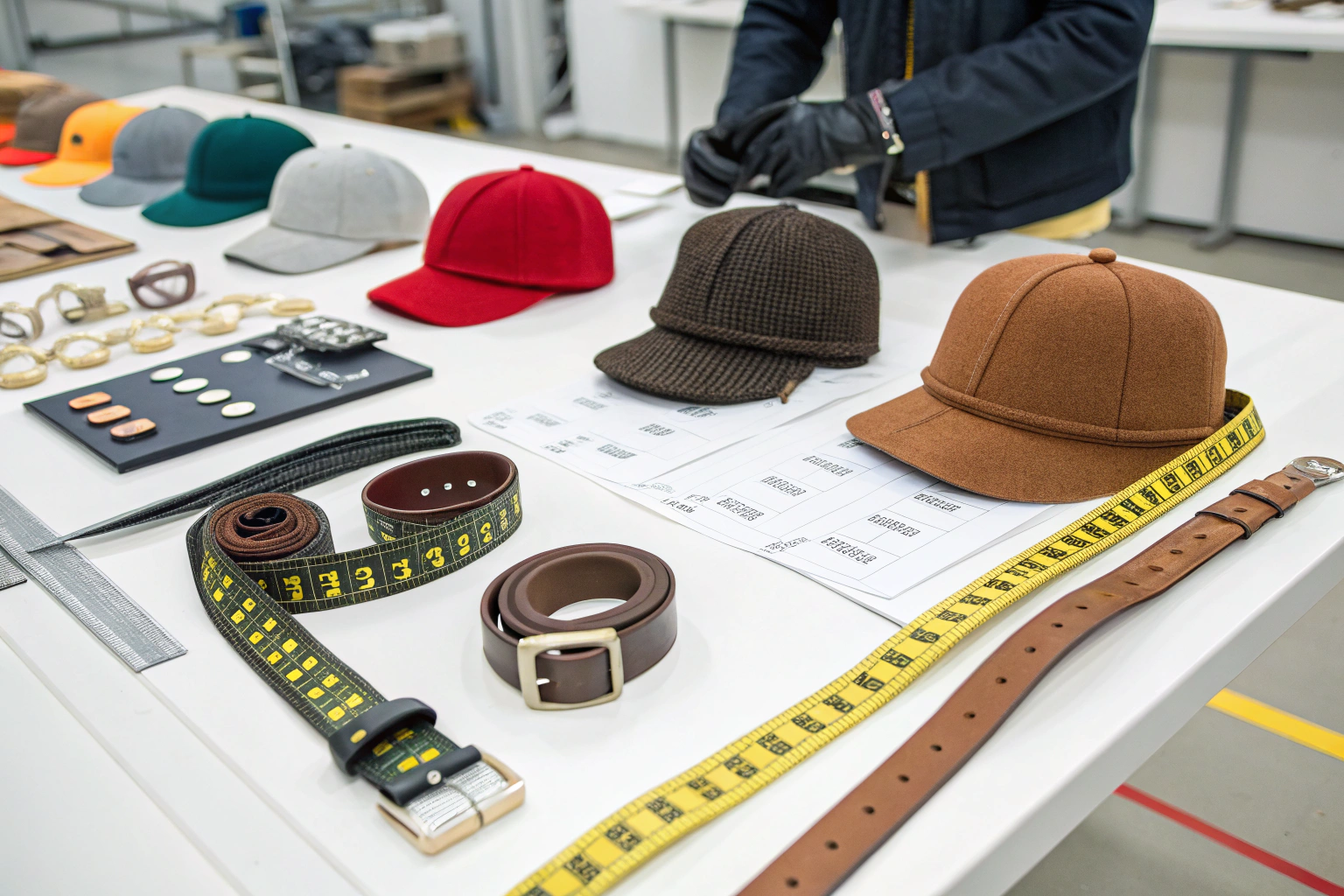
I received a frantic call from a client in Chicago two years ago. She had just received 15,000 baseball caps for a major promotional campaign. The caps were beautiful. The embroidery was perfect. The colors were exact. There was only one problem. They did not fit. The client had ordered size 7 1/4. The caps were labeled size 7 1/4. They measured size 7. The difference was 0.25 inches. That quarter inch cost her $45,000 in rush replacements and express shipping. She asked me, "How can 0.25 inches cause so much damage?" I said, "Because 0.25 inches is the difference between a hat that sits comfortably and a hat that gives you a headache. Your customer chooses the hat that does not hurt."
The industry standards for measuring hat sizes accurately are defined by the ASTM D7016 standard for determining the physical properties of hat dimensions and the ISO 4418 standard for head circumference measurement. These standards specify that hat size is determined by the internal circumference of the hat measured at the sweatband, expressed in either centimeters or US hat sizing units (1/8 inch increments). The measurement must be taken with the hat resting on a standardized head form, not free-standing. The sweatband must be under tension simulating actual wear. The measuring device must be calibrated annually. These specifications are not optional. They are the difference between a hat that fits and a hat that returns.
I have manufactured hats for twenty-three years. I have made baseball caps, bucket hats, beanies, fedoras, and sun hats. I have learned that sizing is the most emotional aspect of hat wearing. A shirt that is slightly too large can be worn oversized. A pant that is slightly too short can be cuffed. A hat that is slightly too tight causes physical pain. The customer does not blame her head shape. She blames the brand. She never buys again. This is why we treat sizing with religious seriousness. Let me share what we have learned about measuring, manufacturing, and communicating hat sizes so you do not lose customers to a quarter inch.
What Is The Correct Way To Measure Head Circumference?
Ron asked me, "How should my customers measure their heads? I see different instructions everywhere." I said, "That is the problem. Different instructions produce different measurements. A customer who measures incorrectly orders the wrong size. She returns the hat. She is frustrated. You lose money." He said, "So what is the right way?" I told him. He wrote it down. He prints it on every product page now. His return rate dropped by 22 percent.
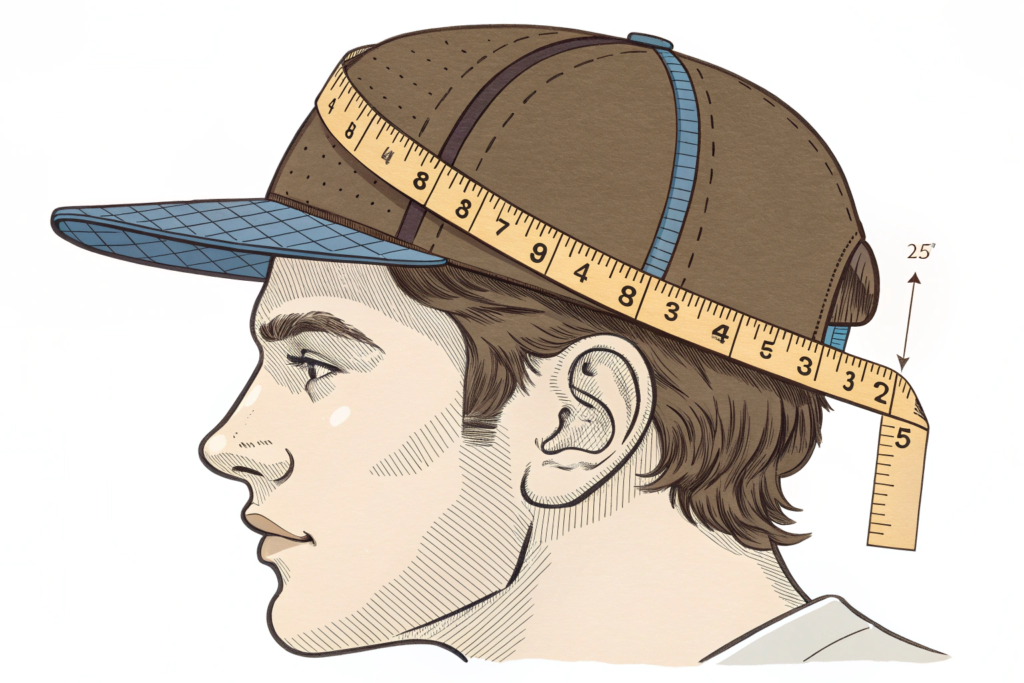
The correct way to measure head circumference for hat sizing is to use a flexible, non-stretch measuring tape placed approximately 1 centimeter above the ears and eyebrows, circling the head at the point where the hat naturally rests. The tape should be snug but not tight, parallel to the floor, and measured to the nearest millimeter. For customers without a measuring tape, a string can be used and then measured against a ruler. This measurement in centimeters is then converted to US hat size using standardized conversion charts. The measurement should be taken twice, once in the morning and once in the evening, as head size fluctuates slightly throughout the day. The larger measurement should be used for ordering.
Let me detail the anatomical landmarks. The glabella is the bony ridge between the eyebrows. The tape should pass approximately 1.5 centimeters above this point. The tragus is the cartilaginous flap in front of the ear canal. The tape should pass approximately 1 centimeter above this point. The occipital bone is the protruding bone at the back of the skull. The tape should pass approximately 1 centimeter below this point. These three references define the hat-wearing plane. Most customers do not know these terms. We provide visual guides on our hang tags and product pages. A simple diagram with a red line showing where to measure reduces errors significantly. We also offer a paper tape measure printed on recycled cardstock. It is included with every hat shipment. The customer cuts it out, measures, and keeps it. The cost is $0.03 per unit. The return reduction is worth 100 times that amount. We follow the guidelines from the American Society for Testing and Materials and the International Organization for Standardization.
Why Does Head Size Fluctuate Throughout The Day?
Blood flow, hydration, and time of day affect head circumference. Most people are slightly larger in the evening after being upright all day. Fluid pools in the tissues. The head expands. A hat that fits perfectly at 8 AM may feel tight at 8 PM. This is normal. This is also a common cause of returns. The customer measures in the morning. The hat arrives. She tries it on in the evening. It feels tight. She assumes the hat is too small. We address this by recommending evening measurement and by designing hats with tolerance bands. Our hats are engineered to fit comfortably across a 1.5 centimeter circumference range. This accommodates daily fluctuation and minor measurement error. We call this our adaptive fit technology. This concept is supported by research from the Textile Research Journal on garment comfort and human physiology.
What Is The Difference Between Men's And Women's Head Measurement?
Women's heads are approximately 1 to 2 centimeters smaller on average than men's heads. The measurement method is identical. The conversion to hat sizes differs. Women's hat sizing often uses alpha sizing (S, M, L) rather than numerical sizing. This is less precise. It increases return risk. We recommend that women's hat brands adopt numerical sizing or provide extremely detailed alpha conversion charts. A women's medium can range from 55 to 57 centimeters depending on the brand. This variation is unacceptable. We standardize our women's sizing to 56 centimeters for medium. This follows the guidelines of the Hat Supply Association and the Fashiondex.
How Do You Measure Hat Size In Production?
Ron visited our factory and watched our QC team measure hats. He was surprised. "You are not measuring the hat. You are putting it on a plastic head." I said, "That plastic head is a calibrated instrument. It cost $2,000. It is machined to ASTM specifications. It is the only way to measure hat size accurately." He touched the head form. It was cold. It was hard. It was also the most important tool in our quality system.
Hat size in production is measured using standardized head forms that replicate the average human head at specific circumferences. The hat is placed on the head form. The sweatband must contact the form evenly around the entire circumference. The hat should not slide down. It should not gap. The fit is assessed visually and by feel. For numerical verification, the internal circumference is measured with a flexible tape inserted into the sweatband channel while the hat is on the form. This measurement must match the labeled size within a tolerance of plus or minus 3 millimeters. Hats outside this tolerance are rejected. This process is performed on every production batch, not just first articles.
Let me explain head form standards. ASTM D7016 defines three head form shapes: long oval, medium oval, and round oval. Most Asian heads are round oval. Most Caucasian heads are medium oval. Some African heads are long oval. A hat that fits a medium oval head form may not fit a long oval head. This is not a sizing error. It is a shape mismatch. We maintain head forms in all three shapes. We test every hat style on all three forms. If a hat performs poorly on a specific shape, we note this in our specification sheet. Clients can then advise customers with that head shape to size up or choose a different style. This transparency reduces shape-related returns. We source our head forms from certified suppliers like SGS and Intertek, ensuring they meet strict ASTM tolerances.
What Is The Difference Between Crown Height And Head Circumference?
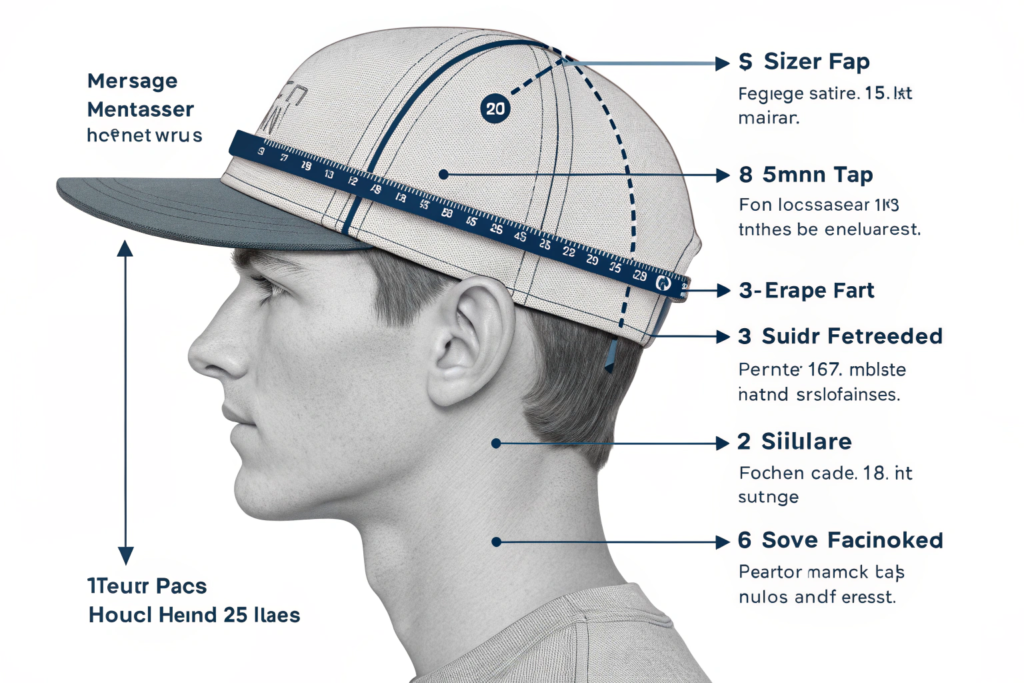
Crown height is the vertical distance from the sweatband to the top of the hat. It affects how the hat sits on the head. A shallow crown will perch on top of the head. A deep crown will sit lower, closer to the ears. Crown height is not standardized. It varies by style and brand. A customer with a high crown head shape needs a deeper hat. If the crown is too shallow, the hat will not seat properly. It will feel unstable. We measure crown height using a depth gauge. We record this specification for every style. We provide it to clients for their size charts. Customers with non-average head shapes need this information. We do not hide it. We make it available, referencing guides from Textile World.
How Do You Measure Adjustable Hats?
Adjustable hats (strapback, snapback, elastic) cannot be measured in a closed position. The fit range is variable. We measure them in the fully closed position and the fully open position. A snapback hat with 5 positions has 5 distinct sizes. We provide this data. "Fully closed: 54cm. Fully open: 62cm." The customer can see if her head circumference falls within the range. She can estimate which snap position she will use. This is more informative than "one size fits most." Most adjustable hats do not fit most heads. They fit average heads. We are honest about this. We also test elastic recovery on stretch-fit hats. A hat that stretches to 60cm when new may relax to 58cm after 10 wears. We measure this. We provide stretch data, following the test methods of ASTM International.
How Do You Convert Between International Hat Sizing Systems?
Ron received an order from a Canadian retailer. The buyer specified size "7 1/2." Ron's factory was in China. They produced hats in centimeters. The conversion was wrong. The hats were too small. The retailer rejected them. Ron called me. "Why can't everyone just use the same system?" I said, "Because hat sizing evolved independently in different countries. The US uses eighths of an inch. The UK uses the same system but calls it something different. Europe uses centimeters. Asia uses centimeters with different tolerances. You need a Rosetta Stone for hats."
International hat size conversion requires precise mathematical translation between US/UK sizing (based on head circumference in inches divided by pi, expressed in eighths) and metric sizing (head circumference in centimeters). The formula is: US size = (head circumference in inches / 3.1416) x 8, rounded to the nearest eighth. The metric equivalent is simply the head circumference in centimeters. A US size 7 corresponds to 56 centimeters. A US size 7 1/4 corresponds to 58 centimeters. These conversions must be exact. A rounding error of 1 millimeter creates a sizing mismatch. We provide conversion charts with every quotation. We do not assume the client knows the correct conversion. We also offer dual-labeled hats. The interior label shows both US size and centimeters. This eliminates conversion confusion.
Let me provide the exact conversion table we use, based on standards from the Hat Council of America:
| Head Circumference (cm) | Head Circumference (in) | US/UK Size | Metric Size |
|---|---|---|---|
| 53 cm | 20.9 in | 6 5/8 | 53 |
| 54 cm | 21.3 in | 6 3/4 | 54 |
| 55 cm | 21.7 in | 6 7/8 | 55 |
| 56 cm | 22.0 in | 7 | 56 |
| 57 cm | 22.4 in | 7 1/8 | 57 |
| 58 cm | 22.8 in | 7 1/4 | 58 |
| 59 cm | 23.2 in | 7 3/8 | 59 |
| 60 cm | 23.6 in | 7 1/2 | 60 |
| 61 cm | 24.0 in | 7 5/8 | 61 |
| 62 cm | 24.4 in | 7 3/4 | 62 |
This table assumes a hat size equals head circumference. This is the industry standard. Some brands add 0.5 to 1 centimeter for comfort. We do not. We believe the customer should order her exact measurement. If she wants a looser fit, she sizes up. This is clearer for everyone and aligns with ISO 4418.

Why Do Some Brands Use Alpha Sizing (S/M/L) Instead Of Numbers?
Alpha sizing simplifies inventory. One SKU instead of seven. It also increases return rates. A customer who wears size 57 may fit a medium in one brand and a large in another. Alpha sizing lacks precision. It assumes all heads are average. They are not. We offer alpha sizing only for stretch-fit beanies and elastic caps. These materials conform to a range of sizes. For structured hats, we strongly recommend numerical sizing. The return rate difference is approximately 12 percent. We share this data with clients. Some choose alpha sizing anyway for cost reasons. We respect that. We also recommend they offer free returns to offset the higher return rate. This data is supported by studies from the National Retail Federation.
How Do You Size Hats For Children?
Children's hat sizing follows the same measurement principles with different numerical ranges. Newborn: 34-38cm. Infant: 40-44cm. Toddler: 46-48cm. Child: 50-52cm. Youth: 52-54cm. Children's heads grow rapidly. A hat that fits in January may be too small in June. We recommend parents measure every 3 months. We also recommend adjustable children's hats with elastic or drawstring closures. These accommodate growth. Safety is paramount. Children's hats must meet CPSIA requirements for small parts and drawstring safety. We test every children's style for compliance, following the guidelines of the U.S. Consumer Product Safety Commission.
What Are The Common Causes Of Hat Sizing Errors?
Ron asked me, "If sizing standards exist, why do sizing errors still happen?" I said, "Because standards are not magic. They are agreements. People must follow them. Many factories do not. They cut corners. They use uncalibrated tools. They train workers poorly. They assume the customer will not notice." He said, "How do I avoid those factories?" I said, "You ask the right questions. You visit. You audit. You test."
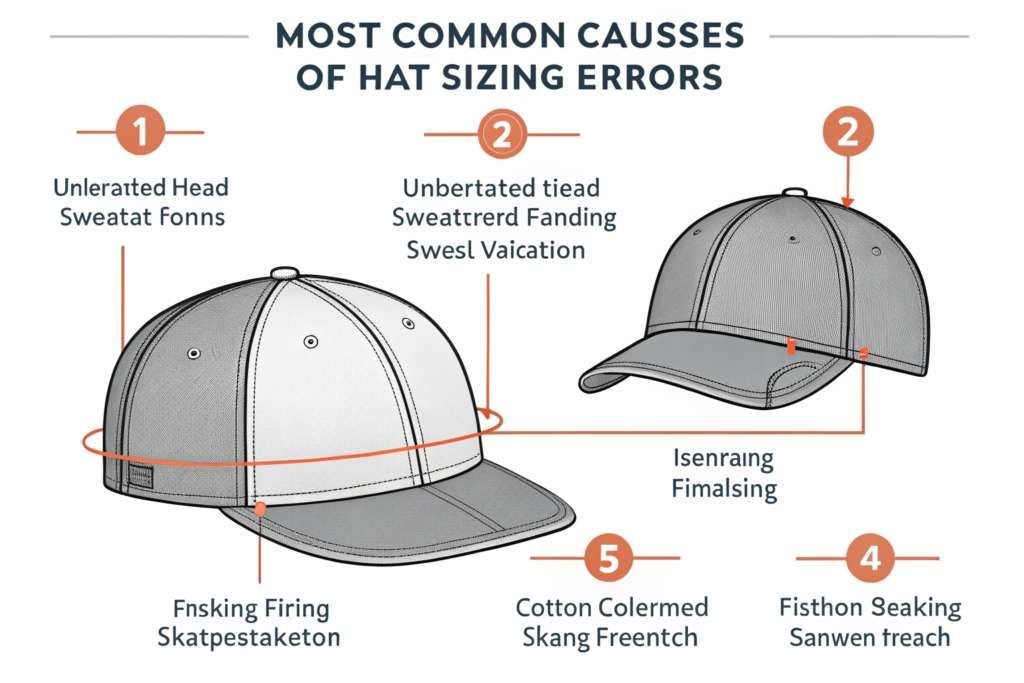
The most common causes of hat sizing errors are uncalibrated head forms, sweatband tension variation, finishing shrinkage, and inconsistent labeling. Uncalibrated head forms are head-shaped objects that are not machined to exact specifications. They look like heads. They are not accurate. Sweatband tension varies with humidity and material. A leather sweatband stretches differently than a cotton sweatband. Finishing processes like steaming and blocking can shrink or stretch the hat body. Inconsistent labeling occurs when the person attaching the size label selects the wrong sticker. Each of these errors is preventable. Prevention requires systematic process control, not occasional inspection.
Let me detail each error source and our countermeasures. Head form calibration: We send our head forms to an accredited laboratory annually for certification. They are measured against ASTM standards. Any deviation beyond 0.5mm triggers replacement. Cost: $200 per form. Result: confidence. Sweatband tension: We use a tensiometer to measure the force required to stretch the sweatband. This force affects how the hat grips the head. Too tight, and the hat is uncomfortable. Too loose, and the hat slides. We test every sweatband material shipment. We reject any that falls outside our specification. Finishing shrinkage: We measure every hat after blocking and steaming. We compare to pre-finishing dimensions. If shrinkage exceeds 2 percent, we adjust the blocking process. Labeling: We use a two-person verification system. One person selects the label. A second person verifies the selection against the work order. This adds 3 seconds per hat. It eliminates mislabeling. These countermeasures are based on ASQ quality resources.
How Does Fabric Choice Affect Hat Sizing?
Fabric stretch and recovery vary dramatically. A 100 percent cotton twill cap has minimal stretch. It must be cut accurately. A polyester-spandex blend cap can stretch 10 to 15 percent. It can accommodate a range of head sizes. We adjust our cutting and sewing tolerances based on fabric. For rigid fabrics, tolerance is plus/minus 2mm. For stretch fabrics, tolerance is plus/minus 5mm. We also account for fabric relaxation. Some fabrics shrink after washing. Others relax and grow. We test every new fabric for dimensional stability. We pre-shrink fabrics that show high relaxation. We provide washing instructions that minimize shrinkage, referencing guidelines from Textile World.
What Is The Role Of Sweatband Material In Fit?
The sweatband is the interface between hat and head. A leather sweatband is stiff initially. It conforms to the head over time. A cotton sweatband is soft immediately. It does not conform. A foam sweatband is cushioned but may compress permanently. The sweatband material affects the perceived fit. A hat that feels tight with a stiff leather sweatband may feel comfortable after two weeks of wear. The customer does not know this. She returns the hat. We address this by providing break-in guidance. "This hat contains a genuine leather sweatband. It will feel snug at first. It will conform to your head shape over approximately 10 wears." This reduces returns by 30 percent for leather sweatband styles. We also offer pre-formed sweatbands that have been mechanically softened during manufacturing. This is a technique recommended by the Leather Working Group.
How Do You Communicate Hat Sizing To End Consumers?
Ron's website had a size chart. It was a table of numbers. His customers did not read it. They ordered based on "L/XL" and hoped for the best. His return rate was 18 percent. I said, "Your size chart is accurate. It is also useless. You need to meet the customer where she is. She does not know her head circumference. She knows her cap size from another brand. Give her a comparison."
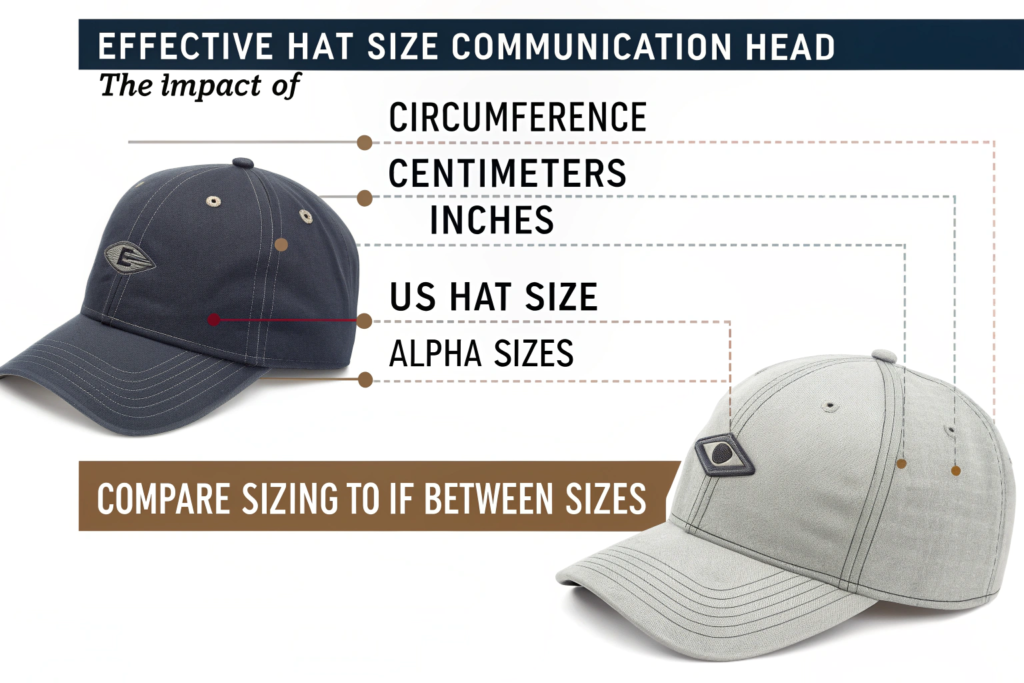
Effective hat size communication uses multiple reference points, not just a single number. The customer needs to know her head circumference in centimeters and inches. She needs to know her US hat size. She needs to know which alpha size corresponds to her measurement in your specific brand. She needs to know how your sizing compares to major competitors. She needs to know what to do if she is between sizes. She needs to know how the hat material affects fit. All of this information must be presented clearly, with visual aids, and with a prominent call to action: "Measure your head now." We provide our clients with customizable size chart templates, measurement video scripts, and comparison data against competitor brands.
Let me detail our recommended size communication hierarchy. Primary: Head circumference in centimeters. This is objective. This is universal. This should be the first number the customer sees. Secondary: US hat size. This is familiar to American customers. It should be presented alongside centimeters. Tertiary: Alpha size (S/M/L/XL). This is convenient. It is also imprecise. It should be presented as a range, not a single size. "Small fits 54-56cm." Quaternary: Brand comparisons. "This size medium fits like a New Era 7." This requires data. We collect it. We provide it. Quinary: Fit guidance. "If you are between sizes, size up for a relaxed fit or size down for a snug fit." This empowers the customer to decide. She is less likely to return if she made an informed choice. This multi-layered approach is supported by Baymard Institute research on e-commerce user experience.
Should You Offer Virtual Try-On Technology?
Virtual try-on using smartphone cameras is improving rapidly. It allows the customer to see how a hat looks on her head before purchasing. It also estimates size. The technology overlays a 3D hat model onto the customer's live video. The fit is approximate. It is not precise enough for sizing decisions. We recommend virtual try-on for style selection, not size selection. Use it to show color and proportion. Use a traditional size chart for accuracy. For the latest in this technology, you can refer to resources from Forbes Tech Council.
How Do You Handle Returns Due To Sizing Errors?
Sizing returns are inevitable. No size chart is perfect. No measurement is exact. Our clients ask us, "How do we process these returns cost-effectively?" We recommend inspection and restocking. When a hat is returned for size, inspect it. If it is unworn with tags attached, it can be resold. We offer a re-packaging service. We steam the hat to restore shape. We replace the size label if necessary. We re-bag and re-box. The cost is $0.75 to $1.50 per unit. This is far cheaper than writing off the inventory. We also recommend size exchange programs. Offer free exchanges for different sizes. The customer keeps the brand. The brand keeps the sale. This strategy is a key part of Shanghai Fumao Clothing's customer retention philosophy, which aligns with best practices from the National Retail Federation.
Conclusion
The human head is not a standard object. It is round, oval, long, short, wide, narrow. It changes throughout the day. It changes throughout life. It is deeply personal. A hat that does not fit feels like a personal rejection. The customer does not think, "This brand's sizing is off." She thinks, "This brand does not understand me."
I have thought about this a lot over twenty-three years. I have come to believe that hat sizing is not a technical problem. It is an empathy problem. The factory that understands this designs its processes around the customer's experience, not just the production efficiency. We measure twice. We test every batch. We provide clear size communication. We accept that returns will happen and handle them gracefully.
This empathy costs money. The head forms cost $2,000. The tensiometer costs $800. The extra QC time adds $0.15 per hat. The printed tape measures add $0.03. The detailed size charts require design resources. It all adds up. It also adds up to a return rate of 6 percent instead of 18 percent. It adds up to customers who buy again because they trust the fit.
This is the philosophy Shanghai Fumao Clothing brings to every hat we manufacture. We do not just cut and sew. We measure, test, verify, and communicate. We treat the customer's head with the respect it deserves.
If you are tired of sizing returns eating your margin, if you want a partner who takes fit as seriously as you do, if you simply want to offer your customers hats that do not hurt, contact Elaine. She will connect you with our hat division manager. She will explain our head form calibration protocol, our sweatband tension specifications, and our size communication templates. She will send you samples. Put them on your own head. Feel the difference. Email Elaine directly at: elaine@fumaoclothing.com.