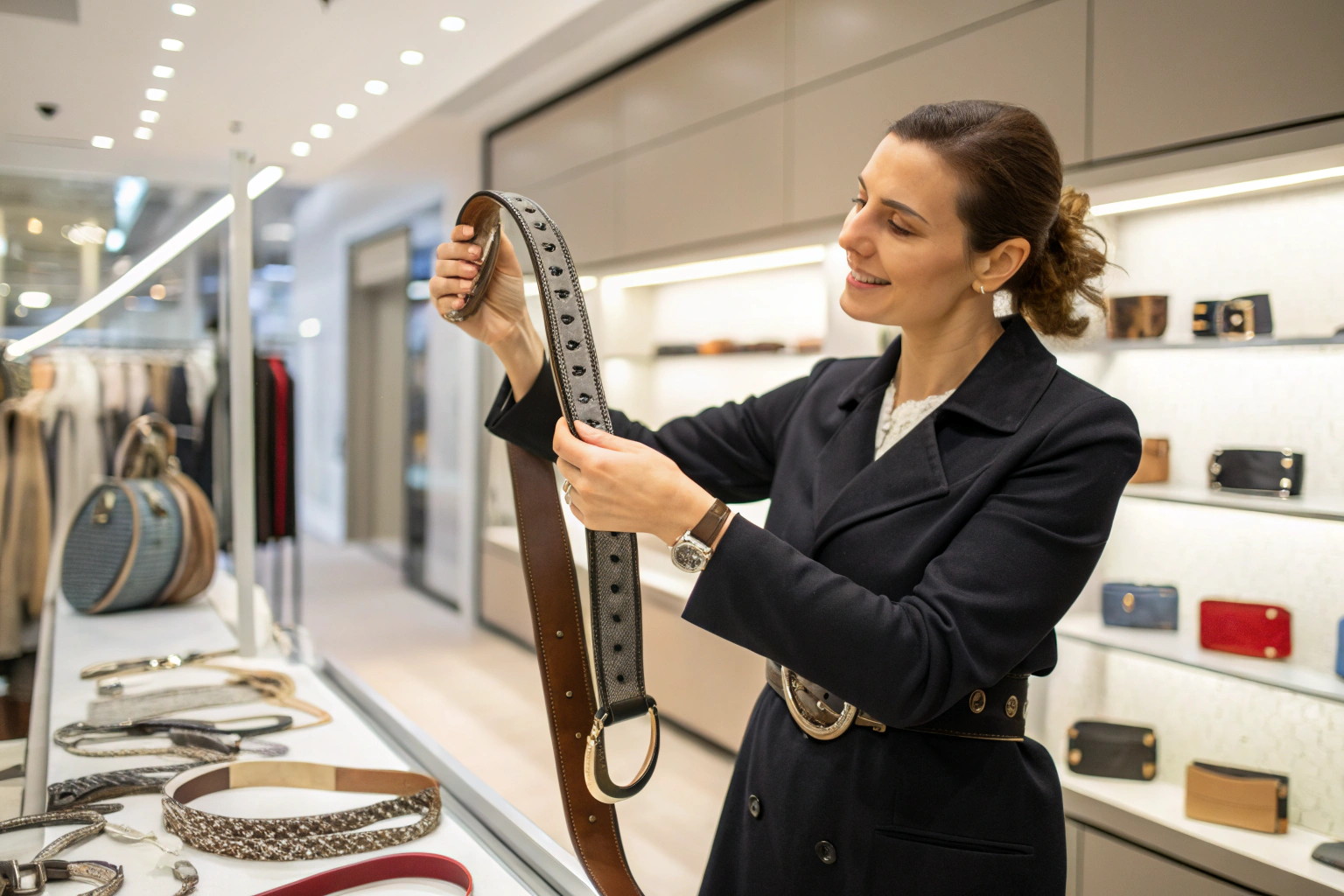
Five years ago, I received a shipment return that made me physically ill. Twenty thousand metal hair claws. Beautiful designs. French barrette style. Antique brass finish. They looked perfect when they left our factory. Three months later, they were sitting in a warehouse in Ohio. The buyer opened a carton for a spot check. The clips were green. Not slightly discolored. Bright, powdery, malachite green. The brass had oxidized. The finish had failed. The buyer cancelled the entire order. She never ordered from us again. I took one of those green clips home. I put it on my desk. I look at it every day. It reminds me that metal finishes are not decoration. They are protection. And protection requires science, not hope.
The best finishes to prevent tarnishing on costume jewelry accessories are palladium plating, ruthenium plating, gold flash with clear e-coat, and zirconium-based PVD coating. Each offers different aesthetics and different durability profiles. Palladium provides bright white color similar to platinum. Ruthenium provides dark grey with exceptional hardness. Gold flash with e-coat provides warmth with a clear polymer barrier. Zirconium PVD provides near-diamond hardness in various colors. The common thread is the absence of copper and nickel. Copper tarnishes. Nickel corrodes. Remove these elements from the surface chemistry and you remove the primary failure mechanism. Your finish is only as good as the barrier it creates between the base metal and the atmosphere.
I grew up believing that "gold plating" meant gold. It does not. Gold plating is a microscopic layer of precious metal over a base of brass, zinc alloy, or steel. If that layer is too thin, or too porous, or applied over an inappropriate underplate, it will fail. The customer sees "18K Gold." She assumes it is durable. She does not know that the gold is 0.1 microns thick and will abrade off in three weeks. This gap between expectation and reality destroys brands. We decided ten years ago to stop contributing to this problem. We invested in electroplating engineers, not just electroplating machines. We built our own in-house plating line. We stopped relying on vendors who prioritized cost over durability. Today, I want to share what we learned. It may save you the sight of twenty thousand green hair clips.
What Causes Tarnishing In Costume Jewelry Accessories?
Ron asked me, "Why do some cheap accessories tarnish immediately and some expensive ones tarnish just as fast?" He was frustrated. He had paid premium prices for "anti-tarnish" finishes that failed within weeks. He had paid rock-bottom prices for accessories that somehow lasted months. He could not find correlation between price and performance. I told him, "Price is not the variable. The variable is the barrier. You are paying for gold. You should be paying for protection."
Tarnishing is chemical corrosion. It occurs when the metal surface reacts with oxygen, sulfur, or moisture in the air. Silver tarnishes black. Copper tarnishes green. Brass tarnishes brown. Steel rusts red. These reactions are accelerated by humidity, salt, skin acidity, and pollution. A finish prevents tarnishing by creating a physical barrier between the reactive base metal and the corrosive environment. If the barrier is continuous, the metal remains bright. If the barrier is porous, too thin, or chemically incompatible, the corrosion begins at the microscopic defects and spreads outward. You cannot see it until it is too late.
Let me explain the specific enemy. It is not oxygen. It is sulfur. Sulfur is everywhere. It is in the air from industrial pollution. It is in rubber bands and elastic fabrics. It is in some papers and packaging materials. It is in the perspiration of people who eat eggs or garlic. Silver and copper are extremely reactive with sulfur. They form silver sulfide (black) and copper sulfide (brown/black). Gold does not react with sulfur. This is why gold does not tarnish. But costume jewelry is not solid gold. It is a thin layer of gold over a copper-rich brass or zinc alloy. The gold layer is never perfect. There are microscopic pores. Sulfur penetrates these pores. It reaches the copper underplate. It begins to corrode. The corrosion products migrate to the surface. They appear as black spots, green discoloration, or a general dulling. This is not the gold tarnishing. This is the base metal failing through the gold. The solution is not thicker gold. The solution is eliminating the reactive underplate materials.

Why Does Skin Chemistry Affect Tarnishing Speed?
Human perspiration is not pure water. It contains salt, urea, lactic acid, and fatty acids. The pH varies from 4.5 to 7.0 depending on the individual. Some people have "aggressive sweat." Their body chemistry attacks metal finishes rapidly. This is not a defect in the jewelry. It is a biological incompatibility. However, the customer does not know this. She believes the jewelry is "cheap" because it turned her skin green. In reality, her sweat dissolved the copper in the alloy and the copper salts stained her skin. We address this with hypoallergenic barriers. A clear e-coat or palladium flash prevents direct contact between skin and copper. The jewelry still tarnishes if the barrier fails. The skin does not turn green. We test our finishes against artificial perspiration using ISO 12870. We require zero copper migration after 24 hours. This is a consumer safety issue as much as a quality issue.
What Is The Role Of Humidity In Tarnish Acceleration?
Humidity is the catalyst. Dry air causes minimal corrosion. Moist air provides an electrolyte. Ions move. Reactions accelerate. A finish that lasts five years in Arizona may last five months in Florida. We simulate this using steady-state humidity testing. We place finished accessories in a chamber at 40°C and 90 percent relative humidity for 10 days. This is approximately equivalent to one year of coastal exposure. We inspect every 24 hours. We photograph the progression. We reject any finish that shows visible tarnish before day 7. This test is brutal. It fails many commercial finishes. It also identifies exactly where the barrier is weakest.
What Plating Technologies Provide Superior Tarnish Resistance?
Ron asked me, "Should I specify 14K gold or 18K gold?" I said, "It does not matter. The karat is irrelevant. The thickness and the underplate determine durability, not the color." He was shocked. He had been paying premiums for higher gold content. I explained that 24K pure gold is softer than 14K gold. It wears faster. It also costs more. The relationship between karat and durability is inverse, not direct. He had been optimizing the wrong variable.
The most tarnish-resistant plating technologies are palladium, ruthenium, and rhodium for white finishes, and flash gold with clear e-coat or PVD for yellow and rose finishes. Palladium is a platinum group metal. It is bright white, extremely hard, and completely inert. It does not tarnish. It does not wear easily. It is expensive. Ruthenium is also a platinum group metal. It is dark grey, even harder than palladium, and highly corrosion resistant. It is popular for industrial-chic aesthetics. Rhodium is the standard for white gold and platinum jewelry. It is bright, hard, and tarnish-free. It is also extremely expensive and brittle. For yellow gold aesthetics, we recommend a thin gold flash (0.1 to 0.3 microns) over a nickel-free underplate, followed by a clear cathodic e-coat. The e-coat provides the abrasion resistance. The gold provides the color. The combination provides durability at a reasonable cost.
Let me detail each option with specific cost and performance data. Palladium plating costs approximately $0.35 to $0.60 per square decimeter. It achieves a hardness of 400 to 600 Vickers. It passes 48 hours of neutral salt spray without corrosion. It is our recommended finish for high-end fashion jewelry and accessories intended for daily wear. Ruthenium plating costs approximately $0.40 to $0.70 per square decimeter. It achieves 800 to 1000 Vickers hardness. It is extremely scratch resistant. It passes 72 hours salt spray. Its dark color is fashionable but not universal. Rhodium plating costs $0.80 to $1.50 per square decimeter. It is the hardest of the precious metal platings at 900 Vickers. It is also the most brittle. It can crack if the base metal flexes. It is ideal for rigid components like belt buckles. It is risky for spring clips that flex repeatedly. Gold flash with e-coat costs $0.15 to $0.25 per square decimeter. The gold provides color. The e-coat provides protection. The combination passes 24 hours salt spray. This is sufficient for fashion accessories worn occasionally. It is not sufficient for daily-wear items.

What Is E-Coat And How Does It Prevent Tarnishing?
E-coat is electrophoretic deposition. The accessory is immersed in a bath of water-borne polymer. An electrical current is applied. The polymer particles migrate to the metal surface and deposit as a continuous film. The film is then heat-cured. It cross-links into a hard, clear, chemically resistant barrier. The thickness is typically 10 to 25 microns. This is 100 times thicker than a gold flash. The polymer is completely inert. It does not react with sulfur, oxygen, or perspiration. It does not contain nickel, copper, or any allergenic metals. It is also electrically insulating. It prevents galvanic corrosion between dissimilar metals. The only disadvantage is aesthetics. E-coat adds a slight plastic sheen. It is not perceptible on textured surfaces. It can be noticeable on high-polish finishes. We offer e-coat in gloss, matte, and satin formulations. We match the sheen to the client's desired appearance.
Is PVD Coating Better Than Electroplating?
PVD (Physical Vapor Deposition) is a vacuum coating process. Metal atoms are vaporized and deposited onto the substrate in a high-vacuum chamber. The resulting coating is extremely dense, extremely hard, and extremely thin. PVD coatings are typically 0.3 to 1.0 microns. They are applied to stainless steel or titanium, not to brass or zinc. The base metal must be vacuum-compatible. PVD coatings are almost impossible to distinguish from electroplated finishes. They are significantly more durable. They do not tarnish. They do not wear through easily. They are also significantly more expensive. A PVD-coated belt buckle costs $1.50 to $3.00 more than an electroplated buckle. The durability justifies the cost for luxury brands and technical applications. For mass-market fashion accessories, electroplating with e-coat remains the most cost-effective solution.
How Do You Prevent Nickel Migration In Hypoallergenic Finishes?
Ron received a complaint from a major retailer. A customer developed a rash under a belt buckle. She demanded compensation. The retailer demanded answers. Ron called me. "Is there nickel in your plating?" I said, "No. We eliminated nickel five years ago." He said, "Then why is she reacting?" I asked him to send the buckle for testing. The base metal was brass. The plating was gold flash. There was no nickel in the plating layer. There was also no barrier layer. The customer's sweat dissolved the zinc and copper in the brass. The metal ions irritated her skin. It was not nickel allergy. It was heavy metal sensitivity. The distinction did not matter to her. She was still inflamed.
Preventing nickel migration requires complete encapsulation of the base metal. A thin gold flash is not encapsulation. It is decoration. Perspiration penetrates the pores, dissolves the base metal, and carries the dissolved ions to the skin. The skin reacts. The solution is a continuous, non-porous barrier layer between the base metal and the skin. Electroless nickel used to be this barrier. It is now prohibited in Europe and increasingly restricted in the US due to nickel allergy prevalence. The modern alternatives are palladium, platinum, or e-coat. Palladium and platinum are precious metals. They are expensive. They are also completely inert and hypoallergenic. E-coat is non-metallic. It is also completely inert. It is also much less expensive. For mass-market hypoallergenic accessories, e-coat over copper-free brass is our standard specification.
Let me explain the EU regulatory context. The Nickel Directive (REACH Annex XVII) limits nickel release to 0.5 micrograms per square centimeter per week for products in direct and prolonged skin contact. This includes belt buckles, hair clips, and jewelry. Compliance requires testing per EN 1811 and EN 12472. We test every hypoallergenic product we manufacture. We maintain a database of release rates. Our e-coated products consistently achieve non-detectable results. Our palladium-plated products achieve non-detectable results. Our standard gold flash without e-coat often fails. We do not offer it for skin-contact applications anymore. It is not worth the regulatory risk.

What Is "Copper-Free" Brass And Why Does It Matter?
Standard brass is approximately 60 to 70 percent copper and 30 to 40 percent zinc. Copper is highly reactive. It tarnishes. It also migrates into sweat and stains skin green. Copper-free brass replaces most of the copper with zinc and other alloying elements. The color is similar. The corrosion resistance is lower. The nickel content is zero. The copper content is below 10 percent. This significantly reduces the risk of green skin staining. It does not eliminate the risk entirely. We still recommend e-coat or palladium encapsulation for guaranteed performance. Copper-free brass is also more difficult to cast and polish. It requires different tooling and finishing parameters. We have invested in this capability because our European clients require it.
Can You Test For Nickel In Finished Products?
Yes, we maintain a spot test kit for rapid screening. Dimethylglyoxime (DMG) solution turns pink in contact with nickel. This is a qualitative test. It detects nickel above approximately 0.5 percent concentration. It does not measure release rate. It is useful for incoming inspection of raw materials and quick verification of finished goods. For quantitative release testing, we send samples to third-party laboratories in Shanghai and Hong Kong. The test takes 7 to 10 days. The cost is approximately $150 per sample. We test every new alloy and every new plating combination. We test annually for established products. We provide certificates to clients upon request. This is not expensive. It is essential compliance.
What Are The Best Practices For Testing Finish Durability?
Ron asked me, "How do I know if the finish will last? I cannot wait six months to find out." I told him, "You accelerate time. You simulate six months of wear in six hours. You torture the product until it fails. Then you know exactly how durable it is."
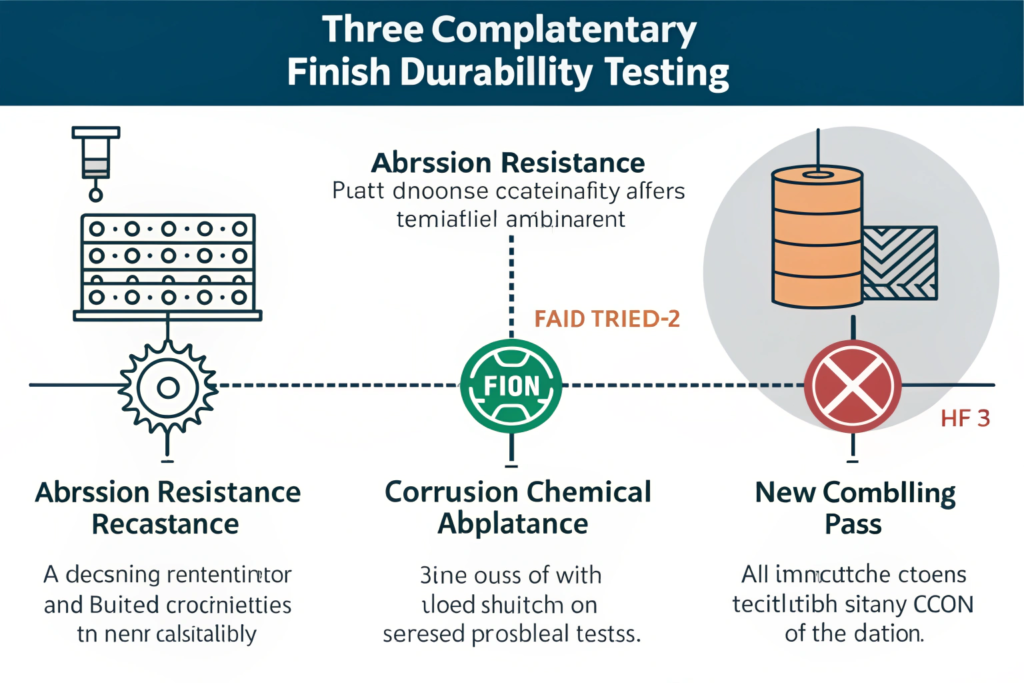
Finish durability testing requires three complementary methods: abrasion resistance, corrosion resistance, and adhesion. Abrasion resistance measures wear-through. Corrosion resistance measures chemical attack. Adhesion measures mechanical bonding. A finish can pass corrosion testing but fail abrasion. It can pass abrasion but fail adhesion. Each test reveals a different potential failure mode. We perform all three on every new finish specification. We perform reduced testing on every production batch. We provide the data to clients. You do not have to guess. You do not have to wait. You have the numbers.
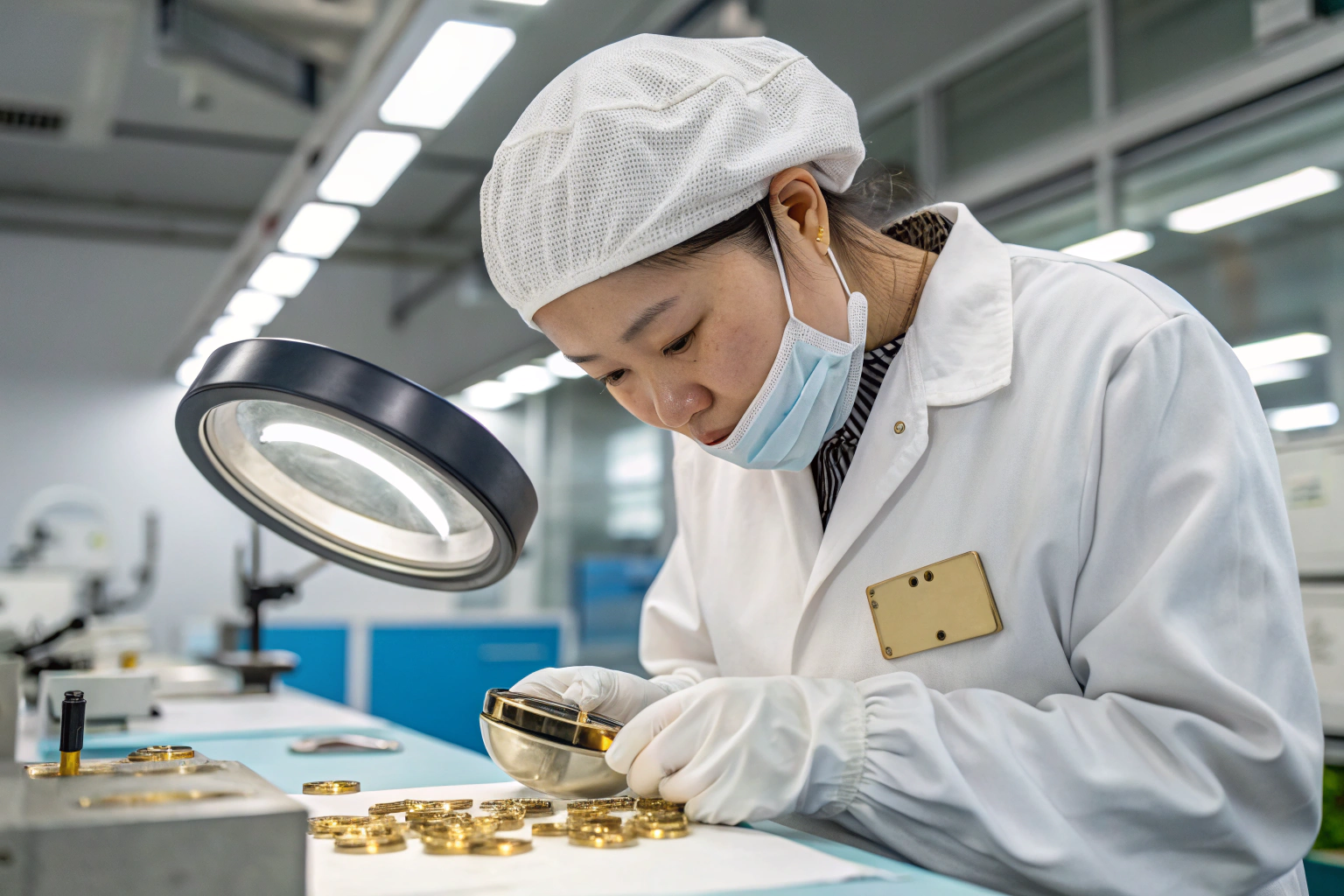
Let me detail our specific test protocols. Abrasion resistance uses a Taber Linear Abraser. We mount the accessory. We abrade with a standardized CS-10 wheel under 250 gram load. We inspect every 50 cycles. We record the cycle count when base metal becomes visible. Our minimum standard for fashion accessories is 300 cycles. Our premium standard is 1,000 cycles. Palladium and PVD coatings routinely exceed 2,000 cycles. Corrosion resistance uses neutral salt spray per ASTM B117. We suspend the accessories in a chamber at 35°C with 5 percent sodium chloride fog. We inspect every 24 hours. Our minimum standard is 24 hours without visible corrosion. Our premium standard is 72 hours. E-coat with palladium underplate achieves 96+ hours. Adhesion uses a tape pull test per ASTM D3359. We cross-hatch the finish with a razor blade. We apply standardized pressure-sensitive tape. We pull rapidly at 180 degrees. We inspect for finish removal. Any removal is failure. This is a basic test. It catches poor surface preparation and incompatible underplates. We perform it on every production batch.
What Is The "Artificial Perspiration" Test And Why Is It Critical?
Artificial perspiration testing is ISO 12870 or EN 1811. We immerse the accessory in a solution formulated to match human sweat chemistry. The solution contains sodium chloride, lactic acid, urea, and ammonia. The pH is adjusted to 4.5 or 6.5 to simulate different body chemistries. The accessory remains immersed for 24 to 48 hours at 40°C. We inspect for tarnish, discoloration, and base metal exposure. This test is more aggressive than salt spray for many finishes. Salt spray attacks via chloride. Perspiration attacks via chloride plus organic acids and complexing agents. A finish that passes salt spray may fail perspiration. We test both. We report both. Your customer sweats. Your finish must resist sweat.
How Do You Test Finish Durability On Flexible Components?
Flexible components like spring clips and hinge mechanisms require mechanical cycling testing. A finish that passes abrasion on a flat surface may crack when the metal bends. We use a custom flex tester. It opens and closes spring clips 10,000 cycles. We inspect the flexure point every 1,000 cycles. We measure the onset of cracking and base metal exposure. This test has eliminated several promising finishes from our approved vendor list. They looked beautiful. They performed well in abrasion. They cracked catastrophically after 3,000 flexes. The customer would have experienced failure after approximately six months of use. We caught it in the lab. We do not accept finishes that cannot flex.
Conclusion
I still keep that green hair clip on my desk. It is not a trophy. It is a scar. It reminds me that finishes are not cosmetic. They are the interface between your brand and your customer's body. If that interface fails, your brand fails.
We spent five years and over one million dollars building our in-house plating line and testing laboratory. We hired electrochemists. We hired quality engineers. We built humidity chambers and salt spray cabinets. We tested hundreds of finish combinations. We rejected dozens of suppliers who could not meet our standards.
Today, we can offer you something rare in the costume jewelry industry. Certainty. When we say a finish is tarnish-resistant, we have the test data to prove it. When we say a finish is hypoallergenic, we have the regulatory certificates to prove it. When we say a finish will last, we have accelerated aging studies to prove it.
This is not marketing. This is engineering. This is the difference between a factory that hopes for the best and a factory that validates the outcome.
This is the commitment Shanghai Fumao Clothing brings to every metal accessory we manufacture. Hair clips. Belt buckles. Bag hardware. Umbrella frames. If it touches skin, we test it. If it can tarnish, we protect it. If it can fail, we catch it before you see it.
If you are tired of green skin, black spots, and customer complaints, if you want a partner who treats finish durability as seriously as you do, if you simply want to know that your accessories will arrive beautiful and stay beautiful, contact Elaine. She will send you our finish specification guide. She will explain our testing protocols. She will connect you with our plating engineers. You can ask them the hard questions. They will answer honestly. Email Elaine directly at: elaine@fumaoclothing.com.