Are you receiving returns because your hats are too tight or too loose? Do you struggle to balance a one-size-fits-all promise with the reality of diverse head shapes and sizes? You're facing one of the most common and costly challenges in headwear manufacturing. A hat that doesn't fit is a hat that won't be worn or recommended, leading to direct revenue loss and brand damage.
The solution isn't a mythical "universal size," but a strategic approach to fit engineering. Ensuring a custom hat fits a wide range of heads requires intentional design, smart sizing architecture, the incorporation of adjustable features, and precise communication of fit expectations. It's about creating a product that adapts to the wearer, not the other way around.
This guide will provide a comprehensive strategy. We'll cover how to design with fit flexibility in mind, establish a multi-size strategy that covers the majority of your market, integrate adjustable mechanisms seamlessly, and finally, communicate sizing clearly to set accurate customer expectations. Let's engineer hats that customers love to wear.
How to Design Hat Patterns for Optimal Fit Flexibility?
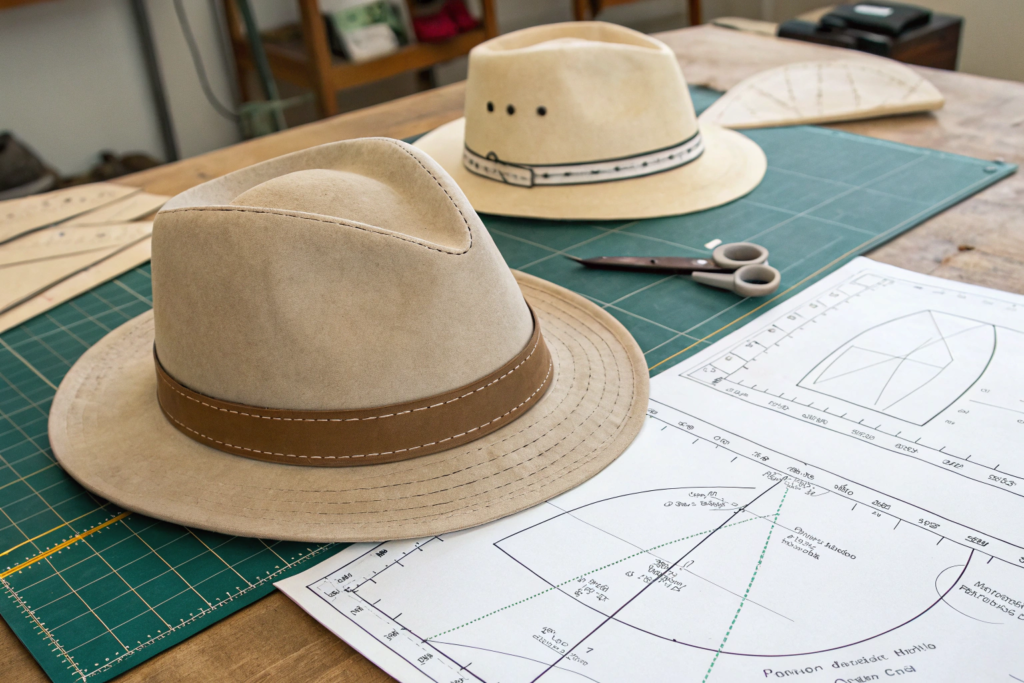
Fit begins on the pattern-making table. The pattern determines the hat's volumetric shape and how it will interact with the three-dimensional curves of the head. A pattern designed for fit flexibility incorporates specific ease, curvature, and material considerations from the start.
The foundational rule is understanding head circumferences. The average adult female head measures 22.5 inches, and male 23 inches, but the range is wide (21" to 24.5"+). Your base pattern should be drafted for a median head size (e.g., 22.75") but with built-in ease—extra space that allows the hat to sit comfortably around the head, not grip it. For a snug-fitting beanie, ease might be 1-2 inches. For a structured bucket hat, ease might be 0.5-1 inch.
Crucially, the crown depth and crown shape are as important as circumference. A crown that is too shallow will perch on top of the head; too deep will cover the eyes. Use a standard head form (like a size 7 or 58cm) for development, but always test on real heads of varying sizes and shapes (round oval, long oval) during sampling. The goal is a pattern that creates a flattering, non-deforming silhouette across a size range.
What Are the Standard Head Size Ranges for Adults and Juniors?
To design effectively, you must know your demographic. Here are the standard industry size ranges:
| Size Category | Circumference Range (Inches) | Circumference Range (CM) | Common "One-Size" Target |
|---|---|---|---|
| Adult Women (XS-L) | 21" - 23.5" | 53.5 - 60 cm | 22.5" - 23" (57-58.5 cm) |
| Adult Men (S-XL) | 22" - 24.5"+ | 56 - 62+ cm | 23" - 23.5" (58.5-60 cm) |
| Juniors/Teens | 20.5" - 22.5" | 52 - 57 cm | 21.5" (54.5 cm) |
A true "one-size-fits-most" adult hat is typically designed to stretch or adjust to fit the 21.5" to 23.5" range, covering approximately 70-80% of the market. If your brand targets a specific gender, your median should shift accordingly. A partner like Shanghai Fumao Clothing uses these precise measurements to draft initial patterns.
How Does Crown Shape and Brim Width Affect Perceived Fit?
The visual proportions of the hat impact the perception of fit. A tall, narrow crown can make a hat feel top-heavy and less secure on a smaller head. A wide, flat brim on a shallow-crowned hat may feel unstable. For universal appeal:
- Crown Shape: Opt for a medium crown height with a gentle, rounded curve. Avoid extreme taper (which fits fewer head shapes) or a perfectly cylindrical "bucket" shape (which can look boxy).
- Brim Proportion: Ensure the brim width is proportional to the crown. A good rule for a versatile sun hat is a brim width between 2.5" and 3.5".
These design choices, combined with thoughtful material selection, create a foundation for broad compatibility.
Should You Offer Multiple Sizes or Aim for One-Size-Fits-Most?
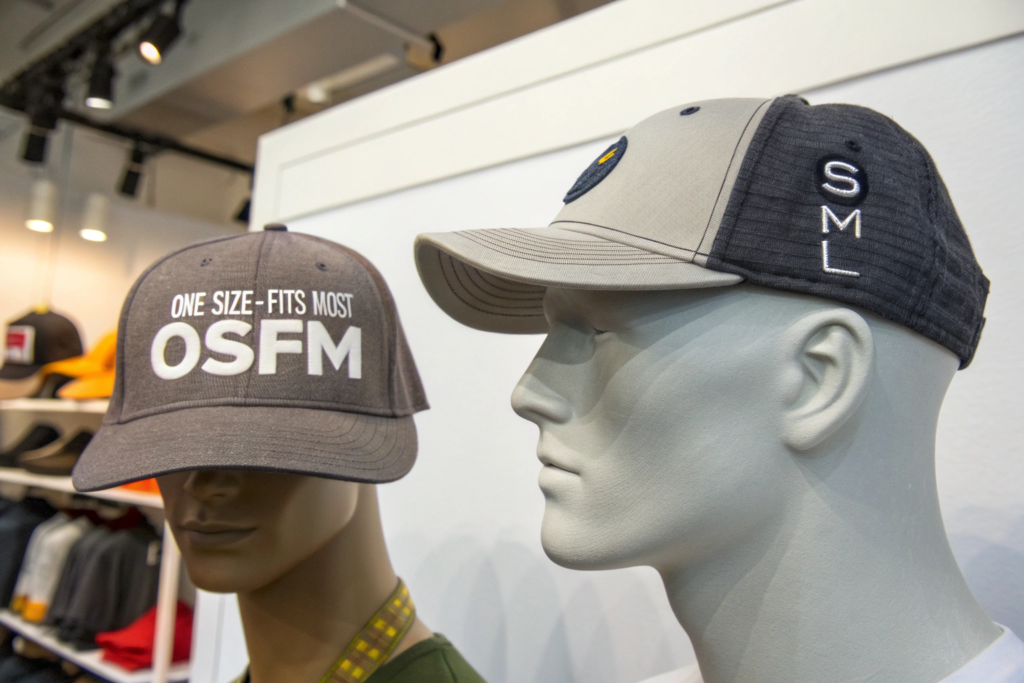
This is a fundamental business and design decision. One-Size-Fits-Most (OSFM) simplifies inventory but risks excluding customers. Multiple Sizes (e.g., S, M, L) maximizes fit but increases complexity and cost. The right choice depends on your hat style, price point, and brand positioning.
Offer Multiple Sizes When:
- The hat is structured (e.g., straw fedoras, wool felt hats, baseball caps). These cannot stretch to accommodate different sizes without losing shape.
- Your price point is premium ($50+). Customers at this level expect a tailored fit.
- You are selling through wholesale/retail where standardized sizing is expected.
OSFM Can Work When:
- The hat is soft and stretchy (e.g., knit beanies, slouchy hats).
- It incorporates a significant adjustable feature (a full inner band, drawstring).
- It's a low-cost, high-volume fashion item where simplicity is key.
For most contemporary brands, a two-tier system is effective: OSFM for stretch knits and casual styles, and S/M/L (or specific circumference sizes) for structured hats.
What is a Smart Size Chart for Structured Hats?
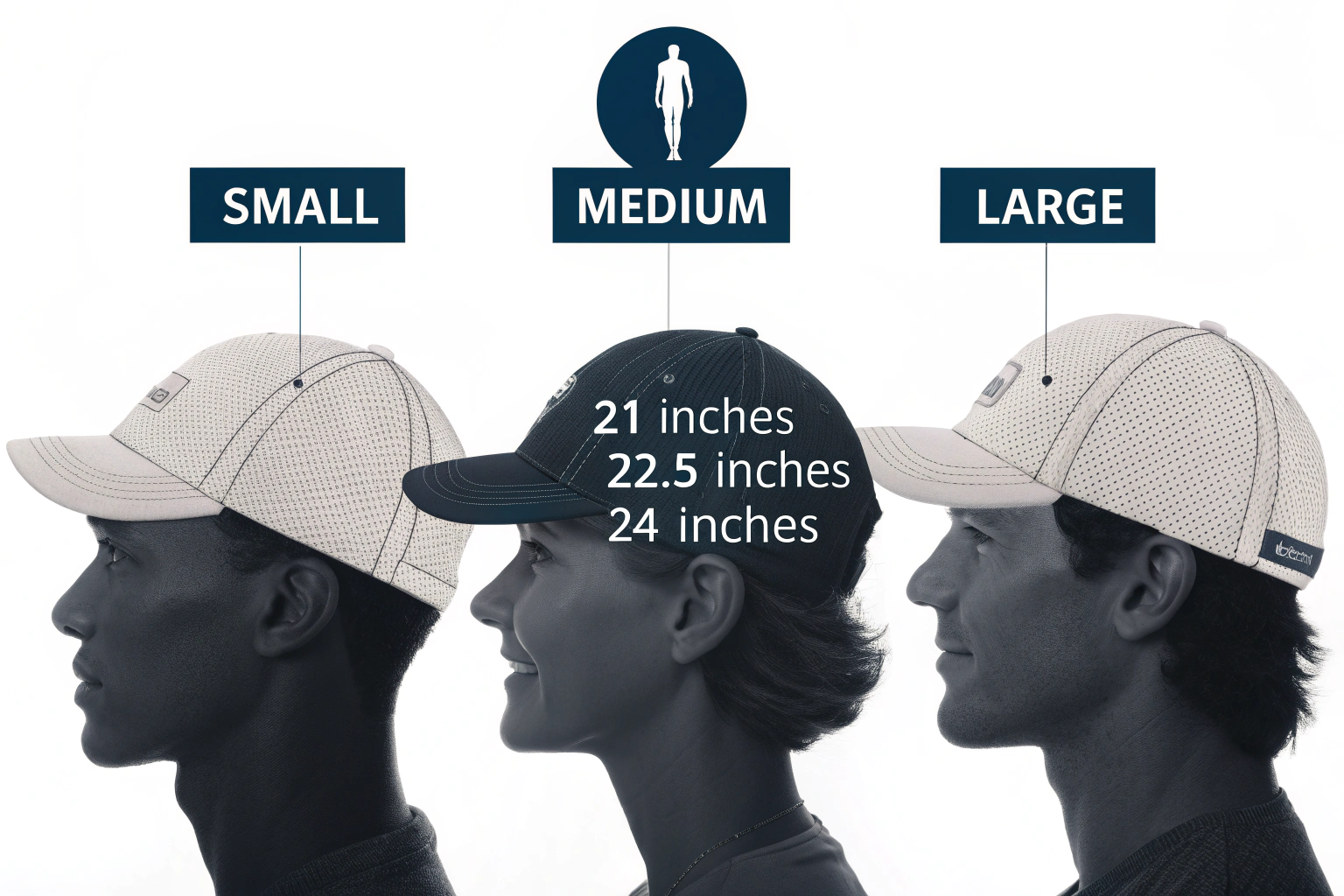
If producing sized hats, use a clear, graduated chart. A standard three-size system is effective:
| Size Label | Head Circumference (Inches) | Head Circumference (CM) | Fits Typically |
|---|---|---|---|
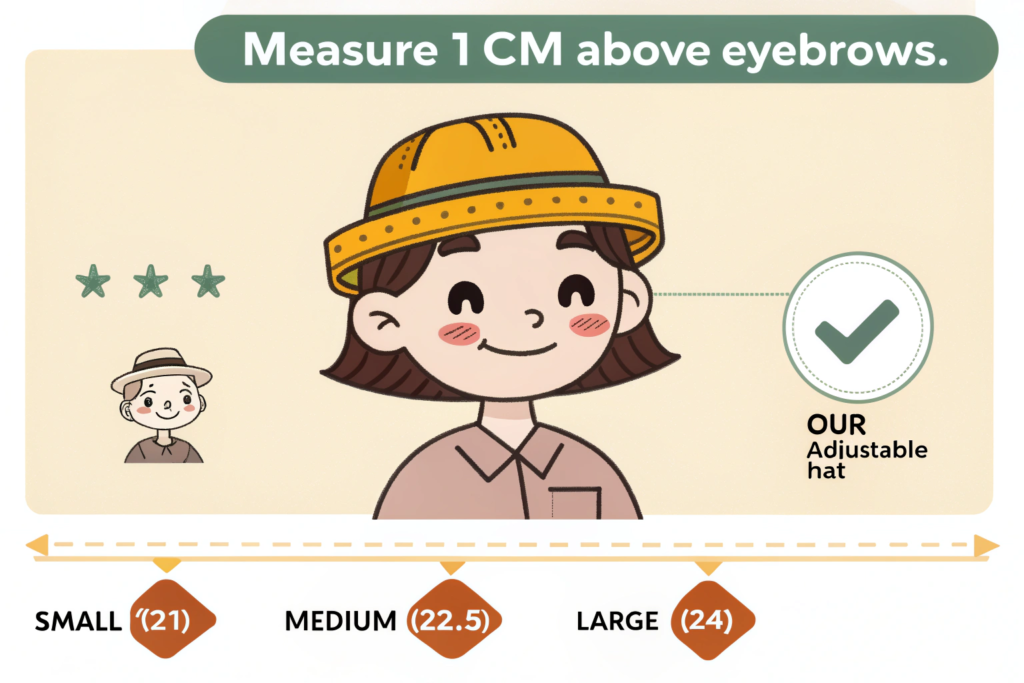
| Small (S) | 21" - 22" | 53.5 - 56 cm | Petite Adults, Large Teens |
| Medium (M) | 22" - 23" | 56 - 58.5 cm | Average Adult Women & Men |
| Large (L) | 23" - 24" | 58.5 - 61 cm | Larger Adult Heads |
Always instruct customers to measure their head with a soft tape measure. Include this instruction graphically on your product pages. This data-driven approach to sizing is as critical as the data used for fabric weight (GSM) specifications.
How to Minimize Inventory Risk with a Multi-Size Strategy?
To avoid being stuck with unpopular sizes, use the 60-30-10 rule as a starting production allocation:
- 60% of units in Medium (covers the peak of the bell curve).
- 30% in Large (as head sizes trend larger in some markets).
- 10% in Small.
This ratio should be adjusted based on your specific customer data from early sales. Start with a pre-order or small batch to gauge demand before full production. This is a key part of strategic inventory planning.
What Adjustable Features Can You Integrate Seamlessly?
Adjustability is the secret weapon for achieving a universal fit, especially for structured hats. The key is to integrate these features in a way that feels intentional and high-quality, not like an afterthought.
Common and Effective Adjustable Features:
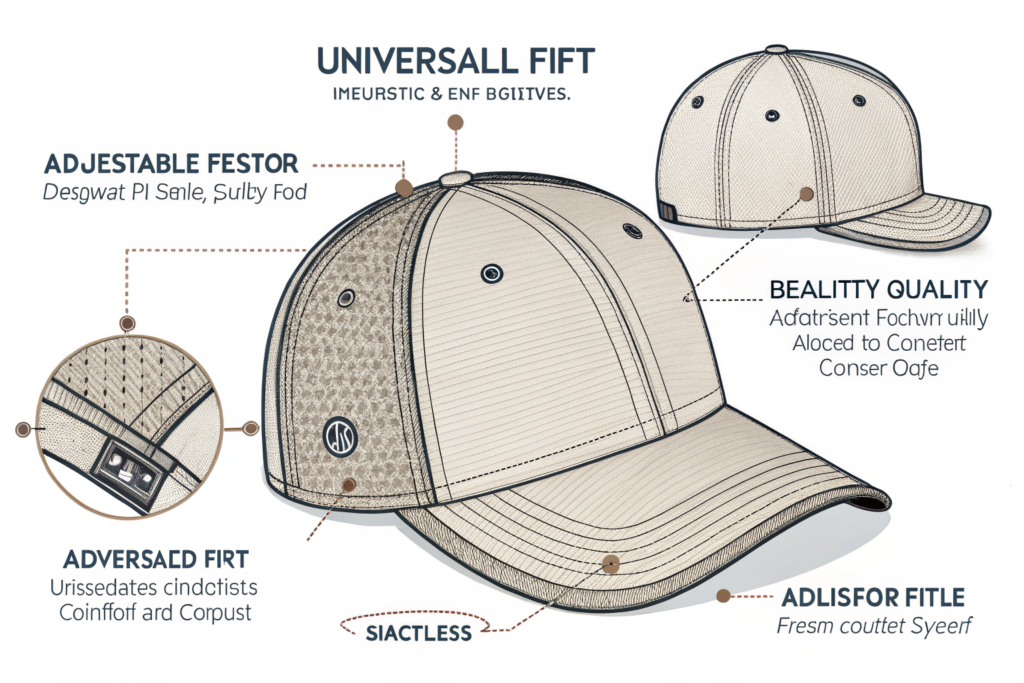
- Inner Sweatband with Adjustable Cord: The most elegant solution for structured hats (e.g., fedoras, trilbies). A concealed, elasticated cord or ribbon sewn inside the sweatband allows the wearer to tighten the hat's internal circumference by 1-2 inches without altering the exterior shape.
- Leather Strap & Buckle or Slide Closure: A classic feature on bucket hats and many sun hats. A strap at the back allows for several inches of adjustment. Ensure the buckle is quality (e.g., solid brass) and the strap is genuine leather or a sturdy fabric.
- Snapback Closures (for Caps): The universal standard for baseball caps. A plastic snap strap offers multiple size settings. For a premium feel, use metal snaps or a leather strap with snaps.
- Drawstring in the Hem: For unstructured bucket hats or certain beanies, a drawstring woven into the hat's bottom hem allows the wearer to cinch the opening.
How to Design an Adjustable Sweatband That Doesn't Compromise Comfort?
The inner adjustable band must be smooth and comfortable against the forehead.
- Construction: Create a tunnel or casing (about 1cm wide) between the outer hat body and the inner lining. Thread a strong, thin elastic cord or a soft ribbon through it.
- Finishing: The adjustment mechanism (a toggle, knot, or hook-and-loop patch) should be hidden under the lining or placed discreetly at the back, away from the forehead.
- Material: Use a soft, absorbent fabric for the sweatband itself, such as cotton twill or suede leather. The adjustable cord should not create pressure points.
This feature, when well-executed, transforms a fixed-size hat into a personalized fit solution.
Are Elasticated Bands or Stretch Fabrics a Reliable Solution?
For soft hats, yes. Stretch fabrics are the primary tool for OSFM knit hats.
- Fabric Choice: Use knitted fabrics with horizontal (2-way) or 4-way stretch. A blend like 95% Cotton, 5% Spandex provides comfort, breathability, and recovery.
- Ribbed Knit Bands: The hem of a beanie is often made with a 1x1 or 2x2 rib knit, which has excellent crosswise elasticity to grip the head gently.
- Limitation: Stretch has limits. A hat knit to fit 22" will stretch to 23.5" comfortably, but stretching to fit 24" may make it too thin and tight. Always define the intended stretch range in your tech pack (e.g., "Fits 21.5" - 23.5" head"). This precision mirrors the need for clarity in custom product specifications.
How to Communicate Fit and Set Accurate Customer Expectations?
Even a perfectly sized hat will generate returns if the customer's expectations are mismatched. Clear, proactive communication is your final layer of fit assurance. This happens on your product page, via imagery, and with sizing aids.
Essential communication tactics:
- Display a Detailed Size Chart: Don't bury it. Place it prominently on the product page. Use both inches and centimeters.
- Provide a "How to Measure" Graphic: A simple diagram showing where to place the tape measure (across the forehead, 1cm above eyebrows, around the widest part).
- Use Model Diversity: Show the same hat on models with different head sizes and hair volumes (e.g., model with fine, short hair and a model with thick, long hair piled up). State the model's head size and the hat size they are wearing.
- Describe the Fit in Text: Use precise language. Is it "snug," "relaxed," or "oversized"? For OSFM, state: "Designed to comfortably fit most adults (head circumference 21.5" - 23.5")."
What Should Your Product Page Say About Fit?
Go beyond "one size fits all." Use descriptive, scenario-based language:
- "This structured bucket hat features an inner adjustable cord, allowing a custom fit for head sizes from 21.5" to 24". Perfect for a secure fit on windy beach days."
- "Our classic beanie is knit with a soft, stretchy ribbed cuff. It comfortably fits heads from 21" to 23" for a snug, casual look."
- "Please note: If you have very thick or long hair you typically wear up, you may prefer to size up for comfort."
This level of detail builds trust and reduces the cognitive load on the buyer, similar to how clear sustainability communication builds brand loyalty.
How Can Sampling and Fit Models Prevent Bulk Production Errors?
Before cutting bulk fabric, conduct a formal fit test.
- Create a Size Run of Samples: Produce samples in at least three key sizes (e.g., 21.5", 22.75", 24").
- Recruit Diverse Fit Models: Find people whose measurements match your target sizes, as well as different head shapes (round vs. oval).
- Gather Structured Feedback: Have them wear the hat for an extended period, perform basic movements, and fill out a questionnaire on comfort, pressure points, and stability.
- Adjust the Pattern: Use this feedback to make final tweaks to the pattern or adjust the size grading (the increments between sizes).
This investment is far cheaper than dealing with thousands of units of ill-fitting hats. It is the epitome of preventive quality control.
Conclusion
Ensuring custom hats fit all head sizes is an achievable goal built on a foundation of informed design, strategic sizing, integrated adjustability, and crystal-clear communication. By understanding standard head measurements, making a conscious choice between OSFM and multi-size strategies, incorporating seamless adjustable features like inner cords or stretch fabrics, and educating customers on how to choose their fit, you dramatically reduce returns and increase customer satisfaction.
This holistic approach transforms fit from a common pain point into a competitive advantage, ensuring your hats are loved, worn, and shared.
Ready to develop a hat line with exceptional, reliable fit? At Shanghai Fumao Clothing, our technical design team specializes in pattern-making for diverse fits, integrating adjustable features, and conducting thorough fit testing. Contact our Business Director Elaine at elaine@fumaoclothing.com to create hats that your customers will keep wearing, season after season.