As a professional buyer like Ron, you are constantly performing a high-wire balancing act. On one side, you have your brand's commitment to quality and your designer's creative vision. On the other, you have the iron-clad reality of the retail market: a product must sell at a specific price point to be profitable. The most beautiful accessory in the world is a commercial failure if it costs you $15 to make and your customers are only willing to pay $20 for it. This is why the most successful product developers don't ask, "What will this cost to make?" They ask, "What must this cost to make?" This is the essence of Target Costing, and it is the single most important calculation in product development.
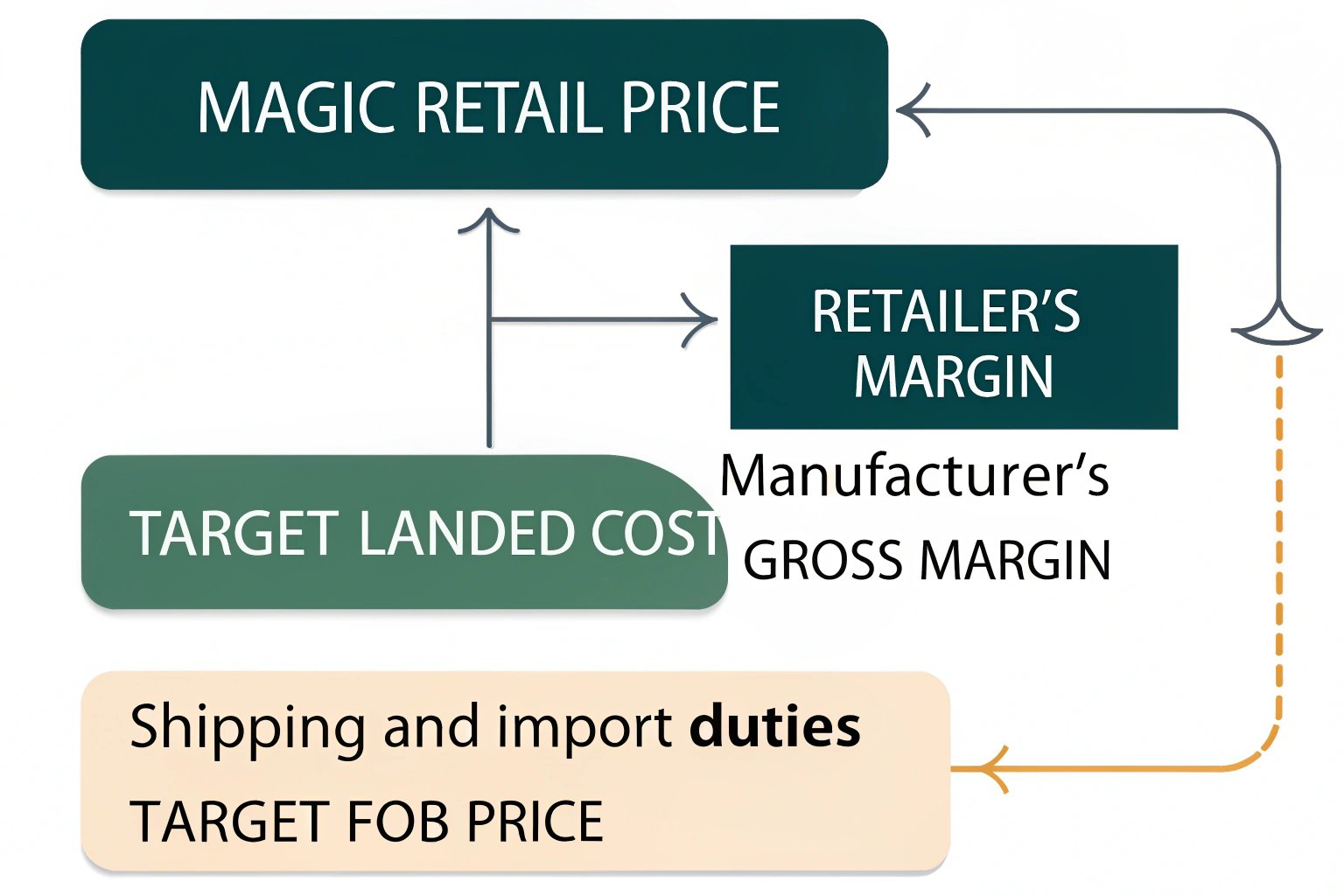
To determine your target price, you must work backward from the retail price point. Start with the "Magic Retail Price" your customer is willing to pay, then subtract the retailer's margin and your own gross margin. The number you are left with is your "Target Landed Cost." From there, you subtract your shipping and import duties to arrive at your "Target FOB Price"—the maximum price you can pay the factory. This disciplined, market-first approach ensures profitability is built into the product from day one.
From my side as a manufacturer, the most professional and successful clients are the ones who come to us with a clear target FOB price. It immediately transforms our conversation. We're no longer just a factory giving a quote; we become your strategic partner in "value engineering"—a process of making smart design and material choices to hit your target without sacrificing quality. At Shanghai Fumao Clothing, this is a collaborative process we excel at. Let me walk you through the professional's method for calculating your target price.
What Is the "Magic Retail Price" and How Do You Find It?
The entire calculation begins with the end customer. What is the price at which your product feels like a fair, easy, and even exciting purchase for them?
The "Magic Retail Price" is the full-price retail value that your target customer is willing to pay for your product without significant hesitation. This price is determined not by your costs, but by your brand's positioning, the perceived value of the item, and, most importantly, a thorough analysis of your competitors' pricing for similar products.
This is your market research phase. You cannot guess this number. You must find it.
- Competitive Analysis: Go to the websites of 5-10 of your direct competitors. Find accessories that are similar to the one you want to develop. What are they charging? Create a spreadsheet. You will quickly see a clear price range emerge.
- Brand Positioning: Where does your brand sit in the market? Are you a premium brand that can command a 20% price premium over the average, or are you a value-oriented brand that needs to be priced slightly below the average?
- Perceived Value: Does your product have a unique feature or material that justifies a higher price? For example, is it made from genuine leather instead of PU, or does it have a unique, custom-designed buckle?
This research will allow you to establish your Magic Retail Price with confidence. For example, you might determine that the sweet spot for your new belt is $60.00 USD. This number is the anchor for all subsequent calculations and is the first step before you can calculate your Target Landed Cost.

What is "perceived value"?
Perceived value is the value a customer believes they are getting from a product. A belt with a heavy, solid-feeling buckle and clean edge paint has a higher perceived value than a flimsy one, even if the cost difference to produce them is small. Our job as manufacturers is to help you maximize perceived value.
Should you ever price based on your cost?
This is called 'cost-plus' pricing, and it's a dangerous trap. It ignores the market dynamics, consumer preferences, and competitive landscapes that shape purchasing decisions. If your costs—whether they stem from raw materials, labor, manufacturing overhead, or distribution expenses—force you into a retail price that is significantly higher than what your competitors are offering for similar or even inferior products, your product will likely fail to gain traction, no matter how innovative, no matter how superior its features or quality may be. Imagine a scenario where your carefully crafted gadget, with cutting-edge technology and sleek design, comes with a price tag that feels like a small fortune to the average consumer.
Meanwhile, across the aisle, a competitor offers a product with slightly fewer bells and whistles but at a price point that feels accessible, almost effortless to justify.
How Do You Calculate Your "Target Landed Cost"?
You have your retail price. Now you need to account for your business partners: the retailers who will sell your product.
Your "Target Landed Cost" is calculated by subtracting the retailer's margin from the retail price. The standard wholesale model involves a "keystone" margin, which is a 50% margin for the retailer. This means your wholesale price (your selling price to the retailer) is typically half of the retail price.
Let's use our example:
- Magic Retail Price: $60.00
- Retailer's Margin (50%): $30.00
- Your Wholesale Selling Price: $30.00
Now, you must subtract your own required gross margin from this wholesale price. This margin needs to cover all your business overheads (salaries, marketing, rent) and your profit. A healthy gross margin for an apparel/accessory brand is typically between 40% and 60%. Let's use 50% for this example.
- Your Wholesale Selling Price: $30.00
- Your Required Gross Margin (50%): $15.00
- Target Landed Cost: $15.00
This is a critical number. $15.00 is the absolute maximum amount you can spend to get that product produced, shipped, and delivered to your warehouse. This is the next crucial step before you can determine your Target FOB Price.

What is "keystone"?
Keystone is a simple pricing rule of thumb where the wholesale price is double the cost, and the retail price is double the wholesale price. In our example, we are just using the second half of that rule: the retailer doubles their cost (your wholesale price) to get the retail price.
Can the retailer margin be different?
Yes. Large department stores or major online retailers might demand a higher margin (e.g., 55-60%). It's crucial to know the typical margin for the specific retailers you sell to.
How Do You Calculate Your "Target FOB Price"?
You know you have $15 to land the product in your warehouse. But that $15 has to include the cost of shipping and import duties. The final step is to subtract these costs to find out how much you can actually pay the factory.
Your "Target FOB Price" is calculated by subtracting the estimated logistics and duty costs from your Target Landed Cost. "FOB" stands for "Free On Board," and it is the price you pay the factory for the finished goods, ready to be loaded onto the ship at the port of origin.
Let's continue our example:
- Target Landed Cost: $15.00
Now, let's estimate the "landed cost factors":
- Ocean Freight & Insurance: This can vary, but a reasonable estimate is 5% of the FOB price.
- US Import Duties: This depends on the product's specific HS code. For a leather belt, the duty might be around 8%. For a fabric belt, it could be higher. Let's use 10% as a conservative, blended estimate.
- Total Landed Cost Factors: 5% + 10% = 15% of the FOB price.
This means the Target Landed Cost ($15.00) is equal to the FOB Price + 15% of the FOB Price (or 1.15 x FOB Price). To find the FOB price, we do the reverse:
- Target FOB Price = Target Landed Cost / 1.15
- $15.00 / 1.15 = $13.04
So, $13.04 is your Target FOB Price. This is the number you bring to a manufacturer like me. This is the number we must hit. This is the final, most important piece of the puzzle that enables a process of Value Engineering.
What is an "HS Code"?
The Harmonized System (HS) code is an internationally standardized system of names and numbers to classify traded products. The HS code determines the specific import duty rate for your product. Your customs broker can help you classify your products correctly. You can also research it on the official U.S. International Trade Commission website.
Is this calculation always the same?
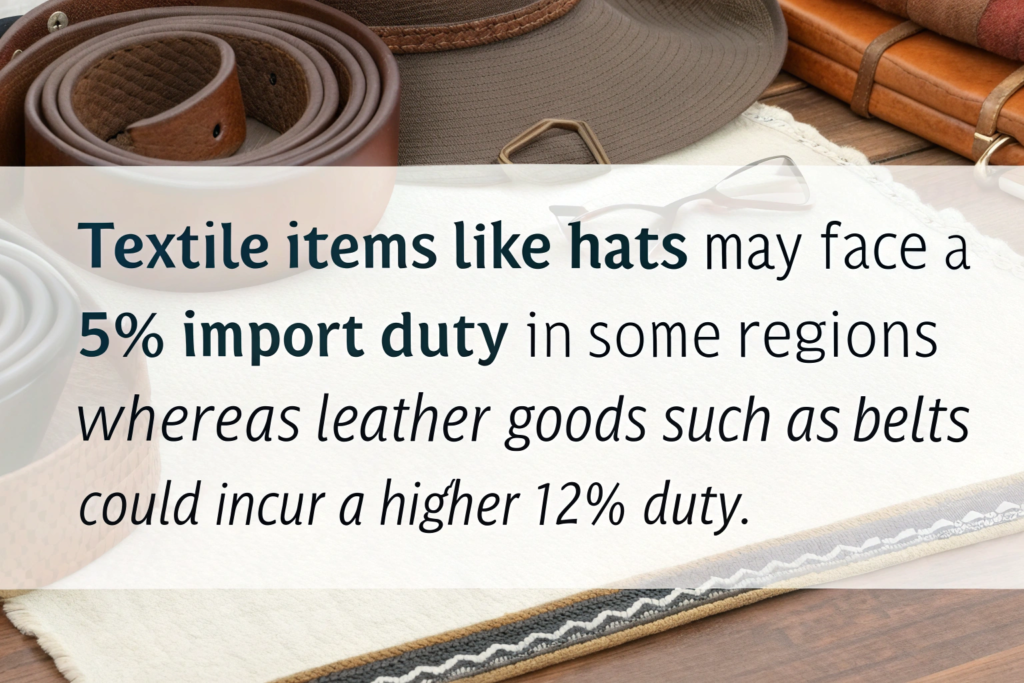
The formula is always the same, but the percentages will change. Your margin might be different—perhaps you aim for a 30% profit on electronics versus a 15% profit on clothing, depending on market demand and production costs. The retailer's margin might be different too; a small boutique could take a 25% markup, while a large chain might settle for 10% to drive volume sales. The duty rate will definitely be different for a hat versus a belt—textile items like hats, which are often crafted from soft materials such as cotton, wool, or synthetic fabrics, may face a 5% import duty in some regions, whereas leather goods such as belts, typically made from full-grain or top-grain leather that undergoes tanning and finishing processes, could incur a higher 12% duty.
How Does a Target FOB Price Enable "Value Engineering"?
When you approach a factory with a design and ask, "How much does this cost?" you will get one price. But when you approach them with a design and a Target FOB Price of $13.04, you start a much more productive conversation.
Having a clear Target FOB Price allows your manufacturing partner to engage in "value engineering"—a collaborative process of making strategic adjustments to the design or materials to meet your price target without compromising the core aesthetic or quality of the product.
This is where a true partnership begins. With your $13.04 target in mind, we can look at your design and make suggestions:
- "The solid brass buckle you specified is beautiful, but it's making the cost $14.50. If we switch to a high-quality zinc alloy buckle with a brass plating, we can get the same look and hit your $13.00 target. Would you like to see a sample?"
- "This full-grain leather is premium, but a top-grain leather has a very similar look and is 15% less expensive. This would meet your target."
- "Reducing the width of the belt from 1.5 inches to 1.25 inches would reduce the material consumption by 17% and get us under your target."
At Shanghai Fumao Clothing, this is a standard part of our service. We see it as our job to provide you with options and solutions, not just a single price.

Does value engineering mean lower quality?
Not at all. It means being smart about where you spend your money. It's about making conscious trade-offs. For example, a customer is unlikely to notice the difference between a solid brass buckle and a well-made, brass-plated zinc alloy buckle, but the cost difference is significant. It's about protecting the perceived quality while managing the actual cost.
What if the target price is impossible?
Sometimes, it is. If a client wants a full-grain leather belt with a solid brass buckle and has a target of $5.00, we will be honest and say that it's not achievable without a major compromise in quality. A good partner will be transparent about what is and isn't possible.
Conclusion
Determining your target price is not an afterthought; it is the foundational act of strategic product development. By working backward from your customer's "Magic Retail Price," calculating your Target Landed Cost after margins, and then deriving your Target FOB Price after logistics and duties, you create a clear, data-driven budget for your product. This target price transforms your relationship with your manufacturer from a simple transaction into a collaborative partnership focused on value engineering. This disciplined, market-first approach is the single best way to ensure that every product you develop is not just creative, but profitable.
At Shanghai Fumao Clothing, we are experts in this collaborative process. We invite you to come to us with your target prices, and we will work with you to build a beautiful, high-quality, and profitable collection.
If you are ready to start developing your next accessory line with a clear financial target, let's talk. Please contact our Business Director, Elaine, at her email: elaine@fumaoclothing.com, to get started.