Are you developing knit hats that consistently miss the mark with buyers and consumers? You source premium yarns, invest in sampling, and follow what you believe are current trends—yet your winter hat line fails to generate the velocity or margins you need. The problem isn't your effort; it's likely a disconnect between traditional manufacturing assumptions and the rapidly shifting demands of the 2026 winter accessory market.
Designing successful knit hats for winter markets in 2026 requires a complete rethinking of three core pillars: silhouette architecture, fiber engineering, and color-story strategy. The era of one-size-fits-all bulky beanies with excessive embellishment is over. Today's market demands refined, head-hugging silhouettes crafted from premium natural or blended fibers, engineered for consistent shape retention through innovative manufacturing techniques, and colored in either grounding earth tones or purposeful bright accents.
This guide translates current runway intelligence, material science, and production methodology into actionable design specifications. You will learn precisely which silhouettes to kill, which fibers command premium pricing, how to engineer fit consistency across head sizes, and which 2026 color families belong in your line sheet.
Which Knit Hat Silhouettes Should You Kill And Which Should You Develop For 2026?
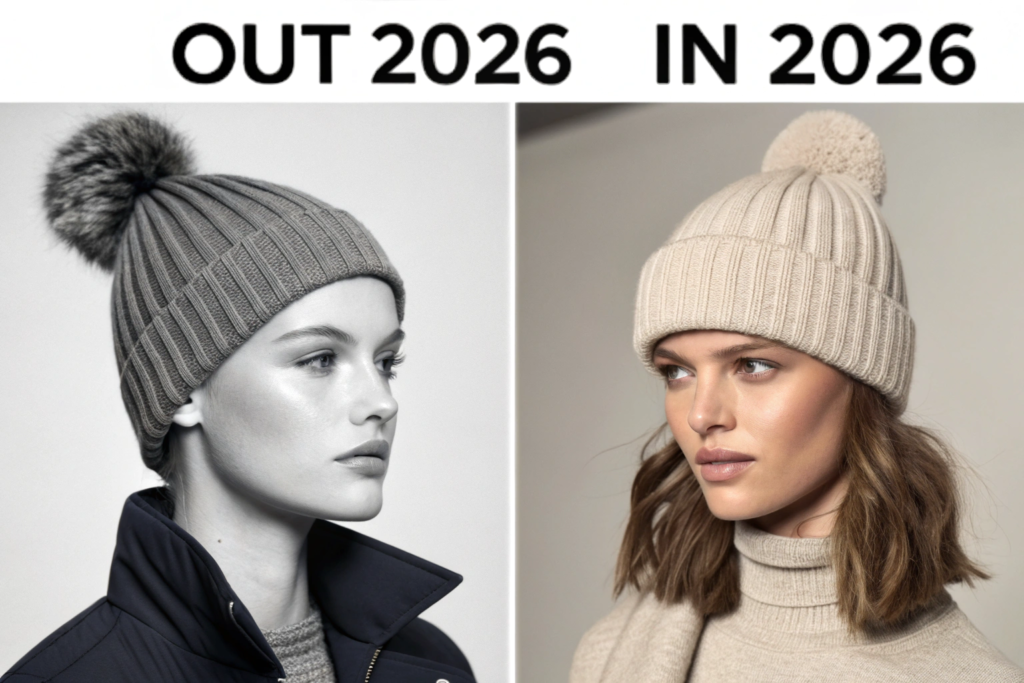
Most factories continue producing the same high-crown, bulky, heavily decorated beanies that defined the market five years ago. This is a costly mistake. The 2026 consumer rejects these styles outright. You must immediately remove from your development pipeline any knit hat with an excessively tall crown, large novelty pom-poms, or aggressive all-over branding .
The anti-trends of 2026 are clear and non-negotiable. High-crown knit hats constrict facial proportions, emphasize wrinkles, and create a top-heavy silhouette that flatters no face shape . Hats with large pom-poms and excessive dimensional decor are now categorized as "childish" and impossible to style with contemporary tailored outerwear. Hooded knit hats and oversized balaclavas that obscure facial contours create a fatigued, sloppy appearance and are strongly rejected by fashion-conscious demographics.
Your 2026 development focus must shift entirely to low-profile, head-hugging silhouettes. The dominant trends are:
| Silhouette | Key Characteristics | Target Consumer | Production Consideration |
|---|---|---|---|
| Thin-Fit Beanie | Snug, follows head contour; minimal to no cuff; clean finish | All demographics; unisex | Requires high-recovery fibers to maintain shape |
| Structured Beret | Renewed silhouette; firmer construction than traditional soft berets; architectural | Women; premium market | May require interfacing or blended yarns for structure |
| Newsboy/Flat Cap | Rounded crown; short, stiff brim; tweed/corduroy textures | Men and women; heritage-modern crossover | Complex assembly; multiple pattern pieces |
| Fuzzy/Textured Bucket Hat | Plush mohair or faux fur finish; playful but sophisticated | Younger women; statement piece | Specialized fiber sourcing; higher raw material cost |
| Refined Fisherman/Crew Hat | Practical, warm, structured brim; wool or felted knit | Outdoor-urban crossover | Brim stiffening; water-resistant finishing |
Shanghai Fumao Clothing has already retired over 60% of traditional beanie molds from our sampling library in response to these shifts. We now guide clients toward these validated silhouettes with pre-developed pattern blocks that reduce sampling iterations by 30-40%.
How Do You Execute The "Thin-Fit Beanie" Without Sacrificing Warmth?
The thin-fit beanie presents an engineering challenge: consumers demand less visual bulk but will not tolerate insufficient warmth. The solution is not in thicker fabric—it is in superior fiber selection.
You must specify yarns with high thermal efficiency per unit of thickness. Merino wool (18.5-21 micron) provides exceptional warmth-to-weight ratio due to its crimped fiber structure that traps dead air . Alpaca fiber, which is hollow, offers approximately three times the insulating value of sheep's wool at equivalent thickness . Cashmere, while expensive, delivers maximum warmth at minimal visual weight .
Construction technique is equally critical. A thin-fit beanie requires dense gauge knitting—typically 7-10 gauge for machine knitting—to eliminate porosity while maintaining drape. The 1x1 or 2x2 rib structure is essential; it provides the negative ease necessary to keep the hat snug against the head without active compression.
For clients targeting the luxury segment, we at Shanghai Fumao Clothing recommend a 15-20% cashmere, 80-85% Merino wool blend. This ratio delivers cashmere's signature softness and warmth while retaining wool's superior elasticity for shape recovery. For mid-tier markets, a superfine Merino and nylon blend (85/15) provides excellent warmth, durability, and machine-washability at accessible price points.
Why Are Embellishments Shifting From "Novelty" To "Refined"?
The market is not rejecting all decoration; it is rejecting loud, juvenile, or oversized embellishments that overwhelm the silhouette . In 2026, acceptable detailing is architectural, tonal, and integrated.
Consider these approved approaches:
- Leather or faux-leather brand patches stitched flush to the cuff (maximum dimension: 3cm x 1cm)
- Subtle contrast stitching at the turn-of-cuff
- Monotone embroidery using yarn identical to the body, creating texture without color contrast
- Miniature woven labels tucked into the interior side seam
Large acrylic pom-poms, jumbo woven badges, and reflective taping are now classified as "mass-market discount goods" and should be eliminated from premium lines. If a buyer requests a pom-pom, offer a detachable faux-fur version using a premium closure system (snap fastener or leather lace) that can be removed for a clean silhouette [citation:10].
What Fiber And Yarn Engineering Decisions Define 2026 Knit Hat Quality?
Your material specification is the single greatest determinant of both manufacturing cost and consumer-perceived value. The 2026 market demands tactile luxury, thermal efficiency, and structural integrity—and these are achieved through deliberate, defensible fiber choices.
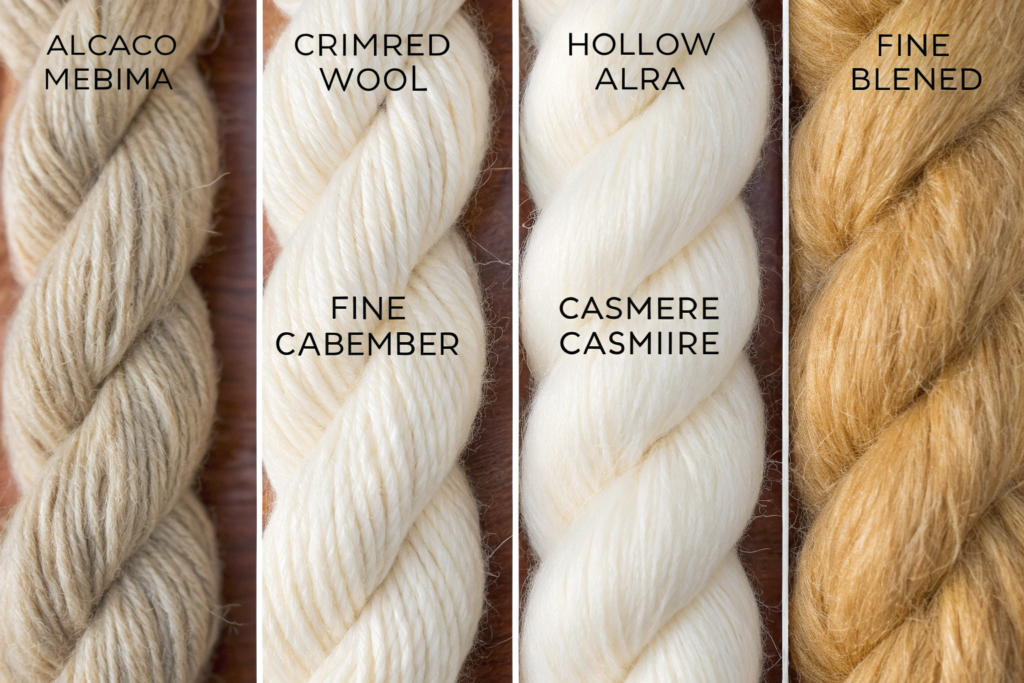
Wool remains the dominant fiber, commanding over 54% market share . However, not all wool is equal. Merino wool (extra-fine grade, 17.5-19.5 micron) is the unequivocal champion for next-to-skin softness and moisture management . Its natural crimp provides superior elasticity, allowing a single size to fit a range of head circumferences while recovering shape after each wear.
Alpaca is the premium-performance play. Its hollow fiber structure traps more heat than wool at equivalent weight, and its lack of lanolin makes it naturally hypoallergenic . However, pure alpaca lacks wool's crimp, resulting in poor shape recovery and sagging over time . The industry-standard solution is a blend: 30-50% alpaca with 50-70% merino wool. This delivers alpaca's signature halo and warmth while maintaining structural integrity.
Cashmere defines the luxury ceiling. Its fine diameter (under 19 micron) and smooth scale structure create unparalleled softness. The 2026 market shows renewed appetite for pure cashmere beanies in the €150+ retail bracket . For broader adoption, cashmere-wool blends (10-30% cashmere) offer a compelling value proposition—cashmere's tactile signature at half the cost.
Blended yarns dominate the value segment and are technologically sophisticated. Merino-nylon blends (80/20) offer abrasion resistance and machine-washability superior to pure wool. Merino-silk blends introduce subtle luster and fluid drape for fashion-oriented styles. Alpaca-acrylic blends lower entry price points while retaining alpaca's visual texture.
Your action item: Reject single-fiber dogmatism. The best 2026 knit hats are engineered from blends that solve specific performance briefs. At Shanghai Fumao Clothing, we maintain a library of 40+ certified, traceable yarn blends with documented test reports for pilling (minimum Grade 4), shrinkage, and colorfastness.
How Do You Engineer "One Size Fits Most" Without Sacrificing Fit?
Traditional knit hats required multiple sizes to accommodate different head circumferences because non-elastic wool constructions lacked adequate stretch . This is obsolete. You can now achieve 54-58cm circumference accommodation in a single SKU through deliberate material and process engineering.**
The patent-backed method validated by knitwear engineers involves:
- Yarn specification: Incorporate 3-8% elastane or polyurethane elastic fiber into the yarn during spinning . This is not spandex; it is a core-spun elastic filament wrapped in the primary textile fiber, invisible in the finished product.
- Oversized knitting: Knit the hat body 20-40% larger than final target dimensions .
- Heat-set relaxation: Apply controlled steam (50-80°C for 1-15 seconds) to relax the elastic fiber and shrink the hat to its engineered dimensions .
The result: A knit hat with 4-way stretch capability that comfortably fits 95% of adult head sizes, recovers shape after stretching, and resists loosening over time . This eliminates the need for size runs (S/M/L), simplifies your inventory, and reduces consumer confusion.
Critical caution: Over-elasticization creates a "compression headband" feel that consumers reject. We recommend targeting 15-20% fabric stretch at 5N force, verified via ASTM D4964 testing.
Why Are Sustainability Certifications Now a Design Specification?
Sustainability is no longer a marketing addendum; it is a technical design specification influencing fiber procurement, dyeing chemistry, and end-of-life planning.
Global Recycled Standard (GRS) certification for recycled wool or recycled nylon content is increasingly mandated by European retailers . Responsible Wool Standard (RWS) certification verifies animal welfare and land management practices. Oeko-Tex® Standard 100 (Class I or II) is now baseline expectation for skin-contact accessories.
Your design brief must include: "Specify certified sustainable fibers wherever commercially feasible." For 2026, this includes:
- RWS-certified Merino wool
- GRS-certified recycled nylon or polyester
- ZQ-certified Merino (New Zealand farm assurance)
- Bluesign®-approved dye houses
Failure to document these credentials will result in exclusion from major European and North American retail programs. We provide full certification traceability packages with every production order.
What Color And Texture Trends Define The 2026 Winter Palette?
Your silhouette and fiber choices may be perfect, but incorrect color selection will strand your inventory. The 2026 winter color story is dichotomous: it splits sharply between grounded, natural earth tones for core basics and deliberate, high-voltage brights for accent pieces.
Dominant Color Families for Winter 2026:
| Color Family | Specific Shades | Application Strategy | Fiber Compatibility |
|---|---|---|---|
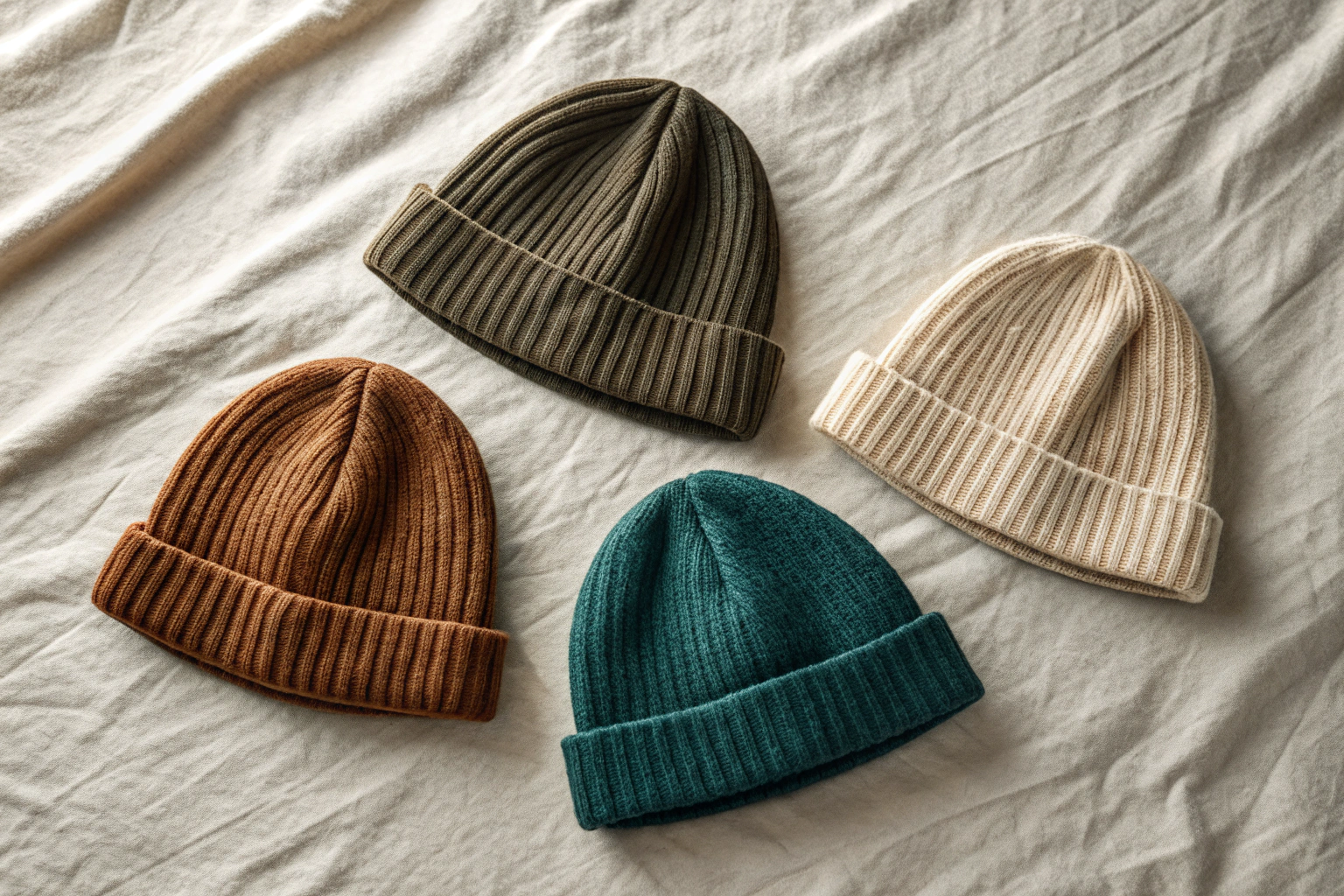
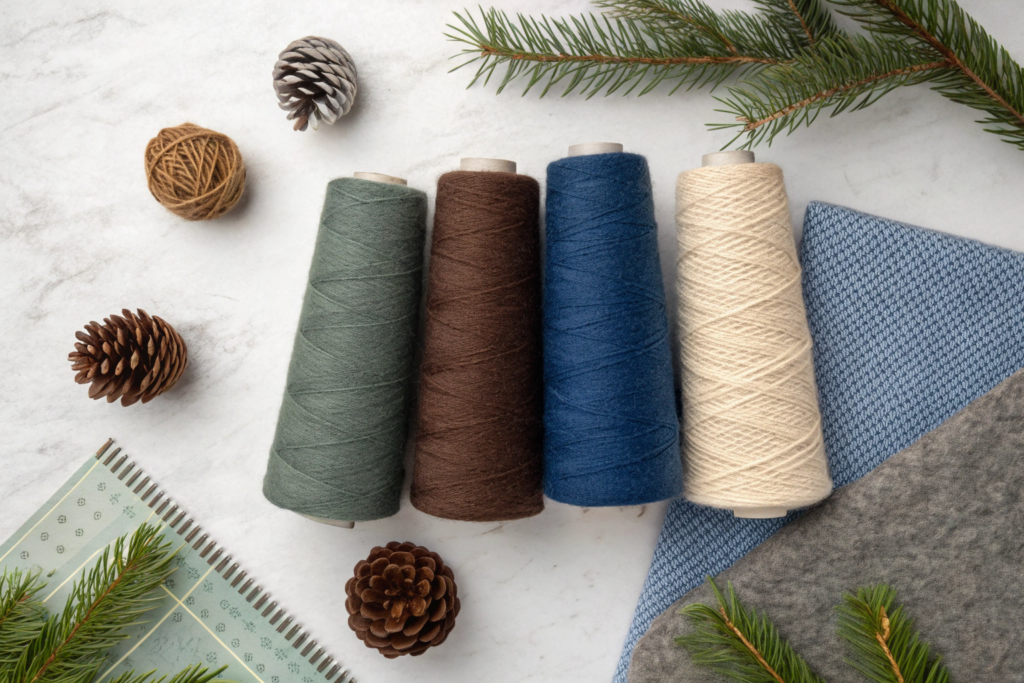
| Rich Earthy Browns | Mocha, Wood Ash, Jaggery, Wilderness, Cafe Rose | Core volume styles; all silhouettes | All natural fibers; especially flattering on wool, alpaca |
| Deep Jewel Tones | Midnight, Emerald Sea, Jodhpur Blue, Deep Teal | Premium/evening styles; structured silhouettes | Merino-polyamide blends; high-twist yarns for stitch definition |
| Soft Neutrals | Jasmine, Moonlit Glow, Cream, Oatmeal | Foundation basics; year-round extension | Cashmere, Merino-silk blends; highlights texture |
| Electric Green | Citrus, Electric Lime, Macha, Jungle Secrets | Limited-edition; accent color; contrast tipping | Fingering or DK weight; colorwork applications |
| Monochrome Blues | Beach House, Sandy Sea, Cobalt Blue, Peacock | Gradient collections; transitional seasons | Worsted weight; tonal stripe programs |
Neutral greys and blacks remain foundational, particularly for men's lines and urban minimalist aesthetics . However, pure black is declining in fashion markets in favor of deep charcoal, ink, and midnight blue—shades with greater visual depth and reduced contrast with winter complexion.
Texture is replacing pattern as the primary visual interest driver. Consider:
- Brushed or "fuzzy" finishes using mohair or alpaca blends for tactile softness
- Bouclé or loop yarns for dimensional, cozy surfaces
- Ribbed variations (1x1, 2x2, honeycomb) for architectural interest
- Heathered melanges created via pre-dyed fiber blending
Shanghai Fumao Clothing recommends a 60-30-10 color architecture for collection planning: 60% core earth tones and neutrals, 30% jewel tones, 10% electric accent colors. This structure provides commercial safety while signaling trend authority.
How Do You Translate Runway Color Trends Into Commercial Volume?
The electric greens and vibrant corals prominent on Spring/Summer 2026 runways present a challenge: they generate editorial buzz but represent a small fraction of actual sell-through . Your production strategy must differentiate between "show color" and "go color."
For "go colors" (earthy browns, jewel tones, neutrals):
- Commit to volume production runs
- Hold inventory across multiple silhouettes
- Extend across price tiers
For "show colors" (electric green, citrus, vibrant coral):
- Limit production to 5-10% of total order quantity
- Apply to only one or two silhouettes (thin-fit beanie, bucket hat)
- Consider "tipping" or "contrast trim" applications rather than full-garment color
Your merchandising hook: Offer buyers a core assortment of 4 earth-tone/jewel-tone basics, with a single "pop color" accent style for visual merchandising and editorial placement.
What Manufacturing Process Controls Ensure Consistency At Scale?
Design is conceptual until it is manufactured consistently across 5,000 units. The 2026 market has zero tolerance for batch-to-batch variation in sizing, hand-feel, or color. You must mandate specific process controls from your factory partner.
Pattern Engineering:
- Reject single-size grading for non-elastic constructions
- Demand digital pattern files (CAD) with verified negative ease calculations
- Require pre-production samples using production-specified yarn and machine tension
Knitting Parameters:
- Document machine gauge (7, 10, 12, 14) per style
- Lock course count and stitch density specifications
- Verify via fabric weight per square meter (GSM) testing
Finishing Protocols:
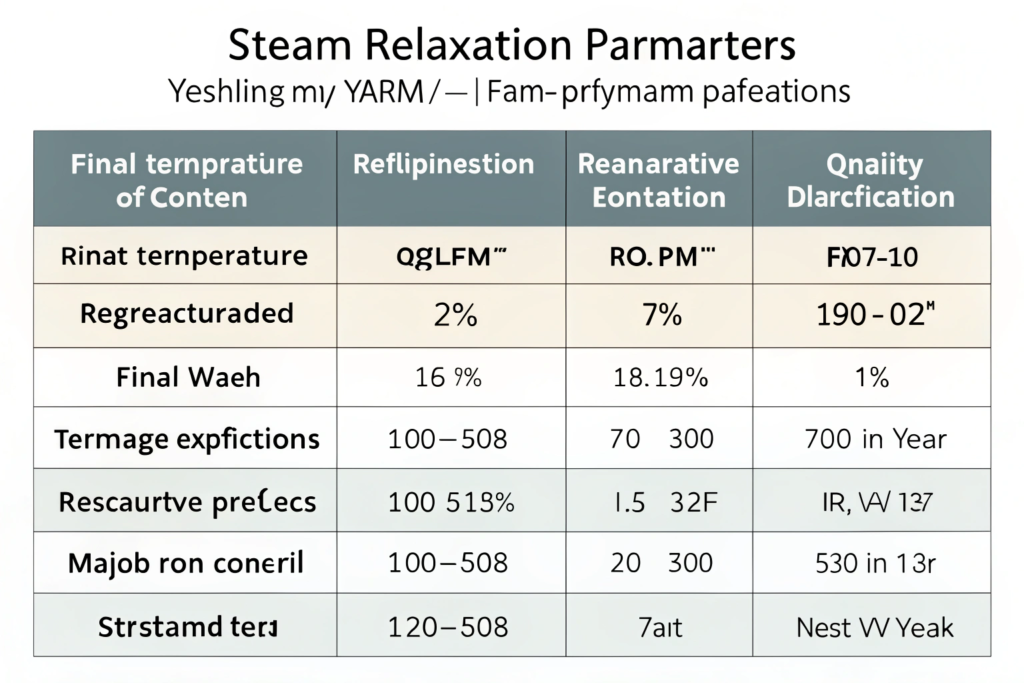
- Steam relaxation parameters (temperature, duration) must be codified per yarn type
- Final wash specifications must be documented and repeatable [citation:8]
- Blocking dimensions must be measured post-finish, not pre-finish
Quality Control:
- In-line inspection during production, not only final audit [citation:8]
- AQL (Acceptable Quality Limit) standards of 1.0 or 1.5 for major defects
- Random sampling for shrinkage and pilling (verified via ISO 6330, ISO 12945)
At Shanghai Fumao Clothing, we enforce these controls through our proprietary Production Technical Package (P-TP), which locks all variables before bulk knitting begins. We invite clients to audit this process.
How Do You Validate Fit Consistency Across Production Batches?
Fit drift is the silent killer of knit hat programs. A style that fits perfectly in the development sample often tightens or loosens unpredictably during bulk production due to yarn tension variation or inconsistent steaming.
Your validation protocol:
- Establish baseline dimensions (cuff height, total length, opening circumference) on the approved salesman sample.
- Require "top-of-production" samples pulled from the first 100 pieces of the bulk run, not from the sampling room.
- Measure and record 10 random samples against the baseline specification. Tolerance should be ±3% maximum.
- Reject and rework if fit consistency fails.
Elastic recovery testing is essential for styles containing elastane. Measure the stretched circumference, hold for 30 seconds, and measure recovery circumference. Recovery should be ≥95% within 60 seconds.
Why Is Packaging Now a Design Element, Not an Afterthought?
E-commerce dominance has transformed packaging from shipping protection to brand communication medium. Your knit hat's first physical touchpoint with the consumer is the poly bag or box.
2026 packaging requirements:
- FSC-certified paper/board for all printed materials
- Recycled-content poly bags (minimum 30% post-consumer recycled)
- Minimal adhesive usage to facilitate recycling
- Die-cut hang tags that double as care instruction booklets
Premium recommendation: A rigid gift box with magnetic closure for cashmere or alpaca styles priced above $80 retail. The box must be sized to prevent hat compression during transit, which can permanently flatten knit structure.
Conclusion
Designing knit hats for winter markets in 2026 is a discipline of subtraction, engineering, and intentional curation. The path to commercial success requires:
-
Deleting high-crown, over-embellished silhouettes from your development pipeline and replacing them with refined, head-hugging shapes like the thin-fit beanie, structured beret, and textured bucket hat.
-
Engineering thermal efficiency and fit consistency through premium fiber blends (Merino, alpaca, cashmere) and scientifically validated manufacturing processes including elastic fiber integration and heat-set relaxation.
-
Coloring your collection with a deliberate architecture of grounding earth tones for volume, deep jewel tones for premium positioning, and highly limited electric brights for accent.
-
Certifying your sustainability claims with third-party verified standards (RWS, GRS, Oeko-Tex) and documenting every stage of production.
The manufacturers who succeed in 2026 will not be those with the lowest FOB prices. They will be those who act as strategic design and engineering partners—translating runway intelligence into manufacturable specifications, guiding buyers away from commercial dead-ends, and delivering consistent quality that builds brand equity season after season.
Shanghai Fumao Clothing has invested in the yarn libraries, patented process capabilities, and quality systems necessary to execute this new generation of knit hats at scale. We do not simply take orders; we collaborate on silhouette refinement, fiber selection, and fit engineering to ensure your winter line is both trend-right and commercially viable.
Ready to develop your 2026 knit hat collection with a partner who understands the difference between a passing fad and a validated market shift? Contact our Business Director, Elaine, at elaine@fumaoclothing.com to schedule a material consultation, review our 2026 silhouette library, and begin sampling.