The clasp of a necklace is far more than a functional afterthought—it is a critical component of design, security, and user experience. A well-chosen clasp ensures the necklace is easy to put on and take off, stays securely fastened during wear, and complements the overall aesthetic. For jewelry designers, manufacturers, and brands, selecting the appropriate clasp is a decision that blends engineering, ergonomics, and style, directly impacting customer satisfaction and product longevity.
Choosing the right clasp for a necklace involves evaluating three core factors: security and function (for the necklace's weight and intended use), aesthetic integration (matching the necklace's style and visibility), and ease of use (considering the wearer's dexterity). The optimal clasp balances these elements to become an invisible, seamless part of the jewelry or a deliberate decorative statement.
At Shanghai Fumao Clothing, while our primary focus is fashion accessories, the principle of selecting the right hardware is universal. We understand that the closure mechanism—whether on a belt, bag, or necklace—is a pivotal detail. For our clients producing jewelry lines, we emphasize that the clasp must be proportionate to the piece, sourced from reliable suppliers for consistent performance, and finished to match the chain or pendant perfectly.
What are the primary functional clasp types and their best uses?
Function is paramount. The clasp must be reliable enough for the necklace's weight and the wearer's activity level—whether it's a delicate pendant that sways gently with every step or a heavy statement piece that demands unyielding grip during a busy day. Different mechanisms offer varying levels of security, ease of use, and suitability for different chain types, each whispering promises of safety and convenience in their own unique way. The main functional categories include spring-loaded clasps, mechanical clasps, and friction/magnetic closures, each serving distinct needs.
Spring-loaded clasps, with their satisfying click as they snap shut, provide a secure hold that resists accidental openings, ideal for active lifestyles where the necklace might jostle against clothing or skin. Mechanical clasps, often adorned with intricate gears or levers, offer a tactile experience as fingers manipulate their components, ensuring a precise fit that feels both sturdy and refined. Friction/magnetic closures, by contrast, glide into place with a soft snap or gentle pull, offering effortless one-handed operation—perfect for those who value speed and simplicity, their subtle magnetic pull creating a seamless connection that feels almost invisible yet deeply reliable.
When should you use a spring-loaded clasp (Lobster, Spring Ring)?
These are the most common and secure everyday clasps.
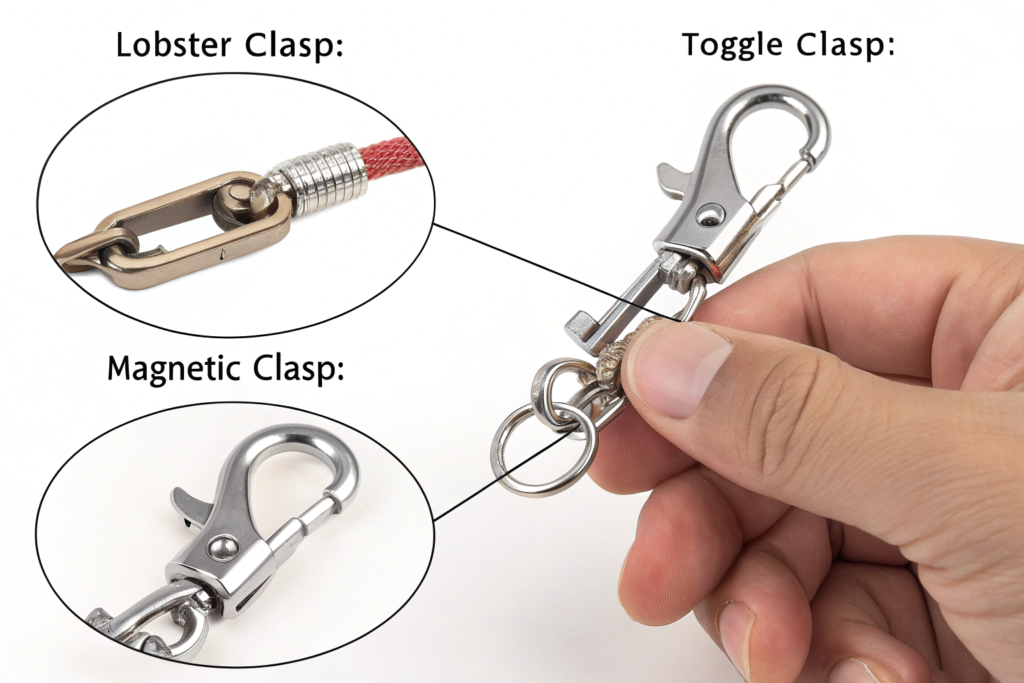
- Lobster Clasp: Named for its resemblance to a lobster claw, this clasp has a spring-loaded lever that opens a hook. It is very secure, suitable for medium-weight chains and pendants. It's ideal for everyday necklaces, charm bracelets, and items of value. Its size can range from very small and discreet to larger, more decorative versions.
- Spring Ring Clasp: A circular clasp with a internal spring that retracts a hook to open. It is slightly less secure than a lobster clasp but is smaller and more discreet. Best for lightweight, delicate chains and necklaces where the clasp should be invisible.
Best For: Security-focused, everyday jewelry. Not ideal for individuals with limited hand dexterity, as they require precise pinching to open.
What are the uses for toggle and box clasps?
These clasps offer a blend of security and distinctive style.
- Toggle Clasp: Consists of a "T" bar that slides through a circle or other shape. It is moderately secure—secure enough for most wear but can snag and pull open if caught. Its main advantage is ease of use; it's much easier to fasten with one hand or with less dexterity. It also serves as a decorative element at the front or back of the necklace.
- Box Clasp (or Tab Lock Clasp): A more secure mechanical clasp where a hinged tongue snaps into a box and is often secured with a secondary safety latch. This is a high-security option used for heavier necklaces, pearl strands, and fine jewelry. It provides a seamless look when closed.
Best For: Toggle clasps for ease of use and decorative appeal; box clasps for security on finer, heavier pieces.
How does the clasp impact the necklace's aesthetics?
The clasp can be hidden or highlighted. Its finish, size, and design must consciously contribute to the necklace's overall visual narrative.
The decision often comes down to whether the clasp is meant to be an invisible fastening or a featured part of the design.
When should the clasp be discreet?
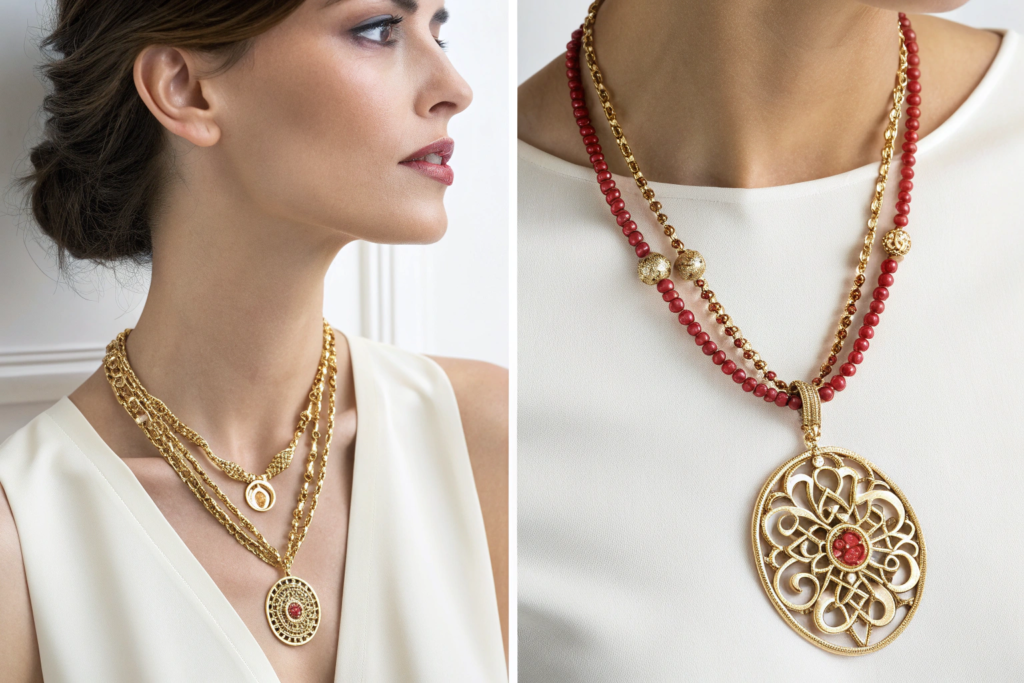
For many necklaces, especially those with a pendant or a continuous pattern, the clasp should be as invisible as possible.
- Strategy: Use a small spring ring or lobster clasp that matches the chain metal exactly (e.g., 14k gold clasp on a 14k gold chain).
- Integration: Consider a built-in or integrated clasp design, where the closure is part of the chain links themselves, creating a seamless look.
- Placement: On a pendant necklace, ensure the clasp sits neatly at the back of the neck without flipping to the front.
A discreet clasp ensures the focus remains on the pendant or the beauty of the chain itself.
When can the clasp be a decorative feature?
In many designs, the clasp is an opportunity for added beauty.
- Statement Toggles: A decorative toggle (e.g., in a moon and star shape, an Art Deco design) can be worn at the front or back as an accent.
- Ornate Box Clasps: Often used in pearl or gemstone necklaces, these can be embellished with small diamonds or enamel work.
- Lobster Clasps with Charm: A larger lobster clasp can feature a dangling charm or gemstone, making it part of the design.
This approach treats the clasp as jewelry in its own right, adding value and design interest.
What are the considerations for wearer comfort and ease of use?
A beautiful and secure necklace, with its delicate chain glinting like liquid silver and a pendant that catches the light like a captured star, is nothing more than a forgotten ornament if the wearer struggles to fasten it. The clasp, that tiny but vital link between elegance and ease, becomes a silent source of frustration when fingers fumble, when the mechanism resists, or when the design feels alien to the hand that wears it.
Dexterity, that quiet dance of coordination, varies from person to person—some hands move with the grace of a pianist, others with the steady precision of a watchmaker, and still others may find even the simplest tasks a challenge.
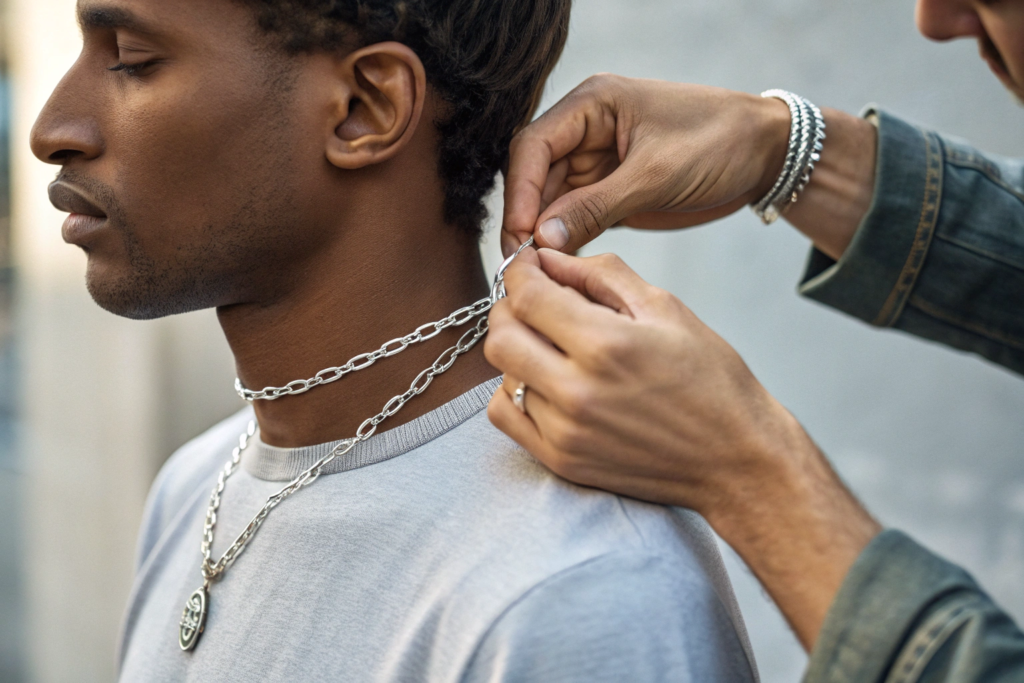
Which clasps are best for limited dexterity or solo wearing?
- Magnetic Clasps: These provide the easiest fastening experience by far. Two powerful magnets snap together effortlessly. However, they offer moderate security and can be pulled apart by force or snagging. They are ideal for lightweight fashion jewelry, lariat styles, or for individuals with arthritis or other dexterity challenges.
- Toggle Clasps: As mentioned, the simple "post through ring" mechanism is much easier to manage than a small spring-loaded clasp, especially at the back of the neck.
- Large Lobster or Bolt Ring Clasps: A larger-sized lobster clasp is easier to grip and manipulate than a tiny one.
Designers should always consider the target demographic; jewelry for older adults may prioritize magnetic or toggle clasps.
How does necklace length and weight influence choice?
- Length: A very short (choker) or very long (opera) necklace can be hard to clasp behind the neck. For these, a front-facing clasp (like a decorative toggle) or a lariat/style with no clasp might be preferable.
- Weight: A heavy pendant or a substantial chain requires a very secure clasp. A small spring ring will fail. A large, heavy-duty lobster clasp, a figure-eight safety clasp, or a screw-type clasp is necessary. For the most valuable pieces, a clasp with a safety chain (a second, shorter chain as a backup) is recommended.
The clasp must be physically proportionate and mechanically adequate for the piece it secures.
What should manufacturers and brands consider for quality and sourcing?
For brands crafting necklaces, the clasp—often a small, unassuming component—stands as a silent sentinel of potential failure, a hidden vulnerability that can unravel the entire piece with a single slip or snap. Imagine a customer, eyes sparkling with anticipation, carefully lifting a delicate pendant necklace from its box, only for the clasp to give way mid-air, sending the precious charm tumbling to the floor, its chain coiling like a broken serpent. This is not merely a momentary inconvenience; it is a fracture in the brand's promise of quality and care.
Sourcing high-quality clasps from reliable suppliers—those who understand the weight of trust placed in their tiny hinges and spring-loaded mechanisms—is non-negotiable for product integrity and brand reputation. These clasps, forged from durable metals like sterling silver or gold-plated brass, should feel sturdy in the palm, their surfaces smooth yet precise, each link and catch engineered to withstand the test of time and daily wear.
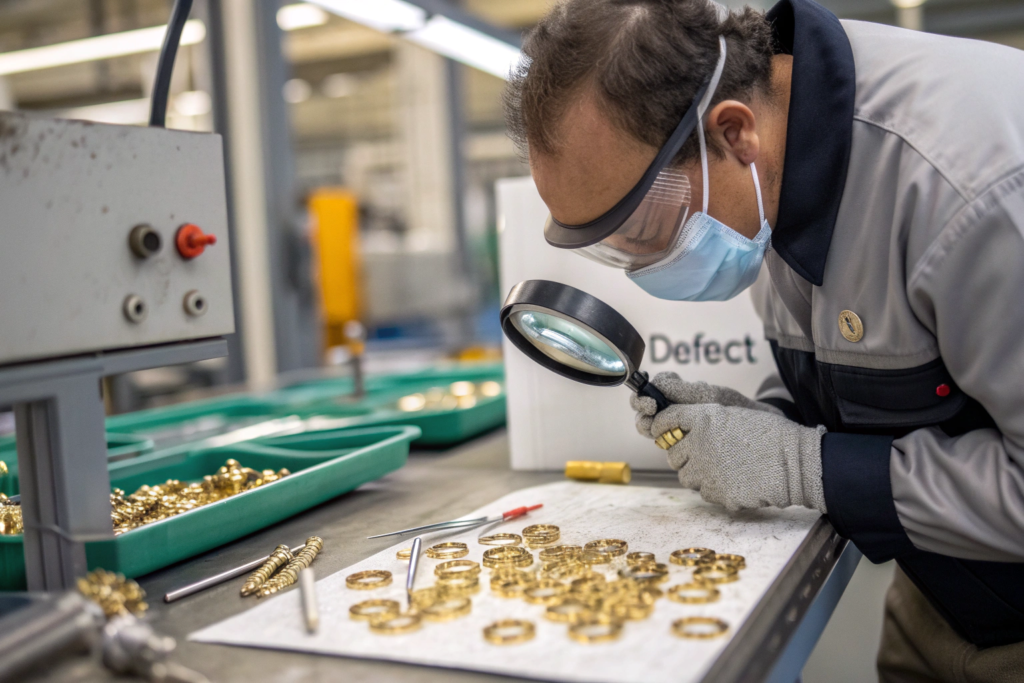
What are the hallmarks of a high-quality clasp?
- Material & Plating: The base metal (usually brass, copper, or steel) and the plating (gold, silver, rhodium) must be durable. Look for clasps with thick plating (e.g., 3 microns of gold) to prevent tarnishing and wear. For fine jewelry, solid gold or sterling silver clasps are essential.
- Spring Mechanism: In lobster and spring ring clasps, the spring must be strong and snappy, made from durable stainless steel. It should open and close smoothly thousands of times without failing.
- Finish & Details: Edges should be smooth and rounded. The jump ring (the ring connecting the clasp to the chain) should be soldered closed to prevent opening. Decorative elements should be securely attached.
Working with a manufacturer like Shanghai Fumao Clothing, which has a network of vetted hardware suppliers and strict QC protocols, ensures these details are managed correctly.
How to match the clasp to the production scale and cost?
- Budget/Lightweight Fashion Jewelry: Durable alloy lobster clasps or magnetic clasps with good plating are cost-effective and functional.
- Mid-Range/Bridge Jewelry: Heavier-gauge lobster clasps, decorative toggles, or simple box clasps with better plating (like 18k gold vermeil) elevate the piece.
- Fine Jewelry: Solid gold versions of the above, or specialized safety bolt ring clasps and invisible box clasps, are required. The cost of the clasp becomes a significant part of the bill of materials.
The clasp should be proportionate in quality and cost to the necklace it secures.
Conclusion
Selecting the right clasp for a necklace is a nuanced decision that sits at the intersection of engineering, design, and human-centered design. It requires a clear understanding of the necklace's purpose, weight, and aesthetic, as well as the needs and abilities of the wearer. A secure lobster clasp may be perfect for a daily chain, while an elegant toggle enhances a bohemian piece, and a sturdy box clasp safeguards a valuable pearl strand.
For brands and designers, this choice is an opportunity to demonstrate attention to detail and commitment to quality. By prioritizing both function and form in the clasp, you create a piece of jewelry that is not only beautiful but also reliable, comfortable, and a joy to wear—key factors in building a loyal customer base.
If you are developing a jewelry line and seek expertise in sourcing high-quality, appropriate clasps and integrating them into well-manufactured pieces, we can connect you with specialized partners and provide guidance. Contact our Business Director Elaine at elaine@fumaoclothing.com to discuss how we can support the hardware and finishing aspects of your accessory collection.